It’s 9:15 am on a Tuesday in Basildon, and your team is sitting idle because the server has gone down again. You’re watching billable hours vanish whilst waiting for a call back from a contractor who only gets paid when things break. This cycle of reactive firefighting is one of the clearest signs you need managed IT support to protect your productivity and your peace of mind.
We understand the frustration of juggling the anxiety of unverified backups with the shock of unexpectedly high invoices. Many Essex business owners accept these disruptions as a normal part of daily operations, but they don’t have to be. Your technology should be a silent engine for growth, not a constant source of stress that keeps you from your core work. This article will help you identify the critical red flags that indicate your current setup is holding your business back. You’ll learn how to transition to a more reliable model that offers better security for client data and predictable monthly costs. We’ll walk through a checklist of five specific indicators that it’s time to partner with a local expert who fixes problems before they impact your bottom line.
Key Takeaways
- Recognise why the traditional “break-fix” model creates a growth ceiling for Essex SMEs reaching 10-15 employees.
- Identify the critical signs you need managed IT support, from unpredictable monthly invoices to recurring login frustrations.
- Quantify the hidden costs of employee downtime and the long-term reputational risk of technical instability.
- Use our five-minute audit to evaluate your current tech capability and test the proactivity of your existing provider.
- Discover how a local, Wickford-based partner provides a “safe pair of hands” for a stress-free transition to better security.
The Tipping Point: Recognising When Reactive IT Fails Your Business
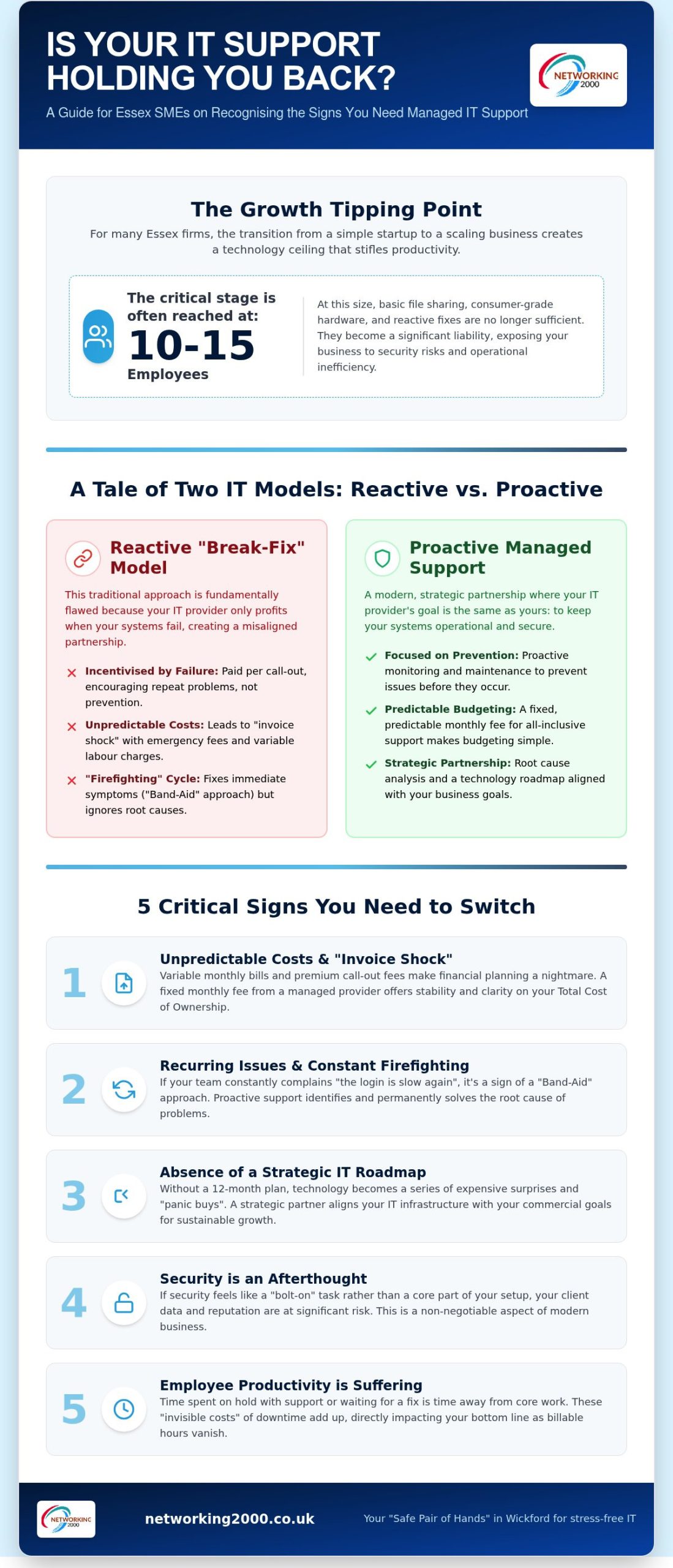
Every business starts somewhere. In the early days of an Essex SME, IT is often handled by the most tech-savvy person in the office or a local contractor on speed dial. This reactive approach, known as the “break-fix” model, works whilst your needs are simple. However, as you scale, this “making do” attitude becomes a significant liability. It creates a tech ceiling that stifles productivity and exposes you to avoidable risks. Transitioning away from this model is a strategic necessity for growth.
Break-Fix vs Managed IT Support
Successful firms in Wickford, Chelmsford, and across Essex often hit a wall when they reach 10 to 15 employees. At this size, basic file sharing and consumer-grade routers no longer suffice. You need robust security, integrated managed IT support services, and reliable VoIP telephony to stay competitive. Growth brings complexity. You move from simple setups to requiring managed firewalls and secure cloud infrastructure.
If your current support cannot explain how to protect client data under the Data (Use and Access) Act 2025, you have outgrown them. “Making do” with ageing hardware isn’t just an inconvenience. It is a security gap. Transitioning to a strategic model turns your IT from a utility bill into a growth engine. It allows you to focus on your business whilst a “safe pair of hands” manages the digital foundation. This psychological shift from seeing IT as a utility to a strategic asset is what separates stagnant businesses from those ready to scale.
5 Critical Signs You Need Managed IT Support Now
Identifying red flags early prevents long-term damage to your Essex business. If you recognise any of the following patterns, your current model is likely holding you back. These issues don’t just cause frustration; they actively drain your resources and limit your ability to scale.
Unpredictable Costs and “Invoice Shock”
Recurring Issues and the “Firefighting” Cycle
Does your team frequently complain that “the login is slow again” or “the printer has stopped working”? This is the classic Band-Aid approach. It fixes the immediate symptom but leaves the underlying cause untouched. Proactive monitoring allows us to identify a failing hard drive or a security vulnerability before it causes a total shutdown. Root cause analysis is essential because it ensures a problem is solved permanently, maintaining your business continuity and keeping your team productive. If your current support is always fixing the same thing, it’s one of the clearest signs you need managed IT support.
The Absence of a Strategic IT Roadmap
Technology shouldn’t be a series of expensive surprises. Without a 12-month roadmap, you are likely to engage in “panic buying” hardware during a crisis. This often leads to incompatible or overpriced systems that don’t serve your long-term needs. Professional IT consultancy in Wickford helps align your technology with your commercial goals. It ensures your infrastructure scales alongside your staff numbers without the usual growing pains.
Security is another major indicator. If security feels like an afterthought or a “bolt-on” task, your client data is at risk. Finally, monitor how much time your staff spend on the phone with support. If they are talking to technicians more than they are talking to your clients, your billable hours are evaporating. These are the most common signs you need managed IT support to protect your margins. Partnering with a reliable IT provider ensures your team stays focused on what they do best whilst we handle the technical heavy lifting.
The Invisible Costs of Staying with the Status Quo
Viewing IT support simply as a line-item expense to be minimised is a common mistake. Whilst a “pay-as-you-go” model looks cheaper on a spreadsheet, the hidden costs of system instability can be devastating. These invisible drains on your revenue are often the most compelling signs you need managed IT support to protect your margins.
Calculating Your Real Downtime Cost
Downtime is more than just a broken PC or a dark screen. It is the cumulative effect of every minute your team spends waiting for a file to load or a server to reboot. To understand the impact, use this simple formula: (Number of staff affected x Hourly rate) + Lost opportunity cost. If ten employees earning £25 per hour are idle for just 30 minutes, you have lost £125 in direct wages alone. This doesn’t account for the lost sales or the damage to staff morale.
Technology should empower your team, not frustrate them. Slow internet and ageing hardware lead to disengaged employees who feel they cannot do their jobs effectively. This is particularly true for your communications. A reliable VoIP telephony system ensures you never miss a client enquiry. It keeps your customer service standards high whilst your competitors struggle with outdated landlines and missed connections.
Security Risks and Compliance Gaps
Cybersecurity is no longer optional for Essex SMEs. In 2026, nearly 60% of small UK businesses experienced a cyber incident. Hackers often target smaller firms because they assume their defences are weak. A single ransomware attack can result in permanent data loss and significant reputational damage that takes years to repair. If you can’t guarantee that your backups are working, you are taking an unnecessary gamble with your company’s future.
Regulatory requirements are also tightening. The Data (Use and Access) Act 2025 now mandates clear mechanisms for handling data protection complaints. Failing to meet these standards, or the requirements of Cyber Essentials v3.3 “Danzell”, can lead to heavy fines and the loss of lucrative contracts. Implementing a managed firewall in Essex provides a robust first line of defence. It ensures your network integrity is monitored constantly, closing the compliance gaps that reactive IT support often ignores. Choosing the “cheap” option for security is often the most expensive mistake a business owner can make.
How to Audit Your Current IT Capability
Assessing your current setup is the first step toward stability. You don’t need to be a technical expert to spot the signs you need managed IT support. Start by identifying your “single point of failure”. This could be a single server that lacks redundancy or a specific staff member who is the only person with administrative passwords. If that one element fails, your entire operation grinds to a halt. Identifying these gaps early is one of the most important signs you need managed IT support to avoid a total system collapse.
Next, examine your data protection. A robust disaster recovery plan is not just about having a backup. It is about knowing exactly how long it takes to get back online after a failure. If you haven’t tested your recovery process in the last six months, you don’t have a plan; you have a hope. A quick health check should include these questions:
- Can we access all critical files if the main office loses power?
- Is our antivirus software updated automatically on every device?
- Do we have a documented list of all hardware assets and their ages?
The “Proactivity Test” for Your IT Provider
A true partner does more than answer the phone when things break. They should be looking ahead to protect your interests. Ask yourself these questions to see if your current support meets the mark:
- When was the last time they suggested a system improvement without you asking first?
- Do they provide monthly reports detailing system health and blocked security threats?
- Do they understand your commercial goals for the next year, or do they just talk about hardware?
If the answer to these is “no” or “never”, your provider is reactive. They are simply waiting for you to fail so they can bill you for the fix.
Reviewing Your Digital Presence
Your website is often the first point of contact for new clients. If it is slow, insecure, or frequently offline, it is a liability. Professional website design ensures your site is a high-performance asset that integrates with your wider IT infrastructure. Outdated plugins and unmanaged hosting are common entry points for hackers. Your web presence and your internal network must work in tandem to maintain security. If your audit reveals gaps in your defences, it is time for a change. Contact the team at Networking2000 for a professional review of your technical ecosystem.
Transitioning to Managed IT Support with Networking2000
Recognising the signs you need managed IT support is only half the battle. The real value lies in finding a partner who can translate those technical requirements into tangible business results. At Networking2000, we don’t just provide a helpdesk. We provide a foundation for your company to grow without the constant fear of digital disruption. Based in Wickford, we’ve spent decades supporting the Essex and London business communities, ensuring that technology remains an asset rather than a burden.
Local Reliability: The “Safe Pair of Hands”
The transition to a managed model should be seamless and stress-free. We follow a methodical onboarding process designed to stabilise your network and provide immediate peace of mind. We don’t believe in complex jargon or high-pressure tactics. Instead, we focus on clarity and immediate impact.
- Step 1: The Infrastructure Audit. We begin with a deep dive into your current setup. We identify security vulnerabilities, ageing hardware, and those “single points of failure” that threaten your uptime. We harden your security from day one.
- Step 2: Proactive Monitoring. We implement our managed firewalls and system monitoring tools. This allows us to spot issues before they become outages. You’ll stop being the person who reports problems. Instead, we’ll be the ones telling you they’ve already been fixed.
- Step 3: The 2026 Roadmap. We sit down with your leadership team to establish a clear technology roadmap. This involves planning for upcoming hardware refreshes, cloud migrations, or VoIP telephony upgrades. We ensure your IT spend is predictable and aligned with your commercial objectives for the next 12 months and beyond. For those looking to scale enterprise data intelligence in 2026, Kagool provides expert guidance on advanced ETL best practices.
We lead your business towards a secure, scalable future. By removing the technical friction from your daily operations, we allow you to focus entirely on your clients and your growth. Our goal is to turn your IT into a silent partner that supports your success every single day.
Take Control of Your Technical Future
Your technology should be the engine that drives your business forward, not the anchor that holds it back. We’ve explored how the reactive “break-fix” model often creates a growth ceiling for Essex SMEs and why unpredictable costs are a major red flag for any leadership team. By auditing your current setup for single points of failure and prioritising root cause analysis, you can eliminate the recurring glitches that drain your productivity and morale.
Recognising the signs you need managed IT support is the first step toward a more stable and secure operation. Since 1998, our Wickford-based team has acted as a “safe pair of hands” for businesses across the region, providing comprehensive IT and security solutions that allow owners to focus on their core goals. You don’t have to navigate the complexities of the modern regulatory landscape alone.
Ready to eliminate tech-induced stress? Book your free IT infrastructure audit with Networking2000 today and start building a more resilient digital foundation. We’re here to help you scale with confidence.
Frequently Asked Questions
What is the main difference between managed IT support and standard IT support?
Standard support is reactive, whilst managed IT is proactive. Standard support rewards the provider for failure, but a managed partnership focuses on maintaining maximum uptime. We monitor your systems constantly to catch issues before they cause disruption. This shift in focus is one of the key signs you need managed IT support to ensure your business remains productive and secure at all times.
Is managed IT support only for large companies with big budgets?
How much does managed IT support typically cost for a UK small business?
Costs are structured as a flat monthly fee based on the number of users or devices in your organisation. This model eliminates the “invoice shock” associated with emergency call-outs and reactive repairs. Whilst we don’t quote fixed rates without an audit, most businesses find that the predictable spend is lower than the cumulative cost of lost productivity and emergency fixes. It allows for accurate financial planning.
Will switching to a managed service provider disrupt my daily operations?
A professional onboarding process is designed to be invisible to your staff. We conduct our initial infrastructure audits and implement monitoring tools in the background. Most of the heavy lifting happens behind the scenes. Our goal is to stabilise your network without interrupting your billable hours. You’ll notice improved speed and security, but you won’t experience the downtime typically associated with major technical changes.
What happens if we have an emergency outside of normal office hours?
Our proactive approach aims to prevent emergencies before they happen. We use automated monitoring tools that work around the clock to flag potential issues like server strain or security threats. Whilst we don’t offer 24/7 emergency call-outs, our preventative care means that most critical problems are identified and resolved before your team even arrives at the office. This reliability provides a level of security that reactive support cannot match.
Can managed IT support help with remote working and cloud migration?
Managed IT is essential for modern hybrid work environments. We facilitate secure remote access through managed firewalls and VPNs, ensuring your data remains protected outside the office. We also manage cloud migrations and provide VoIP telephony solutions that keep your team connected regardless of their location. This holistic approach ensures your staff can work effectively from Wickford, London, or their own homes without technical friction.
Does managed IT support include cybersecurity and data backups?
Cybersecurity and data integrity are the cornerstones of our service. We include managed firewalls, endpoint protection, and automated daily backups as standard. This ensures your business meets the latest UK data protection requirements and Cyber Essentials standards. We don’t just back up your data; we regularly test the recovery process to ensure that your business could be back online within hours of a major incident.
How do I know if I have outgrown my current “one-man-band” IT person?
You have outgrown a single contractor when your business relies on specialised knowledge that one person cannot provide. If you’re experiencing long wait times for fixes or seeing the signs you need managed IT support, such as a lack of strategic planning, it’s time to switch. A “one-man-band” often lacks the resources to provide the proactive security and long-term roadmapping that a dedicated team offers.

