Over two-thirds of UK businesses have already ditched their traditional desk phones, yet many firms are still paying up to £100 per month for a landline that will stop working on 31 January 2027. If you are weighing up VoIP vs landline for business, the clock is ticking. It is natural to feel protective of a reliable system, especially when the fear of technical downtime or complex migrations feels like an unnecessary headache for your team. You want a setup that just works, without the rising rental costs or the lack of flexibility for your remote staff.
You deserve a communication setup that is both future-proof and affordable. This guide explains exactly why the PSTN switch-off matters to your bottom line and how modern VoIP Telephony can slash your costs by up to 75%. We will walk you through the transition process, show you how to keep your existing numbers, and help you build a flexible system that supports hybrid working without compromising on security. By the end, you will have a clear roadmap to move from legacy hardware to a resilient, managed IT infrastructure.
Key Takeaways
- Understand the implications of the January 2027 PSTN switch-off and why traditional landlines are reaching their end of life.
- Compare the long-term financial impact of VoIP vs landline for business, including how to replace rising rental costs with a scalable, feature-rich service.
- Identify the essential infrastructure requirements, such as internet bandwidth and internal cabling, needed to maintain crystal-clear call quality.
- Learn how to keep your existing business numbers whilst gaining the flexibility to handle calls from any location or device.
- Discover why a managed migration with a local Essex partner provides a secure, “safe pair of hands” for your business communication.
Understanding VoIP and Traditional Landlines in the Modern Workplace
The way we talk to clients has fundamentally changed. For decades, the Public Switched Telephone Network (PSTN) was the backbone of British commerce. It relied on physical copper wires and local exchanges to carry analogue signals across the country. Today, the conversation around VoIP vs landline for business is driven by the transition to a software-centric model. What is VoIP? Essentially, it is a technology that allows you to make voice calls using a broadband internet connection instead of a traditional phone line. While landlines are anchored to a physical location, VoIP is cloud-based and travels wherever your internet connection reaches.
This shift represents a move away from “hardware-centric” communication. In the past, adding a new phone line meant a site visit from an engineer to install more copper cabling. Now, scaling your business is as simple as updating a software licence. High-speed fibre broadband has replaced the crackly, unreliable copper signals of the past with crystal-clear HD audio. It is a more efficient, flexible way to manage your company’s voice traffic.
How VoIP Operates in a Business Environment
When you speak into a VoIP handset, your voice is sliced into tiny digital data packets. These packets travel across the internet to a service provider’s cloud, which then routes the call to the recipient. This process happens in milliseconds. Modern systems often use SIP trunks to manage multiple concurrent calls over a single internet connection. Because these calls rely on your data network, maintaining a managed firewall Essex is vital. It ensures your voice traffic is prioritised and protected from external threats, keeping your communications clear and secure.
The Limitations of Traditional Analogue Systems
Legacy systems are showing their age. Traditional landlines are inherently “desk-bound”, meaning your team cannot take their office extension home or on the road without complex call forwarding. As we move closer to the 2027 switch-off, sourcing replacement parts for ageing on-site PBX (Private Branch Exchange) hardware is becoming difficult and expensive. These systems also struggle to talk to modern business tools. Unlike cloud-based telephony, analogue lines cannot automatically log call data into your CRM or sync with your email contacts. This creates silos of information that slow down your team’s productivity and make it harder to track customer interactions effectively.
Key Differences: Comparing Costs, Features, and Reliability
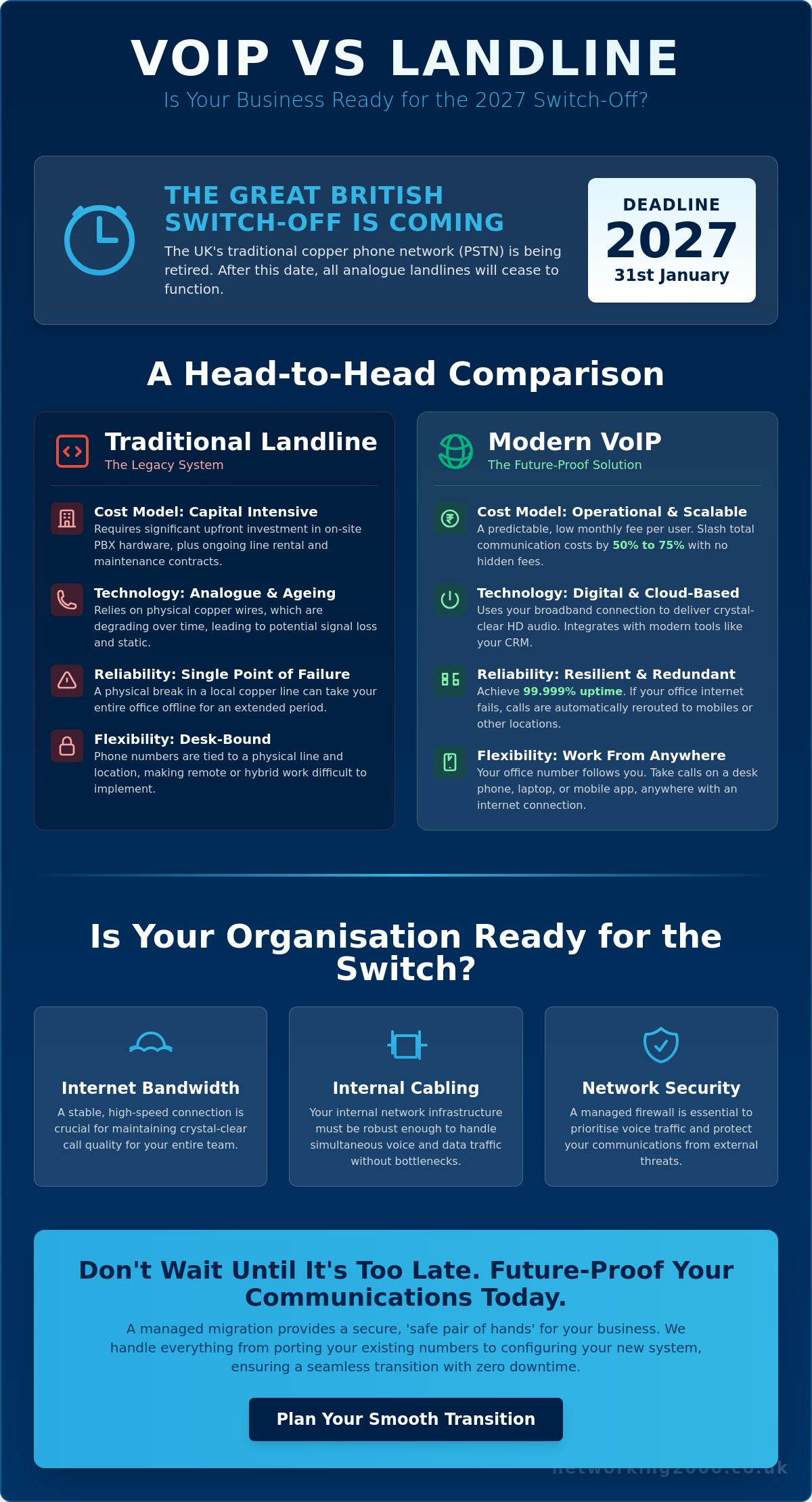
Choosing between VoIP vs landline for business often comes down to how you manage your budget. Traditional systems are hardware-heavy. They require a significant initial capital expenditure (CapEx) for on-site PBX boxes and complex handset wiring. VoIP flips this model. It operates on an operational expenditure (OpEx) basis; you pay a predictable monthly fee per user. This shift makes your communication costs easier to forecast and eliminates the need for expensive, bulky hardware that takes up office space.
Reliability remains a top priority. A single physical break in a copper wire can disconnect an entire office for days. This “single point of failure” is a massive risk for landlines. VoIP is different. If your office internet fails, calls can be instantly rerouted to mobile apps or a secondary location. You get 99.999% uptime with modern providers. You also gain HD audio quality. This eliminates the signal degradation and static often found in ageing analogue lines, ensuring your professional image isn’t marred by poor call quality.
Cost Analysis: Beyond the Monthly Subscription
Traditional landlines carry heavy baggage. You pay for line rental, separate maintenance contracts, and often expensive call packages. Scaling is slow; adding a new staff member might mean paying for a new physical line installation. With VoIP, you simply add a “seat” through a web portal. Businesses switching to cloud-based systems can save between 50% and 75% on total communication costs. International and long-distance calls are usually included or significantly cheaper, which is vital as we approach The Great British Switch-Off in 2027. When you compare the total impact of VoIP vs landline for business, the digital option is the clear winner for long-term savings.
Advanced Features for Competitive Advantage
Modern telephony does more than just make calls. VoIP provides tools that were once only available to huge corporations. Features like auto-attendants, call recording for compliance, and voicemail-to-email come as standard. For managers, “presence” indicators show exactly who is available, in a meeting, or away. This is essential for hybrid work. These systems perform best when they are fully integrated with your managed IT support services. This ensures your phones, firewalls, and desktops all work in harmony, creating a seamless experience for your team. If you are unsure about your current hardware’s compatibility, our team can help you audit your setup to ensure a smooth transition.
The Great British Switch-Off: Why Landlines are Becoming Obsolete
The UK is currently undergoing its biggest telecommunications shake-up in a generation. Openreach is actively decommissioning the Public Switched Telephone Network (PSTN) and the Integrated Services Digital Network (ISDN). This is not an optional upgrade; it is a mandatory transition to a fully digital infrastructure. The final deadline for the complete shutdown is January 31, 2027. For many firms, the debate over VoIP vs landline for business has already been settled by “Stop Sell” orders. As of September 5, 2023, it is no longer possible to order new analogue lines anywhere in the UK.
For businesses in Wickford and across Essex, 2026 represents the final countdown. Waiting until the final months of the year to migrate is a significant risk. Thousands of companies will be vying for the same installation slots, potentially leading to delays that could leave your office without a working phone system. This transition affects more than just your handsets. Any device that plugs into a traditional wall socket, such as intruder alarms, lift emergency phones, and older card payment terminals, will cease to function once the copper network is switched off.
What Happens if You Do Not Switch by 2027?
If you fail to migrate before the January 2027 deadline, your legacy hardware will simply stop working. This results in a total loss of incoming and outgoing calls, which can be devastating for customer service and sales. There are also safety implications. Legacy lines provide their own power, whereas digital systems rely on your local power supply and internet. Understanding these technical shifts is crucial. This FCC guide on VoIP technology explains the fundamental differences in how digital systems handle traffic and the importance of having a backup power plan for emergency calls. Auditing your non-voice equipment now is the only way to avoid a “blackout” of your security and safety systems.
SOGEA and the Move to Broadband-Only Infrastructure
The future of business connectivity is built on SOGEA, which stands for Single Order Generic Ethernet Access. Previously, you had to pay for a traditional phone line rental just to have broadband delivered to your premises. SOGEA removes this requirement. It allows you to order a high-speed internet connection without an underlying analogue voice service. This simplifies your billing and removes the cost of a line you no longer need for voice calls. SOGEA serves as the essential bridge to a digital-only future by providing the stable, data-only foundation that VoIP vs landline for business comparisons now demand.
Critical Considerations: Is Your Business Ready for the Switch?
Before making the final jump in the VoIP vs landline for business debate, you need a clear picture of your current infrastructure. Digital telephony places different demands on your office network compared to traditional copper lines. Start by auditing your internal cabling. Whilst Wi-Fi has improved significantly, a wired connection using Cat5e or Cat6 cabling remains the gold standard for voice stability. You also need to identify every device that currently relies on your phone line. This includes fax machines, PDQ payment terminals, and intruder alarms. Missing just one of these can lead to operational gaps once the analogue signal is cut.
Power is another critical factor. Traditional landlines are powered by the exchange, meaning they often work during a local power cut. VoIP handsets require their own power source. Most modern businesses use Power over Ethernet (PoE) switches to send electricity down the data cable, but you may need local power adapters for some setups. Planning for a battery backup or an Uninterruptible Power Supply (UPS) for your router is a smart move to keep your lines open during an outage. As you modernise your communications infrastructure, it is also the ideal moment to protect your business from cyber threats by reviewing your overall digital security posture alongside the transition.
The Connectivity Audit: Bandwidth vs Quality of Service
High download speeds are great for big files, but they don’t guarantee good call quality. For VoIP, jitter and latency are far more important. High latency causes noticeable delays, whilst jitter leads to jumbled or dropped audio. Your business router should be configured with Quality of Service (QoS) settings to prioritise voice traffic over standard web browsing. We often recommend setting up a dedicated voice VLAN (Virtual Local Area Network). This creates a private lane for your calls, preventing a large file download from interrupting an important client conversation.
Hardware vs Softphones: Choosing Your Interface
You don’t always need a physical phone on every desk. Softphones allow your team to make calls via a computer headset or a mobile app, which is perfect for hybrid working and “Bring Your Own Device” (BYOD) policies. However, many staff still prefer the tactile feel of a physical IP handset. If you have expensive analogue equipment you aren’t ready to replace, an Analogue Telephone Adapter (ATA) can bridge the gap. If you need help determining which setup fits your workflow, our team can provide a full audit of your managed IT support requirements.
Managed VoIP Solutions: Why a Local Essex Partner is Essential
Many national providers promote a “do-it-yourself” approach to cloud telephony. Whilst this might seem simple on paper, it often leaves local businesses struggling with network configuration or jitter issues alone. When comparing VoIP vs landline for business, the technology is only half the battle; the other half is the support system behind it. Choosing a local Essex partner means you aren’t just a ticket number in a global queue. You get a team that understands the local infrastructure and can provide a “safe pair of hands” for your entire transition. For growing firms that also face skills gaps and legacy system challenges, exploring IT outsourcing Wickford options alongside your telephony upgrade can help you build a more resilient and scalable technology foundation.
Having your VoIP Telephony and Managed IT Support under one roof creates a more efficient operation. If a call drops, you don’t want your phone provider blaming your internet and your IT company blaming the phones. We handle both. This holistic approach allows for proactive monitoring, where we can identify and resolve call quality issues before your team even notices them. It turns your communication system from a potential headache into a reliable asset that supports your daily goals.
The Networking2000 Approach to Business Telephony
We don’t believe in “one size fits all” solutions. Our process for Wickford SMEs starts with a bespoke design that maps your communication flow to your actual business needs. We ensure the transition is smooth and stress-free for everyone involved.
- Staff receive clear, no-jargon training during the rollout to ensure they are confident with the new features.
- Every handset and mobile app is pre-configured for your specific network environment.
- Our Essex-based technical support team is available to provide practical, local assistance whenever you need it.
Future-Proofing Your Business Communication
A managed system is built to grow. Whether you are adding new staff in Wickford or opening a second branch in Essex, your VoIP setup scales instantly without the need for new physical lines. This digital foundation also integrates seamlessly with your disaster recovery and business continuity plans. If your office becomes inaccessible for any reason, your business remains operational. Because your phone system exists in the cloud rather than in a physical box on the wall, your team can stay connected from any location. It is the ultimate way to ensure your business remains resilient in a digital-first economy.
Book your VoIP readiness audit with Networking2000 today to secure your communication future.
Secure Your Communication Future Before the 2027 Deadline
The transition from analogue to digital is no longer a distant prospect. With the final PSTN switch-off scheduled for January 2027, the VoIP vs landline for business debate has reached its final chapter. Legacy copper networks are becoming obsolete; they lack the flexibility, scalability, and cost-efficiency required for modern hybrid working. By migrating now, you protect your business from total service loss and ensure your non-voice systems, like alarms and card machines, remain operational.
Success lies in a managed approach. Established in 1998, Networking2000 provides local Wickford-based expert support to guide you through every step of the process. We are specialists in PSTN switch-off transitions, ensuring your new digital setup integrates perfectly with your existing IT infrastructure. Don’t leave your communication to chance as the deadline approaches. Upgrade your business communication with a managed VoIP solution from Networking2000. We are here to provide a safe pair of hands for your business, allowing you to focus on growth whilst we handle the technical details.
Frequently Asked Questions
Can I keep my existing business phone number when switching to VoIP?
Yes, you can keep your current number through a process called porting. Under Ofcom regulations, your new provider must facilitate this transfer, which typically takes one business day once the request is processed. This ensures your clients can still reach you on the same familiar digits whilst you transition your communication infrastructure to a more modern platform.
What happens to my VoIP phone system if the office power goes out?
Your physical desk phones will lose power, but your system remains active in the cloud. Calls can be instantly and automatically rerouted to mobile apps or laptops with battery power. To keep your desk phones and router running during a short outage, we recommend installing an Uninterruptible Power Supply (UPS) to provide emergency backup power for your core network hardware.
Is VoIP call quality as good as a traditional landline?
Modern VoIP call quality is often superior to traditional landlines because it supports High Definition (HD) audio. Analogue signals are prone to static and degradation over long distances, whereas digital packets deliver crisp, clear sound. Provided your internet connection is stable and your router is configured for voice traffic, the audio experience is professional and reliable.
Do I need to replace all my office phones to use VoIP?
No, you have several options that don’t involve buying new hardware for every desk. You can use softphones on existing computers or mobile apps on staff smartphones. If you have high-quality analogue handsets you wish to keep, an Analogue Telephone Adapter (ATA) can connect them to your new digital network, though most businesses prefer the advanced features of dedicated IP handsets.
How much internet bandwidth does a single VoIP call require?
A single high-quality VoIP call typically requires about 100kbps of upload and download bandwidth. This is a very small amount that most modern fibre connections handle easily. The most important factor isn’t the total speed but the stability of the connection; using a managed network ensures that data-heavy tasks, like large file transfers, don’t interfere with your voice packets.
Will my alarm system and credit card machine still work after the PSTN switch-off?
Most legacy alarm systems and older card machines will stop functioning because they rely on the analogue signals of the copper network. You must audit these devices before the January 2027 deadline to see if they require a digital upgrade or an IP-compatible interface. We can help you identify which hardware needs replacing to maintain your security and payment capabilities during the transition.
Is VoIP secure enough for sensitive business conversations?
VoIP is highly secure when implemented with modern encryption protocols and protected by a managed firewall. Unlike traditional landlines, which can be physically tapped, digital calls are encrypted from end to end. When considering VoIP vs landline for business, the ability to monitor your network for unusual activity provides an extra layer of protection that analogue systems simply cannot match. For a broader view of protecting your operations, reviewing the cyber security for small business Essex checklist is a valuable next step to ensure your entire digital environment is safeguarded.
How long does it take to install a VoIP system in a Wickford office?
A standard installation for a local SME can be completed in a matter of days, though number porting may take slightly longer depending on your current provider. If you are using softphones and mobile apps, the setup is almost instantaneous. For offices requiring physical IP handsets and network cabling, our team organises a methodical rollout to ensure there is zero downtime during the switch.

