Did you know that the average cost of IT downtime has reached a staggering $14,056 per minute? For any Essex business, even a brief outage can lead to catastrophic financial losses and permanent damage to your reputation. Whilst many owners believe a simple backup is enough, a comprehensive disaster recovery plan is the only way to ensure your operations survive a crisis.
It is common to feel anxious about the safety of your client data or confused by the technical differences between backups and full recovery. With the enforcement of the Data (Use and Access) Act 2025, the pressure to maintain operational resilience has never been higher. You need to know that your business remains a safe pair of hands for your customers, regardless of what happens to your hardware.
This guide will show you how to protect your assets and eliminate the fear of data loss with a practical, step-by-step strategy. We will break down the essential components of a recovery plan and help you prioritise your most critical digital systems. You will gain a clear understanding of how to keep your business running whilst your competitors are still struggling to get back online.
Key Takeaways
- Understand why a formalised disaster recovery plan is essential for restoring your IT systems and data after a cyber incident or hardware failure.
- Learn how to set a realistic Recovery Time Objective (RTO) to keep the costs of business downtime as low as possible.
- Discover the critical differences between technical disaster recovery and broader business continuity strategies.
- Identify how to prioritise your most important digital assets through a thorough Business Impact Analysis.
- Find out how proactive monitoring and tailored IT security can prevent many digital disasters from occurring in the first place.
What is a Disaster Recovery Plan and Why Does It Matter?
A Disaster Recovery Plan (DRP) is much more than a simple data backup. It is a formalised, documented strategy designed to help your business restore its IT systems and data after a disruptive event. Whether you are hit by a cyber-attack or a total hardware failure, this plan provides the exact steps your team needs to take to get back to work. Without one, you are essentially trying to build a map whilst you are already lost in the woods.
Many Essex business owners treat their IT strategy as a “set and forget” task. This is a dangerous mistake. Technology changes, your team grows, and new security threats emerge every week. Your DRP must be a living document. It needs regular testing and updates to remain effective. If your plan is gathering dust in a drawer, it likely won’t work when you actually need it. A strategy that worked in 2023 will almost certainly fail to address the sophisticated threats of 2026.
The Real-World Risks for Wickford Businesses
Local businesses in Wickford and the surrounding areas face specific, everyday challenges. You might deal with a sudden broadband outage during a peak trading period or a localised power cut that shuts down your on-site servers. Whilst these might seem like minor inconveniences, the “cost of silence” is high. If your customers cannot reach you or your services go offline without explanation, they will quickly look to your competitors. Relying on luck is not a business strategy; it is a gamble with your livelihood. A DRP acts as a comprehensive insurance policy for your digital assets, ensuring that your business can survive even the most severe technical failure.
The Emotional and Financial Benefits of Preparedness
Preparing for the worst brings immediate advantages. First, there is the undeniable peace of mind. Knowing you have a “safe pair of hands” managing your recovery allows you to focus on your core operations without constant anxiety over data loss. There are financial incentives too. Most cyber insurance providers now require proof of a documented recovery strategy before they will offer coverage. By showing you have a plan in place, you can often lower your premiums. More importantly, you protect your hard-earned reputation. Maintaining service continuity during a crisis proves to your clients that you are a reliable, professional partner they can trust.
The Core Components of a Robust Disaster Recovery Strategy
Building an effective disaster recovery plan requires more than just purchasing a backup drive. It starts with a clear-eyed assessment of your digital infrastructure. You must identify which assets are mission-critical and which are merely “nice to have”. For example, your customer database and payment processing systems are vital for survival. Conversely, your internal staff training archives or historical marketing assets can likely wait. By categorising your data, you ensure that your resources are focused on the systems that keep the lights on.
Defining RTO and RPO for Your Business
Two technical metrics define the success of your strategy: Recovery Time Objective (RTO) and Recovery Point Objective (RPO). RTO measures how quickly you need to be back online. If your business loses thousands of pounds for every hour of downtime, a four-hour RTO is likely too slow. RPO determines how much data you can afford to lose. If your last backup was 24 hours ago, you lose an entire day of work. For financial records, you might need an RPO of minutes; for general correspondence, a few hours might suffice. Balancing these targets against your budget is essential for a sustainable strategy.
Technology is only half the battle. A plan fails if nobody knows what to do when the screens go dark. You need established communication protocols that function even if your primary email server is offline. This includes a clear chain of command for notifying staff, updating clients via social media or SMS, and reporting breaches to authorities. Clear communication prevents panic and ensures that everyone moves in the same direction during a crisis.
Roles and Responsibilities: Who Does What?
Every effective disaster recovery plan assigns specific, documented roles. The DR Coordinator is the leader. They “call the play” and make the final decision to trigger the recovery process based on the severity of the incident. The IT Response Team handles the technical heavy lifting, such as restoring virtual servers and reconfiguring secure networks. This is where your managed IT support services partner becomes invaluable. They act as a seasoned extension of your team, providing the technical expertise needed to execute a clean recovery whilst you focus on managing your staff and customers. If you are unsure who would take charge during a server failure, it is time to audit your current IT support and define these roles clearly.
A well-defined strategy removes the guesswork from a high-pressure situation. By knowing exactly what is being recovered, how fast it needs to happen, and who is responsible for the work, you turn a potential catastrophe into a manageable technical hurdle.
DRP vs Business Continuity: Understanding the Differences
Many people use the terms “disaster recovery” and “business continuity” interchangeably. They aren’t the same. A disaster recovery plan is a specialised subset of your broader business continuity strategy. Whilst business continuity focuses on the entire organisation, including where staff work and how they communicate with clients, disaster recovery focuses specifically on your IT systems. It’s the technical engine that restores your data, servers, and networks after they fail.
You cannot build an effective business continuity planning Essex strategy without a solid DRP. If your staff have a temporary office to work from but no access to their files, your business is still at a standstill. IT resilience is the backbone of modern organisational survival. The overlap between the two is significant; your IT infrastructure must be resilient enough to support your overall business goals during a crisis.
Backups Are Not a Plan: The Common Misconception
It’s a common trap to think that because you have a daily backup, you’re safe. A backup is just a copy of your data; it’s only about 20% of the recovery process. Think of your backup as a pile of bricks. Without a blueprint, those bricks won’t build a house. Your disaster recovery plan is that blueprint. It provides the exact instructions for using your backups effectively, including which systems to restore first and how to reconnect them to your network.
An untested backup is as good as no backup at all. We often see businesses discover their backup files are corrupted only when they try to restore them during a live crisis. A regular “Restore Test” should be part of your routine. It’s the only way to prove your data is actually recoverable when the pressure is on. Without testing, your backup is just a theory.
Which One Does Your Business Need First?
For most modern Essex firms, IT recovery is the foundation. You should prioritise your disaster recovery plan first because almost every other business function relies on digital access. Once your data is secure and your systems are restorable, you can build out the rest of your continuity strategy. It’s much easier to find a temporary desk than it is to recreate a lost customer database.
Integrating these two areas creates a cohesive resilience strategy. It ensures that your technical recovery aligns with your operational needs. Whilst backups store data, a DRP restores operations. By focusing on both, you ensure your business doesn’t just survive an incident but recovers with its reputation and productivity intact.
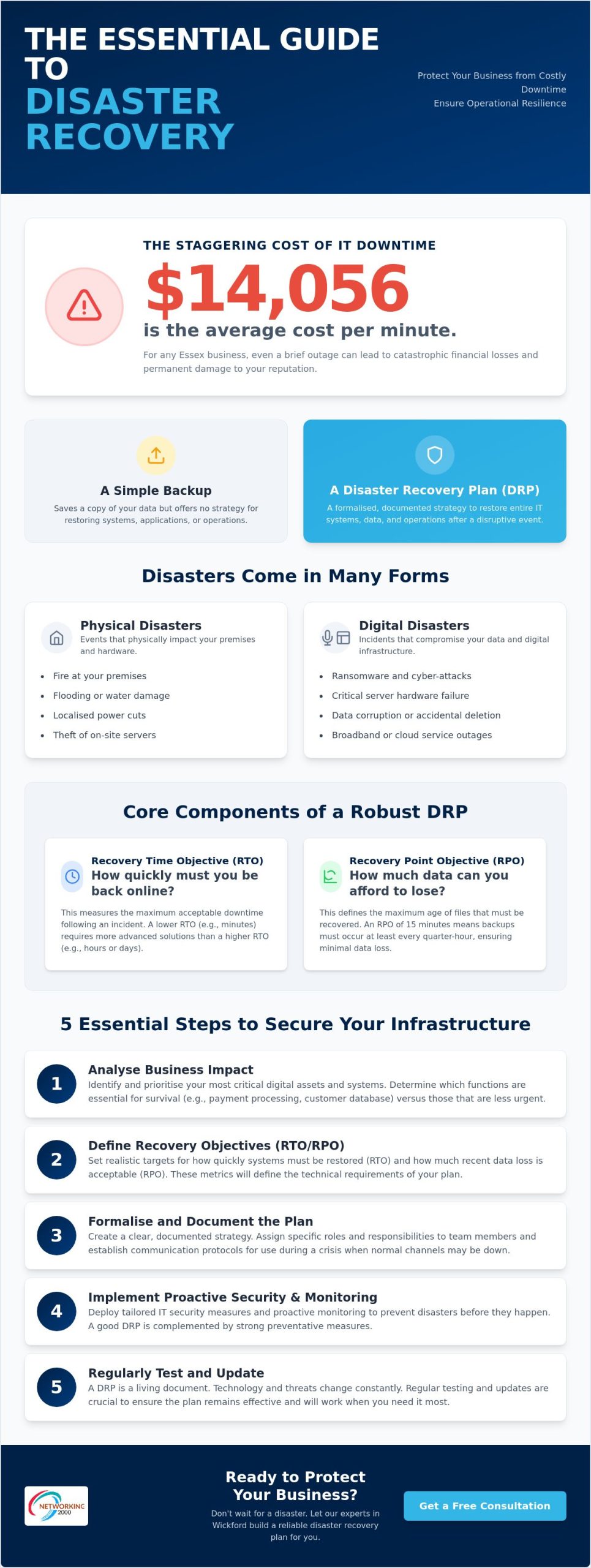
Building Your Plan: 5 Essential Steps to Secure Your Infrastructure
Moving from a theoretical understanding to a functional disaster recovery plan requires a methodical approach. It isn’t about complex jargon; it’s about creating a reliable roadmap for your business. By following these five steps, you can transform your IT security from a source of anxiety into a pillar of operational strength. A structured approach ensures that no critical system is overlooked when the pressure is on.
Step 1 & 2: Assessment and Mapping
The first step is a Business Impact Analysis (BIA). This process identifies which functions are critical to your daily survival. You must pinpoint “Single Points of Failure” in your Wickford office, such as a legacy server that lacks redundancy or a single internet line that frequently drops. Mapping your data locations is equally vital. With 42% of data breaches in 2025 occurring in cloud-based systems according to IBM, you must account for data stored in Microsoft 365 or cloud backups just as carefully as your local files.
Prevention is always better than recovery. Investing in managed firewall Essex services acts as your first line of defence, often stopping threats before they require you to trigger your recovery protocols. Categorising your data by sensitivity and operational importance ensures that when a crisis hits, your team knows exactly what to secure first. This clarity prevents wasted time on low-priority systems whilst your main revenue-generating tools remain offline.
Once you know what you have, you must decide where it goes. Step 3 involves choosing a recovery site. For most Essex SMEs, a cloud failover is the most cost-effective and reliable option. Step 4 is the documentation phase. You must write your restoration procedures in plain English. If your lead technician is unavailable during an emergency, the document should be clear enough for another staff member to follow the basic steps to keep the business ticking over. Avoid dense technical manuals that only one person can understand.
Step 5: The Importance of Regular Drills
A plan is only as good as its last successful test. Your disaster recovery plan is not a static file; it must be updated every time you install new software or upgrade your hardware. Running “Tabletop Exercises” is a great way to start. These are simulated disasters where your team sits down and talks through the response step-by-step. It allows you to find gaps in your strategy without actually pulling the plug on your live systems.
Use the results of these drills to refine your recovery speed. Every minute saved during a drill is a minute of revenue protected during a real event. If you want to ensure your infrastructure is truly resilient, you can book a comprehensive IT audit with our team to identify and fix vulnerabilities today. Regular testing turns a theoretical strategy into a proven survival tool.
How Networking2000 Implements Reliable Disaster Recovery in Wickford
Networking2000 understands that an Essex SME has different needs than a global corporation. We don’t use “one size fits all” templates. Instead, we build a disaster recovery plan that mirrors your specific operational flow. Our focus is on proactive monitoring. We use advanced tools to spot hardware fatigue or security vulnerabilities before they escalate into a crisis. This approach often prevents the need for a full-scale recovery in the first place.
Communication is often the first thing to break during an outage. We ensure your plan includes seamless integration with your communications infrastructure. Understanding the nuances of VoIP vs landline for business is critical here. If your physical office is inaccessible, a cloud-based VoIP system allows your team to maintain client contact from any location. This ensures that whilst your servers are being restored, your customer service remains uninterrupted.
Our Approach to Local Business Resilience
Being a local veteran in the Essex and London community allows us to provide a level of responsiveness that national competitors cannot match. Our clients value having a partner they can visit in Wickford or London. We provide straightforward, jargon-free technical support that focuses on results rather than abstract concepts. In one recent instance, we helped a local firm recover from a total server failure. Because we had a tested disaster recovery plan in place, we restored their critical systems within three hours, far exceeding their original RTO and keeping their financial losses to a minimum.
Take the First Step Toward a More Secure Future
Building resilience doesn’t have to be an overwhelming task. It begins with a clear understanding of your current strengths and weaknesses. A professional IT audit is the most effective way to identify your DR gaps and prioritise your next steps. We help you map your assets and define your recovery objectives without the stress of complex technical management. This methodical approach ensures you meet the new standards set by the Data (Use and Access) Act 2025 whilst protecting your reputation.
You don’t have to wait for a disruptive event to find out if your systems are secure. Protecting your livelihood starts with a single conversation. Contact Networking2000 today for a professional IT consultancy session and ensure your business remains a “safe pair of hands” for your clients.
Build a Resilient Future for Your Essex Business
A comprehensive disaster recovery plan is the difference between a minor technical hitch and a permanent closure. You have learned that backups are only one part of the puzzle; true resilience comes from clear documentation, assigned roles, and regular testing. By prioritising your critical assets now, you ensure your business remains operational whilst others are left struggling in the dark. Preparedness is not just a technical requirement; it is a commitment to your customers and your staff.
Networking2000 has been providing expert IT support in Wickford and across Essex since 1998. We specialise in proactive managed security solutions that stop threats before they disrupt your workflow. Our team acts as a reliable partner, ensuring your infrastructure meets the latest regulatory standards whilst giving you the peace of mind to focus on your core operations. We pride ourselves on being a local veteran that understands the unique challenges of regional SMEs.
Don’t leave your reputation to chance. Secure your business today with a professional Disaster Recovery Plan from Networking2000. Taking this step now provides the security your clients expect and the stability your business deserves. We are ready to help you build a safer, more resilient digital future.
Frequently Asked Questions
How often should we test our disaster recovery plan?
You should test your plan at least twice a year or whenever you make significant changes to your IT infrastructure. Regular testing ensures that your procedures remain effective as your business evolves. If you add new software or hardware, run a tabletop exercise immediately to verify that the new assets are covered by your existing strategy.
Is a disaster recovery plan the same as a backup?
No, a backup is merely a copy of your data, whilst a disaster recovery plan is the comprehensive strategy for restoring your entire operation. Think of the backup as the ingredients and the DRP as the recipe. Without the plan, you have the data but no clear method to make it functional again for your staff during a crisis.
What are the three main types of disaster recovery?
The three main types are Data Centre Disaster Recovery, Cloud-Based Disaster Recovery, and Virtualised Disaster Recovery. Data centre recovery involves physical hardware at a secondary site. Cloud-based options use off-site servers for failover, whilst virtualised recovery allows you to replicate your entire server environment quickly onto new hardware without needing identical physical machines.
Can a small business with only 5 employees justify a DRP?
How much does it cost to create a disaster recovery plan in the UK?
The cost varies significantly based on the complexity of your systems and the amount of data you need to protect. Most businesses find that the investment is a small fraction of the potential losses from a single day of downtime. It’s best to view the cost as a necessary operational insurance policy that protects your long-term survival rather than an optional expense.
What is the most common cause of business disasters in 2026?
Cyber-attacks, specifically ransomware and sophisticated phishing, remain the most common cause of business disasters in 2026. Research from Sophos in 2025 showed that 18% of organisations took more than a month to recover from a ransomware attack. These digital threats have now overtaken physical disasters like fire or flooding as the primary risk to local business continuity.
How does cloud computing affect disaster recovery planning?
Cloud computing simplifies recovery by allowing for rapid data replication and off-site failover, but it also introduces new security risks. Since 42% of data breaches in 2025 occurred in cloud-based systems, your disaster recovery plan must include specific protocols for these platforms. You need a clear strategy to access your data even if your primary cloud provider experiences a major service outage.
What should be the first thing we do if our systems go down?
Your first step should be to trigger your communication protocol and notify your designated Disaster Recovery Coordinator. Don’t waste time trying to fix complex technical problems yourself if they fall outside your expertise. Alerting your IT support team immediately ensures that professional recovery steps begin within your predefined Recovery Time Objective, minimising the total impact on your revenue.

