What if your biggest barrier to growth isn’t your competition, but the very technology meant to support you? In a year where 90% to 95% of UK organisations have transitioned to cloud computing, relying on legacy hardware can leave your firm trailing behind. We understand that upgrading business IT infrastructure Essex can feel like a daunting task, especially when you’re already juggling system lag and the pressure of the new Cyber Security and Resilience Bill 2026.
It’s frustrating when remote working feels inconsistent or when jargon-heavy advice from national providers leaves you more confused than before. You deserve a reliable, fast network that just works, giving you the peace of mind to focus on your core operations. This guide provides a straightforward roadmap to modernising your setup, ensuring seamless VoIP communication and a scalable system that grows with you.
We’ll explore how to bolster your security to meet current standards and improve efficiency without causing operational disruption. From proactive maintenance to the benefits of local support, discover how to turn your IT from a headache into a genuine competitive advantage for your business.
Key Takeaways
- Identify and eliminate the “hidden tax” of legacy systems that cause daily lag and impact your team’s productivity.
- Learn how to conduct a thorough audit to spot “End of Life” hardware before it becomes a security or compliance risk.
- Determine whether a Cloud, Hybrid, or On-Premise model is the most efficient and secure fit for your firm’s 2026 growth goals.
- Follow a strategic, phased roadmap for upgrading business IT infrastructure Essex without causing costly operational downtime.
- Discover the benefits of a local Wickford-based partner for responsive, on-site support that national providers cannot match.
Understanding the Real Cost of Outdated IT Infrastructure for Essex SMEs
Before you can improve your setup, you need to understand what’s at stake. What is IT Infrastructure? In simple terms, it is the collection of hardware, software, and network foundations that keep your firm running. This includes everything from the physical servers in your office to the cloud-based email systems your team uses every day. For many local firms, this infrastructure is the silent partner in their success, but when it’s outdated, it becomes a significant liability.
Many business owners in the region are currently paying a “hidden tax” on legacy systems. This isn’t a line item on your accounts; it’s the cost of inefficiency. Slow boot times, software incompatibility, and frequent system freezes don’t just waste time. They create deep-seated employee frustration. When your team spends their morning fighting with technology rather than focusing on their roles, your bottom line suffers. Often, upgrading business IT infrastructure Essex is the only way to stop this drain on your resources and restore staff morale.
Beyond office software, this modernisation should also extend to how you handle transactions; for instance, PenguinPay provides bespoke EPOS and card payment systems that eliminate the lag and frustration often associated with older point-of-sale hardware.
Security is another major concern. Old routers and unpatched servers act as magnets for modern cyber threats. In 2026, the risks are higher than ever. Cybercriminals target vulnerabilities in older hardware that no longer receives security updates. Moving away from a “break-fix” model allows you to stay ahead. Firms that modernise their systems enjoy a clear competitive advantage over those that only react when something stops working. Strategically upgrading business IT infrastructure Essex ensures your business remains resilient in a fast-moving market.
The Financial Impact of IT Downtime
Think about what one hour of total downtime costs your Essex team. You can calculate this by adding your hourly payroll costs to the estimated lost revenue during that window. If your network fails, your staff are still being paid, but they cannot work. Managed IT support changes this dynamic by using proactive monitoring to identify and fix issues before they cause a crash. Technical debt is the accumulated cost of delaying necessary IT upgrades.
Compliance and Data Security in 2026
Meeting current UK data protection standards requires more than just a strong password. Modern infrastructure is built with compliance in mind, offering the encryption and security features necessary to protect sensitive client information. Using a managed firewall Essex provides a robust layer of protection for your local network. These systems are monitored by experts, ensuring your business stays compliant with 2026 regulations whilst you focus on growth.
Conducting a Comprehensive IT Audit: Identifying Your Business Bottlenecks
Every successful project involving upgrading business IT infrastructure Essex begins with a clear picture of your current environment. You cannot fix what you haven’t properly measured. An audit isn’t just a list of your PCs; it’s a diagnostic check of your entire business engine. This process identifies exactly where your technology is supporting your goals and where it is actively holding you back. By mapping out every piece of hardware and every software licence, you prevent wasted spend on unnecessary “fixes” that don’t address the root cause of your lag.
A critical part of this audit is identifying “End of Life” (EOL) hardware. These are devices that the manufacturer no longer supports with security patches or firmware updates. In 2026, running EOL hardware is a massive risk. These devices act as open doors for cybercriminals who exploit known vulnerabilities that will never be patched. If your office is still using routers or switches from five years ago, they likely fall into this category. Replacing these is not just about speed; it’s about basic business survival.
Don’t overlook your communication tools during this phase. Many Essex firms are still tied to traditional landlines that lack the flexibility of modern working. If your team cannot seamlessly take office calls whilst working from home, your infrastructure is failing the modern flexibility test. Transitioning to a VoIP system is often a quick win that provides immediate improvements to client communication and internal collaboration.
Hardware and Server Health Checks
Is your on-site server a ticking time bomb? Many Wickford businesses still rely on a humming box in a cupboard that is well past its prime. If your server is over five years old, the risk of hardware failure increases significantly every day. We are seeing a massive shift towards cloud-hosted environments, but the decision depends on your specific data needs. When choosing the right IT model, you must weigh up the speed of local file access against the resilience and scalability of the cloud. Reviewing the individual performance of desktops and laptops across your office will also reveal which team members are losing the most time to system freezes.
Connectivity and Network Performance
Your internet connection is the lifeblood of your digital operations. We often find that businesses have moved to modern cloud apps but are still trying to run them on basic broadband. This leads to “bottlenecking” where the software is fast, but the connection is too slow to handle the traffic. Testing your current speeds against your actual usage is vital. You should also check for internal Wi-Fi dead zones that disrupt productivity. Professional it support companies in essex can perform these technical audits to ensure your structured cabling and wireless access points are optimised for 2026. If you are unsure where to start, booking a professional IT audit is the most reliable way to uncover the hidden issues slowing your business down.
Cloud, On-Premise, or Hybrid: Selecting the Right Model for Your Essex Firm
Choosing the right operational model is the most significant decision you’ll face when upgrading business IT infrastructure Essex. For most small and medium businesses in the region, the cloud revolution has already won. Moving away from noisy local server rooms reduces physical maintenance and allows your team to work securely from anywhere. It turns a large, unpredictable capital expense into a manageable monthly cost that scales as you grow.
However, on-premise infrastructure still has its place. If your firm handles massive data sets, such as architectural renders or high-resolution video, a local server might remain a necessity for speed. The hybrid approach often provides the best of both worlds. It allows you to keep sensitive or heavy data on-site whilst leveraging the cloud for daily collaboration and email. Experts often highlight that navigating hybrid IT complexities requires a clear strategy to ensure these different systems talk to each other without friction.
Your choice will dictate your long-term scalability. A cloud-first model allows you to add new users or storage in minutes, rather than waiting for hardware deliveries. Strategically upgrading business IT infrastructure Essex means matching your technology to your actual workflow, not just following the latest trend. It’s about building a foundation that supports your 2026 growth goals without over-complicating your daily operations.
Upgrading to VoIP Telephony
The 2025/2026 PSTN switch-off has moved VoIP from a “nice-to-have” to an essential infrastructure component. If you haven’t moved away from traditional copper lines, your business communications are on borrowed time. Cloud-hosted phone systems provide the flexibility that modern remote and hybrid teams need to stay connected. For a detailed breakdown of the differences, see our VoIP vs landline for business guide.
The Role of Managed Firewalls in Your New Setup
Your security shouldn’t be an afterthought. A standard ISP router isn’t designed to protect a business network from modern threats. Managed firewalls act as a proactive perimeter, blocking malicious traffic before it ever enters your system. By integrating this protection directly into your infrastructure design, you create a “security-first” environment. This ensures that as you modernise your network, you’re also bolstering your defences against the evolving cyber risks of 2026.
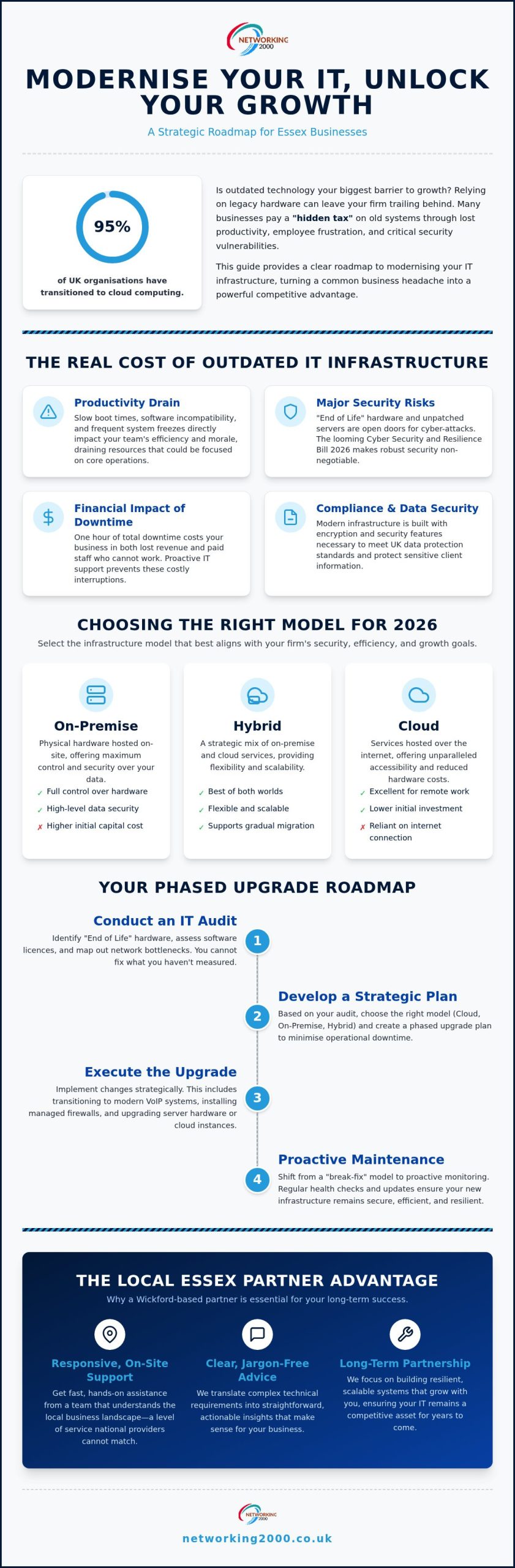
Step-by-Step Guide to Executing a Seamless IT Infrastructure Upgrade
Successfully upgrading business IT infrastructure Essex requires more than just buying new kit. It demands a methodical, phased approach that respects your operational hours and staff productivity. By following a structured roadmap, you turn a complex technical project into a series of manageable milestones. This ensures that the transition feels like an evolution rather than a disruption.
- Phase 1: Planning and Budgeting. We begin by aligning your technology with your specific 2026 growth goals. This prevents over-spending on features you don’t need.
- Phase 2: Procurement and Preparation. All hardware is ordered and software is configured off-site. This drastically reduces the time spent on-site at your office.
- Phase 3: Implementation and Migration. The actual switch-over happens. We move your data and applications to the new environment using proven migration protocols.
- Phase 4: Testing and Staff Training. We don’t just leave once the lights are green. We verify every connection and ensure your team knows how to use their new tools.
- Phase 5: Ongoing Managed Support. Your upgrade marks the shift from a reactive “break-fix” cycle to a proactive, managed maintenance model.
Minimising Disruption During the Upgrade
Nobody wants their business to grind to a halt during a server move or network overhaul. We recommend out-of-hours migrations to ensure your team starts their Monday morning on a fresh, fast system. The “Parallel Run” method is another effective strategy; we keep your old systems live whilst the new infrastructure is stress-tested. Having a robust disaster recovery plan is vital during any major change to ensure your data remains protected at every stage.
Budgeting for Your IT Future
Modern infrastructure allows you to move from heavy Capital Expenditure (CapEx) to a more flexible Operational Expenditure (OpEx) model. Instead of paying thousands upfront for hardware that depreciates, you pay a predictable monthly fee for managed IT support. This keeps your cash flow steady whilst providing access to the latest security and performance updates. Eligible businesses in Essex should also investigate the Made Smarter Adoption East of England Grant, which can provide up to £20,000 to support digital technology adoption. If you want to see how these savings apply to your firm, you can request a tailored infrastructure quote from our Wickford office.
Why a Local Essex IT Partner is Essential for Long-Term Infrastructure Success
Choosing the right partner for upgrading business IT infrastructure Essex is just as critical as the technology you select. National providers often rely on “cookie-cutter” packages that ignore the unique realities of local business parks and regional connectivity. A local partner brings a level of context that a remote helpdesk simply cannot match. We understand the specific challenges facing firms in Wickford, Chelmsford, and Southend because we operate in the same environment every day.
The “Wickford Advantage” is built on proximity and accountability. When you need on-site support for a complex network setup or hardware installation, having an expert just a short drive away is invaluable. This local presence ensures that your infrastructure is physically optimised for your office space, not just configured on a screen hundreds of miles away. Since 1998, Networking2000 has acted as a “safe pair of hands” for regional SMEs, providing the stability needed to focus on growth rather than technical troubleshooting.
Your business deserves a strategy that evolves with the Essex economy. Rather than offering generic advice, a local veteran provides tailored solutions that align with your specific industry requirements. This personalised touch builds a foundation of trust and reliability, ensuring your technology remains a tool for success rather than a source of frustration.
The Benefits of Proactive Managed IT Support
Modern infrastructure requires a shift in mindset from reactive repairs to proactive stability. Moving away from the “Break-Fix” cycle means identifying potential hardware failures or security vulnerabilities before they impact your operations. Regular maintenance and remote monitoring extend the lifespan of your upgraded systems, ensuring you get the maximum return on your investment. By choosing managed IT support services, you eliminate the need for emergency calls by keeping your network in peak condition year-round.
Strategic IT Consultancy for Growth
An experienced IT consultant acts as a virtual CTO for your small business. This partnership allows you to plan your next upgrade cycle three to five years in advance, preventing the sudden “technical debt” discussed earlier in this guide. We help you navigate the complexities of 2026 regulations and emerging tech trends, ensuring your infrastructure is always ready for what comes next. If you are ready to build a faster, more secure future for your firm, contact Networking2000 today for an IT infrastructure audit and take the first step toward a more reliable network.
Secure Your Future with a Modern Network
Modernising your network is more than a technical task; it’s a strategic investment in your company’s resilience. We’ve explored how a thorough audit reveals hidden bottlenecks and why selecting the right cloud or hybrid model is vital for your 2026 growth. By prioritising a proactive maintenance model, you move away from costly downtime and toward a system that simply works.
Networking2000 has been a trusted partner for regional firms since 1998. With over 25 years of experience, our Wickford-based team provides the rapid response and technical expertise national providers lack. We specialise in VoIP telephony and managed security, ensuring your business stays connected and compliant. Upgrading business IT infrastructure Essex doesn’t have to be a source of stress when you have a local “safe pair of hands” guiding the process.
Ready to eliminate system lag and bolster your cyber security? Book your free IT infrastructure audit with our Essex experts today. Let’s build a foundation that supports your business for years to come.
Frequently Asked Questions
How long does a typical business IT infrastructure upgrade take?
A standard upgrade usually takes between two and six weeks from the initial audit to final completion. The timeline depends on the complexity of your network and the volume of data being migrated. Whilst the planning and procurement phases take the most time, the actual “switch-over” is often completed over a single weekend to avoid disrupting your working week.
Will our Essex business experience downtime during the IT upgrade?
No, we aim for zero operational downtime by using strategic migration techniques. We often perform the heavy lifting out-of-hours or use parallel systems so your old network remains live whilst the new one is tested. This methodical approach ensures your team can start work on Monday morning without facing technical hurdles or system lag.
What is the most important part of an IT infrastructure upgrade in 2026?
Security and compliance are the top priorities for any firm upgrading business IT infrastructure Essex this year. With the implementation of the Cyber Security and Resilience Bill 2026, your network must have a proactive defence. This means integrating managed firewalls and encrypted backups directly into your foundation rather than treating security as an optional add-on.
Can I upgrade my IT infrastructure in stages to manage the cost?
Yes, a modular approach is a very effective way to modernise without a massive upfront investment. You might choose to upgrade your VoIP telephony first to improve communication, followed by a security overhaul. We help you prioritise the most critical “bottlenecks” so you can spread the cost whilst still seeing immediate performance gains.
Is cloud-based infrastructure safer than having a server in my Essex office?
In almost all cases, yes. Leading cloud providers invest billions in physical and digital security that a small office server simply cannot match. Cloud systems also protect you from local risks like hardware theft, fire, or accidental damage. Your data is backed up across multiple secure centres, ensuring it’s always available when you need it.
Do I need to replace all my hardware when upgrading my network?
Not necessarily, as we always look to repurpose existing kit that still meets performance standards. However, any hardware that has reached “End of Life” (EOL) must be replaced. These older devices don’t receive security patches, making them a major liability. We’ll identify exactly which components are still viable and which ones are holding you back.
What is the difference between IT infrastructure and managed IT support?
Think of infrastructure as the physical and digital “engine” of your business, including servers, cabling, and software. Managed IT support is the ongoing maintenance service that keeps that engine running smoothly. Whilst the upgrade builds a better system, managed support provides the proactive monitoring and helpdesk access needed to prevent future issues.
How often should a business in Essex audit its IT setup?
You should conduct a thorough IT audit at least once every twelve months. Technology moves fast, and regular checks ensure your infrastructure still aligns with your growth goals and current UK security regulations. Annual audits help you catch minor hardware issues before they turn into expensive emergency repairs, keeping your business stable and secure.

