Did you know that 50% of UK businesses experienced a cyber incident in 2024? For many local firms, the threat of data loss or a sudden power cut is a constant source of anxiety. Effective business continuity planning Essex is no longer just a “nice to have” feature. It is a vital shield for your daily operations. You have likely spent far too much time dealing with IT downtime or scratching your head over the complexities of new regulations like Martyn’s Law, which was passed in April 2025.
We understand that you want to focus on growth, not disaster recovery. It’s frustrating when technical glitches or shifting legal requirements get in the way of your hard work. This guide provides a practical roadmap to help you build a resilient strategy for 2026. You will learn how to safeguard your data, meet legal obligations, and keep your doors open during an emergency. We will walk you through the essential steps to ensure your Essex business remains steady, secure, and fully compliant with the latest UK standards. It is about finding peace of mind whilst protecting your livelihood.
Key Takeaways
- Understand why a basic backup isn’t enough and how a robust failsafe strategy keeps your operations running during major IT failures or power cuts.
- Learn how to identify your most critical assets and set precise recovery time limits to minimise operational disruption.
- Navigate the requirements of Martyn’s Law (2025) to ensure your digital systems, such as VoIP and access control, meet new legal standards.
- Get a practical, step-by-step roadmap for business continuity planning Essex that helps you assign roles and conduct a thorough impact analysis.
- Discover the value of proactive monitoring and local managed IT support to stop potential disasters before they require a full recovery response.
What is Business Continuity Planning and Why Does it Matter in Essex?
Think of it as the ultimate failsafe for your company. Business continuity planning is more than just a document tucked away in a drawer. It is a living strategy designed to keep your doors open when things go wrong. Whilst many owners assume a simple data backup is enough, there is a massive difference between having your files saved and having a system that allows you to keep working. Robust business continuity planning Essex ensures that if a server dies or a power cut hits, your staff can still serve customers and process orders without missing a beat.
In 2026, the stakes are higher than ever. UK businesses are facing increasingly sophisticated cyber threats. Research shows that the average cost of a data breach in the UK has reached £3.4 million. For an Essex SME, even a few hours of downtime can lead to thousands of pounds in lost revenue and lasting damage to your reputation. If your systems are down, your clients won’t wait; they will simply head to a competitor who is still online. Reliability is the currency of the modern market.
The Local Context: Risks Facing Essex Firms
Operating in Essex brings specific challenges that national guides often overlook. Our county relies heavily on key infrastructure like the A127 and A13 corridors. A major accident on these routes does more than just delay deliveries; it can prevent staff from reaching the office or disrupt local logistics for hours. We also see frequent “micro-disruptions” such as localised internet outages or power grid fluctuations in older industrial estates. For Wickford firms, a solid continuity plan acts as the essential bridge between a sudden disaster and a full recovery.
Resilience vs. Recovery: Knowing the Difference
It is helpful to distinguish between these two concepts. Resilience is about your ability to stay open during a crisis. Recovery is the process of getting back to normal once the immediate threat has passed. Essex businesses must prioritise resilience to maintain customer trust. If you can keep your VoIP phones ringing and your website live during a regional outage, you prove your reliability to your clients. Building a foundation with managed IT support services is the first step in creating this resilience. It allows you to move beyond simple “break-fix” mentalities and into a proactive stance where your business is ready for anything.
The 5 Essential Pillars of a Disaster Recovery Strategy
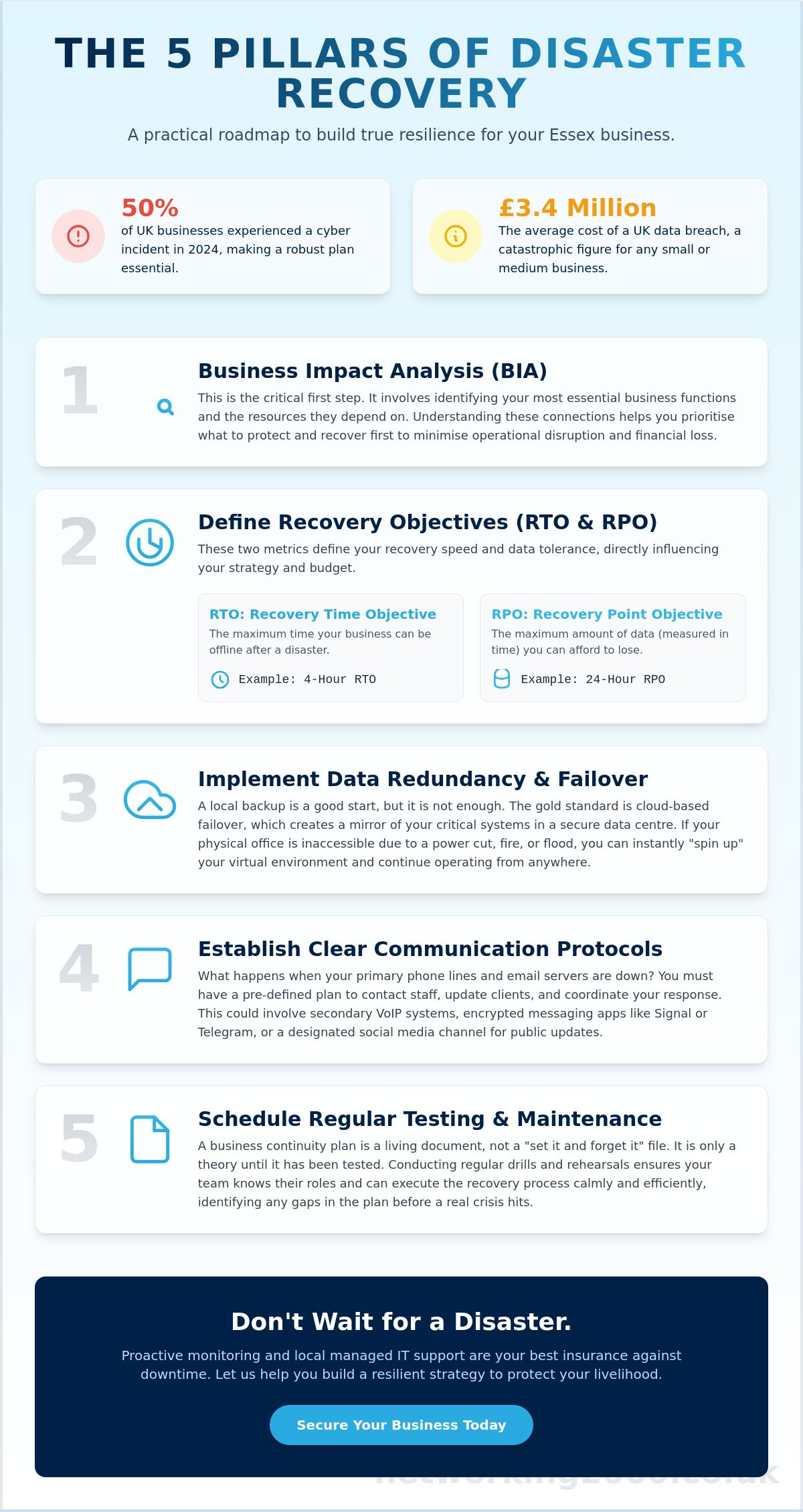
Effective business continuity planning Essex requires more than just a backup drive; it demands a structured approach to risk. A plan that only exists on paper won’t help you when a cyber-attack encrypts your database or a local power surge fries your server. To build true resilience, your strategy must stand on five core pillars. These elements ensure that your team knows exactly what to do when the unexpected happens.
- Business Impact Analysis (BIA): This is the process of identifying your most critical functions. You need to know which parts of your business must stay running to avoid total failure. You can find detailed resources on How to Create Your Business Continuity Plan to help you map out these dependencies.
- RTO and RPO: These metrics define your recovery speed and data tolerance. We will break these down further below.
- Data Redundancy: Local backups are a start, but cloud-based failover is the gold standard. It allows you to “spin up” your environment in a secure data centre if your physical office is inaccessible.
- Communication Protocols: You must have a way to reach staff and clients when your main phone lines or email servers are down. This often involves secondary VoIP systems or encrypted messaging apps.
- Testing and Maintenance: A plan is only a theory until it’s tested. Regular rehearsals ensure your team can execute the recovery process without panic.
Understanding RTO and RPO for SMEs
Recovery Time Objective (RTO) is the maximum amount of time your business can afford to be offline. Recovery Point Objective (RPO) refers to how much data you can lose, measured in time. For example, a 4-hour RTO means you must be back online within four hours of a crash. A 24-hour RPO means you could lose up to a day’s worth of data. These numbers dictate your IT budget. High-frequency backups and instant failover systems cost more, but they are essential for businesses that cannot afford even an hour of downtime. A well-structured disaster recovery plan for Essex businesses will help you define these metrics accurately and build the right technical safeguards around them.
Cloud-First Continuity for Wickford Businesses
Modern resilience is built in the cloud. Virtualisation allows us to create a digital twin of your entire IT environment. If your local hardware fails, you can switch to this cloud version almost instantly. This approach bypasses the need for physical server repairs during a crisis. To protect this digital gateway, a robust managed firewall Essex is vital. It acts as the first line of defence, stopping threats before they can trigger your recovery plan. If you are unsure whether your current setup can handle a 2026-level threat, our team can help you audit your systems for hidden vulnerabilities.
Digital Resilience and Martyn’s Law (2025): New Requirements for Essex Firms
The Terrorism (Protection of Premises) Act 2025, known as Martyn’s Law, was passed on April 3, 2025. It represents a major shift in how public-facing organisations must approach safety. While previous discussions on business continuity planning Essex often focused on data breaches or power cuts, this law brings physical security into the digital age. It requires businesses to prove they have “protective security” measures in place. This includes the digital infrastructure that supports physical safety, such as CCTV, access control, and emergency communication systems.
The law is currently in a two-year implementation phase. Essex firms have until 2027 to comply fully. The Security Industry Authority (SIA) will act as the regulator, ensuring that premises are prepared for potential security incidents. IT is no longer just a support function; it is the backbone of your legal compliance. If your digital systems fail during an incident, your business could face significant legal and financial repercussions. Resilience now means protecting your people as well as your servers.
Is Your Essex Business Compliant?
Compliance depends on your capacity. The Standard Tier applies to premises holding 200 to 799 people. These businesses must notify the SIA and have clear public protection procedures. The Enhanced Tier is for sites with a capacity of 800 or more, requiring more rigorous vulnerability assessments. Many local venues, from community halls to larger retail spaces, fall under these new rules. A comprehensive audit from an IT consultancy in Wickford can help you identify if your current security tech meets these legislative demands. It’s better to find the gaps now than during an official inspection.
Integrating Physical and Cyber Security
Your continuity strategy must bridge the gap between the physical and digital worlds. Modern security hardware relies on your network. If your internet goes down, your CCTV or access control shouldn’t go with it. We recommend using VoIP telephony for rapid, automated emergency alerts. These systems can broadcast critical information to all staff instantly during a security event. You also need to ensure your security hardware remains online during power failures. This involves using Uninterruptible Power Supplies (UPS) to keep your protective security active, regardless of the local grid’s stability. Integrating these elements into your business continuity planning Essex ensures you protect both your data and your people.
Step-by-Step: How to Create Your Business Continuity Plan
Creating a plan is about logic, not just filling in a template. Many static PDF guides fail because they don’t account for the unique technical dependencies of a modern office. A successful business continuity planning Essex strategy requires a clear, five-step approach to ensure your team can act decisively when a crisis occurs. This process moves from identifying people to securing the digital tools that keep them productive.
- Step 1: Form your continuity team. Assign clear roles such as an Incident Commander, an IT Lead, and a Communications Lead. Without these, your staff will look to you for answers while your systems are down.
- Step 2: Conduct a Business Impact Analysis (BIA). Determine what happens to your revenue if a specific department goes offline.
- Step 3: Map your critical IT dependencies. List every piece of software, hardware, and internet connection you need. Don’t forget cloud-based tools that require specific login credentials.
- Step 4: Draft response procedures. Write specific “playbooks” for scenarios like a cyber-attack, a flood, or a fire.
- Step 5: Schedule bi-annual testing. Rehearse your plan every six months. Technology changes quickly, and a plan from last year might not work today.
Conducting Your Business Impact Analysis
To get the most out of your BIA, you must interview department heads. Ask them: “What happens if this process stops for 24 hours?” and “Which third-party suppliers are essential for your daily tasks?”. These questions help identify “Single Points of Failure,” such as a legacy server that no one knows how to fix. You should rank every business process on a scale of one to five, where one is a minor inconvenience and five represents a total cessation of trade. This mission-critical ranking allows you to prioritise your IT recovery budget where it matters most. Pairing your BIA findings with a robust disaster recovery plan ensures you have both the analysis and the technical response procedures in place to act swiftly.
The Role of VoIP in Your Response Plan
Communication is the first thing to fail in a disaster. When comparing VoIP vs landline for business, the resilience benefits of cloud-based telephony are clear. If your Essex office is inaccessible due to a local flood or power cut, VoIP allows your team to work from home using the same business numbers. Features like “find me/follow me” ensure calls are automatically routed to available staff on any device. You can also set up an “Emergency Mode” that instantly redirects all inbound calls to a pre-recorded message or a secondary site. This keeps your business reachable and professional, even when your physical premises are out of action.
If you need expert help mapping out these technical steps, contact Networking2000 for a comprehensive business continuity audit tailored to your local requirements.
Why Local Managed IT Support is Your Best Continuity Insurance
When a crisis hits, you don’t want a generic call centre agent reading from a script. You need a “safe pair of hands” that understands your local environment. Having a partner based in Wickford means we can be on-site quickly if a physical hardware failure occurs. This local presence is the bedrock of business continuity planning Essex. It transforms a theoretical document into a responsive, real-world defence system. We know the local infrastructure, from the power grid quirks to the transport links, allowing us to react with precision.
Proactive monitoring is where true resilience begins. Instead of waiting for a system to crash, we use advanced tools to identify potential issues before they escalate. If a hard drive shows signs of failure or a firewall detects a suspicious pattern, we act immediately. This “shift left” approach means many potential disasters are neutralised before they ever require you to trigger your recovery plan. It’s about maintaining a steady state of operation rather than constantly reacting to emergencies.
At Networking2000, we integrate business continuity planning Essex into every managed IT contract we sign. We don’t view resilience as an optional extra; it’s a fundamental part of a professional IT strategy. By combining Managed IT Support with robust IT Security and VoIP Telephony, we create a multi-layered shield for your business. This holistic approach ensures that your data is safe, your team is connected, and your reputation remains intact, regardless of external disruptions.
The Networking2000 Approach to Resilience
We’ve been supporting local firms since 1998. As a local veteran, we’ve seen technology evolve and threats multiply. Our method is straightforward and free from unnecessary jargon. We focus on practical outcomes that keep your business moving. Whether it’s ensuring your Website Design & Development includes secure failovers or managing your IT Security to block AI-powered phishing, we provide versatile support. We bridge the gap between creative digital needs and technical infrastructure, giving you a single, reliable point of contact.
Next Steps: Securing Your Business Future
The best time to prepare for a disaster is whilst things are running smoothly. Don’t wait for a power cut or a cyber-attack to test your resolve. We invite you to book a comprehensive continuity audit with our team. We will look at your RTOs, RPOs, and your current recovery protocols to find any hidden weaknesses. It’s about providing you with the stability and speed you need to grow with confidence. Protect your Essex business with a professional continuity strategy from Networking2000 and gain the peace of mind that comes from expert-led protection.
Secure Your Business Future with a Resilient Strategy
Resilience in 2026 is about more than just surviving a power cut; it’s about building a foundation that supports growth and meets new legal standards. You now have the tools to define your recovery limits and navigate the complex requirements of Martyn’s Law. Effective business continuity planning Essex ensures that your operations remain steady whilst competitors struggle with avoidable downtime. By integrating physical security with digital resilience, you protect both your people and your assets.
Since 1998, Networking2000 has acted as a trusted partner for firms across Essex and London. We provide specialist IT support that combines technical expertise with a practical, no-jargon approach to keep your systems compliant. Don’t leave your business reputation to chance during an emergency. Book your 2026 Business Continuity Audit with Networking2000 today to ensure your organisation is ready for any challenge. We are here to help you build a more secure, reliable future for your team.
Frequently Asked Questions
What is the difference between a disaster recovery plan and a business continuity plan?
A business continuity plan is a comprehensive strategy for the entire organisation, whilst a disaster recovery plan focuses specifically on IT systems. Your continuity plan covers staff safety, alternative workspaces, and customer communication. The disaster recovery plan is the technical subset that handles restoring your servers, data, and network after a crash. You need both to ensure your Essex firm is truly resilient.
How often should an Essex business test its business continuity plan?
You should test your plan at least twice a year to account for staff turnover and technology updates. Regular rehearsals ensure that your business continuity planning Essex remains effective when a real emergency strikes. If you implement new software or move premises, you must update and test your procedures immediately. A plan that isn’t rehearsed is just a theory that might fail under pressure.
Does Martyn’s Law (2025) apply to small offices in Essex?
Martyn’s Law, also known as the Terrorism (Protection of Premises) Act 2025, applies to premises with a capacity of 200 or more people. Small offices that don’t meet this threshold are generally exempt from the specific Standard and Enhanced tier requirements. However, all business owners should maintain basic security and safety protocols to protect their employees. It’s better to be prepared regardless of your official capacity.
How much does it cost to implement a professional business continuity strategy?
The cost depends on the complexity of your infrastructure and your specific recovery time requirements. Factors such as the number of users, the volume of data, and the need for instant failover systems will influence the total investment. It’s best to view this as essential insurance that protects your revenue and reputation from total loss. Every business has different needs based on their mission-critical processes.
Can cloud backups replace a full business continuity plan?
Cloud backups cannot replace a full continuity plan because they only address data storage. A backup is just a copy of your files; a continuity plan covers how your staff will work, how you’ll communicate with clients, and what happens if your physical office is inaccessible. Resilience requires a holistic strategy that includes people and processes, not just a digital archive in the cloud.
What are the most common causes of business disruption in Essex?
Cyber-attacks and localised power outages are the most frequent causes of disruption for Essex firms. With 50% of UK businesses experiencing a cyber incident in 2024, digital threats are a primary concern for local owners. Local infrastructure issues, such as major accidents on the A127 or A13 corridors, can also prevent staff from reaching the office or disrupt essential logistics for hours.
Is business continuity planning a legal requirement for UK SMEs?
Business continuity planning isn’t a universal legal requirement for all UK SMEs, but it’s often a regulatory necessity in sectors like finance or healthcare. Additionally, Martyn’s Law now mandates specific security measures for larger public-facing venues. Even without a specific law, company directors have a fiduciary duty to manage risks that could threaten the survival of the firm and its employees.
How do I choose the right RTO and RPO for my company?
You choose your RTO and RPO based on a thorough Business Impact Analysis of your departments. Identify which processes are “mission-critical” and determine how long you can realistically survive without them. If your sales depend on a live website, your RTO should be very short. If your data is updated once a week, a longer RPO might be acceptable for that specific part of your operations.

