Did you know that 65% of medium-sized UK businesses identified a cyber security breach or attack in the last 12 months? For local firms, managing business data protection Essex has never felt more urgent. The Data (Use and Access) Act 2025 is now in full force. It brings mandatory new rules for handling complaints and securing sensitive information. If you feel overwhelmed by the threat of a £17.5 million ICO fine or the complex technical requirements of modern networking, you aren’t alone.
It’s natural to feel concerned when the regulatory goalposts keep moving. You want to focus on running your company, not worrying about whether your firewall is robust enough to stop a phishing attack. We believe security should be straightforward and effective. This guide provides a comprehensive roadmap for 2026. It’ll help you navigate the latest UK regulations and implement professional-grade defences. We’ll explore the mandatory complaints process, essential security layers, and how to achieve total peace of mind through reliable, local support.
Key Takeaways
- Understand the critical shift from UK GDPR to the Data (Use and Access) Act 2025 and how new mandatory complaints processes impact your organisation.
- Learn why managed firewalls and end-to-end encryption are the non-negotiable foundations of business data protection Essex for modern, remote workforces.
- Discover why “paper compliance” is no longer enough and how to build technical resilience that actually stops ransomware attacks.
- Follow a practical 5-step roadmap to audit your current IT infrastructure, map sensitive data flows, and close security gaps.
- See how a local Wickford-based partner provides the “safe pair of hands” needed to integrate professional-grade security into your daily managed IT support.
The Evolving Landscape of Business Data Protection in Essex
Effective business data protection Essex has shifted from a “nice to have” administrative task to a core operational requirement. In 2026, protecting information isn’t just about locking a filing cabinet; it’s about securing every digital touchpoint in your organisation. While many firms previously focused on the General Data Protection Regulation (GDPR), the introduction of the Data (Use and Access) Act 2025 has changed the rules of engagement. This new legislation requires a more proactive approach to technical security and incident management.
Criminals now view regional SMEs as primary targets. They assume smaller firms lack the internal technical expertise or the budget for professional-grade defences. This makes local businesses in Wickford, Basildon, and Chelmsford high-value targets for ransomware and phishing attacks. You aren’t just protecting your own files; you’re protecting the trust your clients place in your brand every single day.
Key Regulations Impacting Essex Firms in 2026
The Data (Use and Access) Act 2025 is the most significant update to UK law since 2018. It works alongside the Data Protection Act 2018 to ensure high standards of privacy. However, the 2025 Act introduces a critical new requirement: the mandatory complaints process. As of June 19, 2026, every UK business must have a formal system to handle data protection complaints. You’re legally required to acknowledge these complaints within 30 days and investigate them without delay. The ICO is actively monitoring regional compliance, focusing on whether businesses have the technical infrastructure to back up their written policies.
The Cost of Non-Compliance: Fines and Reputation
The financial stakes are higher than ever. Under the UK GDPR, the ICO can issue fines of up to £17.5 million or 4% of your global annual turnover, whichever is higher. Even for smaller breaches of marketing regulations, fines can reach £500,000. For an Essex SME, these figures are often terminal. Beyond the immediate financial hit, a breach can destroy years of reputation building. This is especially true for professional sectors like legal, finance, and accounting, where data integrity is your most valuable asset.
Common consequences of a data breach include:
- Immediate loss of client contracts and future revenue.
- Skyrocketing professional indemnity insurance premiums.
- Legal action from affected individuals.
- Permanent damage to local brand reputation in the Essex community.
Implementing business data protection Essex isn’t just about avoiding fines. It’s about building a resilient, reliable company that clients feel safe doing business with. We’ve seen first-hand how a “safe pair of hands” approach to IT security prevents these disasters before they start.
Essential Technical Controls for Essex SME Infrastructure
Written policies provide the framework, but technical controls are the locks on your digital doors. Effective business data protection Essex relies on active enforcement rather than just hope. Multi-Factor Authentication (MFA) is perhaps the simplest yet most powerful tool in your arsenal. It’s estimated that MFA can block up to 99% of bulk-automated cyber attacks. By requiring a second form of verification, you stop criminals even if they’ve stolen a password through phishing. It’s a non-negotiable standard for any business in 2026.
Remote work is now standard for many firms across the county. This shift means your sensitive data often travels across unsecured home networks. End-to-end encryption ensures that even if data is intercepted, it remains unreadable to unauthorised parties. This aligns with the UK government data protection guidance, which stresses the need for appropriate technical measures to keep personal data secure at all times.
Managed Firewalls and Network Integrity
A standard router isn’t enough to protect a growing business. A managed firewall Essex service acts as a sophisticated gatekeeper for your network. It doesn’t just sit there; it proactively monitors incoming and outgoing traffic for suspicious patterns. Unlike passive hardware, a managed setup is constantly updated to recognise the latest threats. This is especially vital for office-based firms in Wickford that provide guest Wi-Fi. You must ensure your guest network is completely isolated from your core business data to prevent internal breaches.
Endpoint Protection and Mobile Device Management
Your network perimeter now extends to every staff member’s laptop and smartphone. Ensuring robust business data protection Essex means controlling every access point, no matter where your team is working. Endpoint protection goes beyond basic consumer antivirus. It provides a centralised way to monitor the health of every device connected to your systems. If a staff member loses their phone in a Chelmsford coffee shop, Mobile Device Management (MDM) allows for a remote wipe. This ensures sensitive business data never falls into the wrong hands.
Keeping these systems updated is a full-time job. Vulnerabilities are discovered daily, and hackers move fast. This is why local managed IT support services are essential for rigorous patch management. We handle the heavy lifting of updates and security monitoring, acting as your “safe pair of hands” so you can focus on growth. If you’re unsure about your current defences, our team can provide a safe pair of hands to review your setup.
Bridging the Gap Between Legal Compliance and Real-World Security
Many Essex business owners mistake a thick folder of policies for actual security. While “paper compliance” meets the basic legal requirements, it offers zero protection against a live ransomware attack. A written policy is a statement of intent; technical resilience is the ability to withstand a breach. True business data protection Essex requires both. You need the legal framework to satisfy the ICO and the technical infrastructure to stop hackers in their tracks.
The human factor remains the weakest link in any security chain. Social engineering attacks, such as phishing, accounted for 38% of business breaches in 2025/2026. Criminals don’t always need to break through your firewall if they can trick an employee into handing over credentials. Integrating security into your business continuity strategy means ensuring that if the worst happens, your team knows exactly how to respond without panic. This turns your staff from a vulnerability into a vital line of defence; to help build these internal capabilities, you can visit Square Skills for accredited IT training and career development.
It’s tempting to download a generic GDPR template and call it a day. However, these often fail local SME audits because they don’t reflect how your business actually operates. If your policy says you delete data after six months, but your server keeps it for six years, you’re in breach. Customising your data retention schedules and security documents is vital. You shouldn’t “set and forget” these files. They need to evolve as your technology and team grow.
Building a Culture of Data Privacy
Educating your staff doesn’t have to be a chore. Simple, regular sessions on spotting suspicious emails or handling client files can make a massive difference. You can find excellent resources in the NCSC Small Business Guide to help structure these conversations. We recommend conducting a basic internal data audit once a quarter. It only takes an afternoon to check who has access to which folders and whether old accounts have been closed.
If a breach does occur, having a clear reporting procedure is essential. Your team needs to know who to call immediately. In Essex, having a local partner means you aren’t waiting in a national queue for help. You have a “safe pair of hands” ready to contain the issue and start the recovery process before the damage spreads. This proactive culture is what separates compliant businesses from truly secure ones. Effective business data protection Essex is a daily habit, not a yearly paperwork exercise.
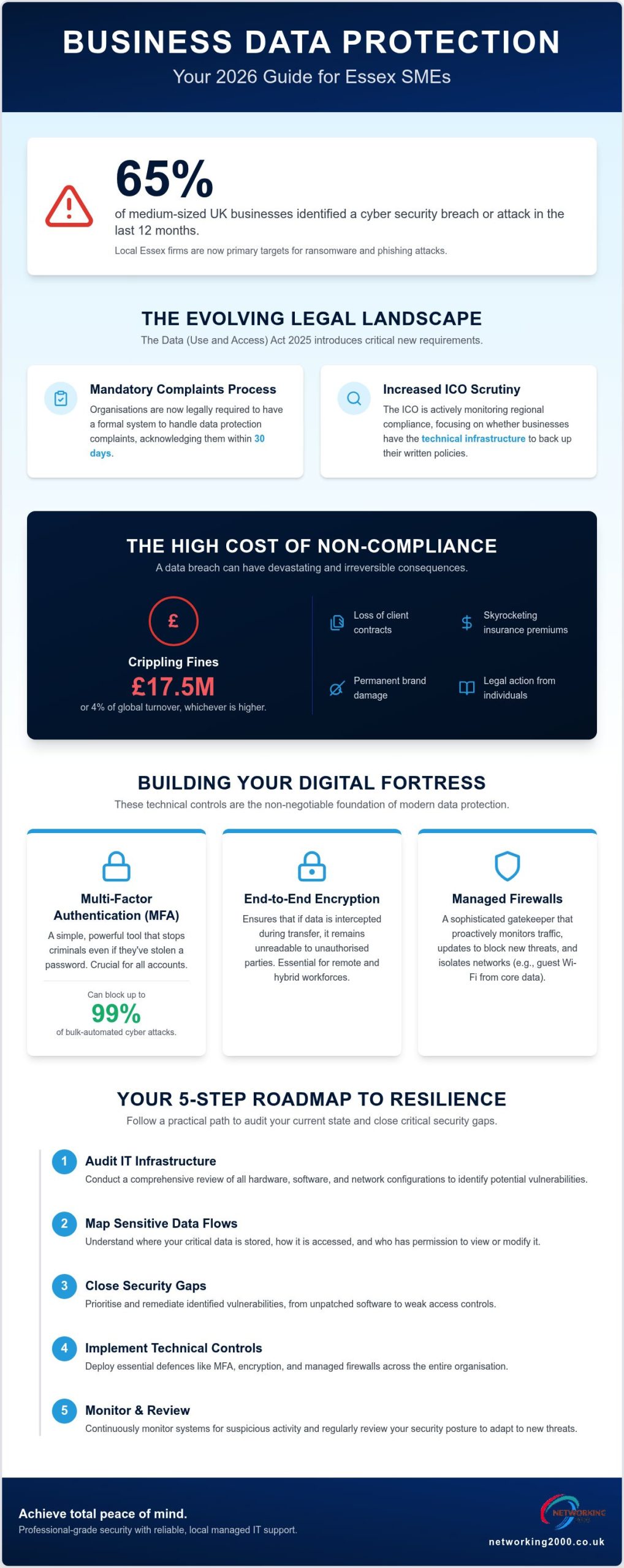
Implementing a Robust Data Protection Strategy: A 5-Step Roadmap
Moving from theory to practice requires a methodical approach. Building effective business data protection Essex isn’t a one-off event but a continuous cycle of improvement. By following these five steps, you can transform your security from a source of anxiety into a competitive advantage.
- Step 1: Map your data flow. You cannot protect what you cannot find. Identify every location where personal data is stored, from local servers in Wickford to cloud-based CRM systems.
- Step 2: Audit your IT infrastructure. Review your current hardware and software. Ensure your firewall settings are optimised to block modern threats and that all devices are running the latest security patches.
- Step 3: Update your disaster recovery plan. In 2026, a backup isn’t enough. You need a documented process to restore operations within hours, not days, following a breach or system failure.
- Step 4: Formalise your Subject Access Request (SAR) process. Create a clear, repeatable system for identifying and extracting data when a customer or employee asks to see their records.
- Step 5: Partner with a local IT expert. Ongoing monitoring is the only way to stay ahead of evolving regulations and cyber threats. A local partner provides the responsiveness that national call centres lack.
Mapping and Auditing Your Assets
Shadow IT is a significant risk for Essex SMEs. This happens when staff use unauthorised cloud storage or personal messaging apps to handle business information. Your audit must uncover these hidden data silos to bring them under professional management. Physical security at your Wickford premises also matters. Ensure server rooms are restricted and sensitive documents aren’t left on desks. Your data perimeter is the boundary between your managed business assets and the unmonitored digital world.
Preparing for Subject Access Requests (SARs)
Responding to data requests can be incredibly time-consuming if your files are disorganised. In 2026, you need to pull data quickly without disrupting your daily business operations. Having a central index of where data lives makes this process seamless. Under current 2026 regulations, businesses must typically respond to a Subject Access Request within one month of receipt. Failing to meet this window can trigger an ICO investigation, so having a formalised response kit is essential for compliance.
Staying compliant and secure is easier with a dedicated team by your side. If you’re ready to secure your infrastructure, contact Networking2000 today for a professional security audit.
Why Local Managed IT Support is Key to Data Integrity in Wickford
Choosing a partner for business data protection Essex shouldn’t be a gamble. You need a team that understands the specific challenges of regional SMEs. We’ve been providing a “safe pair of hands” from our Wickford base since 1998. This long-standing experience means we’ve seen every major shift in the digital landscape. We don’t just fix problems; we prevent them. Reliable IT support is about more than just a helpdesk; it’s about a partnership built on trust and local accountability.
Security isn’t an optional extra in our service model. We integrate robust protection into every managed IT contract. This ensures your data integrity is maintained as a standard, not a luxury. Proactive support is our foundation. By monitoring your network constantly, we identify and neutralise threats before they can impact your operations. This is far more effective than reacting to a disaster after the damage is done. It’s the difference between a secure future and a constant state of digital anxiety.
Personalised Support for Essex SMEs
National providers often rely on distant call centres. They don’t know the Essex business community like we do. Regional expertise is vital for navigating local threat landscapes and understanding the specific needs of firms in our area. Just as we recommend local IT experts, we also value other independent local specialists; you can discover Castle Opticians for professional eye care services across South Essex. We offer on-site assistance for physical security audits. This allows us to spot vulnerabilities, such as unsecure server rooms or poor cable management, that a remote scan would miss. Our modular support packages are tailored to your specific needs. Whether you’re a small legal firm or a growing logistics company, we scale our services to fit your exact requirements.
We take a comprehensive approach to managed firewalls and continuous threat monitoring. Our team handles the heavy lifting of security, ensuring your business data protection Essex meets the highest standards. We also help you achieve Cyber Essentials certification. This is a powerful way to demonstrate your commitment to security, helping you win better tenders and build trust with your clients. We handle the technical complexities so you can focus on your core operations without distraction. Our goal is to provide the stability and speed your business needs to thrive in a digital-first economy.
Ready to secure your organisation’s data? Speak to our Wickford team about your data protection today. We’ll help you build a resilient infrastructure that stands the test of time.
Future-Proof Your Essex Business
The standard for business data protection Essex has reached a critical turning point. Relying on outdated “paper compliance” is no longer a viable strategy for regional SMEs facing the 2026 regulatory shift. True security requires active, technical enforcement that protects your network every second of the day. By following a structured roadmap and prioritising technical resilience, you ensure your organisation remains both compliant and competitive.
You don’t have to navigate these complexities alone. We’ve been established in Wickford since 1998, providing the local expertise needed to secure regional infrastructure. Our team are specialists in SME network security, offering modular IT support tailored to your budget. We believe in straightforward, jargon-free guidance that gives you total peace of mind. Let us handle the technical heavy lifting so you can focus on growing your business with confidence.
Your data is your most valuable asset; it’s time to give it the protection it deserves. Secure your Essex business data with Networking2000 today. We’re ready to be the safe pair of hands your business needs.
Frequently Asked Questions
What is the Data (Use and Access) Act 2025 and how does it affect my Essex business?
The Data (Use and Access) Act 2025 is the primary update to UK data laws, amending both the UK GDPR and PECR. It aims to make data handling more efficient whilst maintaining high privacy standards. For your business, it means moving from vague policies to active technical enforcement. You must now have clearer data handling rules and a formal process for managing how information is accessed and protected.
Does a small SME in Wickford really need a Data Protection Officer (DPO)?
Most small SMEs don’t legally require a formal DPO unless they process large volumes of sensitive data or perform regular, large-scale monitoring. However, you still need someone responsible for data oversight within your firm. Many local companies appoint a Senior Responsible Individual to manage business data protection Essex. This ensures your strategy remains compliant without the formal overhead of a full, regulated DPO role.
What are the mandatory complaint rules introduced in June 2026?
As of June 19, 2026, all UK organisations must have a formal process for handling data protection complaints. You’re legally required to acknowledge any complaint within 30 days and investigate the matter without undue delay. This rule is a major focus for the ICO this year. Every SME must have a documented procedure to prove they can handle customer or employee concerns professionally and promptly.
How long does a business have to respond to a Subject Access Request in 2026?
You typically have one month to respond to a Subject Access Request (SAR) from the day you receive it. In complex cases, you can extend this by a further two months, but you must inform the individual of the delay. Having organised digital systems makes it much easier to meet these deadlines. Disorganised files can lead to missed windows and potential investigations from the ICO.
Is a basic firewall enough to meet UK data protection standards?
A basic, off-the-shelf firewall is rarely enough for professional business data protection Essex. The ICO expects businesses to implement security that is appropriate for the specific risk level they face. For most SMEs, this means a managed firewall that provides active monitoring and regular updates. Passive hardware cannot keep up with the 2026 threat landscape or the sophisticated phishing attacks currently targeting local firms.
What happens if my Essex business suffers a data breach?
You must notify the ICO within 72 hours if the breach poses a risk to individuals. You also need to inform the affected people without delay if the risk to their rights is high. Failing to report a breach can result in fines of up to £17.5 million or 4% of annual turnover. Quick action and a clear recovery plan are your best defences against long-term reputational damage.
How can managed IT support help with GDPR and Data Act compliance?
Managed IT support provides the technical foundation for your legal obligations. We handle essential tasks like patch management, multi-factor authentication, and managed firewalls to move you beyond “paper compliance.” Having a local partner ensures your security is constantly monitored and updated. This proactive approach ensures you meet the 2026 standards set by the Data (Use and Access) Act without needing internal technical experts.
What is the difference between data controllers and data processors for SMEs?
A data controller decides why and how personal data is processed, whilst a data processor handles that data on the controller’s behalf. For example, if you hire us for managed IT, you are the controller of your staff data, and we act as the processor. Both roles have specific legal duties under the 2025 Act to keep information secure and respond to data requests correctly.

