What if hiring a dedicated IT manager is actually the riskiest move your Essex business could make in 2026? With recruitment costs for technical staff soaring and median salaries for specialists reaching £35,000 before benefits, the financial pressure is real. When you’re weighing up IT support vs in-house IT, the choice isn’t just about office space. It’s about whether one person can realistically defend your data against the deepfakes and AI-driven threats now circulating in the UK’s £14.7 billion cybersecurity landscape.
You likely feel that your technology should be an asset, not a source of constant stress or unpredictable invoices. This article provides a clear, practical comparison of outsourced managed IT support versus internal teams to help you secure the most cost-effective and secure solution. We will examine the hidden costs of hiring, the necessity of 2026-standard security, and how the right partnership delivers the predictable monthly costs and peace of mind your business deserves.
Key Takeaways
- Analyse the full financial implications of internal salaries and benefits against fixed, manageable service fees.
- Evaluate the strategic advantages of IT support vs in-house IT when defending against advanced 2026 cyber attacks.
- Identify the specific signs that your internal IT resources are reaching a breaking point and affecting productivity.
- Discover how a “collective brain” of specialists offers more robust protection than a single generalist ever could.
- Explore how the co-managed IT model allows you to keep internal strategy whilst outsourcing complex infrastructure tasks.
What is the Difference Between IT Support and In-House IT?
Choosing the right technical foundation is a critical decision for any growing firm. When you evaluate IT support vs in-house IT, you’re essentially choosing between two different business philosophies. In-house IT refers to dedicated employees on your payroll. These individuals are responsible for your technical infrastructure and report directly to your management team. They are part of your company culture and focus exclusively on your internal systems.
Managed IT support is an external partnership. Instead of hiring individuals, you hire a service provider to act as your entire technical department. This team provides proactive maintenance and helpdesk services for a predictable monthly fee. In the 2026 business environment, the rise of the hybrid workplace has shifted the requirements for both models. With staff working across multiple locations, the core distinction often comes down to fixed salary costs versus scalable service-level agreements (SLAs).
The Evolving Role of the IT Department
IT has moved far beyond the traditional task of fixing PCs. Today, technology is a tool for enabling business growth. Modern firms require strategic IT consultancy to plan their digital future. This involves everything from cloud migration to long-term infrastructure planning. Many local Essex businesses are moving away from the “lone IT guy” model. It’s difficult for one person to stay updated on every new threat and software update. Technical support is now a strategic asset that requires a broad range of skills rather than a single generalist’s perspective.
Defining Managed IT Support in 2026
A modern managed IT support services package is built on proactivity. The days of the reactive “break-fix” approach are over. Instead, providers use advanced monitoring tools to identify and resolve issues before they cause downtime. The debate over IT support vs in-house IT often centres on control versus capability. An external provider offers consistent care for organisations with a diverse footprint.
Whether your team is based in a central office in Wickford or working remotely in London, a managed provider ensures your security remains stable across all sites. They manage your firewalls and digital communications centrally. This allows you to focus on core operations whilst experts handle the technical heavy lifting. It’s a scalable solution that grows alongside your business without the need for constant recruitment cycles.
The Reality of an In-House IT Team: Pros and Cons
Having a dedicated face in the office provides a unique sense of security. When assessing IT support vs in-house IT, the primary advantage of an internal team is their deep, granular knowledge of your specific business operations. They don’t just know your passwords; they understand how your team uses proprietary software to serve customers. If a server physically fails in your Wickford office, an internal technician is already on-site to swap parts whilst your staff continue their day with minimal disruption.
However, this model creates a “single point of failure”. If your only IT person is on holiday or falls ill, your technical safety net disappears. You’re also facing escalating overheads. Beyond the base salary, you must account for National Insurance, pension contributions, and the constant need for expensive technical training to keep pace with 2026 standards. If you’re currently feeling the strain of managing these overheads, it might be time to explore a more scalable technical partnership that removes the burden of recruitment.
The Benefits of Internal Expertise
Internal staff offer cultural alignment that’s hard to replicate. They participate in your weekly meetings and understand your long-term goals. This proximity allows them to build customised workflows around your existing systems. For businesses with highly specialised, non-standard hardware, having that immediate physical presence remains a significant “pro” in the column of internal hiring. They’re part of the team, not just a voice on the phone.
The Challenges of Recruitment and Retention
The London/Essex corridor is a highly competitive market for technical talent. Finding a multi-skilled professional who can handle Managed Firewalls, VoIP Telephony, and Website Design & Development is increasingly difficult. The “skill gap” is a growing concern; one person simply cannot be an expert in every discipline required by a modern business. In 2026, a mid-level IT manager typically commands a median salary of £35,000, a figure that easily exceeds £45,000 once you factor in benefits, NI, and the cost of recruitment. For many SMEs, this financial burden is becoming unsustainable. You can find more guidance on How to Outsource IT Services to see if a different approach fits your current budget and growth plans.
Why Managed IT Support is the Strategic Choice for SMEs
Managed IT support offers a depth of expertise that a single employee cannot match. When comparing IT support vs in-house IT, the most significant advantage is the “collective brain.” You aren’t just hiring one person; you’re accessing a diverse team of specialists. One might be an expert in cloud infrastructure, whilst another focuses on managed firewall Essex services. This breadth of knowledge is vital in 2026. AI-driven cyber threats like deepfakes and “vishing” (voice phishing) are now common. A single generalist often lacks the time or training to monitor these emerging risks effectively.
Financial predictability is another key strategic factor. Managed services provide fixed monthly billing. This simplifies your financial forecasting and removes the shock of unexpected hardware failures or the high recruitment fees mentioned in the previous section. Your technical safety net never goes on holiday or takes sick leave. Monitoring systems work 24/7 to identify vulnerabilities in real-time. This proactive threat mitigation ensures your business remains resilient against the 2,603 cybersecurity firms currently operating in the UK’s £14.7 billion digital sector.
Access to Enterprise-Grade Technology
External providers use sophisticated monitoring and management tools designed for reducing IT downtime. These are often enterprise-level systems that would be too expensive for a single SME to purchase independently. You also benefit from established vendor relationships. This makes hardware and software procurement both faster and more cost-effective. Whether you need to implement robust VoIP telephony or secure cloud communication systems, a managed partner already has the infrastructure and expertise ready to deploy. They also help manage “FinOps” to ensure your cloud spending stays within budget.
Scalability and Flexibility
Your technical needs change as your business grows or market conditions shift. Managed support allows you to scale your resources up or down without the friction of hiring or redundancy. If you need to launch a new project, such as a complex website redesign, you can deploy specialist resources immediately. Many Wickford SMEs favour this model for several reasons:
- Project Agility: Launch new systems without distracting your daily helpdesk support.
- Cost Control: Use a “pay-for-what-you-need” approach to manage seasonal demands.
- Growth Support: Add new users or locations to your network in hours, not weeks.
It’s a flexible approach that adapts to your long-term expansion plans without the permanent overhead of a full-time department. You get the benefit of a seasoned partner that handles technical and creative tasks with equal competence. This allows your internal team to focus on core operations whilst we handle the infrastructure.
IT Support vs In-House IT: A Direct Comparison
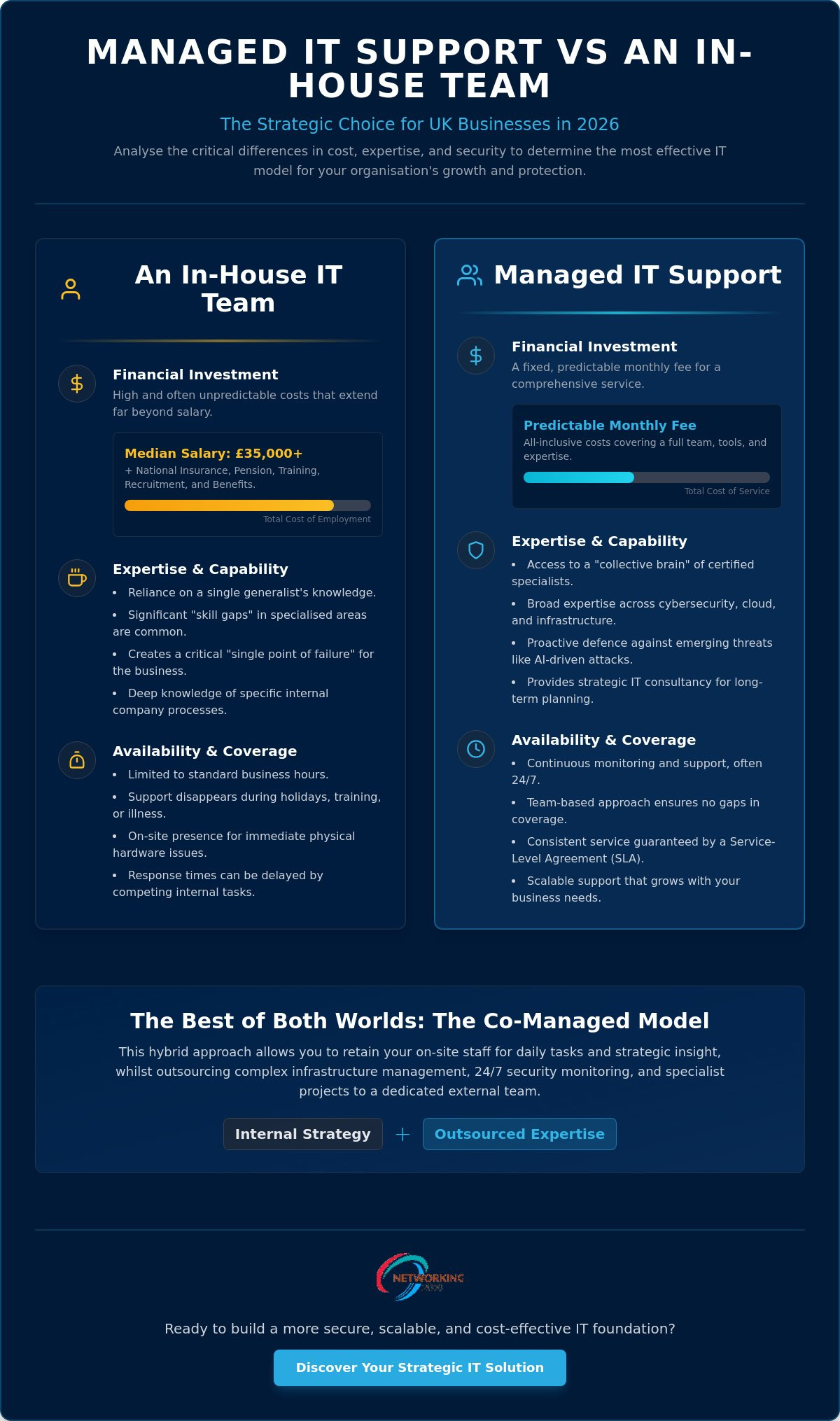
Making a final choice between IT support vs in-house IT requires a clear-eyed look at the trade-offs. An internal team offers high visibility but often lacks the breadth of skill found in a specialist agency. Conversely, a managed partner provides a high level of resilience but operates as an external extension of your business. The decision usually hinges on four key areas: financial commitment, performance metrics, security depth, and operational continuity. Whilst an internal hire might feel like the “default” choice, the escalating complexity of the 2026 digital environment is forcing many Essex organisations to reconsider this stance.
The Financial Breakdown: London & Essex 2026
Managed services replace these volatile variables with a fixed monthly fee. This allows for precise financial forecasting and a better Return on Investment (ROI) by preventing the massive costs associated with data breaches or prolonged downtime. For a detailed look at how these costs compare for your specific business size, consult our managed IT support pricing Essex guide. If you want to see how a predictable service fee could stabilise your budget, contact our team for a tailored quote today.
Security, Compliance, and Peace of Mind
Security is no longer a part-time job. A managed provider is better equipped to handle the rigorous demands of GDPR and Cyber Essentials compliance because they maintain dedicated security protocols as their core business. They deploy Managed Firewalls that are monitored around the clock, a level of oversight that a single in-house generalist simply cannot maintain whilst also handling daily helpdesk tickets. Proactive monitoring systems use advanced analytics to identify the signs you need managed IT support, such as unusual network traffic or failing hardware, long before a system crash actually occurs. This guarantees 365-day coverage, ensuring your business remains protected even when your primary contacts are on holiday or away from the office.
- Continuity: Managed teams provide guaranteed cover; in-house teams are limited by sick days and leave.
- Expertise: Access a pool of specialists for the price of one generalist salary.
- Performance: Focus on proactive uptime rather than just reacting to the next crisis.
Making the Decision: Is the Co-Managed Model the Answer?
Choosing between IT support vs in-house IT doesn’t always have to be an “either-or” decision. Many Essex businesses reach a “tipping point” where their internal IT manager is simply overwhelmed. Between the volume of daily helpdesk tickets and the complexity of 2026 security requirements, one person can’t do it all. This is where the co-managed model becomes the strategic answer. It allows you to keep your trusted internal staff for high-level business strategy whilst outsourcing the repetitive, heavy lifting of infrastructure maintenance to a specialist partner.
Networking2000 integrates seamlessly with existing teams across Wickford and London. We don’t replace your staff; we empower them. By handling the 24/7 monitoring and managed firewalls, we free your internal experts to focus on projects that actually drive revenue. It’s a “safe pair of hands” approach that provides your business with the best of both worlds: internal cultural knowledge and external technical depth.
When to Choose a Hybrid Approach
A hybrid approach works best when you need to support an existing manager with complex cloud migrations or specialist security projects. It provides essential holiday relief and out-of-hours coverage, ensuring your network stays stable 365 days a year. Many growing firms use IT outsourcing Wickford for high-level strategic planning. This ensures your technology roadmap aligns perfectly with your three-year growth targets without burning out your internal team.
Before making your final choice on IT support vs in-house IT, consider this checklist:
- Is your internal IT person spending more time on password resets than strategic growth?
- Do you have a guaranteed 24/7 security monitoring system that never takes a holiday?
- Can your current setup handle a sudden 20% increase in staff or remote locations?
- Are your monthly IT costs predictable, or do they fluctuate with every hardware failure?
Next Steps for Your Business
Start by auditing your current technical performance to identify specific gaps in security or response times. This data is essential when choosing the best IT support companies in Essex. A local partner understands the regional infrastructure and can provide the personalised touch that national competitors often lack. We focus on straightforward solutions that remove complexity and provide immediate impact.
Ready to secure your infrastructure? Contact Networking2000 for a free IT audit and discover how our expertise can support your Essex business in 2026.
Future-Proof Your Technical Infrastructure
The decision between IT support vs in-house IT eventually comes down to your specific growth goals and risk appetite. You’ve seen that whilst internal staff offer deep cultural knowledge, the financial burden of recruitment and the complexity of modern cyber threats often make managed services the more resilient choice. Whether you opt for a fully outsourced model or a co-managed approach to support your existing team, the priority remains the same: ensuring your technology drives your business forward rather than holding it back.
Networking2000 has been a “safe pair of hands” for Essex SMEs since 1998. Based in Wickford, we specialise in Managed IT and Security, providing the local, responsive support that national providers often lack. We’re here to help you navigate the technical challenges of 2026 with straightforward, honest advice that respects your time and budget.
Take the first step toward a more secure, cost-effective future. Book a Free IT Infrastructure Audit with Networking2000 to identify your technical gaps and stabilise your systems today. We look forward to helping your business thrive in an increasingly digital world.
Frequently Asked Questions
Is managed IT support cheaper than hiring an in-house technician?
Managed services are typically much more cost-effective because they eliminate the overheads associated with full-time staff. You avoid recruitment fees, National Insurance, pension contributions, and the high cost of ongoing technical training. When comparing IT support vs in-house IT, a fixed monthly service fee is almost always lower than the total cost of a single salary plus benefits.
Can an outsourced IT company provide on-site support in Wickford?
Yes, local providers prioritising the Essex region can be on-site quickly for hardware failures. Whilst we resolve the vast majority of issues through remote monitoring, we maintain a physical presence for tasks that require hands-on intervention. Being based in Wickford allows us to support local businesses with a level of responsiveness that national competitors cannot match.
What happens if our IT support provider goes out of business?
You remain the sole owner of your data, hardware, and software licences. A professional provider ensures that all administrator credentials and network documentation are shared with you from the start. This transparency means that if you ever need to switch partners, another technician can step in and manage your infrastructure without any loss of service.
How does managed IT support handle cyber security differently than an internal team?
Managed providers offer a “collective brain” of specialists rather than relying on a single generalist’s knowledge. We use enterprise-grade tools to provide 24/7 proactive monitoring and managed firewalls. This constant oversight is often difficult for an internal team to maintain whilst they are busy handling daily helpdesk requests from staff.
Do I lose control over my data if I outsource my IT?
No, you retain absolute control and ownership of your business data at all times. We act as the technical custodians of your infrastructure, ensuring it’s secure and compliant with UK regulations. Our role is to manage the environment where your data lives, not to own or restrict your access to it.
Can managed IT support work alongside my current IT manager?
Yes, this co-managed approach is a very effective way to support an overwhelmed internal manager. We handle the routine maintenance, security patching, and helpdesk tickets. This allows your internal lead to focus on high-level business strategy and the specific software projects that drive your company’s growth.
What is the typical response time for managed IT support in Essex?
Response times are clearly defined in a Service Level Agreement (SLA), often guaranteeing a reaction to critical issues within minutes. Because we have a full team of technicians, we can triage multiple problems simultaneously. You aren’t left waiting because a single staff member is already busy or away from their desk.
How do I transition from in-house IT to a managed service provider?
The process starts with a methodical audit of your current systems and security protocols. We gather all necessary credentials and map your network to ensure a seamless handover. This transition is carefully managed to prevent any downtime, allowing your team to continue working whilst we take over the technical management.

