Did you know that the average cost of IT downtime for a UK SME has climbed to roughly £12,000 per hour in lost productivity? For many business owners, that figure isn’t just a statistic; it’s a constant source of anxiety. You want technology that supports your growth, but instead, you’re often left battling confusing jargon, slow connections in local business parks, and the looming threat of cyber-attacks. Effective IT infrastructure management Essex businesses can rely on is no longer a luxury; it’s a necessity for survival in 2026.
We understand that you need a stable network that simply works without the headache of unpredictable costs. This comprehensive guide provides a clear path to mastering your business technology. We’ll show you how to audit, organise, and secure your systems while ensuring you meet the June 2026 requirements of the Data (Use and Access) Act 2025. You’ll learn how to replace reactive “break-fix” habits with a proactive roadmap for technology upgrades that keep your operations running smoothly. It’s time to take control of your digital environment and focus on what you do best: running your business.
Key Takeaways
- Learn how to conduct a thorough five-step audit of your current hardware and software to identify performance bottlenecks and security gaps.
- Understand the transition from traditional on-site servers to flexible hybrid cloud environments that support modern, regional working.
- Discover the essential pillars of modern IT infrastructure management Essex SMEs require, including managed firewalls and robust network connectivity.
- Compare the total cost of employment for in-house technical staff against the efficiency and reliability of an outsourced Managed Service Provider.
- Gain a clear roadmap for technology upgrades by partnering with a Wickford-based team that understands the specific needs of the Essex business community.
What is IT Infrastructure Management for Essex Businesses?
IT infrastructure management Essex businesses rely on is the foundation of every modern operation. It isn’t just about having a helpdesk number to call when a laptop fails. It’s the strategic oversight of your entire digital engine room. To understand the scope, we must look at What is IT Infrastructure in a professional context. It represents the combined set of hardware, software, network resources, and services required for the existence, operation, and management of an enterprise IT environment. For years, this meant a dusty server cupboard in an office in Wickford or Basildon. Today, the landscape has shifted towards hybrid cloud environments that blend on-site reliability with the flexibility of remote access.
Managing this ecosystem locally is vital. National providers often lack the specific context of regional challenges, such as the varied fibre availability across certain Essex business parks. True management differs from simple IT support because it takes a holistic view. Support is reactive; it fixes a broken printer or resets a password. Management is proactive; it ensures that your network, security protocols, and hardware all work in harmony to prevent failures before they occur. It’s about building a resilient system that scales as your company grows.
The Core Components of Your Business Tech Stack
Your tech stack is built on three main pillars that require constant attention. Hardware includes everything from the physical servers in your rack to the workstations, tablets, and mobile devices your team uses. Networking is the glue that holds everything together. This encompasses your high-speed fibre connectivity, routers, switches, and the secure Wi-Fi that keeps your data moving safely. Finally, software covers your operating systems, CRM tools, and the bespoke applications that drive your unique business processes. If one pillar is weak, the entire structure is at risk.
Why Proactive Management Trumps Reactive Fixing
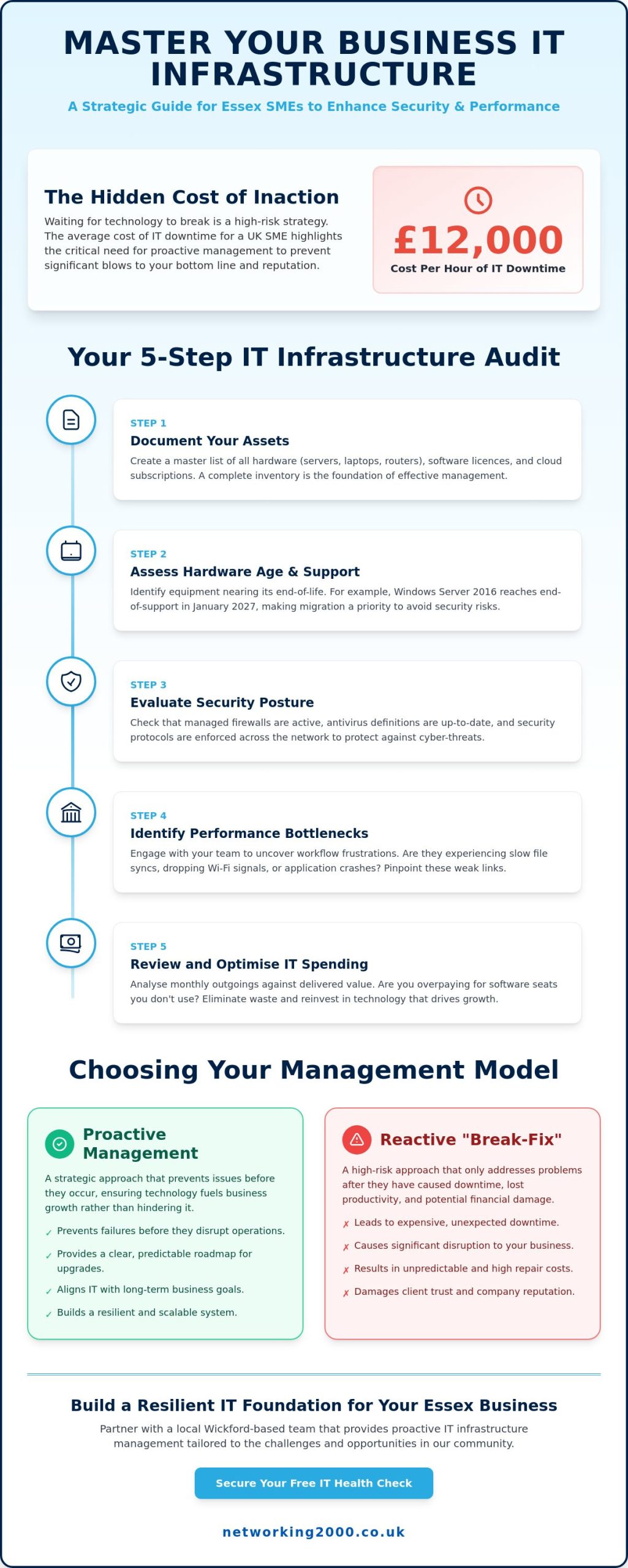
Waiting for technology to break before fixing it is a high-risk strategy that most SMEs can’t afford. Research from mid-2025 shows that the estimated cost of IT downtime for an SME is now around £12,000 per hour in lost productivity. This isn’t just a technical glitch; it’s a significant blow to your bottom line and your reputation. Proactive management identifies these risks before they disrupt your Wickford operations. By aligning your infrastructure with professional IT strategy services, you ensure your technology fuels growth rather than acting as a constant bottleneck. This approach provides a clear roadmap for upgrades, ensuring you aren’t surprised by sudden hardware failures or security vulnerabilities.
How to Audit Your IT Infrastructure: A 5-Step Guide
Before you can optimise your network, you need to know exactly what you’re working with. A thorough audit is the starting point for the professional IT infrastructure management Essex SMEs require to stay competitive. It isn’t just a tick-box exercise; it’s a deep dive into the health of your business technology. Following a structured process ensures you don’t miss hidden vulnerabilities that could lead to system failure or data breaches.
- Step 1: Document your assets. Create a master list of every piece of hardware, from servers and laptops to routers and printers. Include all software licences and cloud subscriptions currently in use.
- Step 2: Assess hardware age. Identify equipment that is nearing the end of its life. For example, Windows Server 2016 reaches its end-of-support date in January 2027. If your audit reveals you’re still running this, it must be a priority for migration.
- Step 3: Evaluate security. Understanding how to audit your IT infrastructure involves checking if your managed firewalls are active and your antivirus signatures are current.
- Step 4: Identify bottlenecks. Talk to your team about their daily digital workflow. Are they waiting for files to sync or struggling with dropping Wi-Fi signals in specific areas of the office?
- Step 5: Review IT spending. Compare your monthly outgoings against the value delivered. Are you paying for 50 software seats when you only have 40 staff?
Identifying Your Infrastructure Weak Points
Shadow IT is a common risk for regional firms. This occurs when staff use unauthorised apps, such as personal cloud storage or unapproved messaging tools, because the official systems feel too slow or restrictive. Your audit should uncover these habits before they create a security gap. You should also test your connectivity against your actual needs. Many Essex business parks suffer from inconsistent speeds; if your infrastructure doesn’t account for local bandwidth limitations, your productivity will suffer. If you’re unsure where to start, our team at Networking2000 can help you map out your current environment.
The Role of IT Consultancy in the Audit Process
It’s often difficult to mark your own homework. An external perspective is vital for an unbiased review because it’s easy to grow used to “workarounds” for broken processes. This is where IT consultancy in Wickford provides the most value. A specialist team can identify hidden risks that an internal manager might overlook. Following the audit, you’ll receive a prioritised action list. This allows you to tackle critical security updates and performance issues first, ensuring your budget is spent where it will have the most immediate impact on your stability.
Essential Pillars of Modern IT Infrastructure in Essex
Once you’ve completed your audit, it’s time to reinforce the foundations. Modern IT infrastructure management Essex SMEs depend on is built upon four essential pillars: connectivity, security, communication, and scalability. These components must work in perfect synchronisation to provide a stable platform for your business operations. If one pillar fails, the others will inevitably struggle to take the strain. Building a resilient system means looking beyond the immediate needs of today and preparing for the demands of tomorrow.
High-speed fibre is no longer optional. You need a connection that handles high-bandwidth tasks like video conferencing and cloud backups simultaneously without slowing down your team’s access to critical tools. Scalability is equally vital. Your infrastructure should be designed to grow alongside your business. Whether you’re adding five new staff members in Wickford or opening a second branch, your network must adapt without requiring a total overhaul. This involves choosing modular hardware and cloud-based services that can be expanded with a few clicks.
Network Security and Managed Firewalls
A standard ISP router is simply not enough to protect an Essex business in 2026. These consumer-grade devices lack the sophisticated threat detection needed to stop modern cyber-attacks. By implementing managed firewall Essex services, you gain a dedicated layer of protection. This includes continuous monitoring and endpoint protection as standard. Your firewall acts as a digital bouncer, screening every packet of data that enters your network whilst your team focuses on their core tasks. This proactive security model is essential for meeting the baseline technical standards required for Cyber Essentials certification.
Cloud Integration and VoIP Telephony
The shift towards hybrid work has made cloud integration a priority amongst Essex staff. Moving your files and applications to the cloud allows for seamless remote access, but it also changes how you communicate. Deciding between VoIP vs landline for business is a critical infrastructure decision. Legacy landlines are inflexible and costly to maintain. Modern VoIP telephony solutions provide high-quality voice and video traffic over your internet connection. This ensures your team stays connected, whether they’re in the office or working from home, without the need for expensive hardware on-site. It also provides the flexibility to scale your phone system instantly as your headcount changes.
Choosing the Right Management Model: In-House vs Outsourced
Deciding how to deliver the IT infrastructure management Essex businesses need is a pivotal choice. It represents the difference between having a single person in the office and an entire department at your disposal. For many SMEs, the decision often comes down to cost versus capability. Whilst having an employee on-site feels reassuring, the financial and operational reality is often more complex than it first appears.
Hiring an in-house manager involves significant “hidden” costs. Beyond the base salary, you must account for National Insurance, pension contributions, and the high cost of ongoing training. Technology moves fast. If your internal hire isn’t constantly learning, your systems will soon fall behind. By contrast, an outsourced model spreads these costs across a wider team, giving you senior-level expertise for a fraction of the price of a full-time executive. This depth of expertise is difficult to replicate with a single hire.
When to Keep IT Management In-House
There are scenarios where a full-time, on-site presence is essential. If your operations involve highly specialised, proprietary hardware that requires constant physical adjustment, an internal hire makes sense. However, the Essex tech market is incredibly competitive. Recruitment and retention are constant challenges for smaller firms. There is also the “single point of failure” risk. If your only IT person is on holiday or leaves the company, your infrastructure is left vulnerable. Managing this risk requires a level of redundancy that most SMEs simply cannot afford to maintain internally.
The Advantages of Managed IT Support Services
The Managed Service Provider (MSP) model effectively eliminates the single point of failure. You gain access to a full team of specialists who understand everything from cyber security to cloud migrations. This collective knowledge far outweighs what a single individual can provide. Professional managed IT support services include proactive maintenance and 24/7 monitoring of your Wickford network. Problems are often fixed before your staff even notice them. This approach ensures your technology remains an asset rather than a distraction. If you want to see how this model fits your specific goals, you can view our managed IT solutions today.
Larger organisations in the region often adopt a hybrid model. This involves keeping a small internal team for day-to-day user support whilst outsourcing the complex, high-level infrastructure management to a local expert. This provides the best of both worlds: immediate on-site help and senior strategic oversight. Regardless of the size of your firm, the goal remains the same. You need a model that provides stability, security, and a clear path for future growth. For a deeper look at how local SMEs are benefiting from this approach, our managed IT support Wickford guide for SMEs in 2026 covers the full picture, from predictable costs to rapid on-site response times.
Partnering with a Local Expert: Networking2000 in Wickford
Choosing a partner for IT infrastructure management Essex can be a daunting task. You need more than just a technical provider; you need a “safe pair of hands” that understands the specific challenges of the regional business landscape. Being based in Wickford gives us a unique perspective. We know the local business parks, the connectivity limitations of certain areas, and the growth ambitions of Essex firms. This local insight allows us to provide a level of responsiveness that national competitors simply cannot match.
Our approach is grounded in simplicity. We strip away the confusing jargon that often surrounds business technology. Instead, we provide straightforward, practical advice that helps you make informed decisions. We believe that technology should be an invisible support system, allowing you to focus on your core operations without worrying about system stability or security breaches. Our team acts as an accessible, friendly guide through every stage of your digital journey.
Tailored Infrastructure Solutions for Wickford SMEs
Every business has unique requirements. We don’t believe in “one size fits all” technology. Since 1998, we’ve focused on delivering practical, reliable solutions that support the specific goals of our clients. Whether you need to overhaul your server room or secure your remote workforce, our experience ensures your network is optimised for peak performance. We’ve spent nearly three decades refining our processes to protect Essex firms from evolving threats whilst ensuring their systems remain fast and scalable.
This long-standing experience allows us to anticipate problems before they occur. We look at your entire ecosystem, from your VoIP telephony to your managed firewalls, ensuring every component is correctly configured. Our commitment is to provide a stable foundation that grows with you, backed by a team that is always just a phone call away.
Get Started with Your Infrastructure Transformation
The journey toward a better network begins with a local audit. Our expert technical team will visit your premises to assess your current setup and identify areas for improvement. This isn’t a high-pressure sales meeting; it’s a methodical review designed to give you a clear roadmap for the future. We analyse your hardware, software, and security protocols to ensure they meet modern standards and regulatory requirements, such as the Data (Use and Access) Act 2025.
Once we’ve identified the necessary upgrades, our transition process is designed for zero disruption. We organise your IT behind the scenes, migrating data and installing new systems whilst your team continues to work. Our goal is a seamless handover that leaves you with a faster, more secure, and more reliable infrastructure. If you’re ready to master your business technology, Contact Networking2000 for expert IT infrastructure management in Essex today.
Take Control of Your Business Technology Today
Your business deserves a digital foundation that empowers growth rather than causing constant frustration. By conducting regular audits and prioritising essential pillars like managed firewalls and VoIP telephony, you move away from the high costs of reactive fixes. Mastering IT infrastructure management Essex requires a strategic approach that balances reliability with regional expertise. This guide has shown that a stable network isn’t a matter of luck; it’s the result of methodical organisation and expert oversight.
Since 1998, we’ve served as local experts for Essex and London businesses from our base in Wickford. We specialise in managed firewalls and network security, providing the “safe pair of hands” your firm needs to navigate changing regulations and emerging threats. You don’t have to handle the complexities of your tech stack alone. Our team is here to ensure your technology remains a silent partner in your success, allowing you to focus on your core operations with absolute confidence.
Secure your business future with expert IT infrastructure management from Networking2000. We’re ready to help you build a stable, secure network that simply works.
Frequently Asked Questions
What is included in IT infrastructure management for a small Essex business?
It encompasses the total lifecycle of your technology. This includes tracking software licences, managing patch schedules, and ensuring all hardware remains under warranty. For a local firm, it’s about maintaining a complete, live inventory so you aren’t surprised by expired subscriptions or sudden hardware failures. It provides a structured way to keep your entire digital estate running at peak efficiency.
How much does IT infrastructure management cost in the UK for 2026?
UK costs in 2026 depend entirely on your specific operational needs. Factors that influence the price include your total user count, the volume of data you store, and the level of security compliance your industry requires. Most businesses find that a fixed monthly fee provides better financial predictability than paying for emergency repairs or the high overheads of an internal department.
Can I manage my own IT infrastructure if I have a small team in Wickford?
Whilst it is possible, managing your own IT often creates a significant knowledge gap. Technology certifications and compliance standards change rapidly. Small teams in Wickford often find that the time spent troubleshooting prevents them from focusing on revenue-generating activities. Partnering with a specialist ensures you have access to the latest expertise without the burden of constant self-training.
How often should a business audit its IT infrastructure?
A full audit is recommended annually, but quarterly reviews of security permissions are now considered best practice. You should also trigger a review if you shift to permanent remote work or if your industry faces new data laws. Regular checks ensure your IT infrastructure management Essex strategy evolves alongside your business and remains resilient against new types of cyber-threats.
What is the difference between IT support and IT infrastructure management?
Support is about fixing what is broken right now. Management is about the strategic oversight of the entire system. Think of support as a mechanic fixing a flat tyre, whilst management is the scheduled maintenance that ensures the car is safe and efficient for a long journey. Management looks at the “big picture” to prevent the breakdown from happening in the first place.
Is cloud-based infrastructure safer than having a physical server in my Essex office?
Cloud environments offer superior disaster recovery options compared to traditional on-site servers. If your Essex office suffers a power cut or flood, cloud-based data remains accessible to your team from any location. It removes the physical risk of hardware damage and provides automated backups that are often more reliable than manual on-site processes.
How does managed infrastructure help with cyber security and GDPR compliance?
Managed infrastructure provides the automated logging and monitoring required to prove compliance to regulators. With the Data (Use and Access) Act 2025 now in force, having a documented history of your security patches and access logs is essential. it moves security from a “best effort” basis to a verifiable business process that protects both your data and your reputation.
What happens if my IT infrastructure fails and I do not have a management plan?
Without a plan, you face extended recovery times and the very real possibility of permanent data loss. You’ll likely pay premium rates for emergency assistance, and your staff will be unable to work whilst you wait for a technician to arrive. A management plan establishes a clear recovery process, significantly reducing the impact on your bottom line during a crisis.

