The longest feature list won’t necessarily give your business the right phone system. The best business VoIP services are the ones that fit how your staff handle calls, support customers and work day to day.
It’s understandable to focus on call quality and worry about disruption when changing systems. But a business phone service can cover more than internet calls. It may include an internet-hosted telephone system, phone lines and calls, and phone system maintenance. These are distinct parts of a service, so it helps to decide what your organisation needs from each before comparing options.
This guide explains the components of business VoIP, then offers a practical framework for assessing users, call flows, existing equipment and support arrangements. You’ll also find steps to plan a smooth transition and keep staff and customers informed. Networking2000 provides internet-hosted telephone systems, lines and calls, and phone system maintenance for businesses across London, Essex and surrounding counties, including Wickford. With 19+ years’ experience, the team offers straightforward advice to help local organisations make a considered choice.
Key Takeaways
- Understand how the phone system, Lines & Calls and Phone System Maintenance serve different roles in a business VoIP service.
- Compare business voip services against your workflows, call patterns, locations and support needs, rather than relying on feature lists alone.
- Build a clear picture of your current telephony and connectivity before planning a change, then prepare staff for the transition.
- See how Networking2000 supports businesses across London, Essex and surrounding counties with hosted telephone systems and related services.
- Use the guide’s practical framework to clarify your requirements before taking the next step.
What do business VoIP services cover and why they matter?
Business VoIP carries voice calls over an internet connection. VoIP is the calling technology; a business service is the wider arrangement that helps an organisation use it. This can include the telephone system, lines and calls, and maintenance. Understanding the difference makes it easier to compare what’s provided and identify what your team needs.
Businesses consider internet-based calling as staff locations and working patterns change. An organisation might have people taking calls at one office, across several sites or from different locations over time. A business phone service brings the system and its ongoing support into the planning conversation, rather than treating the technology as a standalone purchase. The right scope depends on how your business communicates.
What is the difference between VoIP and a business phone service?
Voice over Internet Protocol (VoIP) describes the technology that carries calls over the internet. A business phone service puts that technology into an organisational context. For example, Networking2000 provides Internet Hosted Telephone Systems, alongside Lines & Calls and Phone System Maintenance. These are related but distinct considerations: the system handles business telephony, lines and calls relate to calling provision, and maintenance covers ongoing phone system upkeep.
Separating those parts helps avoid comparing unlike items. A list of system features alone won’t tell you how calling provision or maintenance fits your requirements. Consider each area in turn, then look at how the service as a whole supports your day-to-day communications.
Which businesses might consider business VoIP?
Small and medium-sized businesses reviewing how staff make and receive calls are a natural starting point. A small office may need to map its users and regular call patterns. A customer-facing team may want to understand how incoming and outgoing calls fit its work. A multi-site SME can consider how different locations and existing arrangements affect the system it needs.
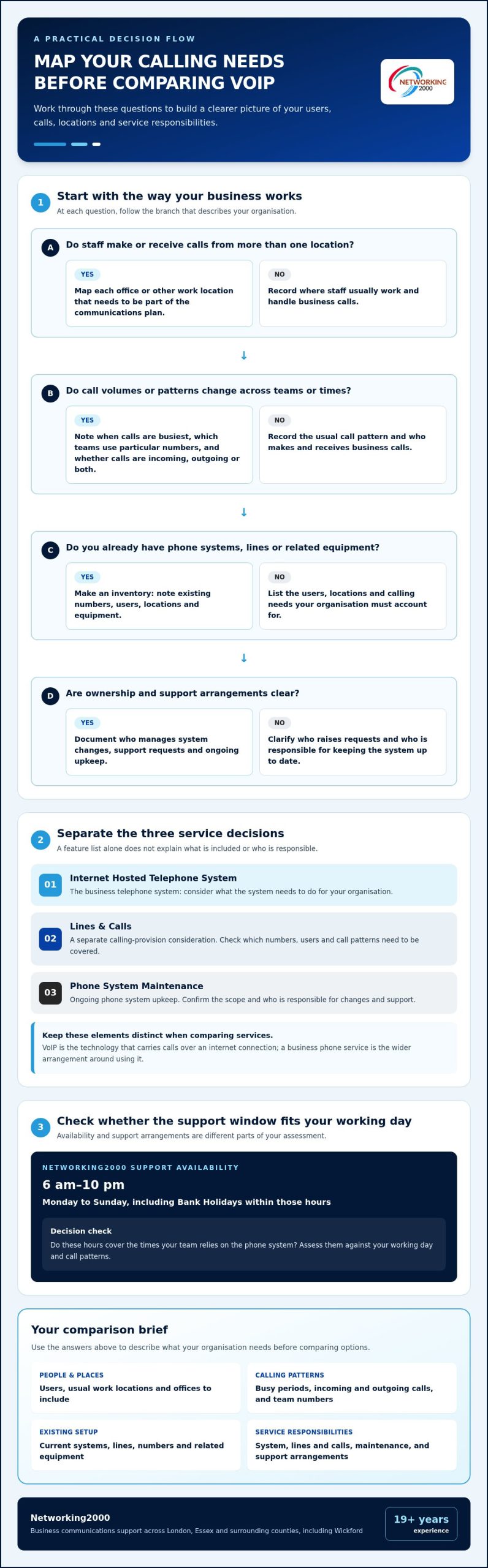
Start with practical details, not assumptions about what a particular technology will deliver:
- Users: Who makes and receives business calls, and where do they usually work?
- Call patterns: When are calls busiest, and are they mainly incoming, outgoing or both?
- Locations: Which offices or other work locations need to be part of the communications plan?
- Existing arrangements: What phone systems, lines and related equipment are already in place?
These answers help shape a sensible discussion about the service scope and any change. They also give you a useful basis for reviewing connectivity and preparing staff, without assuming every business needs the same setup.
Networking2000 supports businesses in London, Essex and surrounding counties, including Wickford, with Internet Hosted Telephone Systems, Lines & Calls and Phone System Maintenance. With 19+ years’ experience, its highly trained professional team can offer straightforward guidance as local SMEs assess their communications needs.
What should a business VoIP service include?
A useful comparison starts by separating the parts of the service. A telephone system, calling provision and ongoing maintenance are connected, but they answer different business needs. The features offered can vary, so a long feature list isn’t a substitute for understanding what’s included and who is responsible for each part.
Keep service availability and support arrangements separate in your assessment. Availability is about when the service can be used; support arrangements explain when help is available. Networking2000 support is available from 6 am to 10 pm Monday to Sunday, including Bank Holidays within those hours. Consider whether these hours fit your working day and the times your team relies on the phone system.
How do hosted telephone systems, lines and calls fit together?
An Internet Hosted Telephone System is the business telephone service. Lines & Calls is a separate communications service, rather than a feature to assume is automatically part of the system. Keeping these elements distinct helps you identify what your organisation already has and what it needs. Before comparing business voip services, record your existing numbers, who uses them, where calls are made and received, and the usual call patterns.
This inventory can reveal practical requirements that a feature checklist might miss. Note which numbers are used by particular teams or locations, for example, and whether call patterns change at certain times. You’ll then have a clearer basis for discussing the system and calling provision as separate parts of the overall arrangement.
What does phone system maintenance mean for a business?
Phone System Maintenance is another distinct service consideration. It concerns the upkeep of the phone system, while the precise work depends on the service scope. Write down how your business currently handles system changes and support requests, who raises them, and who is responsible for keeping the system up to date. This makes ownership clearer before planning a change.
Use a short checklist to define the scope you’re comparing:
- System: What telephone system does the business need?
- Lines and calls: Which numbers, users and calling patterns must be accounted for?
- Maintenance: Who will manage changes, support requests and system upkeep?
- Availability: What working hours does the business depend on?
- Support: What support hours and arrangements suit the people using the system?
- Features: Which capabilities are essential, and which are optional for your workflow?
Use the same checklist for each option, and note where the stated features or support arrangements match your requirements. That keeps the decision grounded in operational needs rather than attractive extras. Networking2000 provides Internet Hosted Telephone Systems, Lines & Calls and Phone System Maintenance for businesses across London, Essex and surrounding counties. Explore Networking2000’s business telephone services to see how these services fit together.
How can you compare business VoIP services for your organisation?
Compare each option against the way your organisation handles calls, not just the number of features on a page. Start with your own requirements, then record what each service description says about system scope, maintenance and support. This keeps published capabilities separate from assumptions about what your team needs.
Which business requirements should you compare first?
Build a simple record of the people and communications involved. Include current users, business numbers, typical call volumes and working locations. Note whether staff need the same approach to handling calls in the office and when working elsewhere. Also write down the support hours your organisation needs, based on when staff use the phone system and when a problem would affect work.
Then compare the requirements across different types of organisation. The table is a starting point, not a fixed rule: priorities depend on your call patterns and working arrangements.
| Business type | Requirements to assess | Service and support considerations |
|---|---|---|
| Small office | Number of users, business numbers and regular call patterns. | Define the system and calling provision needed, then compare maintenance arrangements and support hours with the office’s working day. |
| Customer-facing team | Incoming and outgoing call patterns, busy periods, team locations and how calls are handled across the working day. | Identify which published capabilities match the team’s workflow. Record essential needs separately from optional features. |
| Multi-site SME | Users and numbers at each location, differences in call patterns, and whether staff work across offices or remotely. | Compare the stated service scope and support arrangements against requirements at each site, rather than assuming one approach suits every location. |
How should you assess service and support fit?
Keep three comparison points distinct: the telephone system, Lines & Calls, and Phone System Maintenance. For each option, note the scope described for each area. Then record support hours as a separate criterion. A service feature and the hours when support is available answer different questions.
Networking2000 support is available from 6 am to 10 pm Monday to Sunday, including Bank Holidays within those hours. Compare this window with the times your business depends on its phone system. For a closer look at how the underlying connection differs, read this VoIP versus landline comparison guide.
Use a two-column comparison sheet: put your business requirements on one side and each service’s published scope on the other. Mark a capability as a match only when it’s clearly described, and keep internal needs, such as call volumes or preferred support hours, as your own assessment. This gives you a grounded way to compare business voip services without relying on rankings or assuming one setup fits every organisation.
How should you prepare your business for a VoIP service?
A phone system change is easier to plan when you understand what staff rely on today. Before discussing implementation, build a clear record of your telephony, call workflows and network arrangements. This gives your organisation a practical starting point for assessing business voip services and helps keep important calls in view during planning.
What information should you gather before changing phone systems?
Start with an inventory of business numbers, users and locations. Add a simple description of who handles each type of call, where calls are passed between teams, and which hand-offs commonly cause delays or confusion. Include differences between office-based and remote working, so your requirements reflect how staff actually communicate.
Record your current internet and network arrangements too. Note who looks after the network, any known constraints, and where you’d need advice before a change is planned. This information supports a practical discussion about readiness without assuming the network is suitable or unsuitable in advance.
How can you plan a smoother business changeover?
With the inventory in place, turn it into a changeover plan. Work through these steps in order:
- Identify critical calls. Note the calls that directly affect customers, operations or time-sensitive work, and mark them as priorities for continuity planning.
- Assign responsibilities. Decide who owns decisions, supplies information about users and numbers, and communicates updates to staff.
- Set staff expectations. Explain what is changing, when staff will receive updates and where they can find practical instructions for using the new arrangement.
- Record timing preferences. Identify busy periods, key business dates and suitable windows for change planning, so the proposed timing takes operational demands into account.
- Review connectivity. Document internet connections, network equipment and any known issues. This information can support a conversation about readiness without assuming the network is suitable or unsuitable in advance.
Keep the plan specific. For example, a business might note that a particular team handles important incoming calls during its busiest period, then identify who will coordinate communications with that team. This turns a broad concern about disruption into a defined planning requirement.
If your VoIP plans involve wider network or IT considerations, managed IT support for Essex businesses may be relevant. Networking2000 provides VoIP telephony alongside managed IT support, helping businesses consider communications in the context of their IT arrangements.
Once your requirements, responsibilities and priorities are written down, you’ll be better placed to plan the next steps. Read more about Networking2000’s business telephone services as you shape a plan for your organisation.
How Networking2000 supports business VoIP in Essex and London
For businesses reviewing business voip services, local understanding and the scope of communications support matter alongside the technology. Networking2000 works with businesses across London, Essex and surrounding counties, including Wickford, bringing 19+ years’ experience to business telephone requirements.
Its services cover three related but distinct areas: Internet Hosted Telephone Systems, Lines & Calls, and Phone System Maintenance. Keeping these separate helps you discuss what your organisation needs from its phone system, calling arrangements and ongoing upkeep, rather than treating them as one bundle of features.
Networking2000’s highly trained professional team and highly experienced IT engineers offer straightforward advice, helping businesses focus on practical requirements rather than unnecessary jargon. Support is available from 6 am to 10 pm Monday to Sunday and on Bank Holidays within those hours. This gives you clear information to compare with the times your organisation relies on its phone system.
What can local businesses expect from Networking2000?
Businesses can discuss their current setup and communications priorities with a team experienced in business IT and telephony. A useful conversation can cover how staff use the phone system, which numbers and locations are involved, and how Lines & Calls and Phone System Maintenance relate to the organisation’s needs. The aim is to keep the discussion grounded in your working arrangements, not assumptions about a standard setup.
Local context can also help when talking through the realities of a change, such as coordinating requirements across different offices or understanding how staff handle calls. Networking2000 serves London, Essex and surrounding counties, including Wickford, with support hours clearly stated so businesses can compare them with their operating day.
What is a sensible next step for a business?
Before discussing a change, gather a short outline of your current arrangements. It doesn’t need to be a technical document. Include:
- Users and locations: who needs the phone system and where they work.
- Current call handling: which numbers are used, how calls reach teams and where hand-offs happen.
- Service priorities: what matters most, such as maintenance arrangements, support hours or the way calls fit into daily work.
This gives Networking2000 a practical starting point for discussing your business communications requirements. You can explore the options without settling every technical detail in advance. A clear outline helps keep the conversation focused on what your people need and how the separate service elements fit together.
For a straightforward discussion about your organisation’s telephone requirements, read about business VoIP services from Networking2000.
Turn your requirements into a practical next step
Your phone system should support the way your organisation works now, while leaving room to review its needs as teams and working arrangements change. Treat your requirements as a useful working brief, not a one-off checklist. That makes it easier to keep future decisions focused on how staff and customers communicate.
Networking2000 brings 19+ years’ experience, a highly trained professional team and highly experienced IT engineers to business communications. Support is available from 6 am to 10 pm Monday to Sunday, including Bank Holidays within those hours. For organisations considering business voip services, straightforward advice can help turn operational priorities into a clear discussion about the right service scope.
You don’t need every technical detail settled before taking the next step. Share what your business needs from its communications and explore the options with a local team. Discuss business VoIP services with Networking2000 and move forward with a plan shaped around your organisation.
Frequently Asked Questions
Is business VoIP suitable for a small business?
Yes, business VoIP services can suit a small business that wants to make calls over an internet connection. A Wickford firm with a small team, for example, can begin by considering who answers the main business number and how calls are passed on when that person is unavailable. Use everyday scenarios like this to judge what the service needs to support. A long feature list alone won’t show whether it fits your working routine.
Can a business keep its existing phone number when switching to VoIP?
It may be possible, but number retention depends on the number, provider and arrangements for moving the service. Don’t assume every number transfers automatically or that the process is identical in every case. Record the numbers customers and suppliers use, then make continuity part of the changeover discussion. Once the transition arrangements are agreed, plan how staff will communicate any changes to customers and colleagues.
How much internet bandwidth does business VoIP need?
There isn’t one bandwidth figure that suits every business. The requirement depends on how many calls may happen at the same time, connection quality and other activity using the network, such as file transfers or video meetings. Review typical usage and connectivity across the working day, not just a single speed-test result. That result is a snapshot and can’t guarantee call quality or performance during busy periods.
What happens if the internet connection goes down during a VoIP call?
A call relying on an affected internet connection may be interrupted. Include this possibility in continuity planning: identify which calls are time-critical and agree how staff should communicate if the connection is unavailable. For example, a team handling urgent customer enquiries could have a clear internal process for updating colleagues. Discuss the relevant service arrangements during planning, rather than assuming a particular backup or failover feature is included.
Is business VoIP the same as a hosted telephone system?
Not exactly. VoIP refers to voice calls carried over an internet connection, while a hosted telephone system is a business service built around internet-based telephony. The terms are related, but the label doesn’t explain the full service scope. For a fair comparison, establish what the system covers, how maintenance is handled and what support arrangements apply. This helps distinguish the underlying calling technology from the service your organisation will use.
How much do business VoIP services cost?
Costs depend on the service scope and your organisation’s requirements, so a generic figure shouldn’t be treated as a quote. Networking2000 offers pay as you go and monthly maintenance options, but those descriptions don’t specify an amount. To make a useful enquiry, outline the users, locations and current call arrangements, then describe which service elements you need. That gives the discussion a practical basis without relying on an assumed price.
Can employees use a business VoIP system when working remotely?
Business VoIP can support communications across different working locations, but the setup depends on the service and its capabilities. Start by considering a real working pattern: for example, whether a colleague away from the office needs to handle the same business calls as they would on site. Identify the numbers and call workflows involved, then use those needs to shape the service discussion. Don’t assume an app, device or integration is included.

