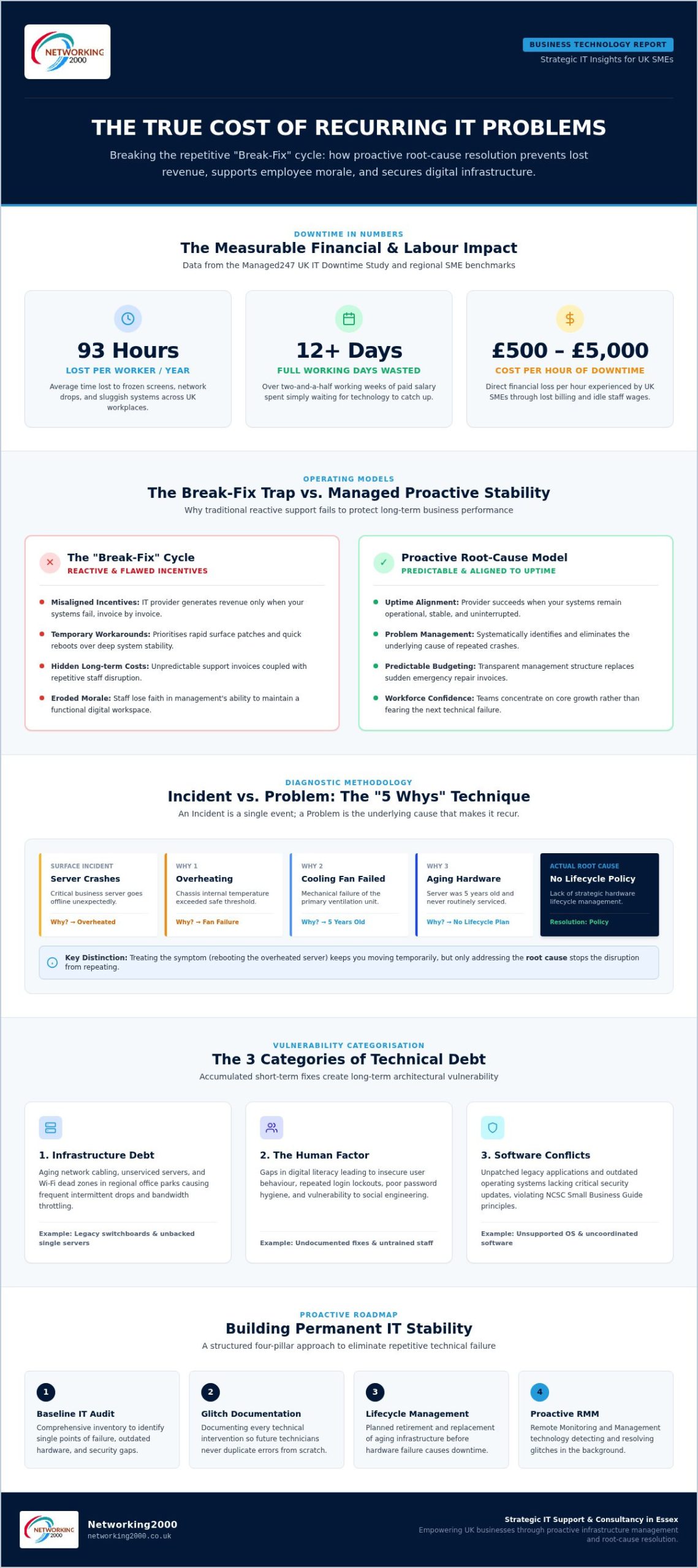
Did you know the average UK worker loses 93 hours every year to frozen screens, network drops, and slow systems? That is over 12 full working days wasted simply waiting for technology to catch up. For many Essex businesses, the struggle of getting rid of recurring IT problems feels like a losing battle against repetitive glitches and unexpected support invoices. You pay for a fix, the system works for a day, and then the same error message reappears. It is frustrating, expensive, and creates a constant sense of anxiety about your company’s daily reliability.
We understand that you want a stable environment where your tools actually support your growth rather than hindering it. This article promises to show you how to break the cycle of constant technical failures by moving away from reactive repairs and towards a permanent, proactive strategy. You will learn how to transition to a managed approach that prioritises root-cause resolution over quick, temporary patches. We will preview the essential steps to achieving predictable costs and a modernised infrastructure that finally just works, leaving your team free to focus on their core operations without the fear of the next crash.
Key Takeaways
- Understand why the “break-fix” cycle is a hidden drain on your budget and how to calculate the true cost of repetitive downtime for your staff.
- Master the “5 Whys” technique to distinguish between surface-level symptoms and the underlying infrastructure issues that cause them to return.
- Implement a permanent solution by getting rid of recurring IT problems through documented glitch tracking and strategic hardware lifecycle management.
- Explore how Remote Monitoring and Management (RMM) technology transitions your business from reactive firefighting to proactive, automated stability.
- Identify the essential qualities of a reliable Essex IT partner to help you build a modern, resilient digital environment that supports long-term growth.
The Hidden Costs of Recurring IT Problems in Your Business
Many firms fall into the “break-fix” trap. You have a problem, you call a technician, they “fix” it, and you pay an invoice. This model is fundamentally flawed for growing firms. It creates a cycle where your IT provider only makes money when things go wrong. For a business to thrive, incentives must align with uptime, not failure.
The financial impact is often higher than the invoice itself. According to the Managed247 UK IT Downtime Study, the average worker loses 93 hours per year to technical delays. That is over 12 working days of paid salary spent staring at a loading icon. For UK SMEs, unplanned downtime can cost between £500 and £5,000 per hour in lost billing and idle staff wages. Beyond the numbers, repetitive glitches erode employee morale. When staff can’t trust their tools, they lose faith in management’s ability to provide a functional workspace.
To break this cycle, you must understand the difference between an “incident” and a “problem”. An incident is a single event, like a crashed application. A problem is the underlying cause that makes that application crash every Tuesday morning. Getting rid of recurring IT problems requires a shift toward root cause analysis to stop the fire, not just the smoke.
Why “Fixed” Doesn’t Always Mean “Resolved”
Reactive support prioritises speed over long-term stability. A technician might apply a quick patch or reboot a router to get you back online, but these are often temporary workarounds. Over time, these “quick fixes” become permanent habits that mask deeper system instabilities. Problem Management is the strategic process of identifying and eliminating the source of these incidents to ensure they never return.
The Impact on Wickford SMEs
Local businesses in Wickford often struggle with limited in-house resources and aging hardware. Many commercial parks in Essex still rely on legacy infrastructure that is prone to bandwidth drops. In a competitive regional market, IT efficiency is a critical advantage. Partnering with a “safe pair of hands” is the first step toward getting rid of recurring IT problems for good. It replaces daily technical anxiety with a clear plan for modernisation.
Identifying Root Causes vs. Surface Symptoms
Getting rid of recurring IT problems starts with a change in perspective. If your staff frequently encounter login failures or slow network speeds, you aren’t just facing bad luck. You are likely dealing with a chain of events that leads back to a single, unresolved fault. Treating the surface symptom is like constantly topping up a leaky radiator without fixing the hole. It keeps you moving for a mile, but it never solves the actual crisis.
A reliable methodology for investigating these faults is the “5 Whys” technique. If a server crashes, ask why. If the answer is “it overheated”, ask why again. Perhaps the cooling fan failed because it was five years old and never serviced. By digging deeper, you find the root cause: a lack of proactive hardware lifecycle management. Poor documentation is another silent killer. When an engineer fixes a fault without recording the steps, the next person to face that issue has to start from scratch. This lack of shared knowledge ensures that the same mistakes are made twice, doubling your downtime costs.
Categorising Your Technical Debt
Technical debt refers to the cost of choosing an easy, short-term solution over a better approach that takes longer. This debt often falls into three categories. First is infrastructure, such as aging cabling or Wi-Fi dead zones that cause intermittent drops in your Wickford office. Second is the human factor, where a lack of digital literacy leads to insecure user behaviour. Finally, software conflicts arise from unpatched legacy systems that no longer receive security updates. Following the NCSC Small Business Guide helps you maintain software hygiene and backups to prevent these repetitive disruptions.
The Role of IT Audits
You cannot fix what you haven’t measured. A professional IT consultancy in Wickford is essential for establishing a baseline audit. This process identifies “single points of failure”, such as a lone server with no backup or a critical application running on an unsupported operating system. We turn these audit findings into a prioritised action plan, tackling the most critical risks first. If you are tired of temporary fixes, our managed IT support can provide the permanent stability your business needs.
5 Steps to Getting Rid of Recurring IT Problems for Good
Moving from a reactive “firefighting” mode to a stable environment requires a structured roadmap. You cannot expect different results if you continue to apply the same temporary fixes to the same aging systems. By following a methodical process, your business can transition toward a state of proactive problem management where glitches are caught before they disrupt your staff.
To begin getting rid of recurring IT problems, follow these five essential steps:
- Step 1: Document every recurring glitch to identify patterns and frequency.
- Step 2: Review your hardware lifecycle and replace any “end-of-life” kit that no longer receives manufacturer support.
- Step 3: Implement a centralised patching and update schedule to ensure all devices are secure and optimised.
- Step 4: Standardise your software environment across the entire team to eliminate compatibility conflicts.
- Step 5: Shift to a proactive monitoring model where your infrastructure is checked in real time.
Documentation and Standardisation
Success starts with visibility. We recommend creating a simple IT Incident Log for your staff to record every time a system hangs or a printer fails. This data allows you to spot trends that might otherwise go unnoticed. Beyond logging, you should aim to standardise your hardware brands. Using the same models across the team reduces driver issues and makes troubleshooting significantly faster. This standardisation should form part of a wider disaster recovery plan that ensures your Wickford business remains resilient against any major failure.
The Hardware Lifecycle Strategy
Many Essex firms fall into the trap of the “false economy”. They spend hundreds of pounds repairing a five-year-old workstation that is out of warranty. It’s often cheaper and more efficient to set a strict 3-5 year replacement cycle for all workstations and servers. Modern hardware isn’t just faster; it supports the latest security protocols and reduces the likelihood of hardware-related software crashes. By getting rid of recurring IT problems caused by failing components, you provide your team with a reliable platform that “just works” every morning. This proactive approach saves more in recovered productivity than it costs in hardware upgrades.
Proactive Monitoring vs. Reactive Support
Choosing between reactive support and proactive monitoring is the difference between surviving a crisis and preventing one. The traditional “break-fix” model is inherently reactive. You only interact with your IT provider when something stops working. This creates a volatile environment where productivity stalls whilst staff wait for technical fixes. In contrast, managed IT focuses on getting rid of recurring IT problems by maintaining the health of your systems around the clock.
Remote Monitoring and Management (RMM) tools are the backbone of this proactive approach. These systems track the health of your workstations and servers in real time. They flag issues like failing hard drives or memory exhaustion before they trigger a system crash. Often, our engineers perform “Silent Fixes”. These are background resolutions where a potential fault is cleared without the end-user ever knowing there was a risk. This ensures your operations remain fluid and uninterrupted.
Budgeting becomes significantly easier under a proactive model. Instead of facing volatile emergency repair bills that arrive without warning, you pay a predictable monthly fee. This transparency allows you to plan your business growth without the fear of a sudden, expensive technical failure. It shifts IT from an unpredictable expense to a controlled operational cost.
The Managed IT Advantage
A managed service provides more than just a helpdesk. It delivers continuous security updates and threat mitigation, ensuring your data remains protected against evolving cyber risks. You gain access to a full team of technical experts for a cost comparable to hiring a single junior staffer. This collective expertise is vital for getting rid of recurring IT problems that require specialised knowledge to resolve. Our Managed IT support services are designed to provide this level of comprehensive care for your infrastructure.
Why Local Support Matters in Essex
While much IT work can be done remotely, having a local partner in Essex offers distinct advantages. If a hardware fault requires an on-site visit, an engineer can be at your Wickford premises quickly. Building a relationship with a local “safe pair of hands” fosters a level of trust that national call centres cannot match. You support the regional economy whilst securing the future of your business with a partner who understands the local landscape. If you are ready to stabilise your infrastructure, contact our Wickford team today to discuss a proactive support plan.
Partnering for a Glitch-Free Future
Escaping the cycle of reactive chaos requires more than just a new set of tools. It requires a partnership built on trust and strategic planning. Transitioning to a managed model allows you to move from constant firefighting to a state of proactive stability. By getting rid of recurring IT problems, you reclaim the time needed to grow your company. You stop being an amateur technician and return to being a business leader.
When evaluating IT support companies in Essex, look for a partner that prioritises root-cause resolution. A “safe pair of hands” should offer more than just a helpdesk; they should provide a roadmap for your infrastructure. The first 90 days of a managed service are critical. This period focuses on stabilisation and optimisation. Your partner should spend this time clearing the technical debt and “quick fixes” that have accumulated over the years, ensuring your systems are resilient for the long term.
Setting Expectations with Your IT Partner
Clear communication is the foundation of a successful partnership. You should have a firm understanding of your Service Level Agreements (SLAs). These define how quickly your partner responds to different types of issues. However, a good partner goes beyond meeting response times. They conduct regular strategic reviews to ensure your technology scales alongside your business growth. IT should never be a bottleneck. It should be a flexible asset that supports your expansion into new markets or larger premises.
Taking the First Step
The journey toward getting rid of recurring IT problems starts with a clear baseline. We recommend booking an infrastructure health check to identify the “single points of failure” discussed earlier. This audit allows us to prioritise “quick wins”-small changes that deliver immediate relief to your staff. These might include optimising your Wi-Fi coverage or automating your security patches. Once the immediate pressure is off, we can focus on the long-term modernisation of your kit. Contact Networking2000 today for a practical audit of your systems and take the first step toward a stable, glitch-free future.
Build a Resilient IT Foundation for Your Business
Recurring technical glitches are more than just a nuisance; they are a direct drain on your company’s potential. By identifying root causes and moving away from the reactive “break-fix” cycle, you protect your staff’s productivity and your bottom line. Transitioning to a proactive model ensures that your technology serves your goals rather than standing in their way. It replaces daily technical anxiety with a clear, modernised strategy for growth.
Networking2000 has been serving Essex businesses since 1998. Our local Wickford-based support team provides the expert managed IT and security specialism required to stabilise your infrastructure. We focus on getting rid of recurring IT problems so you can focus on leading your business with confidence. We act as a “safe pair of hands”, ensuring your systems stay secure, updated, and efficient.
Don’t let aging hardware or repetitive errors slow you down any longer. Take the first step toward a smoother digital future today. Get a free IT health check from our Wickford experts and discover the peace of mind that comes with professional, reliable support. You deserve an IT environment that simply works.
Frequently Asked Questions
What is the main cause of recurring IT problems in small businesses?
The primary cause is often a reactive “break-fix” approach that treats symptoms rather than the underlying fault. When you only call for help after a crash, the technician prioritises speed to get you back online. This often leads to temporary workarounds rather than permanent resolutions. Other factors include aging infrastructure and a lack of centralised patch management, which leaves systems vulnerable to repetitive software errors.
How much does it cost to switch from break-fix to managed IT support?
Costs vary based on the number of users and the complexity of your network. Instead of unpredictable hourly rates for emergency repairs, managed support uses a predictable monthly fee. This model aligns the interests of the provider with your business, as they are incentivised to keep your systems stable. We recommend an initial audit to determine a package that provides the best value for your specific operational needs.
Can getting rid of recurring IT problems really improve staff productivity?
Absolutely. By getting rid of recurring IT problems, you eliminate the technical friction that stalls daily tasks. Research shows the average UK worker loses over 12 working days a year to system delays. Removing these interruptions allows your team to maintain focus and complete projects faster. A stable environment boosts morale, as staff no longer feel frustrated by tools that fail when they are needed most.
Is my business too small to benefit from proactive IT monitoring?
No business is too small for proactive care. In fact, smaller Wickford firms often feel the impact of downtime more acutely because they lack redundant systems. Proactive monitoring identifies potential hardware failures or security breaches before they cause a total shutdown. This level of protection is essential for maintaining a professional reputation and ensuring that your limited resources are focused on growth rather than troubleshooting.
What should I do if my current IT provider keeps fixing the same issue?
It’s time to ask for a permanent resolution or consider a new partner. If the same issue returns, your provider is likely treating the symptom rather than the cause. You should look for a specialist that uses getting rid of recurring IT problems as a performance metric. A managed service provider will use diagnostic tools to perform root cause analysis, ensuring that once a fault is fixed, it stays fixed.
How long does it take to stabilise a network with frequent glitches?
Most networks see significant improvement within the first 90 days. This initial period is dedicated to stabilisation and “clearing the decks” of legacy issues. We start by auditing your infrastructure, patching vulnerabilities, and documenting your setup. Once the “quick wins” are implemented, the frequency of tickets usually drops. This allows your business to move from a state of technical chaos to predictable, daily reliability.
Are recurring IT problems always caused by old hardware?
Hardware is a common culprit, but software and configuration issues are equally frequent. Unpatched applications, conflicting software versions, and poor Wi-Fi coverage can all cause repetitive glitches. Human factors, such as a lack of basic IT hygiene training, also play a role. A comprehensive audit looks at your entire digital environment, from your managed firewalls to your VoIP telephony, to identify every potential point of failure.

