Paying for IT support only when something breaks is often the most expensive way to run a London business. While the “break-fix” model feels like a saving, the reality usually involves unpredictable invoices and crippling downtime that costs far more than a monthly fee. If you’re trying to pin down managed IT support costs London providers are quoting for 2026, you’ve likely noticed a lack of transparency. Most firms hide their true rates behind complex jargon or “out of hours” surcharges that catch you off guard.
We understand the frustration of seeing your IT budget vanish into a black hole of hidden fees and slow response times. You need a partner who acts as a safe pair of hands, not a drain on your resources. This guide promises to strip away the mystery, offering a clear breakdown of what SMEs should expect to pay for reliable support this year. We’ll explore various pricing models, highlight the red flags of hidden charges, and show you how to calculate the actual return on your investment. By the end, you’ll have the clarity needed to organise a predictable monthly budget that keeps your systems secure and your team productive.
Key Takeaways
- Understand why proactive maintenance prevents the “break-fix” trap and allows for predictable monthly budgeting.
- Learn how to compare different pricing structures to find the most scalable way to manage your managed IT support costs London.
- Identify how your infrastructure complexity and security requirements, such as managed firewalls, directly influence your total monthly spend.
- Uncover common hidden extras, including onboarding and project fees, to ensure you aren’t surprised by the final invoice.
- Discover why partnering with a local specialist in Wickford provides London-level expertise without the central London price tag.
Understanding Managed IT Support Costs in London for 2026
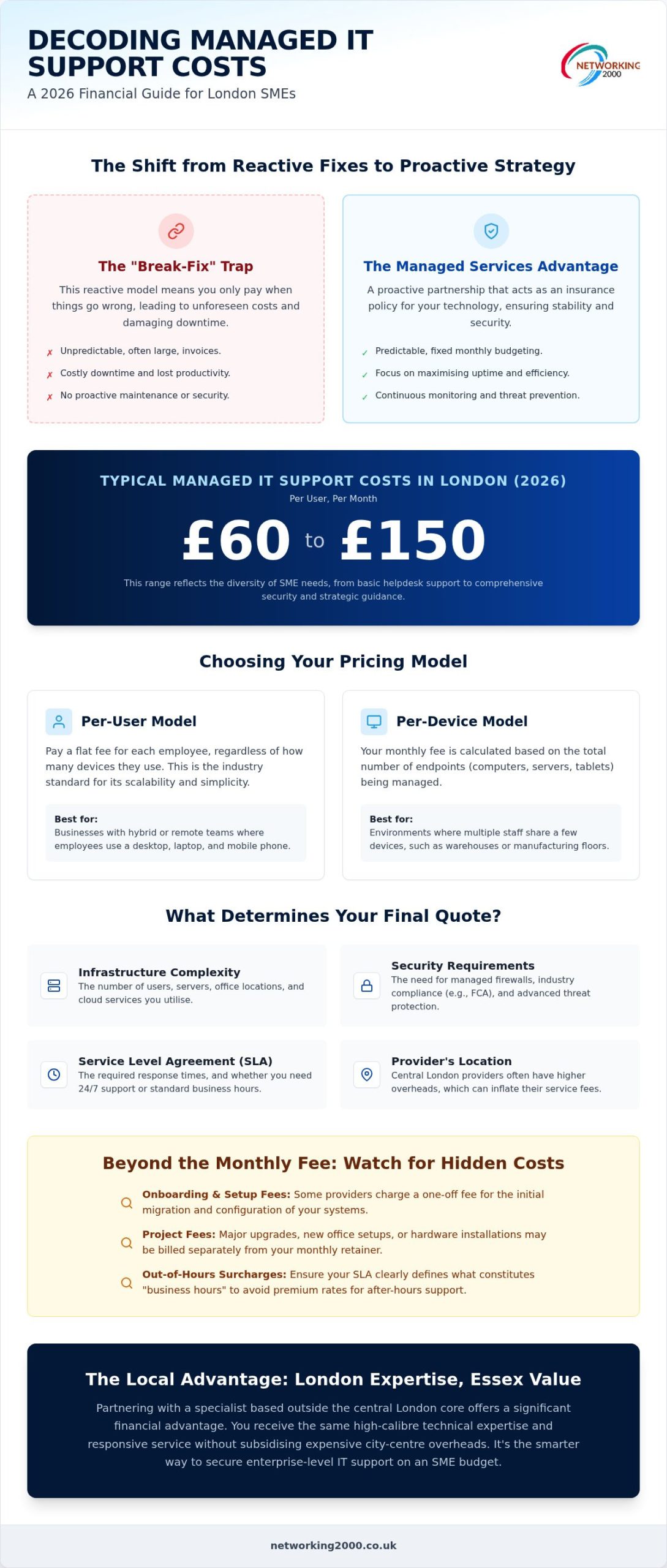
To accurately budget for the year ahead, you first need to understand what managed IT support means in a modern context. It isn’t just about fixing a laptop or resetting a password; it is a proactive partnership designed to keep your business operational. In 2026, the typical range for managed IT support costs London businesses encounter is between £60 and £150 per user, per month. This variation exists because every SME has unique requirements, from basic security to complex cloud infrastructure.
Networking2000 bridges the gap for firms that want premium technical skills without the central London price tag. By operating from our Wickford base, we provide the high-tier expertise expected in the City whilst maintaining the value of a regional partner. We focus on bespoke packages that ensure you only pay for the specific protections your business needs, such as managed firewalls and secure VoIP systems.
Why do London IT support costs vary so much?
Location drives pricing. Providers with offices in the West End or the City face massive overheads. These costs are inevitably passed to you through higher service fees. By contrast, a local veteran based in Essex can offer the same level of responsive care at a more competitive price point. You get the same technical skill sets without subsidising a central London rent.
Industry specialisation and service depth also move the needle. A firm requiring FCA-compliant security or deep strategic guidance will naturally sit at the higher end of the £60 to £150 bracket. Basic helpdesk support is affordable, but full vCIO (Virtual Chief Information Officer) services add a premium for long-term planning and infrastructure optimisation. It is about matching the service level to your specific business risks, and resources like reisinformatica.com can offer additional context on how technical systems integrate with business operations.
The shift from “Break-Fix” to Managed Services
The “break-fix” model is becoming obsolete for modern SMEs. Relying on pay-as-you-go IT leads to erratic invoices and long periods of downtime. When you only call for help after a crash, you’ve already lost money in lost productivity. A managed contract acts like an insurance policy for your digital infrastructure, providing stability and peace of mind.
Modern managed IT support services prioritise uptime above all else. We use proactive monitoring to identify and resolve threats before your staff even notice them. This approach turns IT from a reactive headache into a predictable, fixed monthly expense. It keeps your managed IT support costs London predictable and allows you to focus on your core operations whilst we handle the technical heavy lifting.
Common Pricing Models for London IT Support
Selecting the right billing structure is just as vital as the technical service itself. Most managed IT support costs London providers quote are built around three primary frameworks: per-user, per-device, or tiered service levels. Whilst some firms still offer ad-hoc “block hours” or pay-as-you-go models, these are becoming less popular. Modern businesses prefer the certainty of a fixed monthly fee over the risk of buying a 10-hour bundle that might run out during a critical system failure.
The per-user model is currently the industry standard for scalability. It allows your IT spend to grow or shrink exactly in line with your headcount. This is particularly useful for firms with a hybrid workforce where employees might use multiple gadgets. On the other hand, the per-device model can be beneficial for specific environments, such as warehouses or manufacturing hubs, where many terminals are shared by a small number of staff.
Per-User vs Per-Device: Which is cheaper?
The best choice depends entirely on your hardware-to-staff ratio. Imagine a 25-person firm where every employee has a desktop, a laptop, and a company smartphone. Under a per-device model, you would be paying for 75 separate endpoints. Switching to a per-user model means you only pay for 25 individuals, regardless of how many devices they use to access the network.
This model also simplifies mobile device management (MDM). As highlighted in official guidance on Cybersecurity for Small Business, protecting every endpoint is a non-negotiable requirement in 2026. Per-user pricing typically bundles this security across all of a user’s devices, making it far more transparent for monthly budgeting. It removes the need to track every individual tablet or handset added to the network.
Tiered SLAs and their impact on your bill
Your Service Level Agreement (SLA) is the most significant factor in your final bill. Tiered support packages, often labelled as Bronze, Silver, or Gold, define the speed of response you can expect. A Gold-tier contract might guarantee a one-hour response for critical server issues, whilst a Bronze tier might extend that to four hours. The faster the guarantee, the higher the cost, as the provider must maintain a larger pool of available engineers.
Be cautious when a provider promises “unlimited support.” You should always check the fine print for exclusions. Many “unlimited” contracts actually exclude on-site visits, hardware replacements, or major project work like office moves. When you evaluate a potential IT partner, compare their SLA commitments against your actual business needs. If your operations can’t survive a two-hour outage, paying for a premium response tier is a necessary investment rather than an optional extra.
Key Factors that Influence Your Monthly IT Spend
Whilst headcount is the starting point, the complexity of your infrastructure often dictates the final figure. A firm running legacy on-site servers will face higher managed IT support costs London rates than a business that has fully migrated to the cloud. Servers require physical maintenance, cooling, and complex backup routines that demand more engineering hours. Conversely, a cloud-first business shifts the focus toward identity management and data security, which can often be managed more efficiently.
The “Security Stack” is another major variable. In 2026, a basic antivirus is no longer sufficient to protect against evolving threats. Most reputable providers now bundle advanced Endpoint Detection and Response (EDR), encrypted backups, and multi-factor authentication (MFA) into their core fee. Compliance also plays a role. If your business must adhere to GDPR or Cyber Essentials standards, your provider will spend more time on auditing and reporting, which is reflected in your monthly spend.
Location affects the price of on-site support. Central London visits carry hidden costs, including congestion charges and significant travel time for engineers. This is where regional specialists provide a distinct advantage. By supporting firms in East London and Essex from our Wickford base, we can offer rapid on-site response without the heavy travel surcharges associated with central-city providers.
The role of Cyber Security in modern pricing
Cyber security is no longer an optional add-on. Essential services like managed firewall Essex solutions are now standard components of a robust IT contract. There is a clear price difference between entry-level antivirus and advanced EDR, which uses AI to hunt for threats in real-time. Whilst the latter costs more, it drastically reduces the long-term financial impact of a successful cyber-attack.
Cloud Infrastructure and Microsoft 365
Migrating to Microsoft 365 changes the support dynamic. The focus moves from fixing hardware to managing user identities and cloud licensing. It’s easy for cloud costs to spiral without proper oversight. Professional IT consultancy in Wickford helps you optimise these environments, ensuring you aren’t paying for licenses or storage you don’t actually use. This strategic approach ensures your cloud infrastructure remains lean and cost-effective.
Beyond the Monthly Fee: Hidden Costs and Long-term Value
Managed IT support costs London businesses pay often extend beyond the headline monthly fee. Whilst a per-user rate provides a clear baseline, you must also account for one-off setup costs and third-party licensing. Transparent providers will highlight these upfront; this ensures you aren’t hit with unexpected invoices for hardware procurement or domain renewals. Project fees are another factor. Tasks like office relocations or major server upgrades usually fall outside standard support contracts and are billed as separate, defined engagements.
The “cost of doing nothing” is perhaps the most significant hidden expense. Relying on emergency repairs rather than proactive care leads to higher long-term expenditure. When you invest in a managed service, you’re paying for the prevention of problems, not just the solution to them. This proactive stance creates long-term value by stabilising your technology and making your annual spend predictable. Similar logic applies to other business overheads; for instance, checking easy2switchuk.com can help you identify more competitive energy tariffs, further protecting your bottom line from unexpected market fluctuations.
What to expect during the Onboarding process
The first 30 days of a new partnership are the most intensive. During the audit phase, engineers document your entire network, map out security vulnerabilities, and resolve legacy issues that have been ignored for months. This clean start is essential. It prevents future billing spikes caused by recurring technical debt. Onboarding is the critical phase where an MSP aligns your technology with your business goals. By investing this time and effort early, we ensure your systems are stable and scalable from day one.
Reducing IT downtime for London SMEs
Downtime is a silent profit killer. For a firm in the City or Canary Wharf, a single day of lost productivity can cost thousands in billable hours and reputational damage. A robust disaster recovery plan included in your support package acts as your safety net. It ensures that even in the event of a major failure, your data is secure and your team can resume work quickly.
Proactive monitoring is the engine behind this reliability. Instead of waiting for a hard drive to fail or a network to crash, we identify the warning signs in advance. This allows for planned maintenance during quiet hours, completely bypassing the chaos of an emergency call-out. If you want to move away from reactive fixes and secure a predictable budget, you can request a tailored quote for your business today.
Why Partnering with a Local London and Essex MSP Makes Financial Sense
Finding the right partner often comes down to the “sweet spot” of location. You need City-level expertise, but you shouldn’t have to pay the premiums that central London firms charge. By choosing a provider based in Wickford, you avoid subsidising their expensive West End rents and high city-centre overheads. This allows for more competitive managed IT support costs London SMEs can actually afford whilst maintaining high-tier technical care and reactive response times.
Giant national MSPs often treat smaller firms as just another ticket number in a massive queue. We prefer a more personalised approach. Being a “big fish in a medium pond” means your business receives the dedicated attention it deserves from engineers who know your network inside out. We organise bespoke support packages that align with your specific operational goals. This ensures you aren’t forced into a rigid, one-size-fits-all contract that doesn’t fit your actual workflow or budget.
Bridging the gap between London and Essex
Location is a major logistical advantage. Our Wickford base allows us to reach firms in East London and Essex faster than many central providers who struggle with city-centre congestion. We have deep local knowledge of Essex business parks and the major London commercial districts, allowing us to provide rapid on-site support when remote fixes aren’t enough. This stability is backed by our history; we’ve been a reliable partner for regional businesses since our founding in 1998. It’s about being a “safe pair of hands” for your infrastructure, combining long-standing experience with local agility.
Logistics isn’t just about travel times; it’s about understanding the local business landscape. We know the specific challenges faced by firms operating between the capital and the home counties. This allows us to provide a level of responsiveness that national competitors simply can’t match. When you call us, you’re speaking to a local expert who is invested in your success, not a remote call centre halfway across the country.
The Networking2000 Approach: Practical and Professional
We don’t hide behind technical jargon or complex billing structures. Our team focuses on straightforward problem-solving that keeps your business moving. We offer a holistic support system that goes beyond basic helpdesk tasks. This includes integrated services like website design Essex firms rely on for growth, along with robust VoIP telephony and managed firewalls. By consolidating these services, you simplify your billing and ensure all your technology works in harmony.
Ready for a clearer picture of your IT spend? Contact Networking2000 for a transparent, no-obligation quote today and discover how we can stabilise your budget whilst securing your future.
Secure a Predictable Future for Your Business IT
Achieving a stable IT budget starts with moving away from the chaos of reactive repairs. By understanding the specific variables that drive managed IT support costs London providers charge, you can avoid the “break-fix” trap and focus on your core operations. The most successful partnerships are built on proactive maintenance, robust security measures like managed firewalls, and a clear SLA that respects your time. A well-organised onboarding phase ensures your technology is aligned with your business goals from the very first day.
Networking2000 has been a “safe pair of hands” for businesses across London and Essex since 1998. We provide jargon-free, scannable support plans tailored to your specific needs, bridging the gap between high-tier expertise and regional value. It’s time to stop worrying about unpredictable invoices and start enjoying the peace of mind that comes with professional care. Get a transparent Managed IT Support quote for your London business and take the first step toward a more reliable digital infrastructure. We look forward to helping your business thrive in 2026.
Frequently Asked Questions
How much does IT support cost per user in London in 2026?
Typical 2026 rates for managed IT support costs London businesses pay vary based on the level of security and infrastructure complexity required. As discussed, most SMEs fall into the £60 to £150 per user bracket. Your final price depends on whether you require advanced threat hunting or deep strategic consultancy. It’s best to request a bespoke quote to ensure the service level matches your actual business risks and specific user count.
What is usually included in a standard managed IT support contract?
A standard contract typically covers proactive network monitoring, helpdesk support for end-users, and patch management for your software. Most modern agreements also include essential security tools like managed firewalls and antivirus protection. You should also expect regular system health checks and basic data backup management. We recommend reviewing the service schedule carefully to ensure critical items like VoIP telephony support or website maintenance are included if your business relies on them.
Do London IT support companies charge extra for on-site visits?
Many providers in the capital do charge additional fees for on-site visits due to travel time and congestion charges. Some premium tiers include a set number of visits, whilst others bill them as separate call-out charges. Firms based outside the city centre, like those in Wickford, can often offer more competitive on-site rates for businesses in East London and Essex. Always clarify if travel costs and parking are bundled into your monthly fee.
Is it cheaper to have an in-house IT person or outsource to an MSP?
Outsourcing to a Managed Service Provider is generally 40% to 60% cheaper than hiring a full-time internal IT Manager. In the UK, a junior IT professional’s salary starts around £24,000, whilst a senior manager can command over £55,000. When you add national insurance, pensions, and training costs, an in-house team is a major investment. An MSP provides a whole team of experts for a fraction of the cost of one senior hire.
Are there hidden costs I should look out for in an IT support contract?
Look out for onboarding fees, which cover the initial audit and network documentation phase. These setup charges often influence the managed IT support costs London providers quote. Project-based work, such as office moves or hardware refreshes, is also typically billed outside the monthly fee. Other common extras include software licensing and domain renewals. A transparent provider will list these potential costs upfront so you aren’t surprised by an unexpected invoice.
How long do managed IT support contracts typically last in the UK?
Most managed IT support agreements in the UK run for 12, 24, or 36 months. Longer contracts often provide better price stability and protection against annual inflation. Some providers offer rolling monthly agreements, but these usually come at a higher premium because they lack long-term security. We suggest looking for a 12-month initial term. This gives you enough time to evaluate the partnership without being locked in for several years before trust is established.
Can I get a discount for a larger number of users?
Yes, economies of scale are common in the IT industry. As your user count increases, the per-user rate typically decreases because the provider can manage your systems more efficiently. For example, managing a firm with 50 users isn’t twice as time-consuming as managing one with 25. If your business is growing rapidly, ask your provider for a tiered pricing structure that rewards your expansion and keeps your long-term costs manageable.
What happens if I need support outside of standard business hours?
Standard support usually covers core business hours, typically 9:00 am to 5:00 pm. If your team works late or on weekends, you may need an out-of-hours add-on. Whilst we don’t offer 24/7 emergency call-outs as a standard service, many providers can tailor their coverage to suit your specific operating times. It’s vital to discuss your requirements early to avoid “out of hours” surcharges that can quickly inflate your monthly IT spend.

