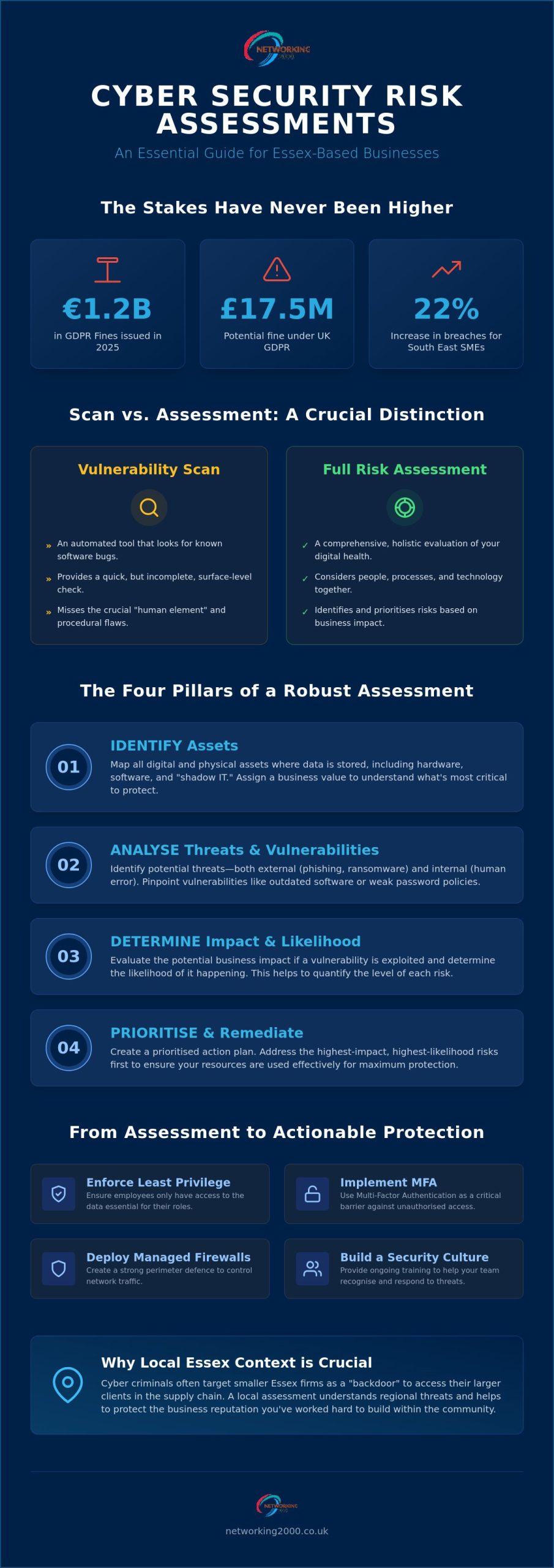
In 2025, regulators issued approximately €1.2 billion in GDPR fines; a stark reminder that “it won’t happen to us” is no longer a viable business strategy. For local business owners, conducting a thorough cyber security risk assessment Essex is the first step in moving from uncertainty to total control. You’ve likely felt the pressure of shifting regulations like the UK Cyber Security and Resilience Bill. It’s easy to feel overwhelmed by technical jargon or the constant worry that a single oversight could result in a fine of up to £17.5 million.
We understand that you want to focus on your core operations, not get lost in complex security manuals. This guide will show you how to identify vulnerabilities and prioritise threats without the headache. You’ll learn to secure your Essex-based business using a structured, common-size approach that delivers a clear roadmap for protection. We’ll walk through exactly how to build a prioritised list of risks, ensuring you stay compliant with industry standards while keeping your data safe and your reputation intact.
Key Takeaways
- Understand why Essex SMEs are increasingly targeted by ransomware and how a structured assessment helps you stay ahead of sophisticated threats.
- Learn how to perform a cyber security risk assessment Essex to categorise your digital assets and identify specific vulnerabilities within your infrastructure.
- Discover practical steps for a preliminary audit, including reviewing multi-factor authentication and enforcing the principle of least privilege.
- Transform your findings into a robust remediation plan that prioritises high-impact risks and implements essential technical controls like managed firewalls.
- Gain a clear roadmap for meeting 2026 regulatory standards while ensuring your business remains resilient against both internal errors and external hackers.
What is a Cyber Security Risk Assessment for Essex Businesses?
A cyber security risk assessment Essex is more than a simple checklist; it’s a comprehensive evaluation of your business’s digital health. Think of it as a thorough health check that looks beyond the obvious symptoms to find underlying issues. By using a formal IT risk management framework, you can identify exactly where your data is stored, who has access to it, and how it might be compromised. This process isn’t just for global corporations. In 2026, small and medium-sized enterprises in the South East are facing a 22% increase in reported data breaches compared to previous years, according to recent industry data.
Hackers often target Essex businesses because they assume local firms lack the robust defences of London-based giants. We see sophisticated phishing campaigns and ransomware attacks specifically designed to trick busy staff. A proactive cyber security risk assessment Essex identifies these weak points before a criminal does. It also ensures you stay on the right side of the law. With UK GDPR fines reaching up to £17.5 million or 4% of global turnover, the cost of ignorance is simply too high. Identifying these risks early prevents costly downtime and protects the local reputation you’ve worked hard to build.
The Difference Between a Scan and an Assessment
Many business owners mistake an automated vulnerability scan for a full assessment. A scan is useful; it’s a quick tool that looks for known software bugs. However, it misses the human element. An assessment looks at employee behaviour, physical security in your Wickford office, and how your team handles sensitive information. It provides a holistic view of your security posture that no automated tool can replicate. This depth is essential for prioritising your budget on the threats that actually matter.
Why Local Context Matters for Wickford Firms
Local context is vital because of how modern supply chains work. Cyber criminals often use smaller Essex firms as “backdoors” to gain access to larger clients. If you’re a supplier for a major regional project, your security isn’t just your problem; it’s a requirement for your partners. Working with a local partner who has been part of the Essex business community since 1998 means you get advice rooted in real-world experience. We help you build a culture of security amongst your local workforce, ensuring every team member knows how to spot a threat whilst it’s still outside your network.
The Core Components of a Robust Risk Assessment
A robust cyber security risk assessment Essex isn’t a one-size-fits-all document. It’s a living strategy that evolves alongside your business. You need to look at every corner of your organisation to understand where the real dangers lie. We break this down into four essential pillars: identification, analysis, determination, and prioritisation. By following this structured approach, you can move from a reactive “firefighting” mode to a proactive stance that protects your bottom line.
Asset Identification and Valuation
Start by mapping your data. Where is your sensitive information stored? It’s often in places you haven’t considered, like personal tablets or unmanaged cloud storage. This “shadow IT” is a major blind spot for many Wickford firms. You must inventory your hardware too; every laptop and server is a potential entry point. Assigning a “business value” to these assets helps you decide where to spend your security budget first for maximum impact.
Threat and Vulnerability Analysis
Once you know what you’re protecting, you need to know who you’re protecting it from. External threats like phishing are common, but internal errors often cause more damage. According to FTC cybersecurity guidance, understanding specific industry risks is vital. Determine the likelihood of a threat and the impact on your daily operations. High-impact, high-likelihood risks must stay at the top of your list to ensure business continuity.
Conducting a cyber security risk assessment Essex allows you to see these vulnerabilities before they are exploited by criminals. You might discover that your remote workers are using unsecured Wi-Fi or that your password policies haven’t been updated in years. These are the “low-hanging fruit” that hackers love to target. Determining the potential impact of each risk helps you allocate resources effectively, ensuring your most critical business functions remain shielded at all times.
Prioritising vulnerabilities isn’t just about technical fixes. It’s about making smart business decisions. If you find the process of mapping your digital landscape complex, our team provides tailored IT security services to help you categorise your assets and identify your most pressing threats with confidence. We act as a seasoned partner, giving you the clarity needed to secure your infrastructure without unnecessary complexity.
How to Conduct a Preliminary Cyber Security Audit
Start your cyber security risk assessment Essex by looking at your digital front door: your login credentials. A preliminary audit doesn’t require a degree in computer science; it requires a methodical approach to your daily operations. Begin by reviewing your current password policies. If your team still uses “Password123” or shares logins for administrative accounts, you’re leaving the door wide open. Implementing multi-factor authentication (MFA) across all platforms is the single most effective way to block unauthorised access.
Next, audit your user access levels. Many businesses suffer from “permission creep”, where employees retain access to files they no longer need for their roles. Enforce the “principle of least privilege” by ensuring staff only have access to the specific data required to do their jobs. This limits the damage if an individual account is ever compromised. You should also check your patch management. In 2026, software vulnerabilities are exploited faster than ever. Ensure every device in your network is running the latest updates and that security patches are applied within days of release.
Finally, evaluate your backup and recovery procedures. A backup is only useful if it actually works when you need it. Test your recovery process to see how long it takes to get your systems back online. Document every finding during this audit. This creates a baseline that allows you to measure your progress and proves to stakeholders that you’re taking proactive steps to secure the business. For more practical tips on starting this process, the SBA cybersecurity guide offers excellent resources for smaller firms.
The DIY Security Checklist
Focus on quick wins to build momentum. Disable unused accounts from former employees immediately and update default credentials on all hardware, especially routers and printers. You can also test your team’s awareness with a mock phishing exercise to see who clicks on suspicious links. Don’t forget physical security; check who has access to your server room or office centre. A misplaced USB stick or an unlocked cabinet can be just as dangerous as a remote hacker.
When to Call in the Professionals
Internal audits are a great start, but they often suffer from the “blind spot” problem. You might miss subtle configuration errors in your firewall or overlook vulnerabilities in your cloud setup. As Essex SMEs grow, their infrastructure becomes more complex, requiring a deeper level of technical scrutiny. A professional cyber security risk assessment Essex provides the expert oversight needed to catch these hidden risks. It also creates a clear roadmap for managed IT support services, ensuring your long-term security strategy is both scalable and resilient.
Turning Assessment Findings into Actionable Protection
Once your cyber security risk assessment Essex is complete, you’ll likely have a long list of vulnerabilities. Don’t let this document sit on a shelf. You must develop a remediation plan that prioritises high-priority risks first. These are the “red flag” items that could stop your business in its tracks. Start by implementing technical controls like endpoint protection and robust encryption for all sensitive data. This ensures that even if a device is lost or stolen, your information remains unreadable to unauthorised parties.
Human error remains a major vulnerability for most firms. Organise regular training sessions to keep security at the front of your team’s mind. You can’t expect staff to remember a single briefing from three years ago. Security is a continuous cycle, not a one-off event. New threats emerge daily, so your monitoring must be constant. If you find the implementation phase daunting, we can help you build a secure infrastructure through our tailored IT security services, giving you the peace of mind that your defences are professionally managed.
Strengthening the Perimeter with Firewalls
A managed firewall in Essex serves as your digital bouncer. It’s your first line of defence against external hackers. We configure specific protocols to block malicious traffic whilst allowing your team to access legitimate resources without delay. You must also perform regular firewall rule audits. Business needs change, and old, forgotten rules can often create new gaps in your network security that criminals are quick to exploit.
Integrating Disaster Recovery
Use your assessment data to inform a comprehensive disaster recovery plan. This ensures your business stays resilient if a breach occurs. You need to set realistic Recovery Time Objectives (RTOs) for your most critical systems. Ask yourself: how long can we survive without our main database? Ensure your backups are isolated from the main network. This “air-gapping” prevents ransomware from spreading to your safety net, allowing for a clean and rapid recovery.
Partnering with Networking2000 for Expert Security in Essex
Since 1998, Networking2000 has acted as a steady hand for SMEs across the region. Based in Wickford, we’ve spent decades building a reputation for reliability and practical expertise. We understand that as a business owner, you’ve got enough on your plate without worrying about the latest ransomware variant. That’s why we position ourselves as a “safe pair of hands” for your infrastructure. We don’t just point out problems; we provide the technical skill to fix them, ensuring your business remains resilient in an increasingly digital world.
A cyber security risk assessment Essex shouldn’t be a source of stress. We simplify the entire process for busy business owners by handling the technical heavy lifting. Our team identifies your vulnerabilities, categorises your assets, and builds a prioritised roadmap for protection. We take the findings from your audit and turn them into a robust remediation plan. This includes the implementation of managed firewalls and tailored security protocols that are designed to grow alongside your Essex-based company.
The Networking2000 Approach
We believe in straightforward, jargon-free advice that focuses on your business outcomes. You won’t find us hiding behind complex terminology or abstract concepts. Instead, we provide clear, actionable steps to secure your network. Our proactive monitoring identifies potential threats before they escalate into serious incidents. Because we’re a local veteran deeply integrated into the Essex community, we offer a personalised touch that national competitors often lack. We know your market, we know your challenges, and we know how to protect your local reputation.
Next Steps for Your Business
The best time to secure your network was yesterday; the second best time is today. Don’t wait for a breach to reveal the gaps in your defences. Book a consultation with our Wickford-based team to discuss your specific security concerns and current infrastructure. We’ll help you achieve compliance with UK GDPR and the Cyber Security and Resilience Bill, giving you the peace of mind to focus on growth. We’ll ensure your team is trained, your data is encrypted, and your backups are isolated from harm. Secure your future today with Networking2000.
Secure Your Essex Business for 2026 and Beyond
Cyber security is no longer a technical afterthought; it’s the foundation of your business resilience. You now have the roadmap to move from feeling overwhelmed by jargon to taking decisive action. By identifying your critical assets and addressing vulnerabilities through a structured cyber security risk assessment Essex, you protect your reputation and your bottom line. Remember that security is a continuous cycle of monitoring and improvement, not a one-off task.
This commitment to resilience often extends beyond the digital realm into everyday operational safety. To find out how digital tools can further enhance your organisation’s safety protocols, you can learn more about Be-Safe Technologies Ltd and their innovative EHS management platforms.
As specialists in SME security infrastructure based in Wickford, Networking2000 has been protecting Essex businesses since 1998. We provide the expert oversight needed to navigate complex regulations and evolving threats. Don’t leave your data to chance when you can have a seasoned partner by your side. Book your expert cyber security consultation with Networking2000 today. It’s time to gain the peace of mind that comes with professional protection, allowing you to focus on growing your business with confidence.
Frequently Asked Questions
How often should my Essex business conduct a cyber security risk assessment?
You should conduct a cyber security risk assessment Essex at least once a year or whenever your business undergoes a significant change. Major triggers include moving to new offices, adopting new cloud-based software, or shifting to a permanent hybrid working model. Regular reviews ensure your defences keep pace with evolving threats and changing operational requirements in the local market.
Is a cyber security risk assessment a legal requirement in the UK?
Yes, conducting a risk assessment is a core requirement under UK GDPR to ensure you’ve implemented appropriate technical and organisational measures. The 2026 UK Cyber Security and Resilience Bill also places stricter requirements on businesses within critical supply chains. Documenting your risks is essential for proving compliance and avoiding the maximum fines of £17.5 million for data breaches.
What is the difference between a risk assessment and a penetration test?
A risk assessment is a high-level strategic review that identifies and prioritises potential threats across your entire organisation, including human behaviour and physical security. A penetration test is a controlled, simulated attack on a specific system to find technical exploits. Think of the assessment as a comprehensive building survey and the penetration test as testing the physical strength of the locks.
How much does a professional cyber security risk assessment cost for an SME?
The cost of a professional assessment varies based on your organisation’s size, the complexity of your network, and the volume of sensitive data you handle. Most providers offer tailored quotes rather than fixed pricing to ensure the service matches your specific needs. Investing in a professional review is a proactive step that is significantly more cost-effective than the recovery expenses associated with a major ransomware attack.
Can I perform a cyber security risk assessment myself?
You can perform a preliminary audit using internal checklists, but a professional cyber security risk assessment Essex is recommended for a truly robust defence. Internal teams often overlook “blind spots” or common configuration errors in their own systems. A specialist partner provides an objective perspective and the technical expertise needed to identify sophisticated vulnerabilities that a DIY approach would likely miss.
What are the most common security risks for small businesses in Essex?
Phishing remains the most prevalent threat for local SMEs, followed closely by ransomware and credential theft. We’re also seeing a rise in supply chain attacks, where criminals target smaller firms to gain a “backdoor” into larger partners. Many of these incidents stem from weak password policies or the lack of multi-factor authentication on critical business accounts.
How long does a typical cyber security risk assessment take to complete?
A typical assessment for a small or medium-sized business usually takes between one and two weeks to complete from start to finish. This timeframe includes the initial data gathering phase, technical scans, and the delivery of a final remediation plan. Larger firms with multiple locations or highly complex cloud infrastructures may require a slightly longer engagement to ensure every asset is covered.
What documentation should I have ready before an assessment begins?
You should have an up-to-date asset register, your current IT security policies, and a basic map of your network infrastructure ready for review. It’s also helpful to provide a list of third-party vendors who have remote access to your systems. Having this documentation prepared allows the assessor to focus on identifying hidden risks rather than spending time hunting for basic operational information.

