Monday morning at a 25-person firm usually starts the same way. One manager has posted an update in WhatsApp, someone else has forwarded a half-read email, the office team never saw the change in the shared inbox, and the same question lands on three desks by 9.15. Nobody is lazy. The business is running internal communications on memory, habit, and hope.
That gets expensive fast. Poor communication does not just annoy people, it drives disengagement, rework, and lost time, which is why internal communications strategy belongs in management, not in admin. In UK terms, the scale is ugly. Disengagement costs the UK £52–£70 billion per year in lost productivity, while global benchmarking still shows 60% of companies have no long-term internal comms strategy and 37% of internal communications teams lack an annual plan.
Internal comms also sits in the same infrastructure conversation as your phones, email, shared drives, and secure messaging. If a message matters, it should go through the tools people already use every day, not a random channel someone checks once a week. Keep the system simple, make the owner clear, and stop pretending a busy inbox is a comms plan.
Table of Contents
- Why Most SMEs Run Internal Comms on Hope
- Audit Your Current Internal Communications
- Set Goals and KPIs an SME Can Actually Measure
- Choosing the Right Channel Mix for a Small Business
- Writing Messages People Will Actually Read
- Governance, Line Managers and Change Management
- Frontline Staff, AI Overload and Your 90-Day Plan
Why Most SMEs Run Internal Comms on Hope
The classic Monday failure is easy to spot. A founder sends one email about a new process, the ops lead mentions it in Teams, line managers pick up part of it in passing, and the warehouse or field team hears a second-hand version by lunchtime. By Friday, people are still asking the same question. The business has paid for the message three times and got it once.
That is an infrastructure problem as much as a people problem. If you do not decide which tool carries which message, every channel gets used for everything, and nobody trusts any of them. Email ends up doing the job of policy, chat becomes the place for decisions, and frontline staff are left guessing because the key update never reached the system they primarily use.
Practical rule: if a message matters enough to affect work, do not rely on one channel and do not rely on memory. Put it in the system, then repeat it in the tools people already use.
A proper internal communications strategy changes that. It turns comms from reactive posting into a managed process, with ownership, cadence, audience fit, and a clear way to check whether anything landed. That matters because internal communication is tied to productivity loss and disengagement, not just frustration in the office.
For small UK firms, the fix is blunt. Treat comms like part of your IT and operations stack. Map each message to the tool you already pay for, whether that is email, VoIP, an intranet, or secure messaging, and stop pretending one channel can do every job. If your team is already using studio-quality AI videos for external work, the same standard should apply internally when you need a message people will watch and understand.
That approach also stops the usual mess around change notices, policy updates, shift alerts, and business-wide announcements. Desk staff, frontline teams, and AI-overloaded managers do not need more noise. They need one clear source of truth, repeated in the right place, in plain English, by the right manager or system owner.
What follows is a working playbook, not a theory piece. Start with the audit if you do not know what is happening now. Go straight to goals and KPIs if the problem is vague reporting. Move to channel mix if your tools are a mess. If the issue is tone and clarity, fix the writing. If the business keeps falling apart when leaders change, focus on governance.
Audit Your Current Internal Communications
Don't start by asking what channel you need next. Start by listing what you already use, because most SMEs have more internal comms infrastructure than they realise. The problem is not lack of tools, it's lack of control over them.
Map the real channel stack
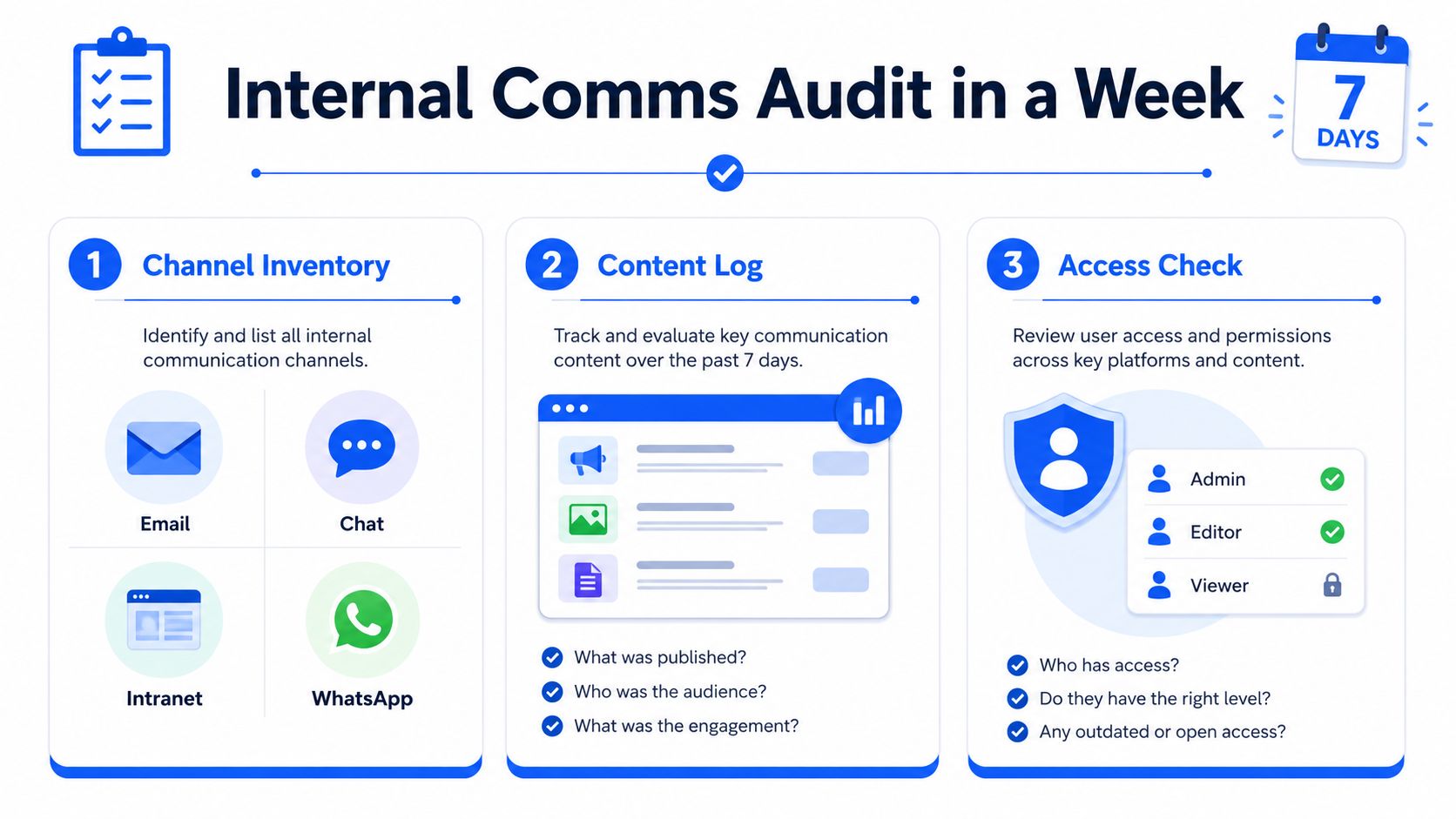
Pull every internal channel into one simple grid, even the messy ones. That means email, chat, WhatsApp groups, noticeboards, all-hands meetings, intranet pages, VoIP broadcasts, shared documents, and manager briefings. Then write down channel, owner, frequency, audience, and last review date beside each one.
That one page will expose the cracks fast. You'll usually find that desk-based staff get the same update in three places, while frontline staff get it in one place they rarely open. You'll also spot channels nobody owns, which is where shadow comms lives and where messages go to die.
Capture baseline data without turning it into a project
Keep the data light and honest. Use short pulse surveys, sample a few open and click rates if you already have them, and talk to managers about the questions they keep hearing. The point isn't perfect research, it's a usable baseline that tells you where information is getting lost.
A useful audit output answers three things. Who receives what. Who misses what. Which channels are duplicate noise. Once you know that, the next decisions get much easier.
If you can't explain how a message moves from sender to employee in under a minute, your internal comms setup is already too vague.
The audit also helps you spot where deskless or remote employees are being assumed into the process instead of being served by it. That gap is one of the most overlooked parts of internal comms planning, especially in SMEs where the same email-first habit gets copied everywhere (internal communications plan).
Set Goals and KPIs an SME Can Actually Measure
A good internal comms goal sounds like a business outcome, not a wish. “Improve communication” is useless. “Reduce repeat questions,” “improve policy understanding,” or “make rollout instructions easier to follow” gives you something you can measure and manage.
Separate output from outcome
Output is what you publish. Outcome is what changed because people saw it and acted on it. If you track only sends, posts, or meeting invites, you'll always look busy and still fail.
The better approach is to pick a small set of KPIs that connect to business reality. Monthly or quarterly review is enough for most SMEs, provided the same measures are used consistently. The relevant measures are the ones you can explain to a manager without turning the meeting into a dashboard demo.
A practical KPI set usually includes:
- Reach: Did the intended audience get the message?
- Engagement: Did they open, click, attend, or respond?
- Understanding: Did they say they understood what to do?
- Action: Did they complete the task, attend the meeting, or use the new process?
- Noise reduction: Did repeat questions or confusion go down?
Set the baseline before you raise the bar
If you want all-hands attendance higher, measure the current attendance pattern first. If the issue is service desk repetition, count the recurring questions before you change the message format. If the issue is policy uptake, track who read the update and who confirmed it.
That's how you keep the strategy alive. Quarterly review should reset priorities, retire dead channels, and tighten the message where needed. Don't let the KPI list grow. Three to five measures is enough for a small business.
The point is not to produce a prettier report. The point is to make internal communications a visible operating discipline. Once you can tie communication to better understanding, smoother change, or fewer repeated questions, leadership starts treating it like part of performance, not admin overhead.
Choosing the Right Channel Mix for a Small Business
Most SMEs don't need more channels. They need fewer, better-defined ones. If every announcement goes everywhere, people stop knowing where the truth lives, and that's when the business starts depending on the loudest person in the room.
Build a default stack and stop improvising
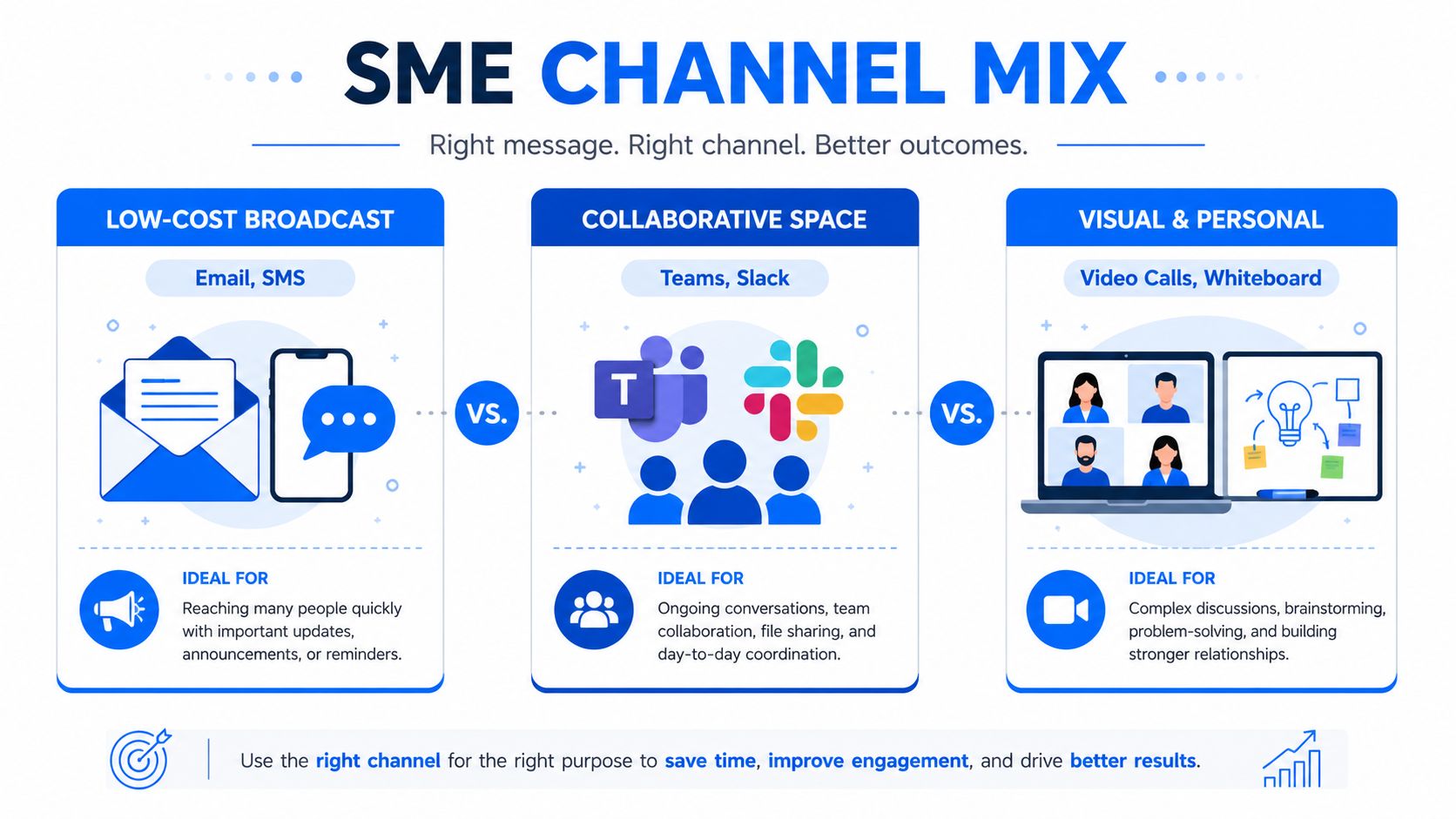
For most small businesses, the default stack should be straightforward. Use email for formal announcements and records, Teams or Slack-style chat for quick coordination, an intranet or shared hub as the single source of truth, and VoIP or phone broadcasts for urgent alerts or phone-based teams. Secure messaging has its place, but only when the content is sensitive or the audience can't be reached reliably by open tools.
That mix works because each tool has a job. Email is good for official wording and audit trail. Chat is good for back-and-forth. The intranet is good for policy, FAQs, and evergreen detail. VoIP is good when time matters and people won't be at a desk.
Choose by reach, fit, and ownership
The channel decision should be boring and defensible. Ask who needs to see it, who uses the tool, and who owns the record. If a channel has no owner, it becomes a dumping ground. If it has no audience fit, it becomes background noise.
| Channel | Best used for | Audience fit | Owner | Cost profile |
|---|---|---|---|---|
| Formal updates, policy, summaries | Desk-based and hybrid staff | Comms or ops lead | Usually already included in existing licences | |
| Teams or Slack-style chat | Fast clarification, reminders, discussion | Desk-based teams, managers | Team leads with comms rules | Usually already paid for if in use |
| Intranet or shared hub | Policies, FAQs, source of truth | Whole business, including managers | HR, IT, or comms owner | Moderate if already bundled |
| VoIP broadcast or phone tree | Urgent alerts, shift changes, service issues | Frontline, field, phone-based teams | Operations or IT | Tied to telephony setup |
| Noticeboards or printed briefings | Site updates, shift notices, safety points | Frontline and non-desk teams | Site managers | Low, but manual |
| Secure messaging app | Sensitive updates, targeted groups | Restricted audiences | IT and compliance | Varies by licensing |
Skip this: using WhatsApp for everything because it feels easy.
Do this instead: keep WhatsApp, if you use it at all, for tightly controlled use cases where governance is clear.
Keep shadow IT out of the middle
If people are building their own side channels, that's a governance failure. Name the owner for each channel, set the rules for what belongs there, and stop duplicating the same message across tools unless repetition is intentional. You want a clear map of channel, purpose, audience, owner that the whole business can follow.
You're not trying to make communication glamorous. You're trying to make it reliable.
Writing Messages People Will Actually Read
People don't read internal messages from top to bottom unless the issue affects them directly. The safer assumption is that they scan, decide fast, and move on. That's why message design matters more than clever wording.
Write for scanning, not admiration
Axios cites University of Maryland research showing that 60% to 80% of people only scan rather than read internal messages (communication strategies that keep teams aligned). That means your subject line, first two lines, and headings carry the load. If the action is buried in a wall of text, don't blame the audience when they miss it.
Use this order every time:
- Headline: what this is about in plain English.
- What's changing: the actual update.
- Why it matters: the business or team reason.
- What to do: one clear action.
- Who to ask: the contact point for questions.
Keep the body short, use bullets for details, and repeat the action in more than one place if needed. That's not overkill, it's how people who skim still catch the point.
Use cadence to reinforce, not nag
One message is rarely enough. Send the main update, follow with a manager briefing or team huddle note, then close the loop with a reminder or summary. Two or three touches is usually plenty for a small business, especially when the message has practical impact.
Here's the rule I'd use in a 20 to 100 person firm. If the message is important but routine, keep it short and repeat it once. If it's a change that affects behaviour, brief managers first, then send the employee message, then follow up with a reminder in the same channel where work happens.
Practical rule: the shorter the attention span, the more disciplined the structure has to be.
A simple template helps with speed and consistency:
| Field | What to include |
|---|---|
| Headline | Plain-English summary |
| What's changing | The actual update |
| Why it matters | The reason behind it |
| What you need to do | One action only |
| By when | Deadline if there is one |
| Help | Named contact or link |
The point is to reduce friction. If the message takes effort to decode, people will do something else first.
Governance, Line Managers and Change Management
A strategy without ownership dies the moment the founder gets busy or the comms lead leaves. That's why governance matters more than polish. Someone has to own the playbook, keep it current, and say no when another low-value channel is about to be added.
Keep governance light and real
Use a named owner, a small steering group, and a monthly review meeting. That's enough for most SMEs. The owner keeps the system moving. The steering group clears blockers. The monthly review checks what worked, what didn't, and what needs to stop.
Line managers sit in the middle, and that role is essential. They turn broad messages into local reality, which is why they need briefing notes, talking points, and a way to send questions back up. If managers are left to improvise, the message mutates before it reaches the team.
Treat change as a rollout, not a one-off announcement
For changes like a new VoIP system or intranet, use a four-phase pattern, announce, train, support, reinforce. First, tell people what's changing and why. Then train them in the actual workflow. After that, support them while they try it. Finally, reinforce the new habit through reminders, manager talk tracks, and visible use by leaders.
A clear goal framework helps. The best leaders don't just say what's changing, they set the direction so people understand how it fits the business. If you want a good reference point for that style of clarity, The OKR Hub's leaders' playbook for goal clarity is a useful companion.
Give managers a toolkit, not a lecture
A manager toolkit should be short enough to use. Include a briefing note, three talking points, one FAQ, and a single place for follow-up questions. Don't bury managers under long PDFs they'll never open.
Resilience is the true test. If the business restructures, the owner changes, or a new system lands, the comms process should keep moving. That only happens when the strategy is documented, the managers know their part, and the review cycle is fixed.
Frontline Staff, AI Overload and Your 90-Day Plan
If your people already live in email, Teams, policy updates, and tool notifications, another broadcast channel just gives them one more thing to ignore. More channels do not fix overload, they spread it faster. The right move is to map each message to the tool people already use, then cut anything that does not earn its place.
Reach people who don't sit at a desk
Frontline teams need a delivery model that fits how they work. Use manager cascades, printed briefings, secure messaging where appropriate, VoIP alerts for urgent updates, and QR-linked intranet pages for shared devices. Email is fine for some people, but it is not a universal reach tool. An intranet login also means little if staff are on a shift, away from a desk, or moving between locations.
This is an IT infrastructure problem as much as a communications one. If the business already pays for email, VoIP, an intranet, and secure messaging, those tools should carry the load in a deliberate way. Tie each channel to a clear purpose. Use one for routine updates, one for urgent alerts, and one for reference material, then stop sending the same message through all three.
AI makes overload worse if you let it. A tool that makes messages faster to produce will tempt leaders to send more of them, and that is the wrong habit. Use AI to simplify wording, target the right group, or cut admin. If it just creates more noise, leave it out.
A practical 90-day starter plan
In the first two weeks, audit the channels and audiences. In weeks three and four, set the goals and KPIs. In weeks five to eight, tighten the channel mix and roll out the message templates. In weeks nine to twelve, measure the result, adjust the mix, and lock in governance.
A few simple FAQs usually come up at this point:
- Do we need every channel? No. Keep the ones that reach people reliably and retire the rest.
- What if frontline staff don't check email? Don't build the plan around email.
- Should we add AI to internal comms now? Only if it helps you simplify, target, or measure better. If it adds noise, skip it.
- How often should we review? Monthly for active campaigns, quarterly for the broader strategy.
The finish line is not a slick comms calendar. It is a business where people know where to look, managers know what to say, and leaders stop treating communication like a side task.
If you want help turning this into a comms setup that fits the way your business runs, talk to Networking2000. They work with UK businesses that need the IT, phone systems, connectivity, and secure infrastructure behind clear communication, not just another message in an inbox. If your current setup is part of the problem, visit Networking2000 and get practical support that matches the way your team really works.

