Did you know that on 31 January 2027, the traditional UK landline network will be switched off permanently? For many owners, finding a reliable cloud phone system for small business isn’t just a luxury; it’s a vital deadline. You’ve likely noticed your current line rental costs creeping up whilst the flexibility of your old hardware stays stuck in the past. It’s a common worry that moving to digital will be technically complex or disrupt your daily operations during the move.
We understand that you need a communication setup that just works. You want the professional polish of an auto-attendant and the freedom to take office calls on your mobile without a hefty price tag. This guide explains how to transition smoothly to VoIP to future-proof your company. We’ll break down the latest 2026 market trends, compare essential features for SMEs, and show you how to lower your monthly bills whilst staying connected from any location.
Key Takeaways
- Understand why the 2027 PSTN switch-off makes adopting a cloud phone system for small business an essential move for your company’s continuity.
- Learn how features like virtual receptionists and mobile integration can project a professional image whilst supporting a flexible, hybrid workforce.
- Compare the long-term cost savings of digital telephony against traditional line rental and discover how HD voice technology ensures crystal-clear reliability.
- Get a step-by-step approach to auditing your call volume and hardware needs to ensure your new system is perfectly scaled to your operations.
- See why a managed VoIP solution from a local expert provides better security and hands-on support than a standard DIY cloud subscription.
What is a Cloud Phone System and Why is it Essential in 2026?
A cloud phone system for small business is a modern communication platform that runs entirely over the internet. Instead of using the old copper wires found in a traditional business telephone system, it converts your voice into digital data packets. This technology, often called hosted VoIP, allows you to make and receive calls from any location with a web connection. It is the new standard for professional communication in the UK, offering a level of clarity and stability that analogue lines simply cannot match.
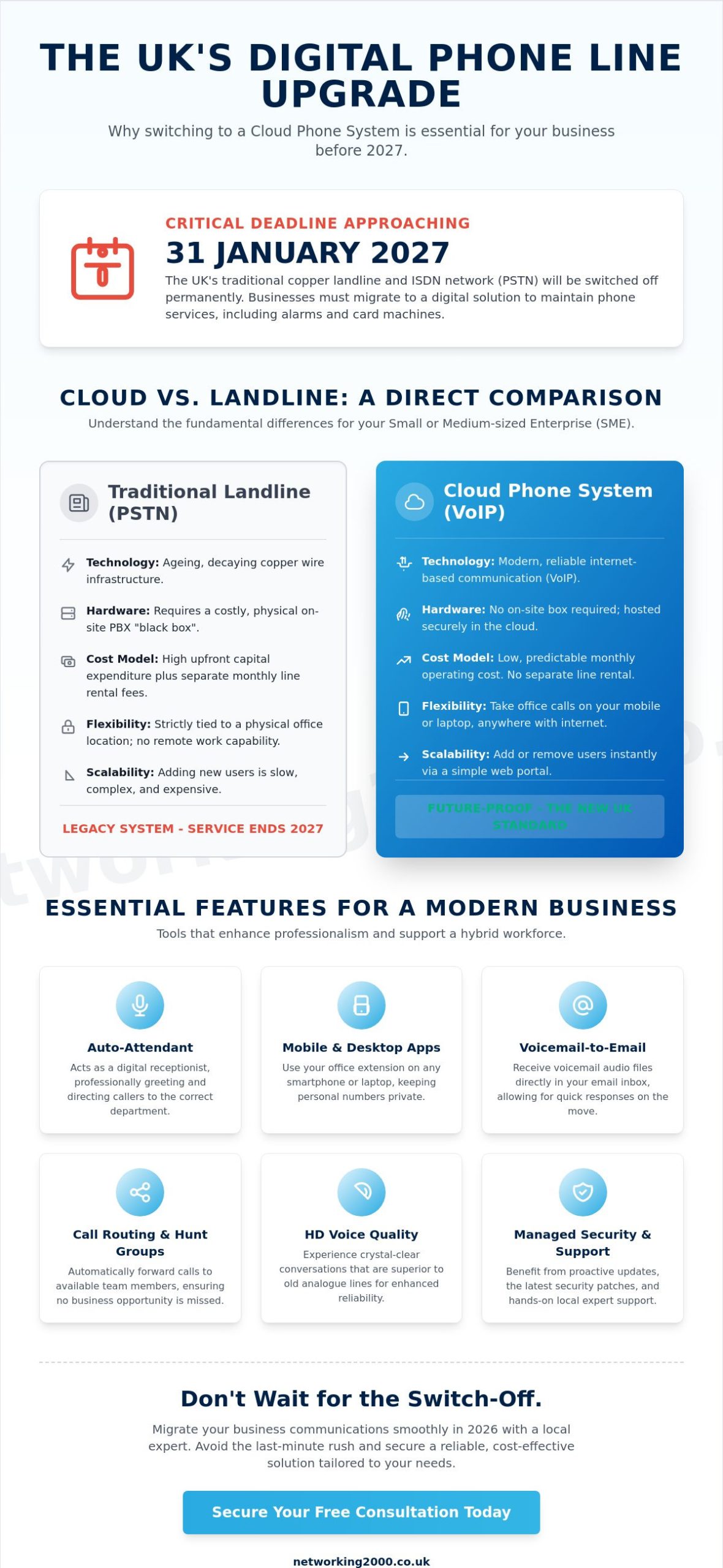
The timing of this shift is vital. The UK is currently retiring its ageing analogue network. By 31 January 2027, every traditional landline and ISDN line will be permanently switched off. This industry-wide change, overseen by Ofcom, means that any business still using old-fashioned sockets will lose service. 2026 is the final year to finalise your digital transition to avoid the inevitable rush and potential disruption as the deadline approaches. Voice data now travels through your existing broadband or fibre connection, eliminating the need for expensive, separate line rental fees.
The move to cloud telephony offers several immediate benefits for your organisation:
- Reliability: Calls are routed through high-speed data centres rather than decaying copper infrastructure.
- Scalability: You can add or remove users in minutes through a simple web portal as your team grows.
- Clarity: High-definition voice technology provides better call quality than old analogue lines.
- Simplicity: Consolidating your communications into one digital stream reduces technical complexity.
How Cloud Telephony Differs from Traditional PBX
Traditional Private Branch Exchange (PBX) systems required a physical “black box” on your office wall. These were expensive to maintain and difficult to upgrade. A cloud phone system for small business removes this hardware, hosting the entire platform in a secure virtual environment. This shifts your financial model from a heavy upfront capital expenditure to a manageable monthly operating cost. Your provider handles the software updates and technical heavy lifting whilst you focus on running your business. Maintenance is proactive rather than reactive, ensuring your system is always running the latest security patches without any downtime.
The Impact of the UK Landline Retirement
The PSTN switch-off isn’t just about voice calls; it also impacts legacy alarms, lift emergency lines, and card machines. Waiting until the January 2027 deadline risks service blackouts and higher installation fees during the final national rush. A cloud-based approach offers a “plug and play” transition that replaces old copper lines with a versatile digital connection. By migrating in 2026, you ensure your business remains fully operational and future-proof. You can integrate your existing office numbers into the new system seamlessly, meaning your clients will never notice the change, even as your underlying technology becomes significantly more robust.
Essential Features of a Cloud Phone System for Small Business
Choosing a cloud phone system for small business gives you access to enterprise-grade tools without the enterprise-grade price tag. It’s about more than just making calls; it’s about how your brand presents itself to the world. A modern system ensures you never miss a lead whilst maintaining a polished, professional image. These features are designed to solve the common frustrations of traditional landlines, such as being tied to a desk or missing calls during peak hours.
Auto-attendants act as your digital receptionist. They greet callers professionally and direct them to the right department, such as “Press 1 for Sales”. This ensures your company sounds like an established firm from the very first ring. Mobile and desktop apps then make hybrid working a reality. Your team can use their office extension on a smartphone or laptop, keeping personal numbers private and ensuring clients always see your professional business ID. If you need help choosing the right features for your workflow, our team provides tailored VoIP telephony solutions to fit your specific needs.
Efficiency is further improved through call routing and hunt groups. If your main line is busy, the call automatically rings through to other team members in a pre-set order. This prevents missed opportunities amongst the team. Voicemail-to-email then sends audio recordings directly to your inbox as an attachment. You can listen to messages and respond to urgent enquiries whilst travelling between meetings or working from home.
Advanced Tools for Growing Teams
Modern systems integrate seamlessly with your existing CRM platforms. When a client calls, their Salesforce or HubSpot record pops up on your screen instantly. This allows for personalised service and better data tracking across your organisation. These platforms also include video conferencing and team chat, turning your phone system into a unified collaboration hub. Call recording and analytics provide the data you need to improve staff performance and resolve customer disputes with ease.
Ensuring Business Continuity
Disaster recovery is a core benefit of the cloud. If your office loses power or internet, calls reroute to mobile devices or other branches automatically. You can maintain a local Essex or London presence even if you move premises, as your numbers are no longer tied to a physical exchange. Scalability is just as simple; you can add or remove “seats” for new hires in minutes. This flexibility allows your communication infrastructure to grow alongside your business without the need for site visits or new wiring.
Cloud vs Landline: A Direct Comparison for SMEs
Small business owners often view landlines as a reliable constant. However, as we approach the final switch-off, the gap between traditional copper and a modern cloud phone system for small business is widening. It’s no longer just a choice of technology. It’s a choice between a rigid, expensive utility and a versatile business tool. Whilst landlines served us well for decades, they lack the intelligence required for a modern, mobile workforce.
Cost remains the most immediate differentiator. Traditional setups involve multiple invoices for line rental, maintenance contracts, and individual call charges. In contrast, cloud systems operate on a flat-rate monthly subscription. This usually includes your lines, your features, and your UK calls in one predictable bundle. Installation is another area where digital wins on speed. Whilst a traditional line might require a BT engineer visit and weeks of waiting, cloud activation is nearly instantaneous. You can be up and running as soon as you plug in your handsets or download the relevant app.
Hardware transitions don’t have to be a “rip and replace” job. You can use Analog Telephone Adapters (ATAs) to keep your existing handsets working during the transition. However, most firms in 2026 find that investing in modern IP phones provides a better return. These devices support HD voice technology. This eliminates the “tinny” sound often associated with old-fashioned calls and provides a much clearer experience for your clients.
The Real Cost of Staying with Traditional Lines
Sticking with legacy lines often hides significant expenses. On-premise hardware requires specialist engineers for every minor change or repair. These call-out fees add up quickly as parts become harder to source for ageing systems. You also face higher tariffs for calls to mobiles and international numbers. Perhaps most importantly, you face the opportunity cost of missed calls. A standard landline can only handle one call at a time. If your line is busy, your next potential customer hears a busy signal and simply rings a competitor instead.
Call Quality and Network Requirements
The old stigma of “internet phones” being unreliable is a thing of the past, provided your infrastructure is ready. A stable internet connection is now the backbone of your office communications. To ensure crystal-clear audio, we implement Quality of Service (QoS) settings. This technical configuration prioritises voice traffic over other data, such as large file downloads or background updates. Because every office environment is different, Networking2000 recommends a professional network audit before you make the switch. This ensures your current broadband can handle the demand without dropping a single syllable.
How to Choose and Implement Your New System
Transitioning to a cloud phone system for small business requires a methodical approach. It is not simply a matter of downloading an app; it is about aligning your communication technology with your daily operations. Start with a thorough usage audit. Determine exactly how many staff members require a physical desk phone versus those who only need a mobile softphone. Assess your peak call times to understand how many concurrent lines your internet connection must support during your busiest hours.
Choosing the right partner is just as critical as the software itself. Whilst national providers offer “off-the-shelf” packages, local support in Essex and London provides a level of accountability they cannot match. A local partner understands the regional infrastructure and can provide hands-on assistance during the setup. For businesses based in the area, a dedicated VoIP phone system Wickford specialist can offer the on-site expertise and regional knowledge that national call centres simply cannot replicate. If you encounter a complex issue, having a seasoned expert who can visit your premises is far more reassuring than waiting in a faceless national call centre queue.
Security is another vital consideration that many businesses overlook. Toll fraud, where unauthorised users hijack your system to make expensive international calls, can lead to devastating bills. We implement robust security protocols, including multi-factor authentication and call-spend limits, to protect your organisation. Once the system is live, prioritise staff training. Ensuring your team knows how to transfer calls, toggle their “do not disturb” status, and manage mobile apps from day one is essential for a smooth transition.
The Number Porting Process Explained
You don’t have to lose your established business identity when moving to the cloud. You can keep your existing numbers through a process called porting. This transition usually takes between seven and fourteen days to complete. You will need to provide a recent phone bill and a signed Letter of Authority (LOA) to start the process. We manage the coordination with your current provider to ensure the switch happens in the background, preventing any downtime for your customers.
Integrating Phones with Your IT Infrastructure
Your phone system should not exist in a silo. It is a critical piece of your managed IT network. Your firewall settings must be specifically configured to prioritise VoIP traffic whilst maintaining high security. This “single pane of glass” approach to managing IT and telecoms ensures better reliability and faster troubleshooting. If you want to ensure your office network is ready for the move, our Managed IT Support can help optimise your infrastructure. Finally, check that your office Wi-Fi is robust enough to handle mobile users moving between rooms without dropping calls.
Future-Proofing Your Business with Networking2000
A DIY cloud subscription might seem like an easy win, but it often leaves small businesses vulnerable to poor call quality and configuration errors. Without professional oversight, your phone system is just another app competing for bandwidth on an unoptimised network. Choosing a managed cloud phone system for small business ensures that your communication tools are fully integrated into your existing infrastructure. We provide the technical stability you need to stay connected with your clients without the headaches of self-management whilst ensuring your data remains secure.
Since 1998, Networking2000 has acted as a “safe pair of hands” for firms across Wickford, Essex, and London. We believe that technology should support your operations, not distract from them. By combining our telephony expertise with our broader managed it support services, we offer a single point of contact for all your digital needs. This holistic approach means we don’t just fix a phone issue; we ensure your entire network is healthy, secure, and ready for the future.
Customised VoIP Solutions for Local SMEs
Every industry has unique requirements. A retail shop in Wickford needs different features than a legal firm in London. We tailor our VoIP telephony to match your specific workflow, whether you need complex hunt groups or simple mobile integration. Our advice is always straightforward and free from unnecessary jargon. We focus on practical outcomes that improve your bottom line. With proactive maintenance, we monitor your system performance in the background, resolving potential issues before they impact your ability to take calls.
Getting Started with a Wickford VoIP Specialist
The first step toward a more flexible future is understanding your current network readiness. We provide local site surveys to assess your existing cabling, Wi-Fi coverage, and broadband speeds. This ensures that when you switch to the cloud, the transition is seamless and the audio quality is perfect. To understand exactly what the process involves from start to finish, our guide to VoIP installation Wickford businesses rely on walks you through every stage in detail. Our promise is simple: reliable, responsive, and professional communication that allows you to focus on your core business goals. Don’t leave your transition to the last minute. Contact Networking2000 for a bespoke cloud phone quote today and secure your business communications for 2026 and beyond.
Secure Your Business Communications for the Digital Era
The transition away from traditional landlines is no longer a choice but a necessity for survival in the UK market. By adopting a cloud phone system for small business, you gain more than just a dial tone. You secure a versatile, cost-effective platform that supports hybrid working and projects a truly professional image. A successful migration depends on your underlying network health and professional configuration to avoid service gaps as the 2027 deadline approaches.
Networking2000 has been a trusted local partner since 1998. We specialise in VoIP installations for SMEs across Essex and London, providing the proactive managed support needed to ensure 100% communication uptime. We handle the technical complexity so you can focus on your core operations with absolute confidence. Our team is ready to audit your current setup and guide you through every step of the digital switch.
Get a reliable cloud phone system for your business today. Let’s get your company ready for the future with technology that works as hard as you do.
Frequently Asked Questions
Can I keep my existing business phone number when switching to the cloud?
Yes, you can keep your existing business numbers through a process called number porting. We coordinate with your current provider to transfer your established identity to the new digital platform. This usually takes between seven and fourteen days to complete. It’s a seamless transition that ensures your clients can still reach you on the same numbers they’ve used for years.
What happens to my cloud phone system if the internet goes down?
Your system remains operational even if your office loses its internet connection. Because the platform is hosted in the cloud rather than on a physical box in your office, calls can be automatically rerouted to mobile devices or other branches. This built-in disaster recovery ensures you never miss an enquiry. We can configure these failover rules in advance so the switch happens instantly.
Do I need to buy new desk phones to use a cloud phone system?
You don’t necessarily need to purchase new hardware to use a cloud phone system for small business. You can use Analog Telephone Adapters (ATAs) to connect your existing handsets to the digital network. Alternatively, many firms choose to use “softphones” which are apps that run on your existing laptops and smartphones. However, modern IP desk phones are recommended for the best HD voice quality and feature access.
Is a cloud phone system secure from hackers and toll fraud?
Yes, modern systems are highly secure when managed correctly by an IT partner. We implement multi-factor authentication, call-spend limits, and encrypted voice traffic to prevent unauthorised access and toll fraud. Unlike old analogue lines that could be easily intercepted, digital telephony uses advanced security protocols to protect your business conversations and your monthly billing from malicious actors.
How much internet bandwidth does a VoIP call actually use?
A standard high-definition VoIP call uses approximately 100kbps of bandwidth. This is a very small amount compared to modern fibre broadband speeds. For example, a typical 80Mbps connection can theoretically handle hundreds of concurrent calls. The key is not just the total speed, but the quality and stability of the connection, which is why we recommend prioritising voice traffic on your office network.
Can I use a cloud phone system on my personal mobile phone?
Yes, you can use a dedicated mobile app to turn your personal smartphone into an office extension. This allows you to make and receive calls using your professional business number rather than your private mobile ID. It’s an ideal solution for hybrid working, as it keeps your personal and professional lives separate whilst ensuring you stay connected to the team from any location.
What is the difference between VoIP and a cloud phone system?
VoIP (Voice over Internet Protocol) is the underlying technology that converts your voice into data packets for transmission. A cloud phone system for small business is the complete service platform that uses this technology to provide features like auto-attendants, call recording, and hunt groups. Essentially, VoIP is the “engine” whilst the cloud system is the “vehicle” that delivers your business communications.
How long does it take to set up a new cloud phone system for a small business?
Basic activation of your cloud account is nearly instantaneous once your order is processed. A full professional implementation, including hardware delivery, network configuration, and staff training, typically takes between three and five working days. If you’re porting existing numbers, the full process usually concludes within a fortnight, although you can use temporary numbers to start making calls immediately.

