In the year ending March 2025, the charge rate for burglaries of an unconnected building, such as a garage or outhouse, was 2.1% in England and Wales, according to the UK Home Office crime outcomes release. A siren that nobody acts on rarely turns into a solved case. That's why I'd judge a burglar alarm for garage use by who responds, not by how loud it sounds.
Table of Contents
- Why a Garage Needs Its Own Alarm Plan
- Which Garage Alarm Response You Actually Get
- Sensors That Suit a Garage Door and Interior
- Wired or Wireless for a Damp Garage
- Linking the Garage Alarm to the House and CCTV
- How a Competent Installer Fits a Garage Alarm
- Decide the Response Then Book a Survey
Why a Garage Needs Its Own Alarm Plan
Say a detached garage in Romford holds power tools, two bikes and a freezer, with the house bedrooms facing the other way. Someone lifts the up-and-over door at night, takes what's easy to carry and leaves. The house alarm never triggers because nobody crossed the hall, and the small garage sounder, if there is one, is out of earshot.
That split is built into how buildings are treated. An attached garage forms part of the dwelling, so it can usually share the house alarm. A detached garage within the grounds is a separate building that can be entered without the house being touched at all.
Attempted entry matters too. A forced side door, a bent hasp or a vehicle door lifted and dropped still tells you someone tested the building, even when nothing was taken. Your alarm should record that event, not only react after stock or a vehicle has gone.
Treat It as a Separate Zone
Don't leave the garage as one spare sensor tagged onto the house system. Give it its own zone, so it can stay armed while you're cooking, working or asleep upstairs. That also means a garage event arrives labelled as a garage event, which helps whoever responds decide what to do first.
Physical delay still comes before electronics. If you're checking hardware for a personnel door or side gate, the guide to UK standards for door bolts from Neasden Hardware is a useful reference for matching the bolt to the door instead of buying the biggest thing on the shelf. A detector that reports a door opening in seconds is worth little if that door opens with one shoulder push.
Practical rule: if the garage can be emptied without waking the house, it needs its own plan for detection and response, not just a louder box on the wall.
The order I'd use on a survey is simple. First, who is told and what will they do. Then which detectors survive cold, damp and dust. Then cable or radio, how the zone joins the house alarm and cameras, and finally what to ask whoever fits it. If you're short of time, go straight to the response table below and work out which row matches your building.
For most attached garages, the answer is the house panel, a separate garage zone and a sounder people nearby will hear. For a detached garage, a unit holding tools or stock, or any building that's empty out of hours, you need a confirmed or monitored response path as well.
Which Garage Alarm Response You Actually Get
Start with who receives the event. Brand, siren design and app layout all come second to that.
| System type | Who is alerted | Police response | Main weakness | Fits best when |
|---|---|---|---|---|
| Audible only | Neighbours or passers-by | Generally no, unless extra evidence | Ignored after false alarms, useless out of earshot | Attached garage with people usually at home |
| App or smart alert | Owner's phone | Not from the app alone | Wi-Fi, mobile or a silent phone can miss it | Owner nearby and connectivity is reliable |
| Auto-dialler | Programmed phone numbers | Only if a person confirms a real incident | Nobody answers the call | A short list of people who will pick up |
| Professionally monitored | Alarm-receiving centre, then keyholders or police | Possible after confirmation | Needs standards, fees and two keyholders within 20 minutes | Detached, out-of-hours or higher-value garage |
Audible Only and App Alerts
An audible-only system makes noise and hopes someone useful hears it. ProtectUK guidance on alarms and CCTV states that a monitored alarm sends a signal to an alarm-receiving company, which can notify police or keyholders, whereas an audible-only alarm primarily relies on neighbours or passers-by, and police generally will not attend an audible-only activation unless additional evidence supports a genuine incident.
That limitation isn't a criticism of sounders. A sounder can shift an opportunist quickly on an attached garage in a busy street. It does far less at the bottom of a garden, behind a workshop, or next to neighbours who've already heard it false-alarm three times this month and now close their windows.
An app alert improves the information but doesn't guarantee action. Your phone might be on silent, out of charge, in another room or in aeroplane mode on holiday. The garage router might be down, or the mobile signal inside a metal-clad building might be too weak to push the notification through.
A phone ping is notification. It isn't monitoring, and it isn't a police response.
Auto-Diallers and Monitored Signalling
An auto-dialler rings programmed numbers in sequence. It's better than noise alone if the people on that list answer unknown numbers at night and know what to do next. If the first person is abroad and the second never checks voicemail, you've bought a delay, not a response.
Monitored signalling changes the chain because an alarm-receiving centre handles the event whether you're awake or not. The references that matter here are BS EN 50131 for the system, BS 8243 for installation and BS EN 50518 for the receiving centre. Ask to see those named in the specification rather than accepting a vague promise of professional monitoring.
Monitored doesn't mean effortless. You need at least two keyholders who understand the controls, can get into the protected area, can be contacted by phone and can attend within 20 minutes. For a small firm in London or Essex, that usually means naming people who live or work nearby, not a director who is an hour away on a good run.
Write the escalation down before anything is fitted:
- Local sounder: sounds at the garage to disturb the intruder and alert anyone close.
- App or telephone notification: reaches you or your listed contacts with the zone name.
- Receiving-centre handling: filters the event and escalates where the system qualifies.
- Named keyholders: attend, check the building safely and reset or secure it.
Don't assume a DIY kit gets a police response, and don't build the whole plan on one broadband connection. Where the contents or business continuity justify it, use supervised communications or a second signalling path, so a router failure doesn't disable your burglar alarm for garage protection. Internet-connected devices also need sensible passwords and updates, because a compromised camera or hub undermines the evidence you were counting on.
Sensors That Suit a Garage Door and Interior
Walk the building in the order an intruder would. Start at the vehicle door, then any personnel door or window, then the route into the house, then the open floor space.
The layout below shows the basic positions for an attached garage and the separate option for a detached one.
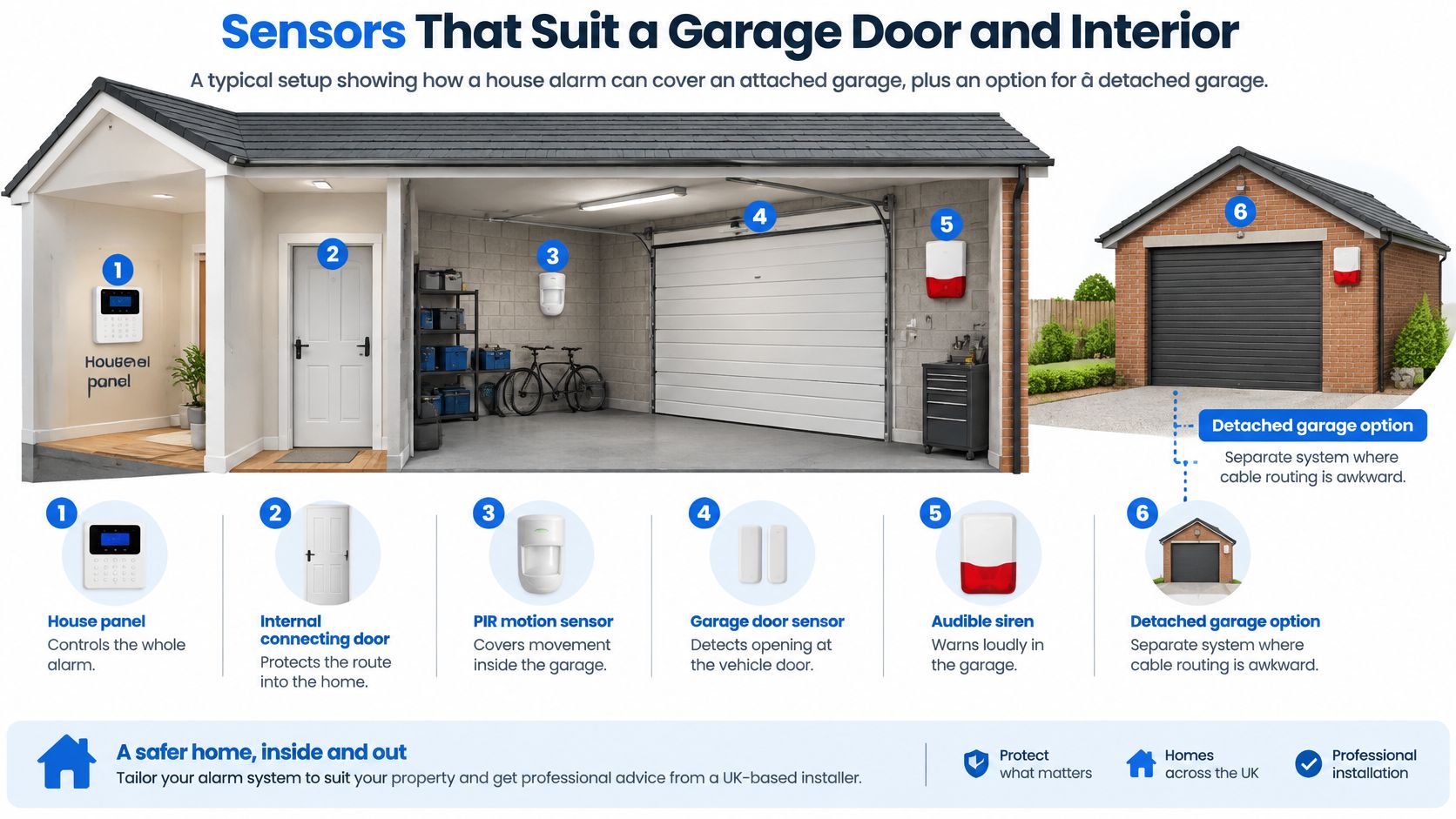
Start With the Doors
Avon and Somerset Police guidance on garage and shed security recommends either extending the house alarm into the garage or installing a separate audible system, and it says an internal connecting door should be solid and protected with an accredited British Standard mortice lock. I'd follow that order. Secure the door first, then detect it opening.
Fit a magnetic contact to the vehicle door, whether it's up-and-over, roller or side-hinged. Position the magnet and reed so a small lift breaks the circuit, not only a full opening. On a roller door, check the bottom bar movement through its whole travel so the contact doesn't chatter in wind and cause nuisance alarms.
Put a second contact on the internal connecting door where one exists. That way, opening the route into the house is an alarm event even if someone entered through a window or forced a side panel. It also catches the everyday risk of the connecting door being left on the latch while the garage side is exposed.
A shock or vibration sensor can help on a thin metal door that's being struck or cut. Treat it as a supplement, though. Vibration sensors need careful sensitivity setting in a building that rattles when lorries pass, and they don't replace the clean open or closed signal you get from a contact.
Cover Movement Without Inviting False Alarms
A passive infrared detector, or PIR, should cover the paths someone must cross to reach tools, a vehicle or the connecting door. Don't aim it at a boiler, a fan heater, a sunlit metal door or a window where headlights sweep in. Heat changes in its field of view are what trigger it, so poor siting creates the false alarms that teach everyone to ignore the system.
BS EN 50131-2-2:2021 defines PIR-detector requirements across security Grades 1 to 4 and environmental Classes I to IV, for both wired and wire-free detectors. A damp, dusty garage with big temperature swings needs equipment whose environmental class matches those conditions. A detector meant for a warm hallway may false-alarm through winter and fail early, however tidy it looks on fitting day.
Add tamper detection on the control panel, the sounder and any device an intruder can reach before entering the house. Garage kit is often accessible at head height from outside the protected area. If opening the sounder case or pulling a detector off the wall raises no signal, the weakest point is the alarm itself.
Partition the garage as a separately identified area when it holds tools, vehicles, networking equipment or stock. The garage stays armed while you use the house, and a breach is reported on its own instead of as a generic house activation. My one-line check for any quote is this: door contact, connecting-door contact, one well-aimed PIR, tampers, and a zone that can stay set.
Wired or Wireless for a Damp Garage
This is a building decision, not a fashion one. The right answer changes with cable routes, wall construction, distance and whether you can keep the panel indoors.
The comparison below sets out the practical differences before you look at specific kit.
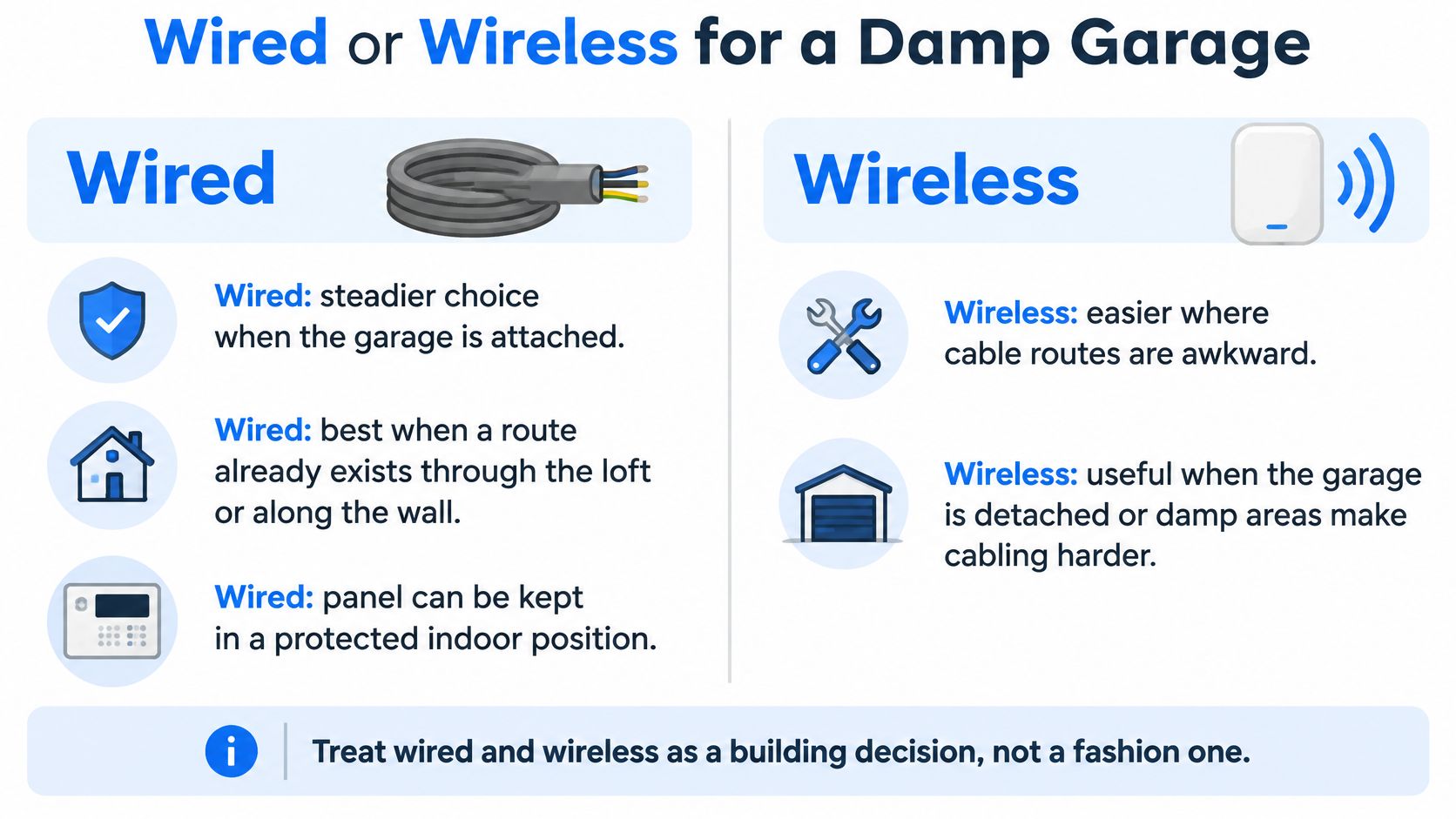
| Method | Power and backup | Signal risk | Best building | Watch-out |
|---|---|---|---|---|
| Fully wired | Mains plus panel battery | Cable cut if left exposed | Attached garage with an easy cable route | Chasing cost through concrete |
| Fully wireless | Device batteries plus panel backup | Range, metal doors, jamming | Detached garage where cable is impractical | Cold kills cheap batteries |
| Hybrid | Wired core, radio at the far door | Only the radio leg | Most mixed house-and-garage sites | Two maintenance routines |
When Cable Earns Its Keep
Cable is the steadier choice on an attached garage where a route exists through the loft, along a wall void or beside existing services. A wired contact and PIR don't depend on small batteries in winter, and there's no radio link to weaken when a metal door closes. Keep the panel inside the house where it's warm, dry and harder to reach.
The weakness is exposed cable. A run clipped across the outside of a detached block at reachable height can be cut, and chasing a new route through concrete or under a drive costs real money. If the cable route looks vulnerable or disproportionate, don't force it for the sake of tradition.
This short video is worth watching for the practical side of detector and cable placement before you commit to a route.
When Wireless Makes Sense
Wireless suits a detached garage where digging across a drive or drilling through thick walls would cost more than the alarm itself. Wire-free detectors sit under the same PIR standard framework, so you can still specify by grade and environmental class rather than buying whatever's bundled in a box.
Test the radio properly. The signal needs margin with the vehicle door shut, a car inside and the house doors closed, not just on a dry day with everything open. Metal doors, foil-backed insulation and thick masonry all eat that margin, and an expander sited inside the house may be needed to give the garage devices a reliable path back.
Every wireless device should be supervised, so the panel knows it's still there and reporting. You also need low-battery warnings that reach someone who'll act on them, and batteries rated for cold conditions. Cheap cells that fade months early in an unheated building turn a tidy installation into regular callouts.
Mains power still matters. The panel or any powered sounder wants a proper fused spur and battery backup long enough to cover an overnight power cut. If there's no dependable mains supply in the garage, say so at survey stage, because it changes where the panel lives and how signalling is powered.
I'd often choose hybrid on real sites. Cable the panel, keypad and connecting door inside the house, then use supervised radio only for the vehicle door or a far corner of the garage. Match the method to the building in front of you, and check the environmental rating applies to the wireless housings too. A loft-grade sensor in a wet garage is a false economy.
Linking the Garage Alarm to the House and CCTV
Keep three layers separate in your head. The alarm detects and reports, the camera shows what happened, and access control manages who may enter. Each one does a different job, and none of them replaces the others.
This diagram shows the garage as one zone on a system the household already understands.
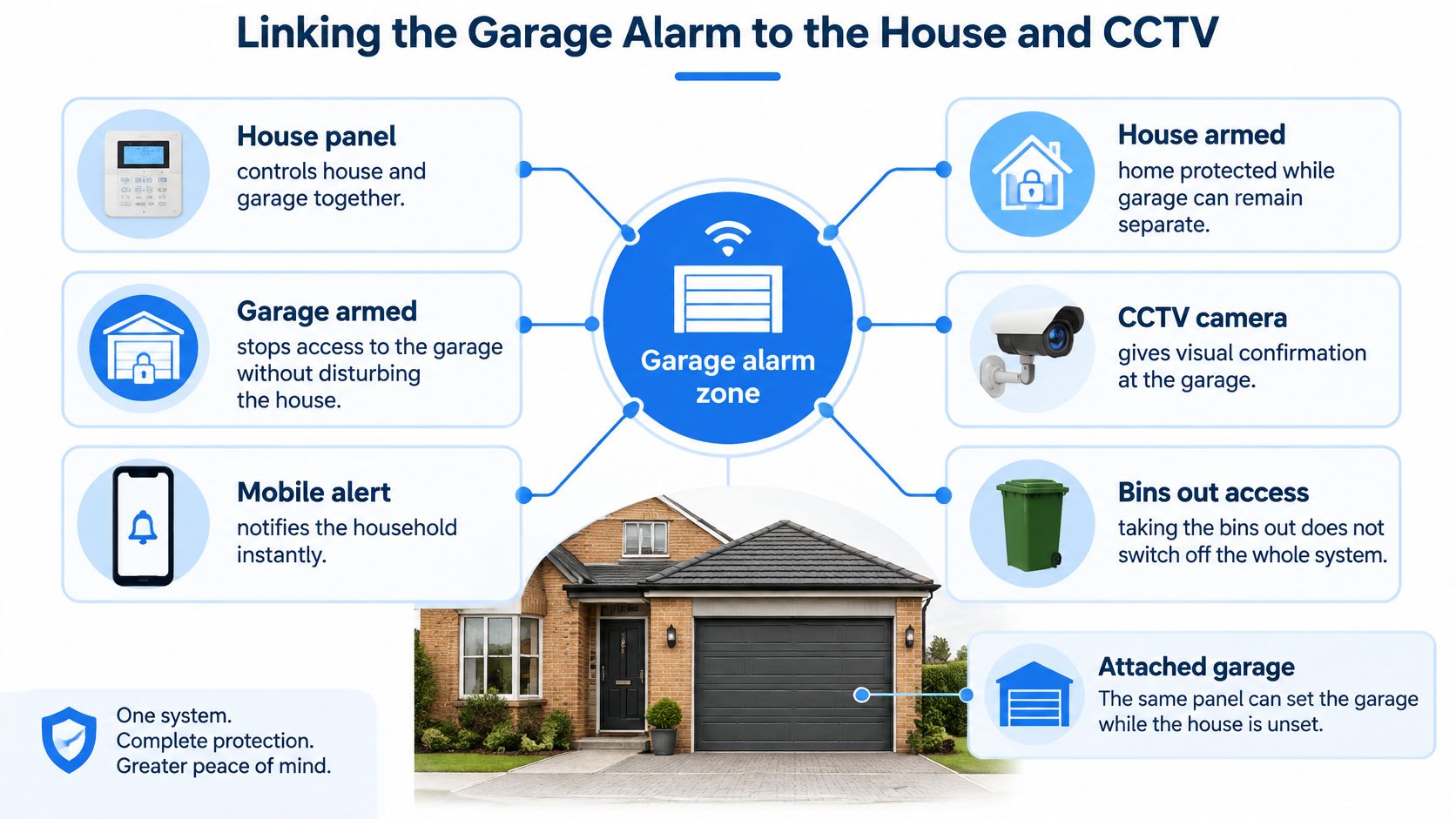
One Panel, Separate Daily Routines
On an attached garage, the same panel can set the garage while the house stays unset. You can take the bins out, load the car or work at a bench without disarming the bedrooms. At night, the house and garage can both be set, with a defined entry route so you don't trigger the system coming in with shopping.
A detached garage may need its own panel. That's fine, provided it reports into the same app or receiving centre and the link back is supervised. If broadband across the garden is the only route, ask what happens when it drops, and specify a second path where the risk justifies it.
Cameras Confirm, Contacts Detect
Don't rely on camera motion detection as your primary trigger. Garages produce constant movement from cars, deliveries, pets, wind-blown covers and changing light. A door contact gives you a clean event at a known time. The camera then confirms what the contact reported, which is the kind of extra evidence that makes attendance more realistic.
Aim the camera at the door apron, the approach where number plates pass, or the internal bay holding the vehicle. Specify it for the light it will see. A dark yard, an undercroft, or an unlit rear lane needs a low-light camera or proper lighting, and any external housing has to survive weather rather than mist up by November. The home camera setup tips from DigiDevice cover the basics of positioning and coverage if you're planning angles before a survey.
Check the clip, not the live view: recording should keep the footage that matches the alarm time, so you can find it in seconds rather than scrubbing through a night of nothing.
Lighting that switches on with detection helps twice. It gives the camera a usable image and it makes the approach safer for whoever attends. Keep it aimed at your own ground, though, and check it doesn't blast a neighbour's bedroom window every time a fox passes.
If family or staff need regular entry without a bunch of keys, access control on a personnel door is a sensible extra layer. It manages entry and can log who came in, but it isn't the intruder alarm and shouldn't be sold as such. You should finish with three things: one easy unset path for daily use, one confirmed alarm path, and a camera that can show the door at the moment the contact opens.
How a Competent Installer Fits a Garage Alarm
A good installation follows a sequence you can check as a customer. If the visit starts with opening boxes, the survey hasn't happened.
This checklist shows the order I'd expect from first walk-round to handover.
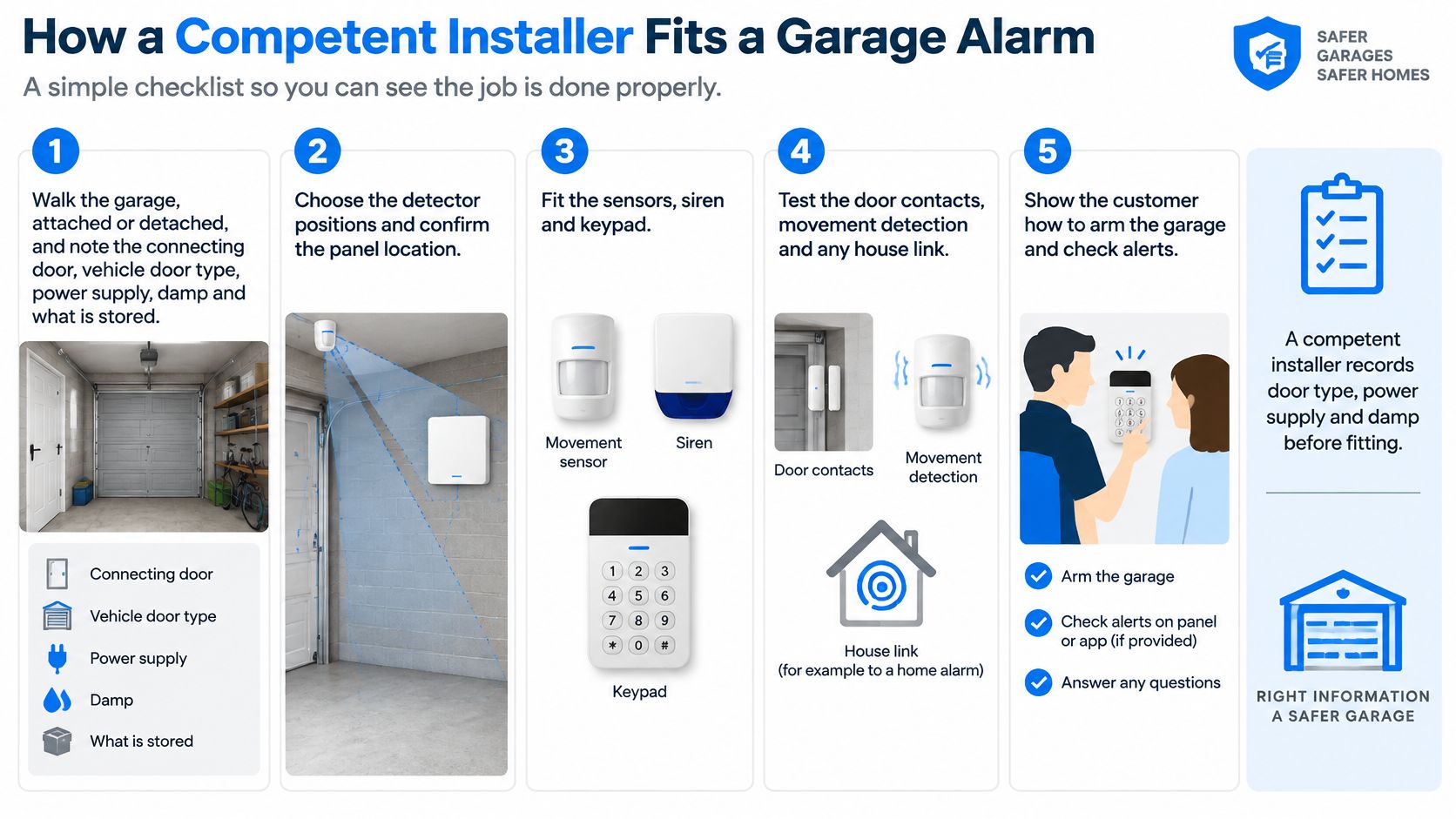
Survey to Handover
- Walk the building: note whether it's attached or detached, the connecting door, vehicle door type, power supply, signs of damp and what's stored inside.
- Agree the zone: confirm the garage can stay armed during normal house use, and define the entry route for legitimate users.
- Fit detection: vehicle-door contact, connecting-door contact and PIR positioned to suit the entry points and internal paths.
- Set the specification: choose the grade and environmental class for that space, then add tamper protection to the panel, sounder and exposed devices.
- Decide cable, radio or hybrid: test any radio link through the closed metal door, not standing in the open doorway.
- Document signalling: for monitored systems, record the receiving arrangements, named keyholders and the attendance plan in writing.
- Aim and light cameras: confirm the view shows the door event, with lighting that works at the times the garage is at risk.
- Test and hand over: run setting, unsetting, a real door opening, tamper, mains failure and low battery, then show the user the keypad or app in plain language.
That testing stage matters because outcomes after the event are poor. In the year ending March 2024, 70% of non-residential burglary offences in England and Wales were closed with no suspect identified, according to the UK Home Office crime outcomes release. Detection and usable evidence at the time carry more weight than hope afterwards.
Questions to Ask Before You Sign
Ask whether the installer is affiliated with NSI or SSAIB, the recognised inspectorates for this work. Ask whether the design cites BS EN 50131 and, for monitored work, BS 8243. Ask what maintenance includes, especially battery replacement dates for wireless devices and the panel backup, and who gets told when a battery runs low.
Also ask how false alarms will be handled in the first month. A competent installer expects a bedding-in conversation about sensitivity, door movement and user routine. An installer who disappears after handover leaves you with a system that's either too twitchy to trust or left unset.
A quotation that only names a siren and a box has skipped the survey. Unreliable alarms and repeated activations teach neighbours to ignore a genuine event, which destroys the one response an audible-only system depends on. The written quote for your burglar alarm for garage should name the detectors, the zone arrangement, the signalling path and the people who'll be contacted. If it doesn't, ask for it again in writing.
Decide the Response Then Book a Survey
The right response depends on how the garage is used and who can act on an alert. An attached domestic garage, used while someone is usually at home, may share the house alarm with its own zone, a contact on the vehicle door and a sounder neighbours can hear. That setup is proportionate if the connecting door is solid, properly locked and detected.
A detached garage needs a different plan. The same applies to a unit holding tools, a vehicle or stock, or one left empty outside working hours. A siren alone relies on someone hearing it and responding. Consider camera confirmation or a second detector event, a signalling route that does not rely solely on broadband, and named people who can attend when contacted.
Monitoring adds a response chain, but it also brings an ongoing fee and depends on keyholders being able to reach the building. If that cost is not justified, prioritise the basics: suitable locks, a secure connecting door and lighting, followed by reliable detection and notification. A louder sounder should not take priority over a clear plan for who will respond.
Buy the response, then the sensors that feed it. Detection without a response plan can leave a garage well covered and still vulnerable.
What a Short Survey Should Capture
Before choosing equipment, establish the building's conditions and how the alarm will be used:
- Building details: whether it is attached or detached, door types, power supply, and signs of damp or condensation.
- Contents and use: what is stored, who uses the garage, and when.
- Response choice: audible alarm, app notification, auto-dialler or monitoring, plus named keyholders where needed.
- Supporting layers: possible camera positions, lighting and access control on a personnel door.
Networking2000 provides CCTV, intruder alarms and access control. Its remote monitoring links a customer's site to its Video Control room, where staff can view and control CCTV and issue warnings over a speaker system. Its surveyors are trained to match CCTV equipment to a customer's system needs. Ask which services suit the garage, and have the proposed response route set out clearly.
Before equipment is ordered, ask who receives an alert, who can attend, and what happens if the first contact does not answer. A survey should leave you able to explain the response in plain English, not just identify the detectors and siren.
Networking2000 provides intruder alarms, CCTV and access control for homes and businesses across London and Essex. Tell the team whether your garage is attached or detached, what you keep in it, and how you want an alarm handled to arrange a survey.

