You're comparing alarm quotes, looking at phone apps, sirens and neat little motion sensors, while the essential question sits underneath: what should happen when someone triggers the system at 2am? A bell-only alarm may wake the neighbours. A monitored system may send an event to an alarm-receiving centre. Neither outcome is useful if the system has blind spots, false alarms, failed communications or untrained keyholders.
Good intruder alarm installation starts with incident response, not equipment selection. You need to decide what response you expect, how the system will verify an activation, who will act, how the property will cope with connectivity failures and how the arrangement will be maintained. Sensor choice matters, but it comes after those decisions.
Table of Contents
- Why Installing an Intruder Alarm Is a Bigger Decision Than It Looks
- Main Alarm System Types Explained in Plain English
- The Site Survey That Protects Your Installation
- Detector and Panel Placement That Actually Works
- Wired, Wireless and Smart, Choosing the Right Connection Method
- UK Compliance and Standards Worth Checking on Any Quote
- Typical Timelines and Cost Considerations
- Reasons to Hire a Professional Installer
Why Installing an Intruder Alarm Is a Bigger Decision Than It Looks
A homeowner might begin with a simple problem. The property is empty during working hours, the side passage is hidden from the road and a rear window is easily reached. A small business owner faces a different version of the same decision: staff leave at different times, cleaners need access, stock is stored in several rooms and the broadband router also supports phones, cameras and payment systems.
In both cases, buying a panel and fitting a few detectors is only the visible part of the job. The installation must turn an activation into a controlled response. That means selecting suitable detection, confirming events properly, transmitting them reliably, contacting the right people and recording what happens afterwards.
The UK industry's history makes this clear. Around 57,000 intruder alarms could signal alarm conditions to police by 1966, while BS 4737:1971 later created a common framework for design, installation, servicing and inspection. The shift towards confirmed alarms for new systems seeking Level 1 police response from October 2001 reinforced the same principle: a siren sounding isn't the same as a verified incident.
Treat the alarm as one layer of security
An alarm can deter, detect and trigger a response. It won't replace sound locks, controlled access, lighting, CCTV, secure doors or sensible staff procedures. For a wider view of how cameras fit alongside alarms and access controls, IT Cloud Global's surveillance guide is a useful complementary resource.
Household ownership also needs interpreting carefully. Research using Crime Survey for England and Wales data found that homes covered by burglar alarms rose from 13% in 1992 to just under 30% in 2009/10, before falling slightly in 2011/12. The same analysis warned that alarm ownership alone shouldn't be treated as proof of protection, because alarms were more common at properties already considered vulnerable or attractive to offenders. The research paper supports a practical conclusion: design, operation and maintenance matter more than having a box on the wall.
Practical rule: Specify the response process first. Then choose hardware capable of delivering it.
Main Alarm System Types Explained in Plain English
The right system depends on the building, the people using it and the consequence of an activation. Don't choose an alarm because the app looks polished. Choose it because the signalling and response arrangement match the risk.
Bells-only systems
A bells-only system activates an internal sounder and an external siren. It suits a flat or lower-risk home where the main objective is local deterrence and warning. It won't normally create a police-attended response by itself. ProtectUK guidance states that police won't normally attend an audible-only activation unless additional information supports that a genuine offence has occurred.
Monitored systems
A monitored alarm sends events to an alarm-receiving centre, often with keyholder and confirmation procedures. This is the sensible route for a business holding stock, a premises that needs an organised out-of-hours response or a customer whose insurance and police-response requirements demand more than a local siren.
Monitoring doesn't remove responsibility. You still need accurate keyholder details, trained users, suitable confirmation logic and a maintenance agreement.
Smart and wireless alarms
Wireless systems reduce cabling and can suit a finished home, listed building or small office where chasing walls would be disruptive. Smart features may provide app control, push alerts and user management. Those features improve convenience, but app control isn't the same as police response. The system still depends on its communications path, account security and the manufacturer's support.
Hybrid commercial systems
Hybrid systems combine wired and wireless devices. They work well when a commercial building already has cabling in some areas but needs flexible coverage in extensions, storage rooms or separate offices. A hybrid design can reduce disruption without forcing every device onto batteries or a wireless link.
| System type | Best fit | Signalling | Installer needed |
|---|---|---|---|
| Bells-only | Lower-risk homes and local deterrence | Local siren and sounders | Not always, but professional setup is safer |
| Monitored | Businesses and premises needing organised escalation | Alarm-receiving centre, with suitable confirmation | Yes, use an appropriately accredited installer |
| Smart or wireless | Finished homes, flats and small premises | Wireless devices, broadband, cellular or app services | Recommended |
| Hybrid commercial | Larger or changing premises | Wired and wireless devices, often monitored | Yes |
For London and Essex SMEs, monitored or hybrid systems are usually more appropriate than treating a consumer smart alarm as a complete incident-response service.
The Site Survey That Protects Your Installation
A competent survey starts outside the property. The installer should walk the perimeter, inspect doors, windows, roof access, side gates, garages and sheds, then ask how people use the building. A drawing with three suggested sensor positions isn't a survey.
The installer should also ask uncomfortable but important questions. When is the property empty? Which doors do staff use? Do pets roam? Do cleaners, delivery workers or contractors need access? Is there a conservatory, open stairwell, vulnerable glazing or a rear route that neighbours can't see? These answers shape the alarm zones and the setting procedure.
What the survey should produce
A proper survey should leave you with more than a price. Look for:
- An entry-point audit: Every relevant door and accessible window is considered, not just the main entrance.
- A detector rationale: The installer can explain why each PIR, contact or other detector is proposed.
- A zone plan: You know what each zone protects and what an activation means.
- A user and keyholder plan: The quote identifies who can arm, disarm and respond.
- A communications review: The installer considers broadband, cellular coverage, mains power and equipment dependencies.
- A maintenance outline: You know who tests, services and updates the system after handover.
Use this London property defects guide as a useful reminder that a property inspection should look beyond the obvious surface features. Alarm surveys similarly need to account for access, condition and practical use, not just room count.
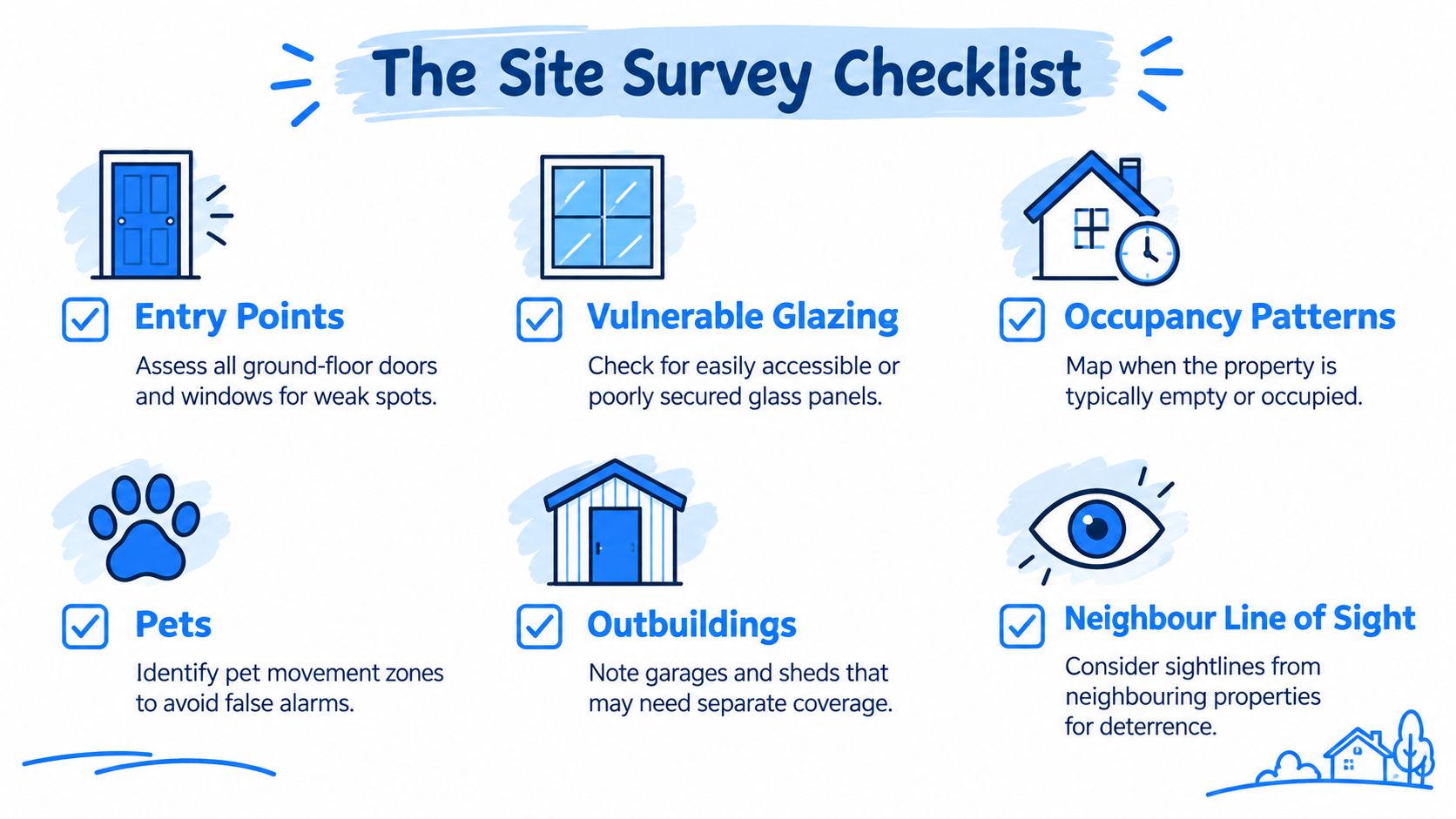
A poor survey often produces a cheap-looking installation with the wrong coverage. A good survey explains the trade-offs before anyone drills a hole. If the installer won't show you the proposed zones or explain how pets and access routines will be handled, don't approve the work yet.
Detector and Panel Placement That Actually Works
Sensor placement is engineering, not decoration. A PIR detects movement and changes in infrared energy, so its position affects what it sees, what it ignores and how often it triggers. A contact protects an opening, while a glass-break detector depends on acoustic coverage and the characteristics of the glazing.
Match each detector to the threat
PIRs generally work best where a person crosses the detection pattern rather than walks directly towards it. They should avoid direct sunlight, heaters, ventilation turbulence and loose fixtures. A detector beside a radiator or facing a bright window may create trouble that no amount of app configuration will fix.
Door contacts need stable mechanical mounting. If the frame moves, the magnet alignment is poor or the contact sits on a flexible surface, the zone can become unreliable. Accessible doors should be considered alongside the way occupants leave and enter, because a technically protected door still creates false alarms if users don't understand the entry delay.
Glass-break detectors need a clear relationship with vulnerable glazing. Don't accept one because it covers a large room on paper. Ask what glass types it supports, where it faces and how curtains, room shape and background noise affect its operation.
The panel is part of the response chain
The control panel and keypad should be convenient for authorised users but not exposed to damp, heat or direct sunlight. A panel hidden in an awkward cupboard may look tidy, yet create rushed setting procedures and more user errors. The internal sounder should be placed so occupants can hear it throughout the premises, while external sounders should be visible enough to provide deterrence without becoming an easy target.
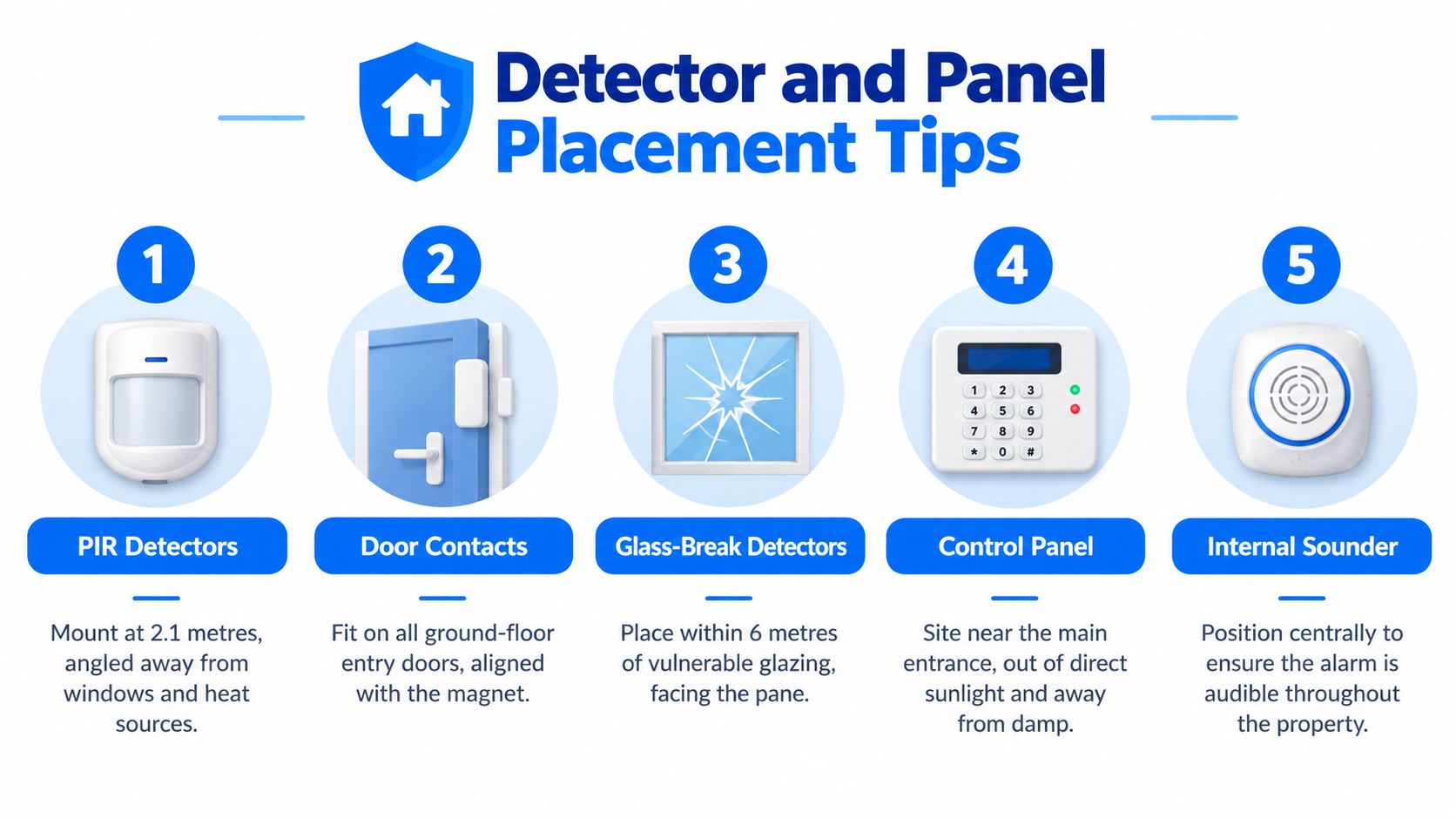
During the walkthrough, ask the installer to explain every proposed detector in plain English. If the answer is only “that's where we normally put it”, push back. A professional should connect the location to the access route, detection pattern, environmental conditions and expected user behaviour.
Wired, Wireless and Smart, Choosing the Right Connection Method
Wired systems remain the straightforward choice for new builds, refurbishments and premises where dependable infrastructure can be installed cleanly. Devices don't rely on individual radio links or frequent battery changes, and a well-designed wired system can be easier to expand in a controlled commercial environment.
Wireless systems make sense when disruption matters more than cable permanence. They suit many homes, flats and smaller commercial premises, especially where finished walls, heritage interiors or occupied offices make cable runs difficult. The trade-off is lifecycle management. Batteries, radio conditions, device tampering, firmware support and replacement availability all need attention.
Think beyond the last metre
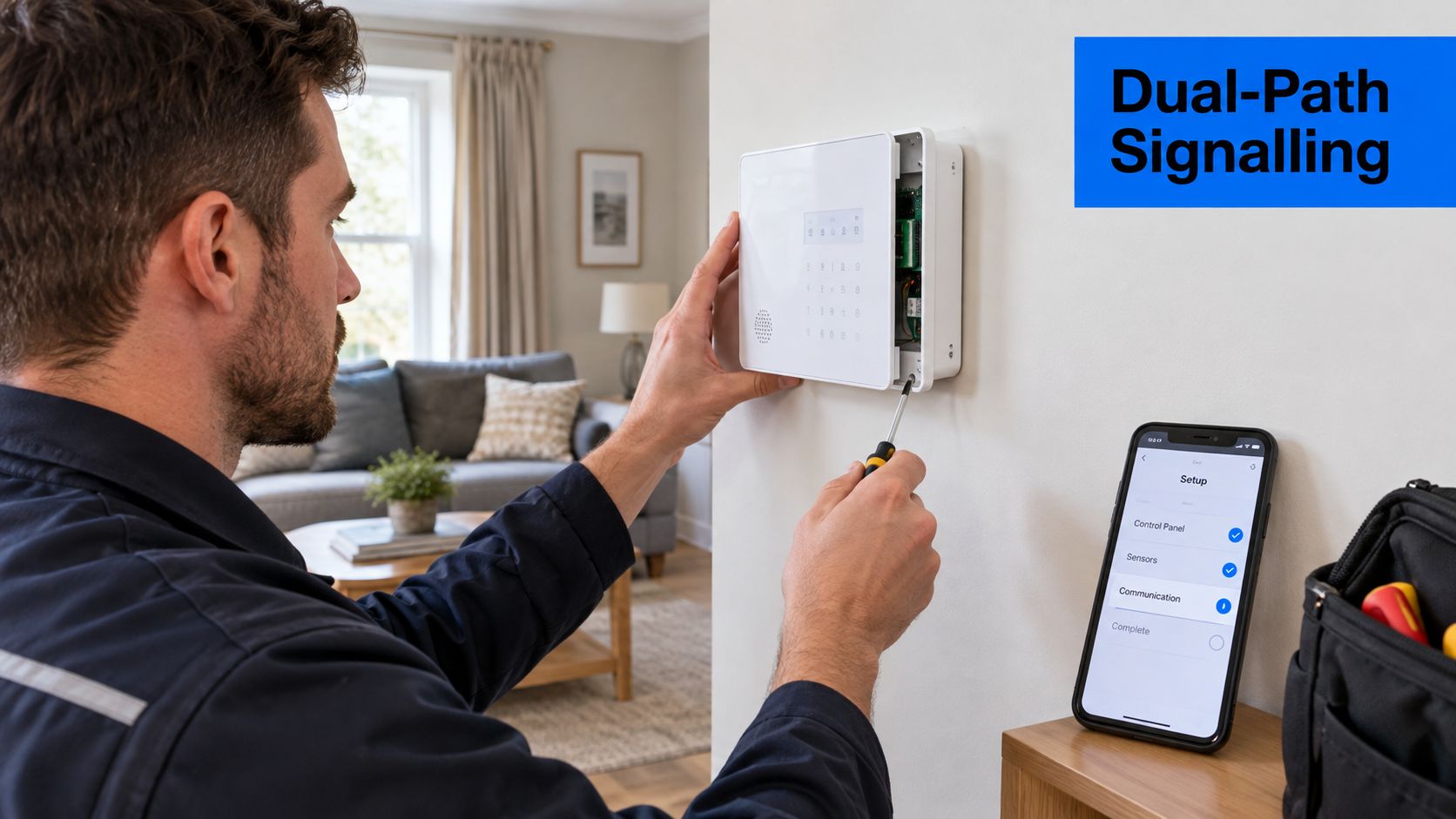
The signalling path matters more than whether a sensor is wireless. A monitored system may use broadband, cellular communications or a dual-path arrangement. Ask what happens if the router fails, the broadband connection drops, the mains supply is interrupted or the cloud account becomes unavailable. The installer should document the expected behaviour and any backup route instead of just saying “you'll get a notification”.
Watch this practical installation example before approving a design, especially if you want to understand how the panel, cabling and commissioning fit together.
Connected alarms also create cybersecurity obligations. UK rules for consumer connectable products have applied since 29 April 2024, including requirements around unique non-universal passwords, vulnerability reporting and disclosure of the minimum software-support period. The Government's smart-device security announcement provides the policy context.
Change default passwords, enable multi-factor authentication where available and keep the app and firmware updated. Put the alarm on a separate security or guest network where practical, restrict administrator access and record the support end date. For a small business, don't let the alarm, CCTV, access control and VoIP system all depend on one untested router without a continuity plan.
UK Compliance and Standards Worth Checking on Any Quote
Compliance only helps when the installer translates it into design and evidence. For a police-response arrangement, the relevant standards operate as a stack rather than a list of badges.
BS EN 50131 addresses system requirements and security grades. It helps define whether the selected equipment and design suit the threat level. BS 8243 covers installation and configuration principles, including the handling of confirmed alarms. PD 6662 provides the UK framework used with monitored systems and police-response arrangements. The alarm-receiving centre also matters, because a compliant premise-side installation is no use if the receiving and handling operation is inadequate.
Use the quote as a compliance checklist
Ask the installer to state:
- The intended system grade: It should reflect the premises and risk, not just the cheapest available package.
- The confirmation method: The quote should explain how an event becomes confirmed rather than relying on one activation.
- The monitoring route: Identify the alarm-receiving centre and the signalling method.
- The installer accreditation: Check whether the company holds relevant NSI or SSAIB approval for the service being offered.
- The handover evidence: Require zone plans, user instructions, test records, keyholder information and maintenance details.
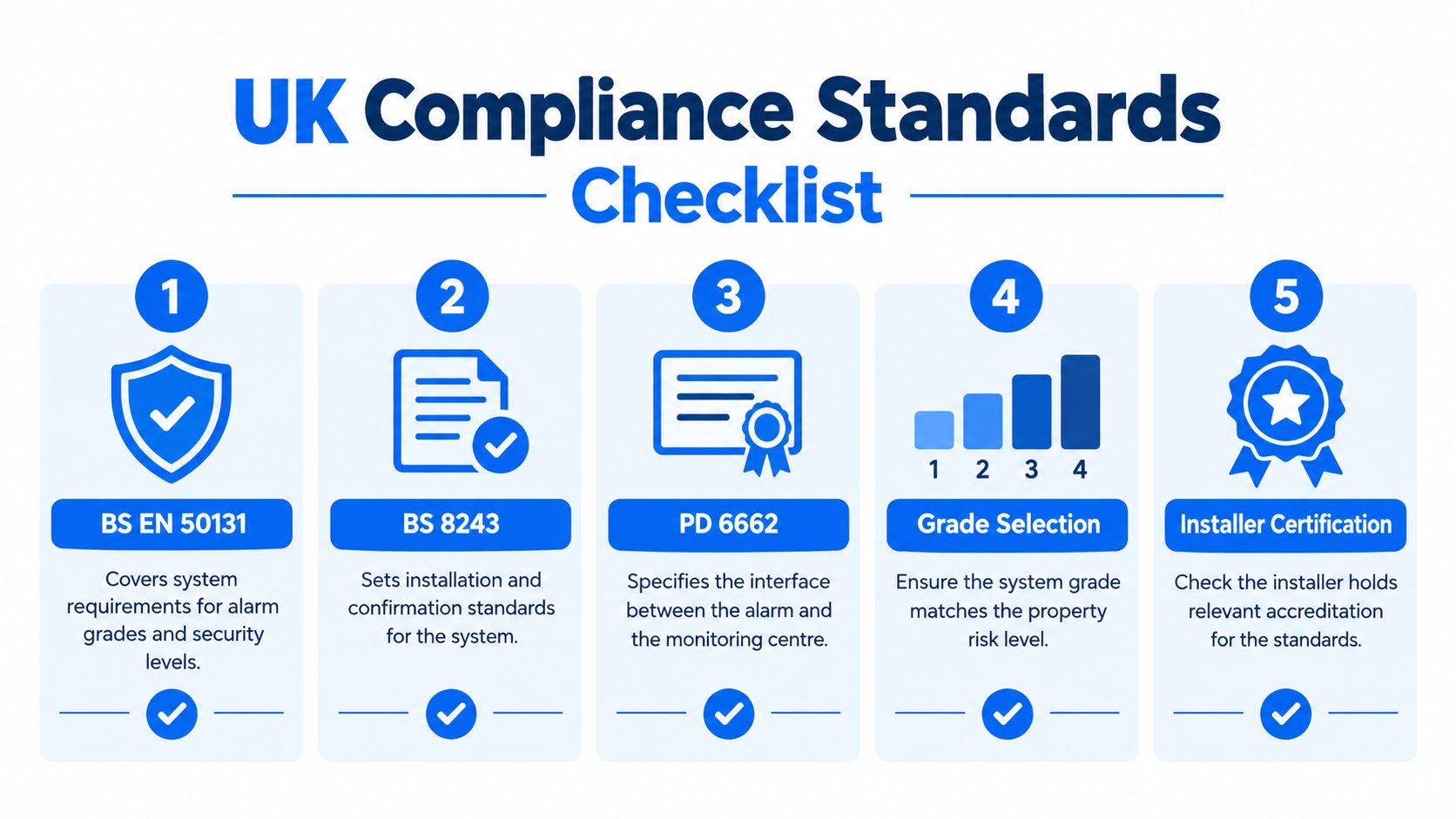
Accreditation isn't a substitute for asking questions. Confirm that the accreditation covers the installation and monitoring arrangement you need, and ask whether the proposed system can support the relevant police registration process. A quote that names standards without describing design, confirmation, maintenance and evidence is incomplete.
False-alarm control is central. National Security Inspectorate guidance says remotely monitored systems installed since June 2019 need conformity with PD 6662:2017 and BS 8243:2021 for police-response arrangements. It also states that three false calls within a rolling 12-month period can downgrade Level One priority response to Level Two, with reinstatement requiring the fault to be corrected and the system to remain false-alarm-free for three months. NSI's alarm guidance explains why commissioning and user training deserve as much attention as the equipment.
Typical Timelines and Cost Considerations
Installation time depends on access, cable routes, detector count, building use and the required signalling. A straightforward domestic wireless installation may be completed quickly, while a wired home system can take much of a working day. A small commercial project may need several visits for the survey, first fix, device installation, monitoring setup, testing and staff training.
Don't accept a price that hides the design assumptions. The main cost drivers are:
- Coverage: More doors, rooms, outbuildings and operating areas mean more devices and more commissioning.
- Connection method: Wired work can involve containment, access panels and making good. Wireless work reduces disruption but introduces batteries and radio planning.
- Monitoring: A monitored system adds an ongoing service commitment, not just an installation charge.
- Building access: Occupied offices, high ceilings, restricted areas and out-of-hours work affect labour.
- Aftercare: Servicing, replacement batteries, call-outs, user changes and keyholder updates create lifecycle costs.
Published consumer guides often quote broad package prices, but those figures don't replace a site survey. The most useful quote separates installation, equipment, monitoring, maintenance and any optional CCTV or access-control work. If you're comparing wider security work, a guide to what security cameras cost to install can help you think about installation as a combination of equipment, labour and ongoing requirements, although local UK pricing still needs separate confirmation.
Budget for the years after handover. An alarm with no plan for servicing, connectivity changes, firmware support or new keyholders becomes less dependable as the property and the people using it change.
Reasons to Hire a Professional Installer
DIY alarms have a legitimate place. A small, lower-risk home may benefit from a simple bells-only or self-monitored system, particularly when the owner understands its limits and is prepared to manage batteries, accounts and alerts. The mistake is calling that arrangement equivalent to a professionally designed police-response system.
For commercial premises, or any installation tied to insurance or formal response requirements, professional work is the sensible option. The installer should survey the site, select suitable equipment, position devices properly, configure confirmation logic, test the signalling path and train every relevant user. That sequence reduces avoidable failures that begin with poor placement or confused setting procedures.
The false-alarm problem is operational
False alarms don't just annoy neighbours. Repeated unverified activations can change the response available to the premises. Common causes include pets crossing detection zones, direct sunlight, heaters, ventilation, loose fittings, unstable door contacts, power interruptions and staff who haven't been trained on the entry procedure.
A professional commissioning process should test those conditions rather than merely proving that the siren makes a noise. It should also leave a clear record of zones, contacts, maintenance responsibilities and what the keyholder must do after an activation.
Cybersecurity belongs in the handover
For connected systems, ask the installer to document:
- Account ownership: The customer should control the primary account and recovery details.
- Access permissions: Staff should receive the access they need, not shared administrator credentials.
- Update support: Record who manages firmware and when the product may reach end of support.
- Outage behaviour: Test mains-power, broadband and cellular failure scenarios where relevant.
- Network separation: Keep security devices away from unnecessary business and guest traffic where practical.
A professional won't make a cloud-dependent alarm independent of the internet. They can, however, expose the dependency, test it and design a response that doesn't rely on wishful thinking.
Before you sign, carry this checklist into the survey:
- Define the response: Decide whether you need a local siren, keyholder notification or monitored escalation.
- Map the property: Include doors, glazing, garages, sheds, pets, staff routines and out-of-hours access.
- Demand a written design: Get the zone plan, detector rationale, signalling path and confirmation method.
- Check credentials: Verify relevant NSI or SSAIB accreditation and ask what evidence you receive at handover.
- Plan maintenance: Agree servicing, batteries, user changes, keyholders and support arrangements.
- Test failure modes: Ask what happens during broadband, mains-power, radio and cloud-service failures.
- Compare total ownership: Separate installation from monitoring, maintenance and future changes.
Networking2000 is one option for businesses and homes across London and Essex, offering intruder alarm installation, including wired and wireless systems, maintenance and related connectivity and security services. The important point isn't the provider's name. It's whether the proposed system delivers the response you need, with documented installation, training and aftercare.
Ask Networking2000 for a site survey that covers alarm response, detector placement, connectivity resilience and ongoing maintenance, rather than a hardware-only quote. Visit Networking2000 to discuss an intruder alarm installation for your home or business in London or Essex.

