A break-in happens just before opening time. The cameras were powered, the recorder shows several hours of footage, and the business owner expects a straightforward police handover. Instead, the critical camera points at the wrong approach, the timestamp is inaccurate, night footage is washed out, and the export file won't play on another computer. The system recorded something, but it didn't produce useful evidence.
That distinction matters for every business choosing CCTV installation and service in London or Essex. A dependable system needs more than cameras on walls. It needs a documented purpose, suitable fields of view, reliable storage, secure access, accurate time, tested exports, privacy controls and ongoing maintenance. The camera is only one part of the security system.
Table of Contents
- Why Professional CCTV Planning Beats the Hardware-First Approach
- CCTV System Types and What Actually Works for Your Premises
- Legal Requirements and Privacy Compliance for London Businesses
- The Professional Installation Process From Survey to Commissioning
- Maintenance Plans and Service Contracts That Protect Your Investment
- Cost Breakdown and Making the Right Investment Decision
Why Professional CCTV Planning Beats the Hardware-First Approach
A hardware-first purchase usually begins with a resolution figure, a camera count or a mobile-viewing feature. Those specifications can be useful, but they don't answer the questions that matter after an incident. Can the footage identify the person? Does it show the relevant event clearly? Can an authorised person retrieve the original recording without altering it?
The UK's CCTV infrastructure developed from early experimental use into a mature public-security technology. A system was used at the 1953 coronation, permanent cameras appeared on some London streets during the 1960s, and public-space adoption accelerated during the 1980s. Bournemouth installed the first large-scale town-centre scheme in 1985, while later government funding supported more than 680 schemes through the Crime Reduction Programme between 1999 and 2003. The Police Foundation's CCTV history explains why businesses now need to treat CCTV as ongoing infrastructure, not a one-off purchase.
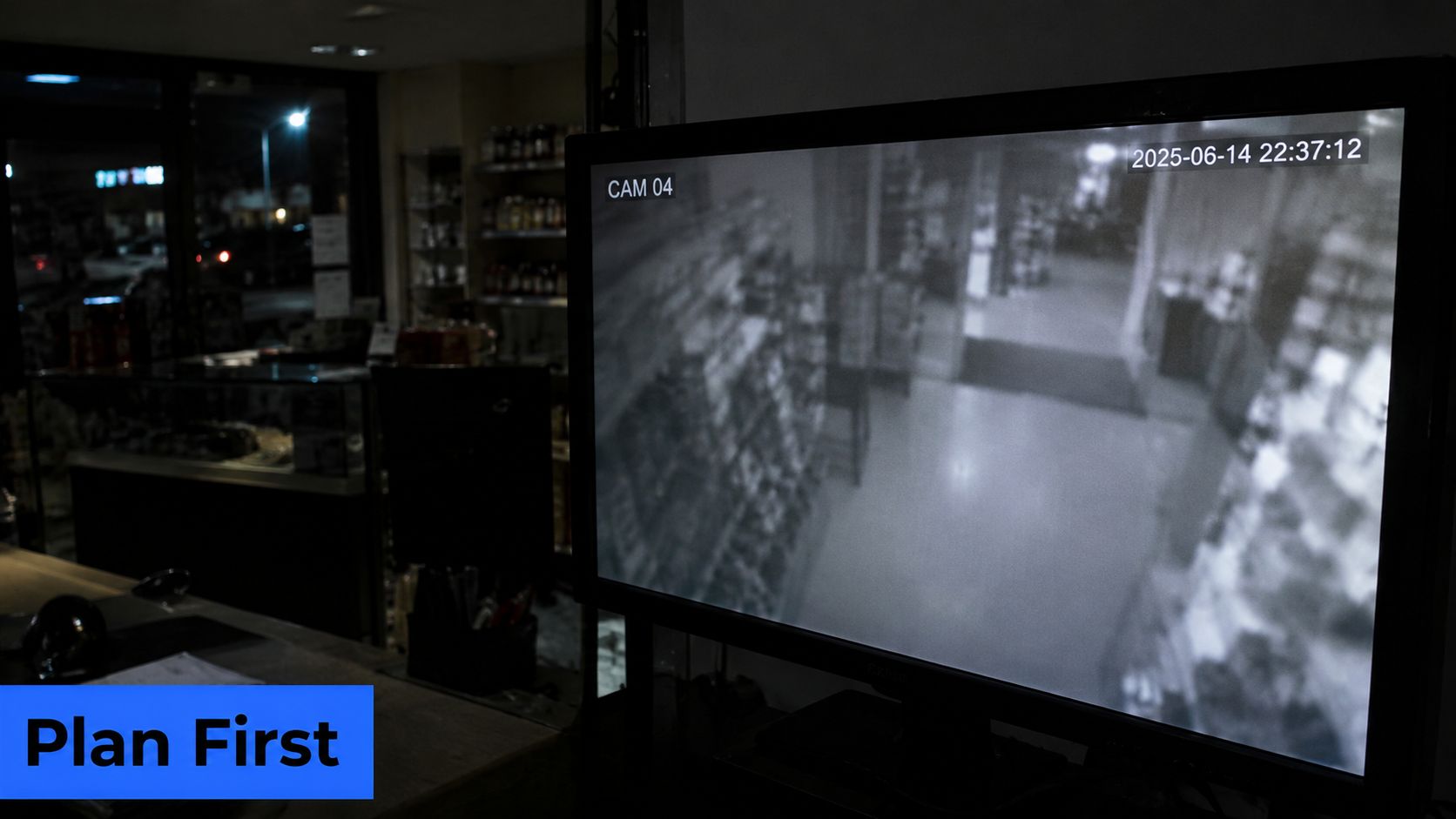
The real failure usually happens before installation
A professional survey starts with the security objective. A shop may need clear images at the entrance and till, while a warehouse may prioritise loading areas, restricted doors and vehicle movement. A small office might need evidence of unauthorised entry rather than continuous observation of every working area.
The installer then considers height, viewing angle, lighting, reflections, obstructions, cable routes, network capacity, recording location and access permissions. This prevents the common mistake of selecting cameras first and trying to make them fit the building afterwards.
Practical rule: A camera that records a poor view is not a successful camera. Judge the design by the evidence it produces at the target point.
The same principle applies after handover. Camera replacement, storage management, network connectivity, monitoring, maintenance and compliance controls all form part of ownership. A business that budgets only for installation may discover later that nobody is checking whether recording has stopped, storage is full or footage can still be exported.
Professional planning also limits unnecessary capture. A camera pointed across a neighbouring property or public area can create privacy problems that a narrower, better-positioned view would avoid. Good design improves security while reducing the amount of irrelevant personal data the organisation holds.
CCTV System Types and What Actually Works for Your Premises
The right system depends on the evidence required, the building layout, the available network and the way staff will respond to incidents. There isn't a universally superior format.
Analogue cameras remain practical where existing coaxial cabling is serviceable and the requirement is straightforward coverage. They can be economical for smaller premises, but expansion and integration may be less flexible than with a modern networked design.
IP cameras transmit digital video across Ethernet networks and suit businesses that need detailed images, flexible placement or integration with access control and remote services. They also make network design and cyber-security part of the installation decision. A camera that shares an unmanaged network with business systems needs careful configuration, not just a network socket.
Storage is an operational choice
An on-site DVR or NVR gives the business local control and can provide quick access when the network connection is reliable. It still needs physical protection, storage-health checks, power resilience and a tested export process.
Cloud storage can simplify remote access and off-site resilience, but it creates dependence on connectivity, account management and the provider's retention and security controls. Hybrid designs can keep local recording available while copying selected footage or events to remote storage. The useful comparison is not “local versus cloud” in the abstract. Ask where the original is held, who can access it, how long it remains available and what happens during an internet outage.
Camera form follows the scene
Fixed cameras provide predictable coverage and are usually the best choice when the area must remain continuously visible. PTZ cameras can support active monitoring across a wider area, but a moving camera may be looking elsewhere when an incident occurs. They work best alongside fixed coverage, not as a substitute for it.
Bullets are visible and easy to deter opportunistic trespass. Domes offer a less obvious viewing direction and can suit customer-facing interiors. Covert cameras have a narrow use case and require especially careful privacy justification. Lighting also matters. If the surrounding illumination is poor, consider the building's lighting design alongside the camera specification. A resource such as browse lumen select recessed lights can help when reviewing commercial lighting options, but lighting should be assessed at the actual camera positions rather than chosen from a catalogue alone.
| System Type | Best For | Resolution Range | Storage | Cost Tier |
|---|---|---|---|---|
| Analogue | Straightforward premises using existing coaxial cabling | Varies by equipment | DVR | Lower to mid |
| IP | Detailed evidence, flexible expansion and integrations | Varies by camera | NVR, cloud or hybrid | Mid to higher |
| Fixed camera | Continuous coverage of defined areas | Varies by camera | Local or remote | Lower to mid |
| PTZ camera | Actively monitored wide areas | Varies by camera | Local or remote | Mid to higher |
| Cloud-connected system | Remote access and distributed operations | Varies by camera | Cloud, often with local buffering | Subscription-based |
The “Resolution Range” column is deliberately not reduced to a misleading universal figure. Nominal resolution doesn't guarantee identification. Position, lens choice, lighting, compression and target distance determine whether the image works.
Legal Requirements and Privacy Compliance for London Businesses
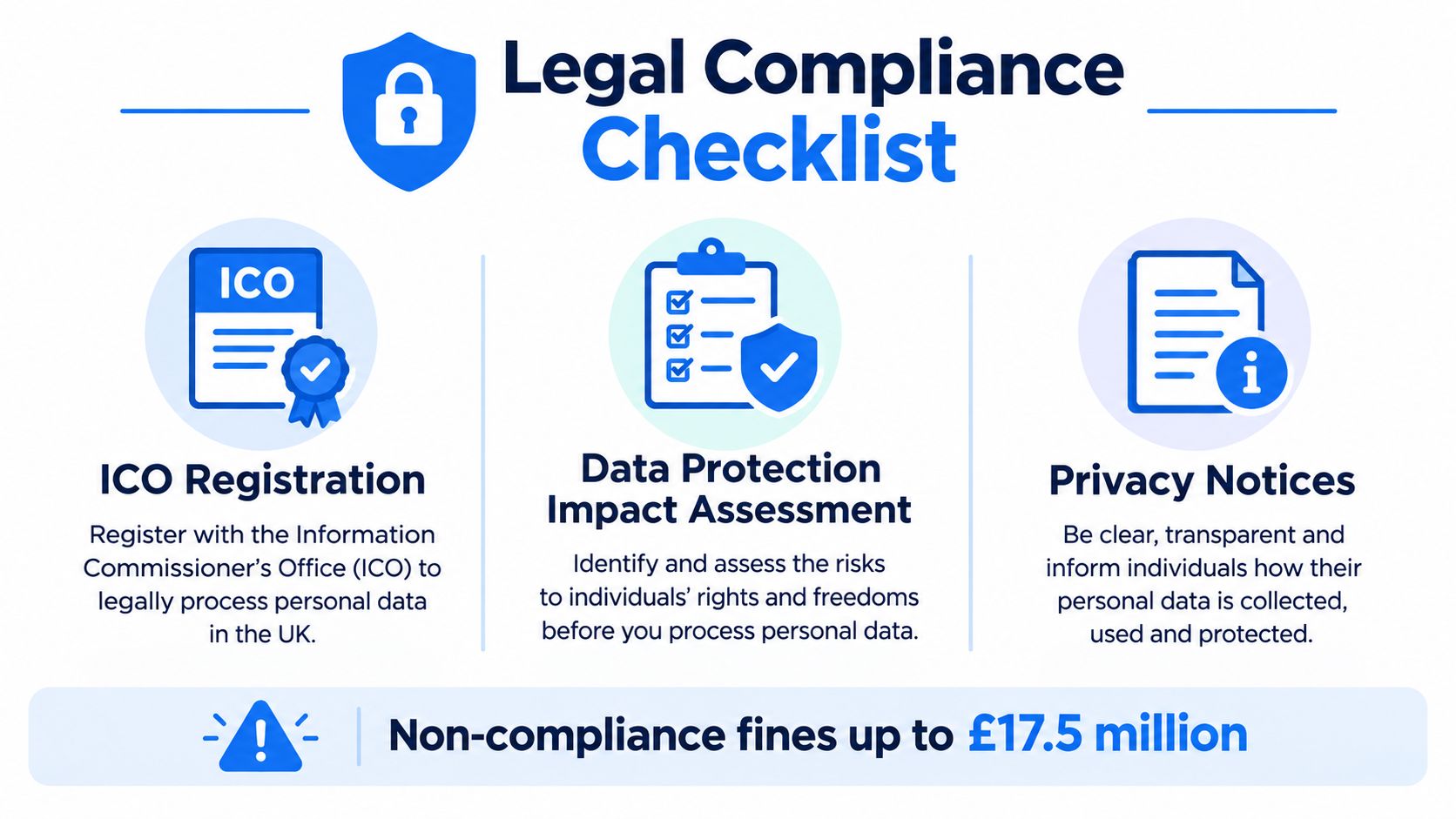
CCTV is a data-protection engineering project. The organisation decides why it is collecting images, what area it needs to see, who may access the recordings, how long footage is retained and when it must be deleted. Those decisions should influence the design before an installer fixes the first bracket.
The Information Commissioner's Office expects organisations to apply data protection by design and default. A Data Protection Impact Assessment, or DPIA, is required where processing is likely to create a high risk to individuals. It should consider necessity, proportionality, potential harm and the safeguards that reduce that harm. The ICO accountability guidance for CCTV sets out the need to document the purpose, sharing arrangements and retention approach.
Design controls that prevent avoidable exposure
A commissioning file should record each camera's field of view, the reason for its position, privacy masking requirements, access permissions, signage and retention decision. The installer and business should check whether the view captures neighbouring homes, gardens, pavements or other areas unrelated to the security purpose.
Audio deserves separate scrutiny. Recording conversations is substantially more intrusive than recording video alone and is harder to justify. If microphones aren't necessary, disabling them is usually the safer design decision.
Clear signage should tell people that surveillance is operating and identify the responsible organisation. Access should be limited by role, with individual accounts where the system allows them. Footage shouldn't be reused for an unrelated purpose, such as staff performance monitoring, just because it happens to be available.
Privacy control: More cameras and microphones don't automatically create better security. They can increase the volume of personal data, the number of access decisions and the consequences of a breach.
The ICO doesn't prescribe one universal retention period. The organisation must justify the period by reference to its purpose, keep it as short as necessary, review it and securely delete footage when it is no longer required. Businesses should also be ready to respond to a person's access request within one calendar month.
Budget for compliance, not just equipment
The ICO's CCTV checklist indicates that non-domestic systems are likely to require a data-protection fee, with fees ranging from £52 to £3,763 depending on business circumstances. The ICO CCTV checklist provides the relevant context for small and medium-sized organisations.
Privacy work also has a practical similarity with other safety-sensitive technologies. Businesses reviewing surveillance governance can find useful general principles in resources about privacy practices for drone pilots, particularly around purpose, responsible handling and limiting unnecessary data collection. The systems differ, but the discipline is the same: define the purpose, control access and document decisions.
The Professional Installation Process From Survey to Commissioning
A proper installation begins before anyone drills into a wall. The survey should turn a general request for “CCTV coverage” into a map of risks, views, infrastructure and responsibilities.
Start with the building, not the catalogue
The survey should record:
- Target areas: Define what each camera must show and why the view matters.
- Blind spots: Identify gaps caused by walls, vehicles, shelving, gates, lighting columns or future changes.
- Lighting conditions: Check daylight, glare, shadows, low-light areas and night-time illumination.
- Cable routes: Assess containment, fire stopping, external exposure, access restrictions and serviceability.
- Network requirements: Confirm switch capacity, power delivery, bandwidth, segmentation and remote-access controls.
- Privacy boundaries: Mark neighbouring property, public space and areas that don't need to be captured.
A survey should also consider how staff will use the system. A remote manager may need a simple event search, while a control-room operator may need multiple live views and alarm integration. The recording platform must support the retrieval workflow, not just display cameras.
Installation is more than mounting
Technicians need to secure brackets, protect cable runs, terminate connectors properly and label equipment so another engineer can trace it later. Outdoor housings should suit the location, and networked cameras should be configured with controlled accounts rather than left with default credentials.
The recorder should be located where authorised staff can reach it but casual visitors cannot. Power protection, ventilation and physical security affect reliability. If remote access is enabled, the installer should document who has it, why they need it and how access will be removed when roles change.
The handover should include a coverage plan, equipment list, user permissions, retention settings, export instructions and maintenance recommendations. Businesses should know what to do before an incident, not learn the interface while police or insurers are waiting.
Acceptance standard: “The camera is online” proves connectivity. It doesn't prove identification, usable playback or evidential quality.
Commission each view under real conditions
UK police guidance advises positioning cameras to produce the clearest possible images, checking blind spots and verifying that daytime and night-time lighting support identification. A technical acceptance test should assess every camera at its intended target distance under both day and low-light conditions, rather than relying only on the manufacturer's megapixel specification. UK government guidance on digital imaging and CCTV evidence provides the relevant operational context.
Test playback, timestamps, motion areas, low-light performance and an export from each important view. Then ask someone unfamiliar with the installation to retrieve a sample clip. If they can't find the correct camera and time window without assistance, the system isn't ready for an incident.
The same project discipline applies to related building work. Businesses comparing contractors can review Growth 4 Trades on UK schemes when considering how tradespeople present qualifications and project arrangements, while still checking CCTV-specific competence and evidence-handling experience.
A visual overview of the workflow can be useful for teams planning a commercial project.
Maintenance Plans and Service Contracts That Protect Your Investment
A CCTV system can fail without warning. The camera may still appear in a live view while the lens has become dirty, the angle has shifted, night illumination has degraded or the recorder is no longer retaining the required footage. A green status icon doesn't confirm that yesterday's evidence will play correctly.
Businesses generally choose one of three service models.
Reactive repair
The business calls when a camera goes offline or an incident exposes a problem. This approach appears economical because it avoids a scheduled service commitment, but it leaves failures undiscovered and often creates urgent call-outs at the worst possible time.
Reactive repair also encourages narrow fixes. An engineer may restore power to a camera without checking storage, time synchronisation, export reliability or other cameras covering the same area. The immediate fault disappears, while the underlying evidential weakness remains.
Planned preventive maintenance
A planned visit checks the system before an incident tests it. The service should include lens cleaning, focus and alignment, infrared and night-mode testing, time verification, storage-health checks, playback review, firmware and cyber-security review, cable inspection and a documented export test.
The technician should compare current views with the original coverage plan. New shelving, signage, plant growth or construction can create blind spots without causing an equipment alarm. Maintenance records should state what was checked, what failed, who corrected it and whether a retest passed.
Managed service and monitoring
A managed contract adds defined ownership. The provider may monitor availability, handle updates, manage accounts, respond to alerts or coordinate repairs, depending on the service scope. This suits businesses without an internal person who can regularly review recordings, storage and access permissions.
Monitoring isn't a substitute for evidence testing. A provider can know that a device is online while missing the fact that the image no longer identifies a face at the required distance. The contract should state both technical response times and the checks that prove footage remains useful.
Service test: Ask to see the maintenance checklist, the fault escalation route and a sample export record. A vague promise to “keep the system running” isn't a service specification.
Evidence handling belongs in the contract
After an incident, staff should isolate the relevant time window, preserve the original recording, create a working copy, log every disclosure, verify the recipient and record the lawful purpose. The process should preserve timestamps and prevent casual editing or public sharing.
The ICO post-deployment governance guidance confirms that organisations remain responsible for disclosure decisions, secure transfers and procedures for access, erasure and restriction requests. Footage generally needs to be supplied within one month when a valid access request applies.
A service plan should therefore cover more than hardware. It should test retrieval, export, user permissions, retention settings and incident records. The goal is a system that can produce reliable evidence when required, not merely one that displays live images on a monitor.
Cost Breakdown and Making the Right Investment Decision
CCTV pricing becomes misleading when a business asks for a camera price without defining the job. The final investment depends on camera positions, cabling, network infrastructure, storage, lighting, integration, access requirements and service arrangements. A low equipment quote can still become expensive if it omits containment, configuration, privacy work, training or future maintenance.
The useful starting point is a written scope. It should identify each target area, the evidence required, the proposed camera type, the recording approach, retention rationale, user groups, export method and acceptance tests. Without that scope, competing quotes may describe completely different systems.
What changes the installation cost
A small retail unit may have a compact footprint but demanding entrance and till views. A medium office may need controlled coverage around doors, reception and restricted rooms. A warehouse can require longer cable routes, higher mounting positions, challenging lighting and protection against dust or impact. A multi-site operation adds central management, consistent user permissions, remote access governance and repeatable maintenance.
The main cost drivers are:
- Camera selection: Specialist low-light, number-plate or vandal-resistant equipment can cost more than general-purpose units.
- Cabling complexity: Long, concealed or externally protected routes take more labour than accessible internal runs.
- Recording and retention: More cameras and longer justified retention require more storage and administration.
- Network changes: IP systems may need suitable switching, segmentation, power delivery and secure remote access.
- Integration: Access control, intruder alarms, monitoring and incident alerts add design and commissioning work.
- Service commitment: Planned inspections, firmware review, export testing and response cover create an ongoing cost but reduce unmanaged risk.
Don't compare a professionally commissioned system with a box bought online as though they deliver the same result. The cheaper option may be adequate for a basic internal view, but it may not include a survey, privacy masking, documented permissions, reliable timestamps, evidence exports or a maintenance owner.
Choose the right level of support
DIY can suit an owner who has a simple property, strong technical confidence and time to manage updates, accounts, storage and testing. It becomes a poor fit when the business needs evidential quality, multiple users, remote access, public-facing coverage or a defensible compliance process.
A local installer is often suitable for a defined single-site project. Ask for references, a site survey, a camera plan, sample commissioning records and a clear service route. A full-service provider is more appropriate when CCTV sits alongside business networking, access control, intruder alarms or managed IT. The same team can then consider how the camera network, remote access and wider security controls interact.
Networking2000 is one London and Essex option for businesses seeking CCTV installation, system design, digital recording, remote monitoring and related networking or security support. Its service scope should still be assessed against the written requirements, acceptance tests and governance responsibilities described above.
Use total cost of ownership as the decision test
Before approving a quote, ask:
- What must the footage prove? Identification, event sequence, vehicle movement and general deterrence require different designs.
- Who owns compliance? Assign responsibility for the DPIA, signage, retention, access requests and disclosure decisions.
- Who checks the system? Name the person or provider responsible for maintenance, storage and export tests.
- What happens during an incident? Confirm the procedure for preserving originals, creating working copies and logging disclosures.
- What happens when the business changes? New doors, lighting, shelving, staff or network equipment can alter the system's performance.
The UK sector's history shows that CCTV is a long-term operational asset. Public-sector spending data also demonstrates that installation, maintenance and monitoring are part of the ownership cycle, not minor extras. A 2016 statement from the Surveillance Camera Commissioner reported a 46.6% fall in local-authority spending on those activities since 2012, from approximately £515 million to about £277 million, while warning that reduced budgets could affect operational effectiveness. The commissioner's IFSEC speech makes the practical point clear: cutting service can leave a large installed estate less reliable.
The most economical decision is the one that produces usable evidence, limits unnecessary data capture and remains maintainable. A camera that records but cannot identify, retrieve or lawfully disclose footage isn't a saving.
Networking2000 provides CCTV installation and service for businesses across London and Essex, including site surveys, system design, digital recording, remote monitoring and related network security support. To discuss a system that is planned around evidence quality, privacy controls and ongoing maintenance, visit Networking2000 and request a practical assessment of your premises.

