What if your website isn’t just losing enquiries, but putting your business at risk? For Essex firms, a website redesign Essex project should do more than refresh the look. It should address slow loading, mobile visitors who leave before they get in touch, and security weaknesses in an ageing platform.
If your current site feels dated or difficult to manage, it’s worth asking whether it still supports your business. A redesign is a practical IT infrastructure upgrade, not simply a creative facelift. It can help you build a faster, more secure website that gives local customers a clearer route to contact you and supports your visibility in Essex search results.
This 2026 checklist explains when a redesign makes sense and what to plan before work begins. We’ll cover mobile usability, speed, security, accessibility, local SEO and how your website can work alongside your business IT systems. Networking2000 is a Wickford-based company founded in 1998, combining bespoke website design and development with managed IT and security expertise, plus ongoing maintenance to help keep your digital presence dependable.
Key Takeaways
- Spot the warning signs that your current website may be losing enquiries or creating avoidable security risks.
- A website redesign Essex businesses can benefit from should improve the foundations too, including clean code, loading speed and search visibility.
- Consider how website security fits with your wider IT setup, including the role managed firewalls can play.
- Use clear navigation and well-placed calls to action to make it easier for visitors to become enquiries.
- See how a structured redesign process can align your website with business goals and support it with ongoing maintenance.
When to Organise a Website Redesign for Your Essex Business
A website can look acceptable and still cost your business enquiries. Visitors may struggle to use it on a phone, wait for pages to load or leave without finding a clear next step. Consider a redesign when these problems persist or when your site no longer reflects the business you run today.
There’s a technical cost to “good enough”, too. An old site may depend on plugins or code that no longer receive updates. That can leave known weaknesses unaddressed and make the site harder to maintain. A redesign gives you the opportunity to review what’s running behind the scenes, remove unnecessary components and plan for ongoing maintenance. It’s a practical way to support your business’s digital future, not just change its appearance.
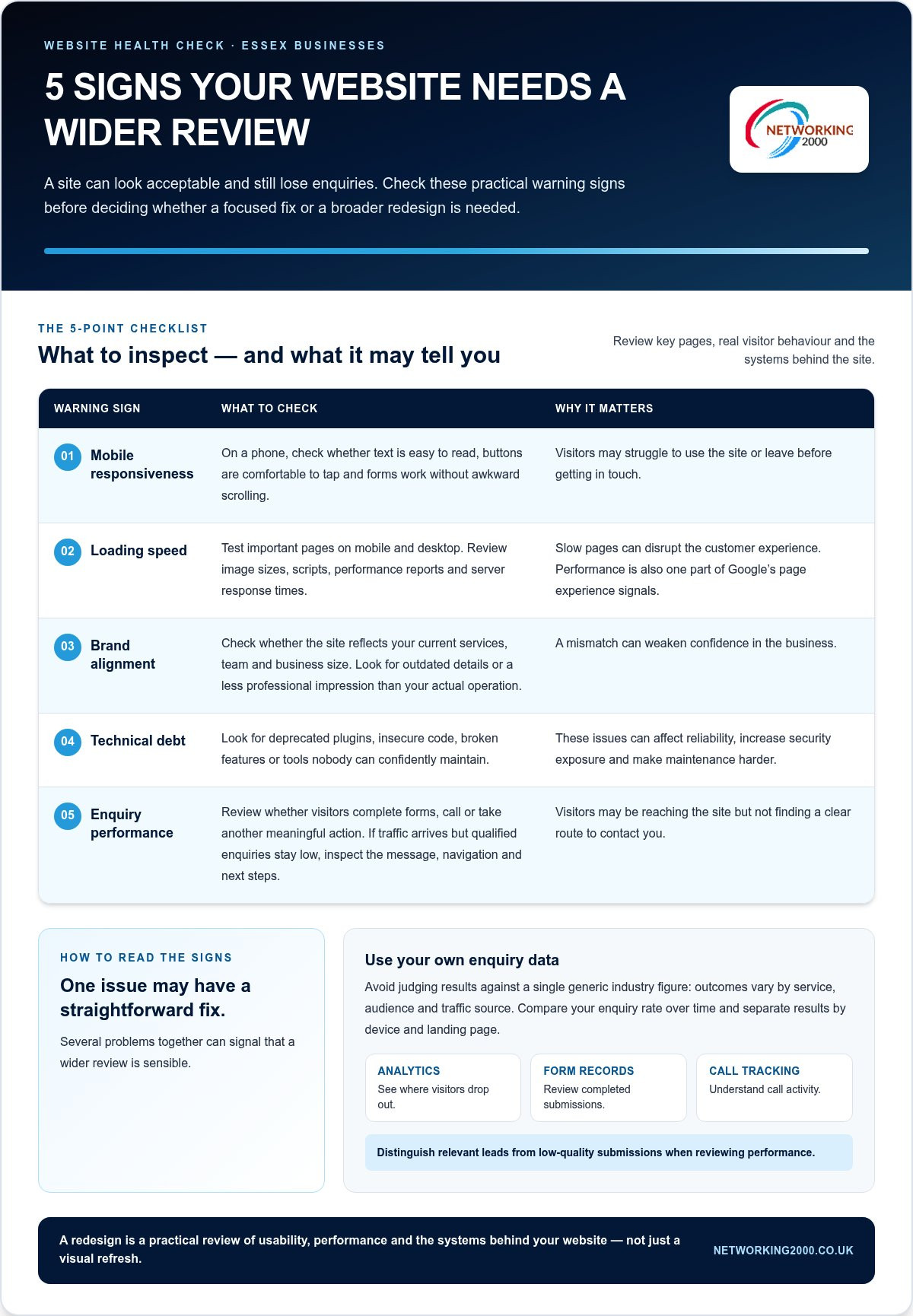
The 5-Point Redesign Trigger Checklist
Use this checklist to identify issues that deserve attention. One problem may have a straightforward fix; several together can signal that a wider review is sensible.
- Mobile responsiveness: Check key pages on a phone. Is text easy to read? Can visitors tap buttons comfortably, and do forms work without awkward scrolling?
- Loading speed: Test important pages on mobile and desktop. If they feel slow, check performance reports and investigate image sizes, scripts and server response times.
- Brand alignment: Does the site reflect your current services, team and business size? Outdated details or a site that feels less professional than your actual operation can weaken confidence.
- Technical debt: Look for deprecated plugins, insecure code, broken features or tools nobody can confidently maintain. These issues can affect reliability and increase security exposure.
- Enquiry performance: Review whether visitors complete forms, call or take another meaningful action. If traffic arrives but qualified enquiries remain low, check whether the message, navigation and next steps are clear.
Don’t judge conversion performance against a single generic industry figure. Results vary with the service, audience and source of traffic. Instead, compare your own enquiry rate over time, split results by device and landing page, and distinguish relevant leads from low-quality submissions. Analytics, form records and call tracking can help reveal where potential customers drop out.
Why Local Essex Context Matters for Design
Local trust comes from relevance, not simply adding “Essex” to a page. Use accurate service-area details, recognisable local context where it genuinely fits, and imagery that feels connected to your business rather than interchangeable stock. As a Wickford-based company, Networking2000 understands the value of a clear, locally grounded digital presence.
People searching from Essex or London may use different place names and service terms, so review the language customers use in enquiries and search data. Local search intent changes as services and customer expectations shift. Build pages around the areas you genuinely serve and the questions customers ask, then check which pages generate useful enquiries. A considered website redesign Essex businesses can use should make those local signals clear without sacrificing straightforward navigation or useful content.
Performance and SEO: Beyond the Visual Facelift
A redesign can look polished and still underperform if the site is weighed down by unnecessary code, slow server responses or a confusing page structure. Clean code helps browsers load and display pages efficiently, and makes the site easier to maintain. Bespoke development can avoid the scripts and features bundled into generic templates when they don’t serve your business. The aim isn’t technical complexity. It’s a site that does what visitors need without carrying avoidable baggage.
Speed matters to people first. A customer searching for a service in Essex may leave if a page stalls, particularly on a mobile connection. Loading performance is also one part of Google’s page experience signals, but it isn’t a shortcut to higher rankings. Useful, relevant content and a clear local focus still matter. Treat performance as a foundation that helps customers and search engines access your pages.
Core Web Vitals in 2026
Core Web Vitals help assess real-world loading, responsiveness and visual stability. Largest Contentful Paint (LCP) measures how quickly the main content appears; Cumulative Layout Shift (CLS) tracks unexpected movement; Interaction to Next Paint (INP) reflects responsiveness to user interactions. First Input Delay (FID), sometimes found in older reports, has been replaced by INP. Review these measures alongside server response times, image sizes and scripts to find what’s slowing the experience.
Hosting is part of that picture. A server closer to UK visitors can help reduce network delay, although location alone won’t make a slow site fast. Server capacity, configuration, caching and image delivery all play a role. Managed hosting can help keep these technical settings maintained and performance monitored. During a website redesign Essex businesses should assess the full hosting environment, not just the page design.
SEO-First Content Architecture
Plan the page structure before development. Give each core service a clear, useful page, then organise supporting information so visitors can find it without guessing. A business serving Wickford and nearby Essex areas should describe its genuine locations and services accurately, rather than creating thin pages that repeat the same wording with place names swapped.
Keep URLs short, readable and stable. A clear service path is easier to understand than a string of numbers or changing parameters. Link related service pages and helpful articles using descriptive anchor text, so people can move naturally between topics and search engines can understand how the content connects.
Protect existing SEO value during migration. Record current URLs, identify pages that attract visits or enquiries, and map any changed address to its closest relevant replacement with a permanent redirect. Retain useful page titles, headings and content where they still fit. Before launch, check internal links, canonical tags, the XML sitemap and key forms. After launch, monitor indexing, traffic and errors so issues can be corrected promptly. Networking2000’s bespoke website design and development brings technical and creative planning together, with ongoing maintenance to help keep the site in good order.
Security and Infrastructure: Protecting Your Digital Asset
Your website is part of your business infrastructure. It may store customer details, connect to enquiry forms or rely on plugins and external services. Attackers often use automated tools to scan websites for familiar weaknesses, so an Essex business doesn’t need to be singled out to face a threat. An outdated platform or weak account security can give an attacker an opportunity to disrupt the site or access data.
Security should be planned into a redesign, not added as a last-minute extra. That means looking beyond the padlock symbol in a browser. HTTPS protects data in transit, but it won’t fix insecure software, weak passwords or excessive user permissions. A secure site also supports trust: clients are more confident sharing information when pages load correctly, forms behave as expected and the business presents a reliable online presence.
Essential Web Security Protocols
Use current TLS encryption across the whole site, with secure settings and certificates configured correctly. Then address the risks within the application itself. SQL injection attempts target weaknesses in how a site handles database queries; cross-site scripting (XSS) can exploit unsafe handling of visitor input. Secure coding, input validation, software updates and appropriate access controls help reduce these risks. If your site connects to other systems through APIs, protect those connections with authentication and validation too.
A managed firewall can add a further layer of protection by controlling and monitoring network traffic. Its role depends on how the website, hosting and business network are set up. It should complement, not replace, secure application code, access controls and malware monitoring. Networking2000 provides managed firewall support in Essex as part of a wider approach to business IT security.
Backups are another essential safeguard. Keep regular copies of the site and its data, protect them from unauthorised access and store them separately from the live environment. A backup is only useful if it can be restored, so include restoration checks in your recovery plan. This helps you respond methodically if a technical fault, compromised account or other incident takes a site offline.
The Role of Ongoing Maintenance
“Set and forget” leaves a site exposed to changes in software and emerging vulnerabilities. Review and apply security patches, update the content management system and plugins, remove tools you no longer need, and check that user accounts still require their access. Schedule these tasks and keep a record of changes. Updates should be tested appropriately so a fix doesn’t disrupt important site functions.
Ongoing website maintenance for Essex businesses helps identify issues before they become prolonged outages. As part of a website redesign Essex project, agree how updates, backups and recovery checks will be handled after launch. With design, hosting and IT security considered together, your website can become a more dependable business asset, supported over time.
Conversion-Led Design: Turning Visitors into Enquiries
A website should make the next step obvious. Visitors need to understand what you do, why it suits their needs and how to reach you. If they have to hunt for a phone number or work through a long, confusing form, they may leave before making an enquiry. Good user experience (UX) removes that friction, with clear navigation, useful service information and calls to action placed where people are ready to act.
For an Essex business, trust matters as much as convenience. Use genuine testimonials, relevant project examples and accurate details about your work to show prospective clients what to expect. Local case studies can help people recognise that you understand the businesses and customers you serve. Keep claims specific and evidence-based. A clear example of a challenge solved is more reassuring than a broad promise.
Calls to action should match the visitor’s intent. A service page might invite someone to make an enquiry, while an informational page can offer a simple route to discuss their requirements. Make buttons descriptive, easy to spot and consistent across the site. Track which pages and contact routes lead to relevant enquiries, then refine the layout based on what visitors actually use.
Integrated Business Communications
Your website’s contact options should connect with the way your team handles enquiries. A visible phone number can be tappable on mobile, whilst a well-designed form can collect the details needed for a useful follow-up. If live messaging suits your audience and support process, make its purpose and availability clear rather than implying an instant response you can’t provide.
Linking your site to business VoIP telephony can help connect digital enquiries with your communications setup. Custom forms can also gather information relevant to a particular service, without asking visitors to complete unnecessary fields. Bespoke website design in Essex makes it possible to shape these journeys around your business processes rather than forcing them into a generic layout.
Mobile-First vs Responsive Design
Responsive design adapts a layout to different screen sizes. A mobile-first approach starts by prioritising the smaller screen, then expands the experience for larger devices. Both matter. Put essential information within easy reach of a thumb, use readable text and make buttons large enough to tap comfortably. For mobile forms, ask only for useful details, use suitable input types and avoid fields that are difficult to complete on the move.
Speed supports the whole journey. A slow page can interrupt a potential customer before they reach your contact details, so test key pages and forms on mobile as well as desktop. A considered website redesign Essex project can bring the design, enquiry routes and communication tools together. Networking2000’s bespoke design and development can help build that joined-up experience. Plan a conversion-led website redesign around the way your customers need to get in touch.
The Networking2000 Redesign Process: A Safe Pair of Hands
A successful redesign needs creative direction and sound technical planning. Networking2000 brings bespoke website design and development together with managed IT and security expertise, so decisions about layout, content and features can take your wider business setup into account. The aim is a website that serves customers now and can be maintained as your organisation changes.
The process starts with discovery. Before design work begins, clarify what the website needs to achieve: more relevant enquiries, clearer service information, easier content updates or a better connection with existing business systems. Reviewing the current site, audience, content and technical requirements helps turn those priorities into a practical plan. It also provides a basis for assessing the finished site, rather than judging it on appearance alone.
Strategic IT Consultancy
Redesign decisions can affect more than the website. If your site connects to email, enquiry handling, customer records or other business tools, those relationships should be understood early. Networking2000’s managed IT support in Wickford brings a broader IT perspective to planning. Reviewing existing systems can help identify integration needs, avoid unnecessary duplication and shape a site that can adapt as your business and technology requirements evolve.
With the objectives agreed, bespoke development can be tailored to the project. That may mean a content structure suited to your services, forms designed around the information your team needs, or connections to relevant business systems. Building around real requirements avoids relying on generic features that add complexity without helping visitors or staff.
Deployment and Quality Assurance
Before launch, test key pages and tasks across a practical range of browsers and devices. Check that navigation, forms, contact details and any integrations work as intended. Review redirects and important page content too, so existing visitors can still reach relevant information. These checks help catch problems before the redesigned site becomes the main experience for customers.
Plan the transition carefully. A launch can involve DNS changes, content migration and platform configuration, so the timing and dependencies need attention. No website transition should be treated as a guaranteed zero-downtime event; careful preparation helps reduce disruption and makes it easier to respond if an issue appears. After launch, monitor the site and keep maintenance in the plan, rather than treating go-live as the end of the work.
A clear handover also matters. Your team should know how to manage routine content and where key site functions sit, with guidance shaped around the new setup. Networking2000 is based in Wickford and was founded in 1998. For a website redesign Essex project, that local presence, technical planning and ongoing maintenance offer a dependable route from first discussion through to the site’s next stage. Discuss your website redesign with a team that brings design and IT together.
Set Your Website Up for What Comes Next
Your website should be ready to support the business you’re building, not just the one you run today. Treat a redesign as a chance to set clear priorities for growth, customer experience and the systems your team relies on. With the right plan, your digital presence can become a more dependable business asset and support your future plans.
A website redesign Essex project starts with understanding what you need the site to do next. Networking2000 combines website development with IT and security expertise, giving you a practical partner for shaping a solution around your goals. The Wickford-based team brings more than 25 years of IT and digital experience, with a focus on bespoke solutions designed to support security and conversion.
Take the next step with a focused discussion about your plans and priorities. Discuss your bespoke website redesign with Networking2000 and start building a website that’s ready for your business’s next chapter.
Frequently Asked Questions
How much does a website redesign in Essex typically cost in 2026?
There isn’t one typical fee because the scope can vary considerably. A straightforward rebuild of a small site differs from bespoke development involving custom functions, content migration or software integrations. To compare proposals, define the pages and features required, identify who is supplying content, and clarify whether ongoing maintenance is included. This gives you a clearer view of what each project covers without relying on a headline figure alone.
How long will the redesign process take from start to finish?
The schedule depends on the project’s complexity, how quickly decisions are made and whether content is ready. A site with a small number of standard pages has fewer moving parts than one involving custom functionality, data migration or several approval stages. During planning, map out responsibilities for content, feedback and sign-off. That makes dependencies visible early and helps the team set a realistic schedule rather than guess at a launch date.
Will a redesign affect my current Google rankings in Essex?
A redesign can affect search visibility, but careful planning helps protect valuable pages. For a website redesign Essex project, document key landing pages and their existing URLs before work starts. If an address changes, direct it to the closest relevant new page, and check that the new site is crawlable after launch. Monitor Google Search Console for indexing issues and changes in impressions or clicks, then investigate unexpected drops promptly.
Do I need to change my hosting provider during a redesign?
No, a redesign doesn’t automatically require a hosting change. First assess whether your current setup supports the new site’s software, expected traffic, security needs and backup process. If it does, keeping it may simplify the transition. If a move is appropriate, plan the migration around domain settings, email dependencies and testing. Separating website hosting from business email can help avoid accidental disruption to staff communications during changes.
Can you integrate my existing business software into the new site?
Existing software can often connect to a new site through an API, secure plugin or another supported method. The practical starting point is to define what information needs to move and why. For example, an enquiry form might pass selected fields into a customer management system, reducing manual re-entry. Integration planning should also cover data permissions, error handling and testing, so a broken connection doesn’t silently interrupt an important business process.
Is bespoke web development better than using a template like WordPress?
Neither option is automatically best. WordPress is a content management system, not a template, and it can be used with either pre-built designs or bespoke development. A template may suit a site with standard requirements, whilst a bespoke build can better match specific workflows or functionality. Decide based on what the site must do, who will update it and how it’ll be maintained. The right choice should fit your business, not add needless complexity.
How often should a business website be redesigned?
There’s no fixed redesign timetable that suits every business. Review the site regularly, including after a change to your services, brand, customer journey or business systems. Ask whether the content is still accurate and whether the platform remains supportable. A full rebuild may not be needed if the foundations work well. Smaller updates, routine maintenance and targeted improvements can keep the site useful between larger projects.
What is the difference between a website refresh and a full redesign?
A refresh usually updates selected elements, such as colours, typography, copy or page layouts, whilst keeping the main structure and platform. A full redesign can involve rethinking navigation, rebuilding page templates, changing technology and reviewing integrations. Choose a refresh if the underlying site still meets your needs. If its structure or technical foundations prevent important changes, a broader redesign may provide a more suitable route forward for your Wickford business.

