43% of UK businesses identified a cyber security breach or attack in the previous 12 months, according to the Government’s Cyber Security Breaches Survey 2025/2026. For businesses searching for “cybersecurity services essex”, the practical question is which protection addresses their risks, not which tool sounds most comprehensive.
A firewall or antivirus subscription can play an important part, but it may leave gaps without ongoing monitoring and sound IT management. Comparing service descriptions and support arrangements can feel difficult. A useful starting point is to see how security measures work together and how they fit your organisation.
This guide explains the practical components of business cybersecurity and what to consider when comparing support. You’ll learn how managed firewall protection, monitoring and threat mitigation can work alongside wider IT support. Networking2000 provides managed IT and security services for businesses across Essex and London, from its base in Wickford. The aim is to help you identify a practical local fit for your business.
Key Takeaways
- Separate cybersecurity from general IT helpdesk support by identifying your security risks and the ongoing oversight your business needs.
- Understand how managed firewalls, network monitoring and threat mitigation can contribute to a broader security approach.
- Compare cybersecurity services essex businesses can use by looking beyond a service list to what is managed routinely and how issues are escalated.
- Prepare to assess your needs by recording critical systems, users, devices, locations and operational dependencies.
- Consider how Networking2000’s Wickford base and combined IT and security support could suit your business in Essex.
Cybersecurity services in Essex: what does a business actually need?
Business cybersecurity is the policies, technology and ongoing support an organisation uses to reduce digital risk and protect its systems, data and day-to-day operations. A security service brings these elements together, while a firewall or antivirus subscription is a single product that addresses only part of the picture. For a foundational overview of the threats, vulnerabilities and safeguards involved in computer security, consider how different controls need to work together.
General IT helpdesk support helps staff resolve routine technology problems, such as access to a work device or a software issue. Cybersecurity focuses on reducing the likelihood and impact of unauthorised access or malicious activity. The two are connected: a security issue might first appear as a locked account or a device behaving unusually, but the response needs to consider risks to the wider business, not just restore access.
For an SME, start by listing the systems and information people rely on. These might include business email, user accounts, computers and mobile devices, office networks, customer and company data, and the tools needed to keep essential work moving if systems are disrupted. Priorities will vary. A small office handling customer records, for example, may have different dependencies from a business that relies on networked systems to deliver its service, and teams seeking greater visibility over sensitive files can explore Software-as-a-Service (SaaS) subscriptions for data discovery and scanning tools.
Which cyber risks should an Essex business consider first?
Phishing messages can trick staff into sharing credentials or opening an unsafe attachment. A compromised account may expose email or business files, while malware can interfere with devices or data. Unauthorised network access can put connected systems at risk. These threats can affect organisations of any size. Their practical impact might include staff losing access to essential information, delayed customer service or disruption to normal operations.
Map each risk to everyday work. Which accounts hold important information? Which devices connect to the business network? What would staff be unable to do if email or shared data became unavailable? Answering these questions gives you a more useful starting point than choosing a product based on its name alone.
When does a business need managed cybersecurity support?
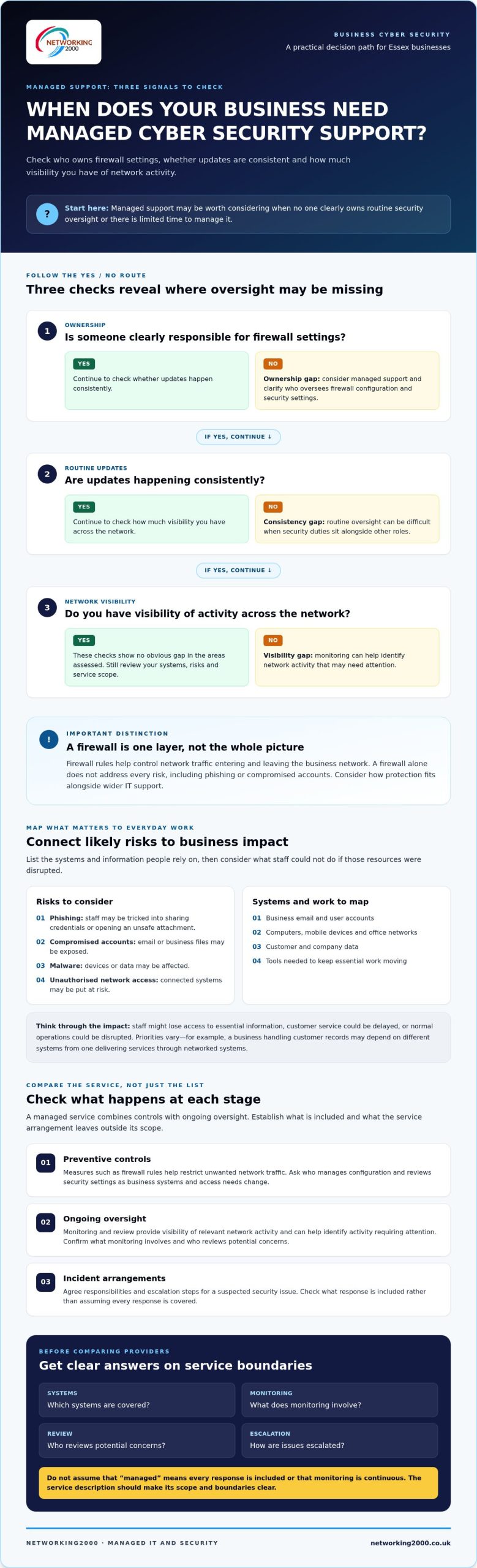
Consider managed support if no one is clearly responsible for firewall settings, updates happen inconsistently or you have little visibility of activity across the network. These gaps can be difficult to manage when IT duties sit alongside other roles and there’s limited time for routine security oversight.
Managed firewall protection, monitoring and threat mitigation can bring security oversight into the wider IT picture. Networking2000 provides IT security and managed IT services for businesses in Essex and London. Read more about managed IT support services for Essex businesses. When comparing cybersecurity services essex, identify what needs ongoing management, not just initial setup.
What managed cybersecurity services cover: firewalls, monitoring and response
How does a managed firewall protect a business network?
A firewall uses rules to control network traffic entering and leaving a business network. Those rules determine which connections are allowed and which should be blocked. A managed firewall service adds oversight of the firewall’s configuration and security settings, rather than treating installation as the end of the work.
Business systems and access needs can change. Reviewing firewall settings helps keep them relevant to the organisation’s current network. A firewall remains one layer of security, not a complete answer to risks such as phishing or compromised accounts. Networking2000 provides managed firewall protection, with network monitoring and threat mitigation as part of its IT security support. Read more about managed firewall protection for Essex businesses.
What should ongoing security monitoring include?
Monitoring provides visibility of relevant network activity so potential threats can be identified and assessed. Threat mitigation means taking steps intended to reduce risk or limit disruption. In practice, security is not treated as a one-off setup task; it has an ongoing management element. The precise scope depends on the service arrangement.
It’s helpful to distinguish three parts of the service:
- Preventive controls: measures such as firewall rules that help restrict unwanted network traffic.
- Ongoing oversight: monitoring and review that help identify activity requiring attention.
- Incident arrangements: agreed responsibilities and escalation steps for handling a suspected security issue.
Before choosing cybersecurity services essex, establish what is included at each stage. A clear scope should explain which systems are covered, what monitoring involves, who reviews potential concerns and how issues are escalated. Don’t assume that “managed” means every response is included or that monitoring is continuous. The service description should make its boundaries and responsibilities clear.
The National Cyber Security Centre’s NCSC small business cybersecurity guide offers practical security guidance for smaller organisations. Businesses looking for joined-up IT security and managed firewall support can explore Networking2000’s business IT and security support.
How to compare cybersecurity providers in Essex without relying on a service list
A list of services shows what a provider names, not how the work fits together or what your organisation will receive over time. Compare the scope, routine management and escalation arrangements, not just the number of security services on offer.
Use this table to organise your comparison of cybersecurity services essex businesses may consider:
| Area | What to compare | Why it matters |
|---|---|---|
| Service scope | Which users, devices, sites, networks and systems are covered? | Clear boundaries show where protection applies and where responsibilities sit. |
| Monitoring | What activity is monitored, who reviews it and how often? | A product setup alone doesn’t explain how potential issues are identified over time. |
| Firewall management | Does the service include configuration oversight and routine review, or only initial setup? | Network needs can change, so ongoing management is different from installation. |
| Escalation | How are potential threats raised, who takes the next step and what sits outside the service? | Defined responsibilities reduce confusion when a concern needs attention. |
Separate one-off work from ongoing responsibilities. A firewall installation may establish initial settings, while managed protection can include continuing oversight. Monitoring should also have a clear owner and a defined route for escalating concerns. Record these differences in plain language rather than treating “managed” as a complete description of the service.
Which questions reveal the real scope of a security service?
Map the service against your business. Which users, devices, locations and network components are included? Who owns monitoring, how is a potential threat escalated, and what does routine review cover? The cybersecurity checklist for businesses from the US Federal Communications Commission can prompt useful planning questions. Treat it as general guidance, not a substitute for UK-specific advice or an assessment of your own systems.
How should a business assess local support and wider IT fit?
Security is easier to manage as part of the wider IT picture. Consider whether firewall oversight and security support align with your IT arrangements, infrastructure and plans for maintaining essential work during disruption. A local working relationship can make it easier to discuss the practical setup of an SME, whether your business is based in Wickford or has teams across Essex. Networking2000 is based in Wickford and supports businesses across Essex and London. For continuity planning, use a disaster recovery plan that reflects your essential systems and operations.
Cyber security checklist for your Essex business
A short review of your systems and responsibilities can help you identify practical security priorities. Work through these steps before comparing cybersecurity services essex businesses may use. Keep the assessment proportionate to your organisation’s size, the sensitivity of its data and the disruption a security issue could cause.
- 1. Identify critical systems. List the services and information your team needs to operate, such as business email, shared files, customer records and essential software. Note what would be affected if access were interrupted.
- 2. Map users, devices and connections. Record key user accounts, computers and mobile devices, business locations, network connections and who needs access to each system. Include dependencies on suppliers or hosted services where relevant.
- 3. Review current controls and responsibilities. Note existing firewalls and other security measures, who manages them, and how updates and concerns are handled. Record known gaps, recurring issues or areas where ownership is unclear.
- 4. Define support needs and compare scope. Decide where your team needs ongoing support, then compare what a service manages routinely with what it sets up once. Check which systems and users are covered, how monitoring works and how concerns are escalated.
What information should you gather before comparing services?
Bring the details together in one place. Include important devices and network connections, access arrangements, existing firewall management and the person responsible for security decisions. Add operational concerns, such as systems that are difficult to work without. Note any security expectations from customers, suppliers or contracts, as these can differ between organisations.
How can businesses prioritise improvements sensibly?
Start with clear ownership and visibility. If nobody knows who manages a firewall or where important systems connect, adding another security product may not address the underlying gap. Prioritise improvements according to plausible exposure and business impact. A small organisation that depends on email and shared records may have different priorities from a firm with several sites or more complex operations.
Use the National Cyber Security Centre’s small business cybersecurity guidance as a practical reference, and consult current UK guidance for relevant recommendations. Legal or certification requirements depend on your circumstances, including the work you do and any contractual commitments. Don’t assume one certification or framework is mandatory for every business; establish what applies before making it a priority.
With your systems, responsibilities and priorities documented, you can have a more focused discussion about proportionate IT security support. Explore Networking2000’s business IT security support.
Cybersecurity services in Essex from Networking2000: a practical next step
Cybersecurity works best when it reflects how your business operates. A firewall is one part of the picture. Your wider IT setup, the people who rely on it and the support available to manage it all shape what’s practical for your organisation.
How Networking2000 supports business security needs
Networking2000 provides IT security, managed firewalls, network monitoring and threat mitigation for businesses in Essex and London. Managed firewall protection brings ongoing oversight to an important part of network security, while monitoring and threat mitigation support a broader approach. These services help address business risks, but no single security measure can remove every risk.
Security can also be considered alongside managed IT support. This joined-up view helps SMEs connect security arrangements with day-to-day IT needs rather than treating them as separate concerns. For example, a business can discuss who manages its firewall, how security fits its network and where practical support is needed. The scope should reflect the organisation’s environment and priorities, not assume every business needs the same arrangement.
Networking2000 is based in Wickford and has supported UK businesses since 1998. Its local base and work with organisations across Essex and London offer relevant context for SMEs looking for a business IT partner familiar with the area. Experience is not a substitute for a security certification, and it doesn’t mean every organisation needs the same solution. The focus is on understanding the business and tailoring support to its requirements.
What happens when you take the next step?
Start with a clear outline of your business environment. Share which systems and locations matter to your work, how your team uses them, who currently looks after security and what concerns you most. You don’t need to arrive with technical terms or a complete assessment. A straightforward account of your setup and priorities gives the discussion a practical starting point.
The conversation can then focus on relevant service scope and requirements: where managed firewall protection fits, what monitoring and threat mitigation involve, and how security relates to your wider IT support. Clear expectations help you understand the role of ongoing management and how it aligns with your organisation.
If you’re considering cybersecurity services essex businesses can use as part of practical, joined-up IT support, discuss your security requirements with Networking2000. Bring your questions and priorities, and take the next step at a pace that suits your business.
Make your next security decision a practical one
Choosing cybersecurity services essex businesses can rely on starts with understanding what matters to your organisation. Identify the systems and information your team depends on, then compare what’s managed routinely, how monitoring works and how concerns are escalated. A firewall is a valuable part of protection, but it should sit within a broader approach to business IT.
Networking2000 is based in Wickford and works with organisations across Essex and London. It provides managed firewall protection that includes monitoring and threat mitigation, alongside managed IT support and security services that can be considered together and tailored to SME requirements.
You don’t need to solve every security question at once. A clear picture of your systems, priorities and current concerns is a useful place to begin. Talk to Networking2000 about your business cybersecurity needs and discuss practical IT and security support for your organisation.
Frequently Asked Questions
What do cybersecurity services for businesses include?
Business cybersecurity services can include security oversight, firewall management, monitoring and threat mitigation. The exact scope depends on your organisation’s requirements. Compare which systems and network components are covered, how potential threats are handled and what ongoing support is included. A list of products alone may not show who manages them or how the different measures work together to support your business.
Do small businesses in Essex need managed cybersecurity?
Small businesses can depend on email, business data, connected devices and network access, so security deserves practical attention. Managed support can help when your team has limited time or specialist capacity for routine security oversight. Start by listing important systems and reviewing existing controls. Then consider whether ongoing oversight and managed firewall protection would address gaps relevant to your operations in Wickford or elsewhere in Essex.
How do managed firewalls protect a business?
A firewall applies rules to help control network traffic entering and leaving a business environment. A managed firewall service adds oversight of its settings and relevant network activity, rather than treating installation as the whole task. Firewalls are one layer of security, not a guarantee against every cyber incident. Compare which configuration and monitoring tasks are included, how threat mitigation works and how potential issues are escalated.
Can cybersecurity services prevent phishing attacks?
No single cybersecurity service can guarantee that every phishing attempt will be stopped. Businesses can reduce risk through appropriate technical controls, clear processes for reporting suspicious messages and staff awareness. Consider how cybersecurity services fit with email and account security, and how concerns are handled. A firewall can help manage network traffic, but it shouldn’t be treated as a complete answer to threats that target people or account credentials.
How often should a business review its cybersecurity?
Review security when your business changes, such as when you add systems, change working arrangements or introduce new access needs. Regular reviews can help you spot changes in risks, responsibilities and controls. The right schedule depends on your organisation and its obligations, so one frequency won’t suit every business. Use current National Cyber Security Centre guidance and relevant contractual requirements as reference points, and revisit your approach when circumstances change.
What is the difference between IT support and cybersecurity services?
IT support helps keep business technology working and assists users with technical issues. Cybersecurity focuses on reducing digital risk through protection, oversight and threat mitigation. The services can overlap: managed IT support may help maintain business systems, while managed firewall services oversee network protection. For SMEs comparing cybersecurity services essex, clarify who is responsible for each task so security work doesn’t fall between internal teams and support arrangements.
How much do cybersecurity services in Essex cost?
There isn’t one price for cybersecurity services in Essex. The scope depends on factors such as the systems involved, the level of ongoing management required and your organisation’s support needs. Compare what each service covers and how it’s managed, rather than relying on headline figures alone. Networking2000 can discuss your business requirements and tailor the service scope, with support based in Wickford for organisations across Essex and London.

