A homeowner in Essex hears the external bell late at night. A shop owner in London receives an alert after closing time and wonders whether anyone will attend, or whether the siren will sound until the battery runs down. Both have an intruder alarm, yet the protection they receive can be completely different.
The important choice isn't just between motion sensors, door contacts, wired equipment and wireless equipment. The decisive question is what happens after detection. Does the system make noise locally, notify a person through an app, or send a signal to an Alarm Receiving Centre that can contact keyholders or police? Signalling route, alarm grade, installation quality and response eligibility determine whether an alarm is a deterrent or part of a dependable security plan.
Table of Contents
- Choosing the Right Security Solution
- How Intruder Alarms Work
- Wired versus Wireless Systems
- Monitored and Audible Alarms
- Hybrid and Smart Alarm Options
- Recommendations for Businesses and Homes
- Next Steps for Your Security
Choosing the Right Security Solution
The phrase types of intruder alarms often produces a simple list: wired, wireless, bells-only and monitored. That list is useful, but it doesn't answer the question most property owners face. A system may have excellent detectors and still fail to provide the response an insurer, landlord or business operator expects.
Consider a small office with a finished interior and no appetite for extensive cabling. A wireless system could minimise disruption and give the installer flexibility around doors, windows and internal partitions. A detached home with accessible loft space may be better suited to wired connections for key devices, particularly where the owner wants to avoid routine battery changes. Neither choice is automatically superior. The building, risk and maintenance arrangements decide the answer.
The more serious decision concerns the route taken by an alarm signal.
- Audible-only systems sound a local external or internal siren. They can deter an intruder and attract attention, but they depend on someone nearby hearing the alarm and taking appropriate action.
- Monitored systems transmit events to an Alarm Receiving Centre, which can follow an agreed process involving keyholders, a security company or police notification.
- Smart systems can send app notifications to occupants or managers. That improves awareness, but an app alert isn't the same as a staffed monitoring service.
- Hybrid systems combine wired and wireless components, helping installers adapt the equipment to the property rather than forcing one format throughout.
UK practice also uses the BS EN 50131 framework, which replaced the older BS 4737 approach for modern systems. BS 4737 was first published in 1971 as a series covering detectors, signalling equipment, installation, maintenance and servicing. It was largely withdrawn from 1 March 2004, while PD 6662:2004 enabled adoption of BS EN 50131 in October 2005. PD 6662:2017 then ran alongside the earlier scheme until 31 May 2019 and became the only implemented scheme from 1 June 2019, as outlined in Aviva's guide to European intruder-alarm standards.
That history matters because a modern specification should be risk-based and standards-led, not built around the loudest siren available.
How Intruder Alarms Work
An intruder alarm is easier to assess when you treat it as a body with three working parts. The sensors are the eyes and ears, the control panel is the brain, and the notification route is the voice.
The detection layer
Sensors watch for changes that suggest entry or movement. A magnetic contact can identify when a protected door or window opens. A motion detector can identify movement within a room. Other devices may detect tampering, masking or environmental conditions, depending on the design and risk.
Placement matters as much as the device itself. A motion detector aimed at a radiator, a window with strong sunlight or an area regularly crossed by pets can create nuisance alarms. A door contact fitted where the frame flexes can produce unreliable operation. Good design starts with how people use the building, not with a box of standard components.
The control layer
The control panel receives signals, checks the programmed rules and decides what should happen. It manages entry and exit delays, user codes, partitions, tamper circuits and communication with the notification equipment. The panel also needs protection against interference and unauthorised access.
An installer should consider what happens if power fails, a cable is cut, a wireless device loses communication or someone opens the panel. A system that only responds to a straightforward movement event isn't a complete security system.
The notification layer
The final stage determines who knows about the event. A local siren may alert neighbours. A speech dialler may call nominated contacts. A smart platform may send an app notification. A monitored system communicates with an ARC, where operators follow an agreed response procedure.
This same principle applies to related safety systems. For example, property owners comparing detection and notification arrangements may also benefit from reviewing the practical considerations in this guide to commercial smoke detector installation Dublin. Fire and intruder systems serve different purposes, but both depend on correct device placement, reliable signalling and a clear response plan.
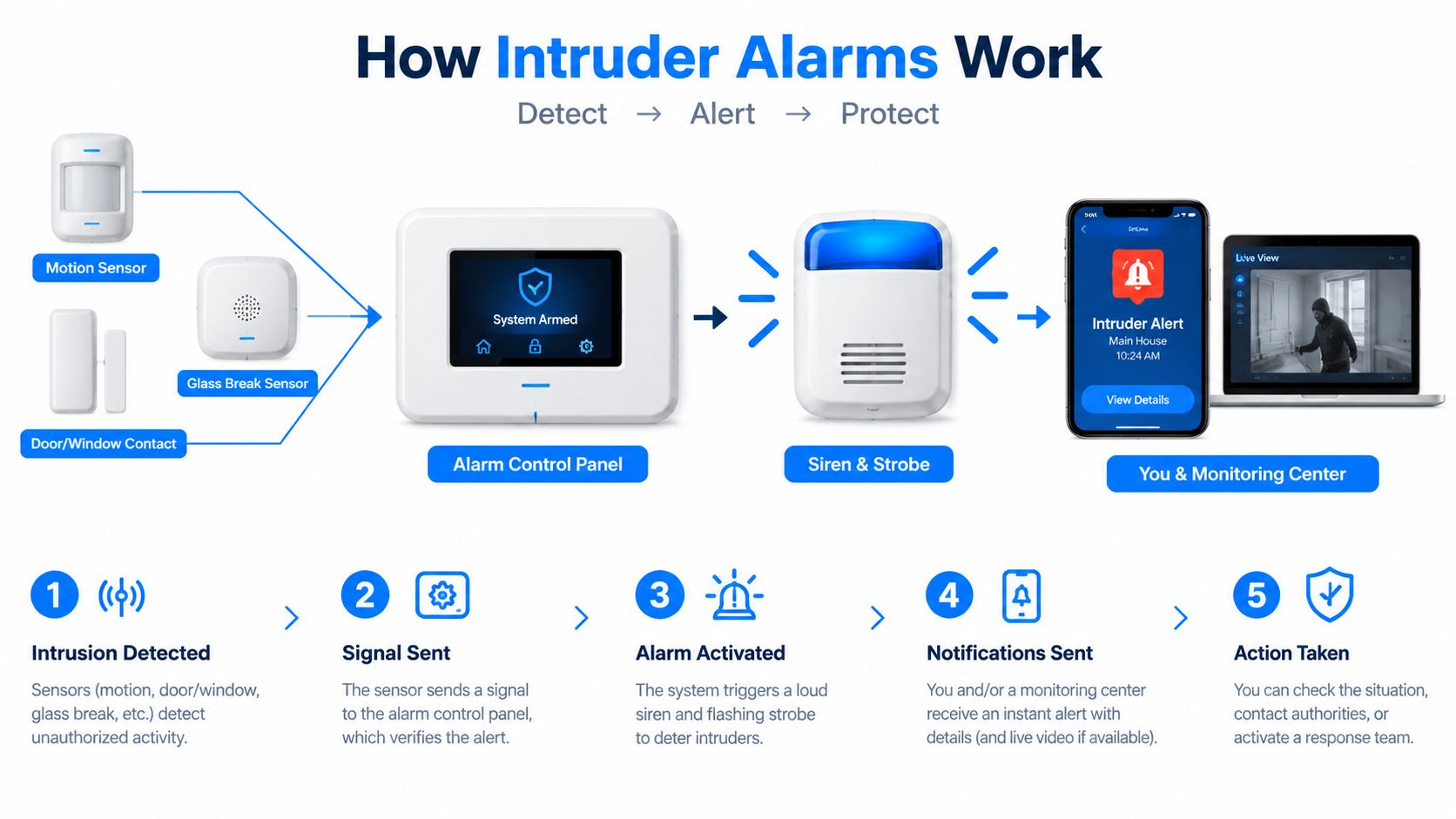
The practical test is simple: trace one alarm event from the first detector activation to the final person or organisation expected to act. If that route is unclear, the system hasn't been specified clearly enough.
Practical rule: A detector only starts the process. Security depends on what the panel verifies, how the signal travels and who responds.
Wired versus Wireless Systems
Wired and wireless alarms can both protect a property effectively. The difference lies in how the devices communicate with the control panel, and that difference affects installation, maintenance, resilience and appearance.
| Consideration | Wired system | Wireless system |
|---|---|---|
| Installation | Requires cable routes between devices and the panel | Avoids most signal cabling to individual devices |
| Building impact | Can involve chasing walls, lifting floors or using trunking | Usually causes less disruption |
| Maintenance | Devices don't rely on replaceable batteries for their alarm connection | Batteries require planned inspection and replacement |
| Flexibility | Excellent for planned construction and stable layouts | Useful where rooms, partitions or access points may change |
| Signal risks | Cable damage and termination faults must be controlled | Radio interference, range and obstruction need assessment |
| Best fit | New builds, major refurbishments and accessible voids | Finished interiors, quick alterations and difficult cable routes |
A wired installation is often the straightforward engineering choice when the building is being refurbished or has accessible ceiling voids. Cables provide a consistent route, and the installer can protect them against accidental damage. The drawback is disruption. In a period home, listed building or occupied office, routing cable neatly can cost more time and create more visual impact than the owner expected.
Wireless equipment solves that practical problem. It can reduce drilling and make it easier to protect outbuildings, glazed extensions or areas where cable access is poor. A UK industry guide states that wireless systems account for over 60% of new UK installations, while also identifying faster fitting and flexibility as key advantages, as described by SIA Guarding's intruder-alarm guide.
That convenience comes with responsibilities. Wireless detectors need battery management, and radio performance must be checked rather than assumed. Thick walls, metal structures and equipment operating in the same radio environment can affect communication. A professional installer should test signal strength at the proposed device location and confirm how the system reports low battery, communication loss and tampering.
Wireless is not the same as maintenance-free. It changes the maintenance task from cable inspection to battery, signal and device supervision.
For many properties, the sensible answer is hybrid. Hardwire the control panel, principal entry points and important fixed devices, then use wireless components where access is awkward. This avoids treating the whole property as an all-or-nothing cabling exercise.
Monitored and Audible Alarms
The most important distinction in alarm selection is what happens after the system confirms an intrusion. An audible-only alarm announces the event locally. A monitored alarm sends the event to an ARC and creates a defined response route.
An external bell can be a useful deterrent. It tells an intruder that the premises are protected and may alert neighbours or passers-by. It doesn't guarantee that anyone will investigate, contact the owner or request assistance. A speech dialler or app alert improves the chances that a nominated person learns about the event, but that person still needs to receive the message, understand it and act.
A monitored system places the communication step with an ARC. The centre can receive alarm signals, apply the agreed verification process and contact keyholders or police where the system and local policy permit it. ProtectUK explains this distinction between monitored alarms and audible-only systems, and sets out the relevance of BS EN 50131:2006+A1:2009, BS 8243:2010/2021 and BS EN 50518 for systems intended to support police response and ARC operation in its guidance on alarms and CCTV.
Grade and response are connected
The grade isn't a marketing label. It indicates the level of resistance and supervision expected from the system, its components and its installation.
The NPSA guidance for security managers states that Grade 2X is commonly used for bells-only domestic systems, while Grade 3 is typically used for remotely monitored systems and is the minimum insurance standard for high-value domestic risk and commercial systems. An insurer may specify an approved installer, a particular grade, ARC monitoring, maintenance visits or a defined signalling method. Check the policy before buying equipment.
Police response also isn't automatic because an alarm has a siren or an app. UK guidance distinguishes systems that may qualify for police response from audible alarms that rely on neighbours or passers-by. ProtectUK lists smart-home app alerts as a separate category, while NPSA guidance says a compliant Type A alarm can qualify for immediate police response under NPCC policy. Eligibility can also depend on URN status, confirmation methods and false-alarm history, as explained in police.uk's advice on keeping burglars out.
The Metropolitan Police reported 56,618 alarms received through compliant ARCs from January 2020 to December 2022. Its charter response target of within 15 minutes was achieved in 93% of calls, and the average response time in 2022 was 8.02 minutes, according to the Metropolitan Police FOI response on intruder alarms. Those figures describe an operational response process, not a promise that every alarm at every property will receive the same outcome.
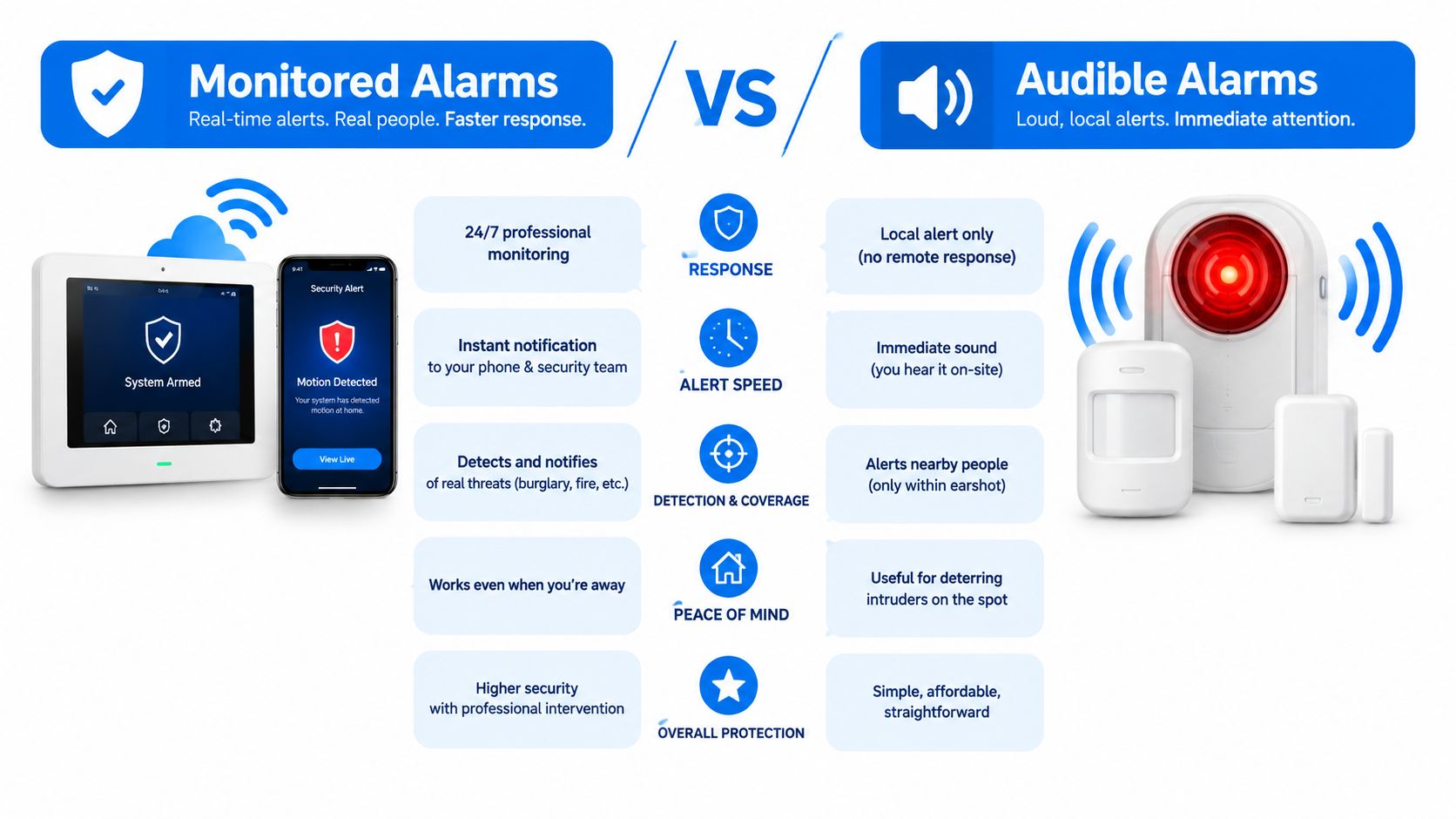
The practical lesson is to specify the whole chain, including detection, confirmation, signalling, ARC handling, keyholder availability and maintenance. A powerful siren can't compensate for an unsuitable response route.
Hybrid and Smart Alarm Options
Hybrid systems make sense where the building has mixed constraints. A solid cable route may exist between the panel and the main entrance, but not to a detached garage, newly built extension or upper-floor window. Hardwiring every point can create unnecessary disruption, while making everything wireless may introduce avoidable battery and radio-management work.
A hybrid panel allows the installer to combine both approaches. Critical or frequently used points can use wired devices, while wireless sensors cover locations that would otherwise require intrusive work. The result can be easier to maintain than a purely wireless system and less disruptive than a fully wired installation.
Smart alarms add another notification layer. Occupants may receive an app alert when the system sets, unsets or detects an event. Managers can use remote access to check status, and some systems can connect with cameras or other building controls. These functions are valuable for awareness, especially when a property is vacant, but they shouldn't be confused with ARC monitoring.
Convenience needs boundaries
A smart notification depends on several links working properly: the detector, control panel, local network, internet connection, cloud service and the user's phone. If one fails, the user may not receive the expected message. The system should report communication failures and provide a clear fallback response.
Smart integration also needs disciplined access control. Use named users, remove access promptly when staff or tenants leave, and avoid sharing one permanent code among everyone. A camera clip can help verify an event, but it doesn't remove the need for suitable alarm grading, secure signalling or regular servicing.
Perimeter improvements can support the alarm without replacing it. For example, a property owner planning a boundary upgrade may review options such as hybrid privacy fencing alongside lighting, access control and camera placement. Fencing can influence approach routes and visibility, while the alarm protects the building itself.
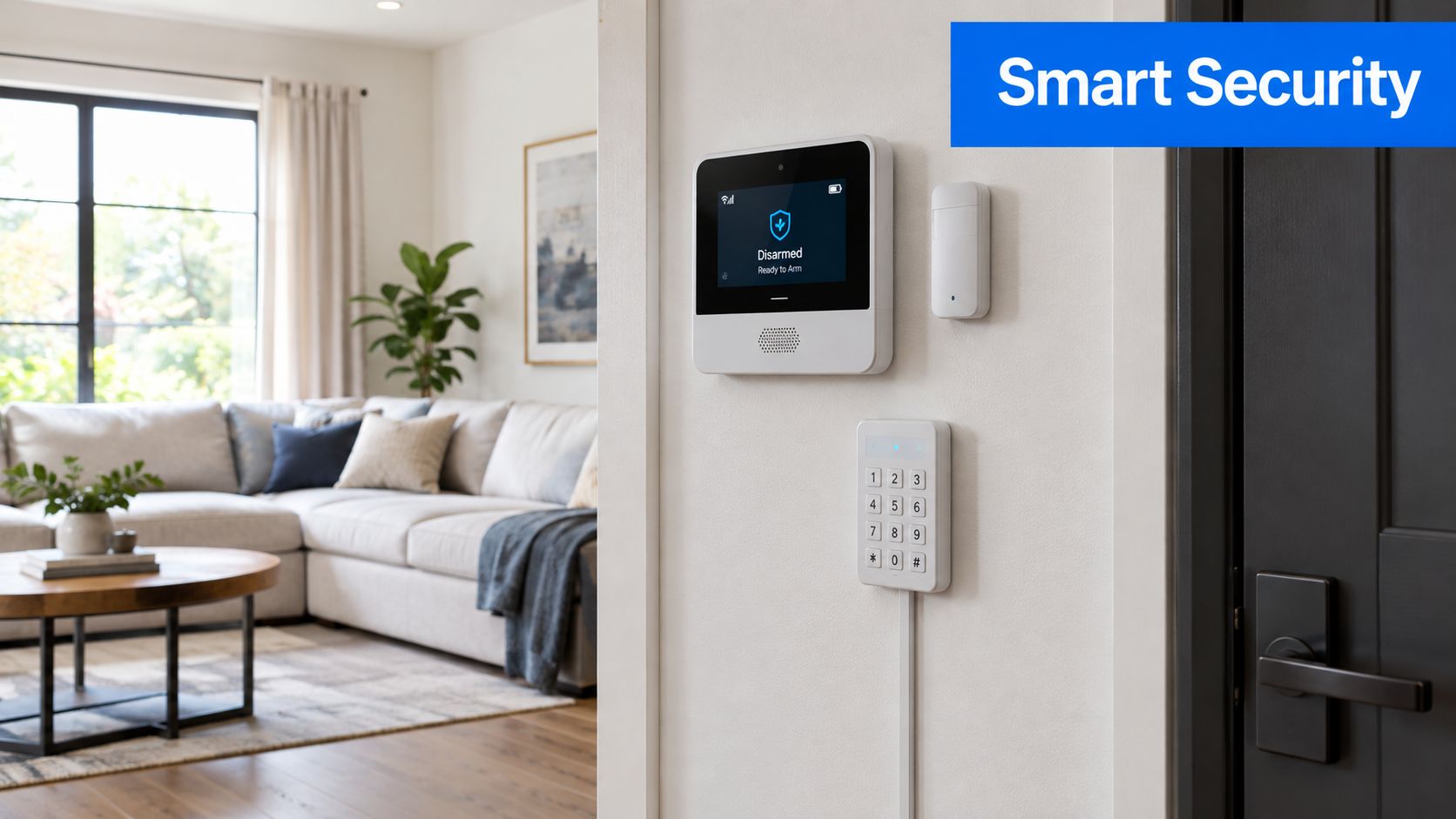
The strongest smart installation keeps local operation available even if the app is unavailable. The keypad, siren, supervised detection and agreed response process still do the essential work.
Recommendations for Businesses and Homes
Start with consequences, not equipment. A home containing ordinary household belongings has a different risk profile from a jeweller, medical practice, server room or warehouse holding valuable stock. Location matters, but occupancy, access patterns, building layout, insurance conditions and keyholder arrangements matter just as much.
Homes
For a typical family home, a professionally designed audible or app-connected system may provide sensible deterrence where the main objective is to alert occupants and neighbours. Wireless equipment can suit finished interiors and extensions, provided the installer tests radio coverage and plans battery maintenance. A larger or higher-value home may justify monitored signalling, particularly where there are reliable keyholders and the insurance policy requires a higher grade.
Don't choose a grade based only on the number of rooms. A smaller property with valuable contents or an isolated location may need a more powerful response route than a larger, occupied home in a well-populated area.
Small businesses
A small office, salon or local shop needs protection during both occupied and unoccupied periods. Partitioned systems can let staff arm selected areas while keeping other zones available. Door contacts at primary entrances, appropriate detection inside the premises and a clear opening procedure usually matter more than adding sensors indiscriminately.
Ask whether the system must support insurance approval, police response eligibility or ARC monitoring. A basic alarm that doesn't meet the policy conditions can leave the owner paying for equipment without receiving the intended protection.
Higher-risk premises
For commercial premises, high-value domestic risk and sites with stock or sensitive equipment, a monitored Grade 3 design may be the appropriate benchmark because NPSA identifies it as the minimum insurance standard for high-value domestic risk and commercial systems. Confirm the requirement with the insurer and specify the signalling path, ARC arrangements, confirmation method and maintenance schedule before installation.
| Property situation | Sensible starting point |
|---|---|
| Finished home with straightforward risk | Wireless or hybrid system with local and app notification |
| Small office or shop | Professionally designed system with zoning and agreed keyholder response |
| High-value home or commercial site | Monitored system, suitable grade and insurer-approved installation |
| Complex or expanding premises | Hybrid design with capacity for additional zones and devices |
Networking2000 offers standard, wireless and visually verified intruder alarm installations, including Grade 2 or Grade 3 systems, insurance-approved installation, ARC monitoring and GPRS or IP signalling. It should be considered alongside other approved installers after the property owner compares design, certification, maintenance and monitoring arrangements.
CCTV can add useful visual verification, but it shouldn't become an excuse to under-specify the alarm. Cameras show what may be happening. The alarm's signalling and response plan determine who learns about it and what happens next.
Next Steps for Your Security
A reliable intruder alarm starts with a site assessment, not a product category. The installer should walk through likely entry points, internal routes, outbuildings, vulnerable glazing, user routines and the consequences of a false alarm. That survey establishes whether wired, wireless or hybrid equipment is practical.
Then agree the response route. Decide whether the property needs a local siren, app alerts, speech dialling, ARC monitoring or a combination. If police response or insurance acceptance matters, confirm the required grade, standards, installer approval, ARC arrangements and maintenance obligations before signing an order.
Use this short checklist when comparing proposals:
- Risk profile: Identify the contents, operating hours, occupancy and likely entry routes.
- Physical format: Check whether cable routes are accessible and whether wireless devices can maintain reliable communication.
- Signalling: Ask exactly who receives an alarm event and what they do next.
- Standards: Request the proposed grade, installation basis and relevant certification in writing.
- False-alarm control: Confirm how users, pets, cleaning staff and opening procedures will be managed.
- Maintenance: Establish battery checks, servicing, call-out arrangements and communication-failure reporting.
- Future changes: Make sure the panel and design can accommodate extensions, new staff or additional protected areas.
Don't compare quotations by siren count or app features alone. Compare the complete security chain and the evidence that the proposed installation meets your insurer's conditions. A modest system with clear signalling, correct placement and disciplined maintenance will often serve a property better than an impressive-looking package that nobody monitors or services properly.
Arrange a professional survey for your home or business in London or Essex, gather the insurer's requirements first, and ask each installer to explain the response route in plain English. That conversation will reveal far more about the value of the system than the equipment brochure.
Networking2000 can assess your premises and provide standard, wireless or visually verified intruder alarm installations with options including Grade 2 or Grade 3 equipment, ARC monitoring and GPRS or IP signalling. Visit Networking2000 to discuss a site survey and a security specification suited to your property, insurer and response requirements.

