You're looking at a five-year-old website, a tired business card and a logo that becomes unreadable on a phone. Your Essex business has moved on, but the way it presents itself hasn't. A designer offers to “refresh the logo” for a few hundred pounds, and you're left wondering whether you need a quick visual tidy-up or a proper brand identity.
That decision matters because brand identity design services are a purchasing decision, not just a creative indulgence. The UK market is mature and crowded. In 2026, the UK Graphic Design Activities industry was valued at £4.2 billion and included 10,943 businesses, while the UK Brand Consultancy industry reached £2.0 billion with 2,195 businesses. Both figures are reported by IBISWorld's UK graphic design industry overview. You have plenty of providers to choose from, but that also means plenty of vague proposals, under-scoped projects and attractive portfolios that don't tell you what you'll receive.
The sensible approach is to define the work, understand the price, test the provider and protect your ownership before signing anything.
Table of Contents
- Why Brand Identity Matters More Than Your Logo
- What Brand Identity Design Services Actually Deliver
- The Step-by-Step Process Most Providers Follow
- UK Pricing and Timelines You Can Plan Around
- How to Evaluate and Brief a Brand Identity Provider
- Local Considerations for London and Essex Businesses
- Your Hiring Checklist Before You Sign Anything
- Bringing It All Together and Next Steps
Why Brand Identity Matters More Than Your Logo
The owner of a Chelmsford engineering firm notices the problem after a sales meeting. The company's service is technically strong, its client list is credible and its quotations are professional. Yet the presentation deck looks different from the website, the LinkedIn graphics use another shade of blue, and the logo disappears when placed beside a London client's polished brand.
Nothing is visibly disastrous. That's why the problem survives.
A logo is one mark. Brand identity is the system that controls how your business is recognised and understood. It includes the colours, typefaces, imagery, layouts, language and supporting assets that shape the experience before a prospect speaks to you. A stranger may encounter your company through a Google Business profile in Chelmsford, a van in Basildon, a website search result or a pitch deck shown to a buyer in London. Each touchpoint either reinforces confidence or creates doubt.
Ask three commercially useful questions
Start with the questions that connect design to buying behaviour:
- Does the presentation match the service? If you deliver specialist work but your materials look improvised, prospects may assume the same lack of care applies elsewhere.
- Do the visuals explain what you do? A fashionable logo doesn't help if the colour, imagery and messaging leave visitors guessing.
- Could inconsistent branding be costing invisible opportunities? You may never know which prospect dismissed the business before making contact.
A 2023 Chartered Institute of Marketing survey found that 68% of UK businesses had updated their brand identity in the previous five years, and 42% of those updates were driven by changing market conditions or consumer preferences, as reported in the UK evidence summarised by Sortlist's UK brand identity market data. That doesn't mean every SME needs a major rebrand. It does show that businesses regularly revisit how they present themselves when their market, customers or offer changes.
Practical rule: If your business has outgrown its customers, services or operating model, check the identity before commissioning another isolated logo.
Brand identity design services give you a structured way to fix the whole presentation. The right project may be a phased visual system, not an expensive reinvention. The wrong project is another logo file that leaves the underlying inconsistency untouched.
What Brand Identity Design Services Actually Deliver
Professional brand identity design services produce a working toolkit, not merely a logo exported as a JPEG. Before accepting a proposal, ask the provider to list every asset, format and usage right in writing.

The core identity system
A sensible identity package may include:
- Logo suite: A primary mark, secondary versions, stacked or horizontal lock-ups and a small-format option. The same identity should work on a Basildon van livery, a proposal cover and a browser favicon.
- Colour palette: Primary and supporting colours with clear digital and print specifications. “Use this blue” isn't a usable rule.
- Typography system: Typeface choices for headings, body copy and supporting information, with guidance that your team can apply in documents and social posts.
- Graphic devices: Icons, patterns, shapes or layout principles that give the business a recognisable visual language beyond the logo.
- Image direction: Photography, illustration and image-treatment guidance, so stock photography doesn't make your website feel disconnected from your service.
- Voice and messaging: A practical framework covering tone, key messages and descriptions of your offer. This stops a junior member of staff guessing how the company should sound on LinkedIn.
- Brand guidelines: A document showing correct use, spacing, colour, typography, examples and common mistakes.
The central deliverable is consistency under pressure. Your next web developer, printer, marketing assistant or signage supplier should be able to use the system without repeatedly asking the original designer to interpret it. Clear brand guidelines and practical templates are useful precisely because small businesses don't have a design director checking every output.
For broader perspective on identity systems, messaging and practical brand decisions, Custom Mark branding insights offers a useful resource alongside a provider's own proposal.
Add-ons and ownership
Stationery, social templates, presentation decks, signage, packaging, vehicle graphics and website design are often separate line items. They can be valuable, but don't pay for assets you won't use. A trades firm may gain more from a quotation template, vehicle livery and Google Business graphics than from an elaborate packaging system.
Get the following confirmed:
- Which source files are included, not just flattened exports.
- Which file formats are supplied for web, print, signage and editing.
- Who owns the intellectual property after final payment.
- Whether fonts, photography and third-party assets have separate licences.
- How the identity can be adapted by future suppliers.
A provider that can't explain these points clearly is selling a visual result, not a dependable business system.
The Step-by-Step Process Most Providers Follow
A credible project has a visible process. You should know what happens before the first concept appears, how decisions are approved and what “final delivery” includes.

Five phases to look for
1. Discovery and brief alignment
The provider talks to the owners and relevant staff, reviews competitors, defines the audience and records the commercial problem. The output should be a written brief that both sides understand and approve. If this phase consists only of a short form asking for your favourite colours, the project has started too shallowly.
2. Research and positioning
The designer examines how comparable businesses present themselves and identifies the territory your brand should occupy. You should see a positioning summary, creative direction or moodboard before detailed design begins. This prevents the team from choosing a visual style only because it looks attractive in a portfolio.
3. Concept development
The provider develops a small number of distinct routes, each with a rationale connected to the brief. The decision isn't “which logo do you like?” It's “which direction best supports the business we need to build?” The selected route then receives focused refinement.
4. Identity system development
The chosen mark becomes a broader system. Colour, typography, layouts, imagery, icons, templates and verbal guidance must work together across the channels you use. A logo project becomes brand identity design.
5. Rollout and handover
The final phase covers the guidelines, exports, source files and implementation support. It may also include website assets, stationery, signage files or a briefing for your web developer. A handover should leave you able to use the identity without returning to the designer for every small change.
The most common shortcuts are predictable. Cheap providers may skip research, show flat mock-ups without explaining the thinking, or send one PDF without editable files. Each shortcut creates a future cost. Your website supplier may recreate the logo badly, your printer may use the wrong colour, and your staff may produce inconsistent materials because nobody received usable rules.
Before approving a concept, ask what business decision the concept is designed to support. If the answer is only “it feels modern”, the strategy is missing.
UK Pricing and Timelines You Can Plan Around
Pricing becomes easier to judge when you compare scope rather than isolated quotes. UK buyers often anchor on a logo purchase, but a logo and a full identity system solve different problems.
The entry market is particularly price-sensitive. UK logo purchases averaged £121 in 2025, with a median spend of £108, and 61% of purchases fell between £100 and £149, according to Lux Branding's UK logo statistics. That can be perfectly reasonable for a basic logo requirement. It isn't a sensible benchmark for research, messaging, a complete visual system and rollout support.
Compare the package to the business problem
| Package | Price band (GBP) | Typical timeline | Core deliverables |
|---|---|---|---|
| Freelancer logo-only | £400 to £1,500 | 3 to 5 weeks | Primary logo, limited variations, basic exports |
| Mid-tier visual identity | £2,500 to £7,500 | 6 to 10 weeks | Logo suite, colours, typography, selected assets and concise guidelines |
| Full brand identity system | £8,000 to £25,000+ | 10 to 16 weeks | Discovery, positioning, complete identity system, messaging guidance, templates and detailed handover |
These bands are a planning framework, not a universal tariff. Cost rises with the number of touchpoints, depth of strategy, amount of copywriting, stationery or template requirements, revision rounds and involvement from senior specialists.
UK benchmark guidance places a complete identity package at £3,750 to £15,000, while strategic programmes involving 200 to 300+ hours of research, positioning, typography, colour systems and rollout support can reach £20,000 to £75,000+, as outlined by Designstack's UK brand identity cost guidance. The difference isn't just a designer charging more for the same logo. It reflects more investigation, more decisions to coordinate and more applications to make reliable.
Choose the right level
A logo-only project suits a new or very small business that needs a credible starting mark and has limited immediate applications. A mid-tier identity suits an established SME whose website, documents and social presence need to look related. A full system makes sense when you're repositioning, entering a more competitive market, managing several locations or coordinating multiple suppliers.
Don't buy an agency-sized process because it sounds impressive. If your immediate need is a consistent website, quotation template, signage package and social toolkit, ask for a phased project that solves those problems first.
How to Evaluate and Brief a Brand Identity Provider
Treat provider selection like procurement. A polished portfolio is useful, but it doesn't prove that the designer can understand your business, manage approvals or supply files you can use.
Filter the shortlist
Look for work involving businesses with similar complexity, not just a matching aesthetic. A provider who has designed identities for local professional services, trades, hospitality or B2B firms will understand the constraints of lean teams and practical applications.
Ask who will do the work. You should know the name of the strategist, designer and project contact, rather than dealing with a salesperson until the contract is signed. Request references from comparable clients and ask about communication, scope changes, deadlines and the handover.
A strong proposal should show:
- Named deliverables: Every major asset is listed.
- Decision points: You know when feedback and approval happen.
- Revision terms: The included rounds and additional fees are clear.
- Commercial assumptions: Copywriting, photography, web development and printing aren't hidden extras.
- Ownership terms: Intellectual property and source files are addressed directly.
Red flags include “unlimited revisions”, a quote issued after a superficial call, vague claims that everything is bespoke and portfolios containing only polished mock-ups. Unlimited revisions usually signals poor scope control, not exceptional service.
Write a brief that can survive disagreement
Give the provider enough information to challenge your assumptions:
- Business overview and current offer
- Priority audiences and buying situations
- Competitors you admire and those you want to avoid
- Must-keep elements and reasons for keeping them
- Practical applications, such as vehicles, signage, web, print and social
- Budget range and deadline
- People who can approve decisions
A brief is a contract precursor. Ambiguity at the start becomes a disagreement about scope, cost or approval later.
The right provider will question your brief. They may recommend a phased identity rather than a complete rebrand, or explain why a favourite visual reference would attract the wrong customer. A provider who quotes instantly without interrogating the problem is treating your project as a production order.
Local Considerations for London and Essex Businesses
London-facing buyers often expect a small supplier to look as organised as a larger agency. Your location doesn't lower their expectations, particularly when your proposal competes with firms operating from central London or nearby commuter towns.
Essex businesses face a different pressure. Local markets are full of recognisable cafés, salons, trades firms, consultants and professional practices, so generic branding disappears quickly. A provider needs to understand the difference between a brand selling to City procurement teams, residential customers in Rayleigh and industrial-park B2B buyers near Chelmsford.
Design for the places customers encounter you
Ask the provider to test the identity in real regional situations:
- Google Business profiles: Can the mark and colours remain clear in small digital placements?
- Vehicle livery: Does the logo work at distance on a van moving through Basildon or Brentwood?
- Premises and signage: Are the colour contrasts, type sizes and layouts practical from the street?
- Two-location consistency: Can a Chelmsford headquarters and London satellite use one coherent system?
- Sales materials: Does the identity hold up in a proposal to a London client as well as a local quotation?
A local kick-off can also improve the project. In-person conversations make it easier to inspect printed materials, visit a site, understand signage constraints and resolve decisions without a long chain of remote messages. Remote work can succeed, but regional access is a practical advantage when the project includes physical applications.
Local knowledge isn't a soft extra. It helps the provider judge whether the identity must feel premium, approachable, technical, traditional or highly visible in a specific trading environment. The best choice isn't automatically the nearest designer. It's the provider who understands where your customers are, how they buy and which touchpoints influence their decision.
Your Hiring Checklist Before You Sign Anything
Use this as a final procurement check. If a provider gives a good answer verbally, ask for the same answer in the proposal or contract.
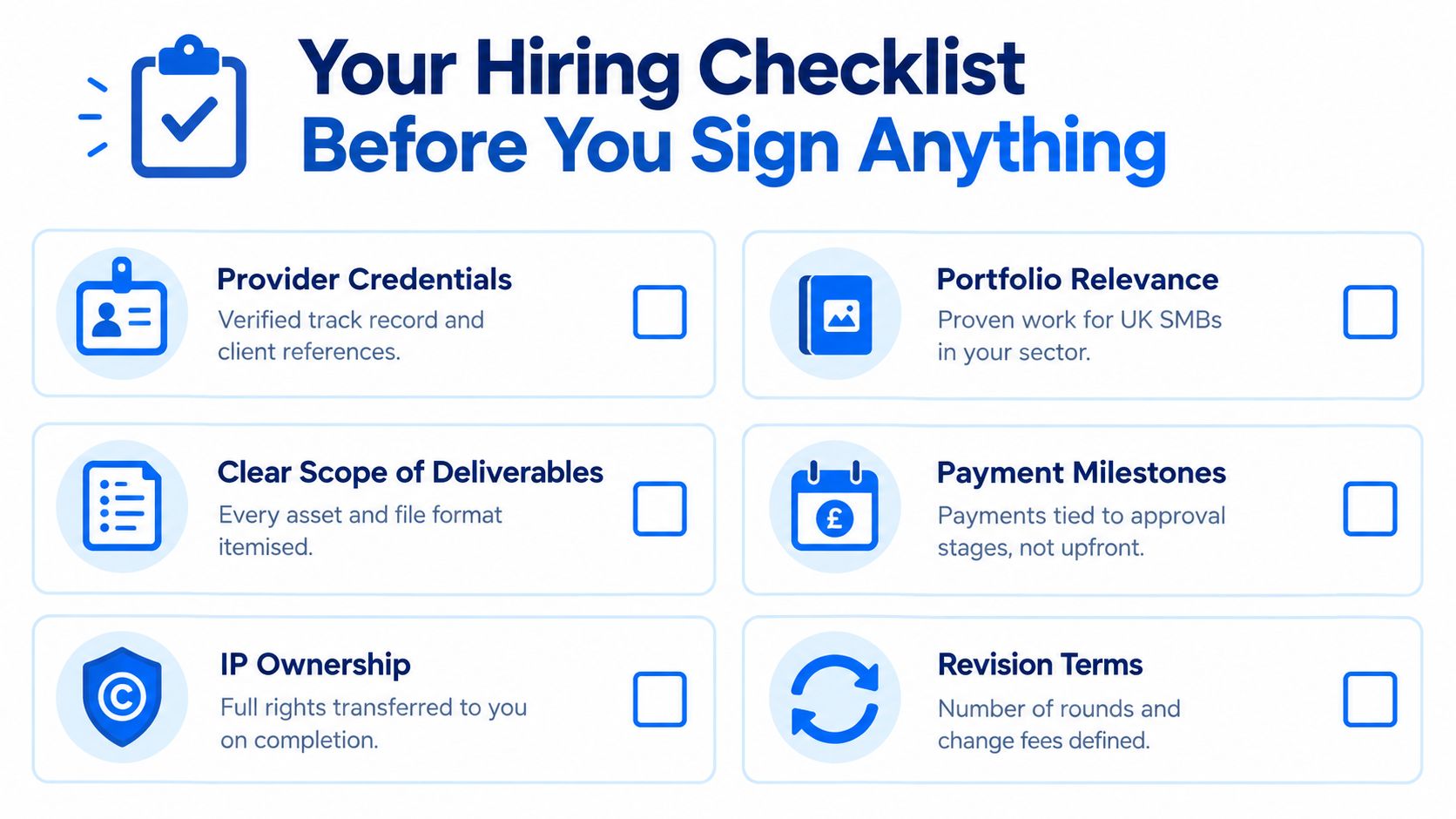
- Provider credentials: Can the provider show relevant work, explain their role in it and supply references? Be cautious if the portfolio contains only anonymous images or work unrelated to your business type.
- Portfolio relevance: Look for UK SME examples with practical applications, not only dramatic campaign visuals. You need evidence that the identity works on websites, documents, signage and social assets.
- Clear scope of deliverables: Require an itemised list covering logo variations, colour specifications, fonts, templates, guidelines, source files and file formats. "Complete branding" isn't a deliverable.
- Payment milestones: Tie payments to agreed approval stages. The proposal should explain what happens at discovery approval, concept selection, identity approval and final handover.
- Intellectual property: Confirm when rights transfer, what third-party licences remain separate and whether you can appoint another designer later.
- Revision terms: Establish the number of included rounds, who consolidates feedback and what extra work costs. Multiple decision-makers giving separate comments can derail an otherwise sound project.
- Timeline buffers: Check whether the schedule accounts for your own approvals, supplier availability and busy trading periods. A provider can't protect a deadline if your team hasn't reserved time to decide.
- Cross-channel testing: Ask to see how the system works in print, web, signage, social graphics, presentations and any vehicle applications you need.
A provider that resists putting these answers in writing is asking you to accept risk without control. Walk away.
Bringing It All Together and Next Steps
Brand identity design services should leave your business easier to recognise, easier to manage and easier for suppliers to reproduce consistently. That makes the work an operating asset, not a decorative purchase. The strongest value comes from the system you use repeatedly across proposals, websites, signage, social content and customer conversations.
You now have four decisions to make:
- Scope: Decide whether you need a logo, a visual identity or a broader system.
- Budget: Choose a price band that matches the research, applications and guidance required.
- Timing: Allow enough time for discovery, decisions, refinement and handover.
- Provider fit: Select someone who understands your market and can document the work properly.
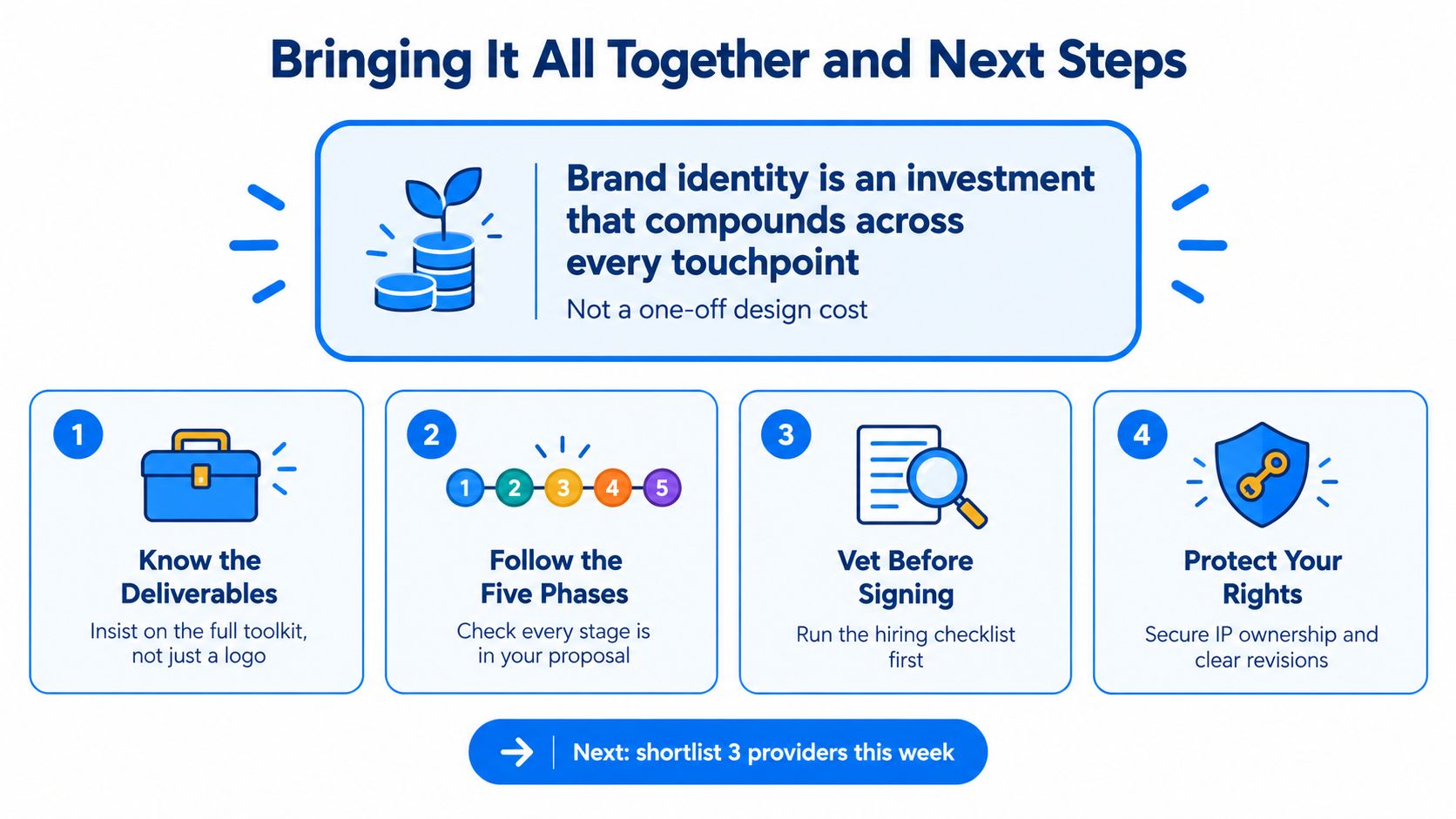
Start with three actions this week. Gather the people who will approve the identity and agree the essential deliverables. Shortlist two or three providers with relevant London or Essex SME work. Then book a paid discovery session if it gives you a clearer brief, scope and recommendation before the full commission.
The cheapest quote may produce a usable logo, but it won't necessarily protect the value of your wider brand. The right investment is the one that gives your business a practical system, clear ownership and enough flexibility to support the next stage of growth.
Networking2000 offers identity and branding support alongside website design, sales and marketing services for businesses across London and Essex, helping owners define their position and create usable brand assets. If your outdated identity is tied to wider website, communications or technology decisions, visit Networking2000 to discuss the requirements and plan a practical next step.

