A six-person accountancy firm in Chelmsford is halfway through a Teams call with a client when the conversation starts breaking up. The screen share freezes, voices overlap, and someone asks, politely, whether anyone can hear them. The broadband package promises a respectable download speed, but that figure doesn't explain why the call failed at the moment the business needed it.
That's the decision behind business broadband fibre. You're not choosing the biggest number on a sales page. You're choosing how your company handles voice calls, cloud applications, remote access, payments, backups and outages. The right service depends on the work running over the connection, the consequences of failure and the support terms attached to the circuit.
| Option | Best suited to | Main strength | Main limitation |
|---|---|---|---|
| FTTC | Sole traders and light-use offices | Low-cost fibre-fed access | Copper final section, weaker uploads and repair commitments |
| FTTP | Most small offices and home-based workers | Full fibre to the premises | Usually shared access, with commercial terms varying by provider |
| Ethernet over Fibre | Linked sites and growing operations | Carrier-grade site connectivity | More complex and costlier than ordinary broadband |
| Leased line | VoIP-heavy, multi-site or critical operations | Dedicated, uncontended bandwidth | Higher cost and potentially longer installation |
UK access has changed quickly. By July 2024, 63% of SMEs were within reach of a full-fibre network, an increase of 12 percentage points from September 2023, according to the Ofcom-linked UK fibre broadband statistics. Availability is no longer the only question. You need to know whether the service includes the performance and recovery characteristics your business needs.
Table of Contents
- What Business Broadband Fibre Really Means for Your Company
- The Four Main Fibre Connectivity Options Explained
- Comparing Speed, SLAs, Symmetry and Cost Side by Side
- Why SLAs, Contention and Resilience Matter More Than Headline Speed
- Matching the Right Fibre Option to Your SMB Scenario
- Hidden Trade-offs Most Fibre Comparisons Overlook
- Choosing and Installing the Right Service with Networking2000
What Business Broadband Fibre Really Means for Your Company
“Fibre” describes how the connection reaches your premises. Business broadband fibre describes the access technology plus the commercial service wrapped around it. The physical cable might be similar to a residential connection, but the contract, support model, router options and fault handling can be very different.
A business package may include a static IP address, business-hours or extended-hours support, priority escalation, traffic policies and a defined repair target. Those details matter when you operate hosted telephony, permit secure remote access or need engineers to investigate a fault quickly. A consumer package may deliver a strong download result under normal conditions, but it usually isn't designed around the operational obligations of a company.
Start with the failure you need to avoid
Ask what happens when the line degrades during working hours. If staff use Teams, Zoom or hosted VoIP, download speed alone won't protect call quality. Upload capacity, latency, jitter, Wi-Fi design and local network congestion all affect the experience.
Cloud accounting, Microsoft 365, CRM platforms and remote support tools also create two-way traffic. Staff download documents, but they also upload files, synchronise folders and send backups. A connection with modest upload performance can appear fine during browsing and still become a bottleneck during a busy afternoon.
Practical rule: Buy the service around your most business-critical application, not around the largest speed figure you can find.
What the four options will and won't fix
FTTC can provide an affordable step up from older broadband, but the copper section remains a weakness for distance, upload performance and fault recovery. FTTP removes that copper final section and is the sensible default for many small businesses, provided the provider offers suitable support and the premises has adequate internal networking.
Ethernet over Fibre is more appropriate when you need a carrier-grade connection between locations or a structured business service. A leased line goes further, providing a dedicated, uncontended circuit with stronger service commitments. It won't automatically fix poor Wi-Fi, an overloaded firewall or badly configured VoIP handsets, but it gives your network a more predictable foundation.
UK coverage figures show why this choice has become practical for more businesses. Ofcom-linked reporting found that 98% of UK homes and businesses had access to at least decent fixed-line broadband, while full-fibre availability still differed by business size, with 46% of micro premises, 36% of small premises and 33% of medium premises covered in the reported period. The problem for many firms is now selecting the right service at the site, not finding any connection at all.
The Four Main Fibre Connectivity Options Explained
The easiest way to understand the options is to follow the connection from the provider's network to your router.
FTTC, or fibre to the cabinet, runs fibre from the exchange or aggregation point to a street cabinet. Copper then carries the final section to the building. The router normally connects through the existing phone-line termination, and the service is commonly asymmetric, with a faster download than upload and shared capacity beyond the cabinet. FTTC was designed as a practical upgrade for ordinary premises without replacing every final copper section.
FTTP, or fibre to the premises, runs fibre directly into the building. An optical network terminal hands the service to a business router or firewall, removing the copper final section. FTTP suits small offices, professional services firms and home-based workers that depend on cloud systems and video calls. It can offer much better upload performance than FTTC, but it remains broadband access and may still be contended upstream.
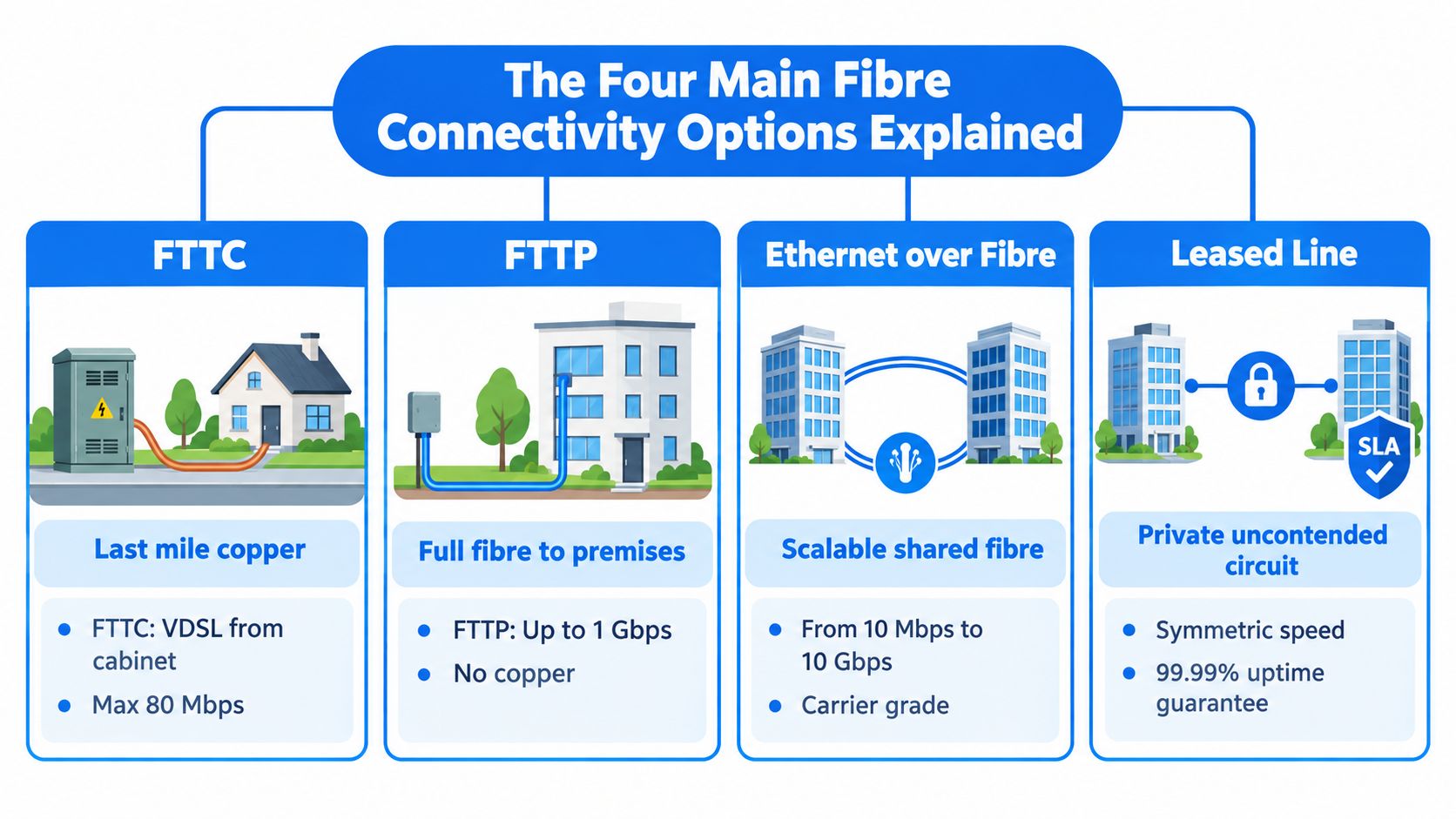
Ethernet over Fibre, often shortened to EoF, presents a fibre connection as an Ethernet handoff. The provider may terminate it on a managed router, firewall or network switch, making it suitable for linking offices, connecting a business park location or carrying traffic into a wider corporate network. The service is built for organisations that need more structured connectivity than ordinary broadband, without necessarily requiring the fully dedicated model of a leased line.
A leased line is a private, point-to-point fibre circuit. The provider installs an optical network termination and hands the service to your router or firewall. Bandwidth is dedicated rather than shared with local broadband users, and the service is normally symmetric with stronger uptime and fix-time commitments. It was designed for organisations where connectivity is part of the operating platform, including multi-site businesses, voice-dependent offices and sites carrying important backups or security traffic.
The key distinction isn't fibre versus copper. It's shared access versus dedicated service, and consumer-style repair handling versus a contract that defines what happens when the line fails.
Comparing Speed, SLAs, Symmetry and Cost Side by Side
The table below is a buying aid, not a quotation. Costs, lead times and service levels vary by postcode, bearer size, provider and contract term, so treat the descriptions as planning guidance and ask for the exact terms before signing.
| Option | Typical Speed | Symmetry | Contention | Target Fix SLA | Indicative Monthly Cost |
|---|---|---|---|---|---|
| FTTC | Up to the location's available service tier | Asymmetric | Shared | Often best effort or next working day | Lower |
| FTTP | Broad range, including high-capacity tiers | Asymmetric or near-symmetric, depending on package | Shared | Business package dependent | Lower to mid-range |
| Ethernet over Fibre | Scalable from modest business capacity to high-capacity circuits | Usually symmetric | Provider-dependent, often engineered | Defined business target | Mid-range to high |
| Leased line | Selected bearer speed to match the site | Symmetric | Uncontended | Strong contractual target, commonly faster than broadband | High |
A low monthly price usually means you're accepting more shared infrastructure, weaker upload symmetry or less decisive fault handling. That may be entirely reasonable for a sole trader who can work around a short outage. It's a poor bargain for a firm whose telephone system, payment platform or remote access service stops when the line does.
The UK market is moving towards broad fibre availability. Ofcom's market review materials indicate that full-fibre coverage reached nearly eight in ten premises by 2025, with gigabit-capable coverage at a similarly broad national level, as described in the Telecoms Access Review materials. That shifts procurement towards service quality, SLA wording, circuit design and contention rather than basic access.
Read the table as a filter. If upload symmetry, repair certainty or private bandwidth is essential, skip straight to those terms in the supplier proposal rather than comparing advertised downloads. The commercial detail matters more than the badge on the package.
Why SLAs, Contention and Resilience Matter More Than Headline Speed
A service-level agreement tells you what the provider has promised after a fault is accepted. It may define response time, target restoration, escalation and possible service credits. It doesn't guarantee that no outage will occur, and a target fix isn't the same as a guaranteed restoration, so read the wording carefully.
A best-effort broadband fault can leave a VoIP-dependent office unable to call clients while the provider works through its normal process. A stronger leased-line commitment gives the provider a defined obligation to prioritise restoration, which can materially reduce the operational exposure. The value isn't abstract. It's the difference between switching to a prepared backup process and asking staff to stop work.
Contention changes performance at busy times
Contention means multiple customers share capacity. That shared design is normal for broadband and can work well, but performance may vary when demand rises. A line that looks fast during a quiet test can feel poor when employees upload files, join video meetings and synchronise cloud storage together.
A leased line is designed differently. Its bandwidth is dedicated to your circuit, so you're not competing with nearby premises for the same access capacity. That doesn't solve every problem, because your firewall, switch and Wi-Fi still have limits, but it removes a major source of unpredictability.

Resilience is a design choice
A second line can keep basic operations running during a primary fault. Common approaches include:
- 4G failover: A mobile connection takes over for essential traffic when the fibre circuit drops.
- Dual-line routing: A firewall monitors two services and sends traffic through the available path.
- Diverse routing: Separate circuits use different physical routes or network providers, reducing the risk that one incident affects both.
- Bearer resilience: Higher-capacity services are designed with additional protection, subject to the provider's actual architecture and contract.
The right question isn't “How fast is it?” It's “Which failure can this business tolerate, and for how long?”
Use the UK leased-line and broadband performance comparison to distinguish the practical characteristics that matter, including asymmetric broadband, symmetric dedicated fibre, contention and repair expectations. Then specify resilience based on your business process, not on a generic package tier.
Matching the Right Fibre Option to Your SMB Scenario
A service that's sensible for a Chelmsford accountant may be wasteful for a retail counter and inadequate for a multi-site care provider. Start with the applications and the cost of interruption.
A professional services office
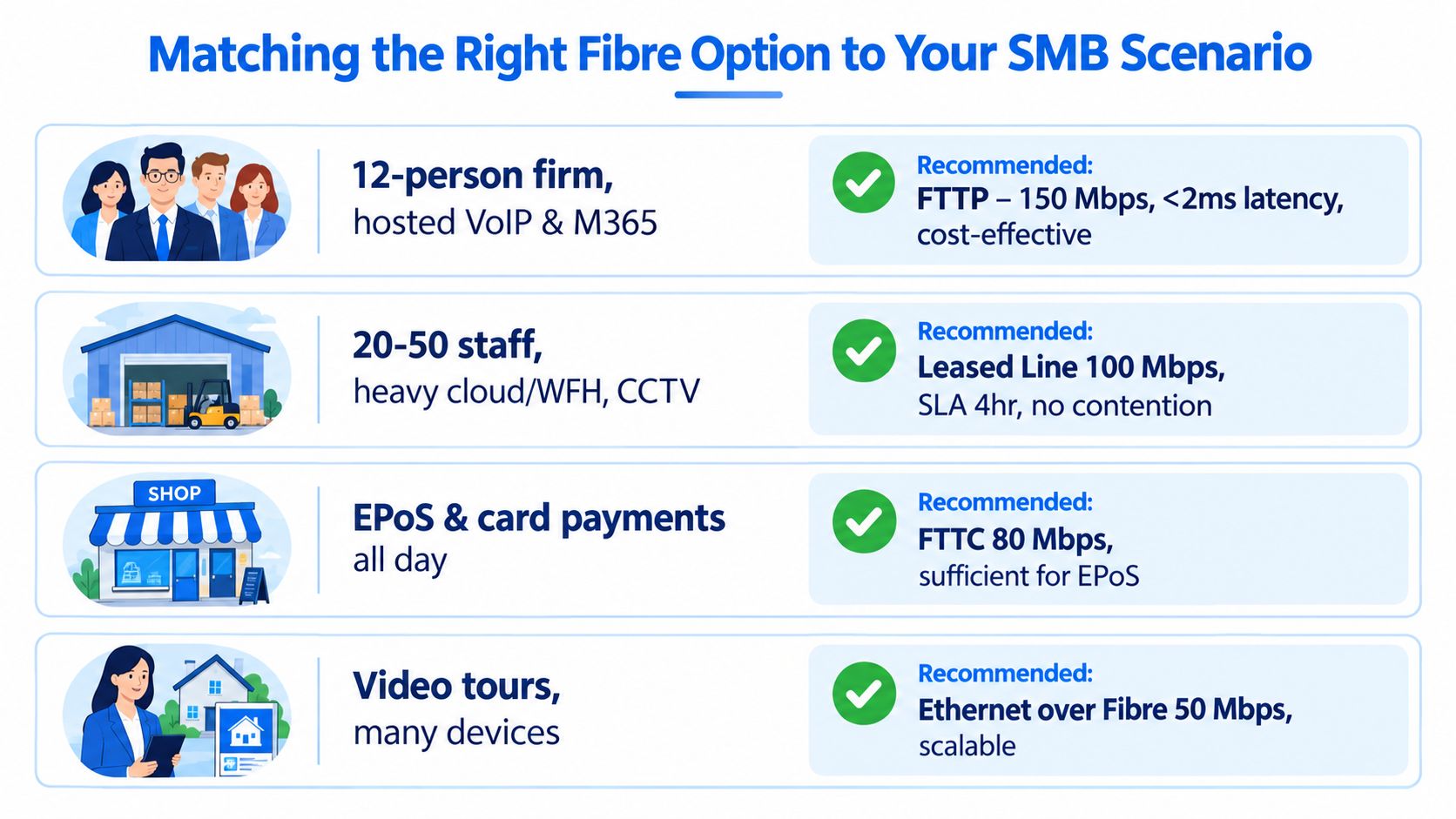
A 12-person firm using hosted VoIP and Microsoft 365 usually needs stable full-fibre access, capable internal Wi-Fi and business support. FTTP with a strong SLA is normally the sensible starting point. A second connection becomes more important if the firm cannot divert calls or work offline during an outage.
Verdict: Choose FTTP with business support, then add failover if voice is central to client service.
A busy retail shop
A shop running card terminals, EPOS and guest Wi-Fi doesn't automatically need a leased line. FTTC may be adequate where the service is stable and the traffic is modest, while FTTP gives the premises a cleaner foundation for cloud tills, stock systems and cameras.
Separate operational traffic from guest Wi-Fi, use a managed firewall and test payment failover. A mobile backup can be more valuable than paying for a much larger primary circuit.
Verdict: Use FTTC or entry-level FTTP with resilient payment connectivity and properly separated networks.
A multi-site retailer or care provider
A multi-site operation creates traffic that ordinary broadband isn't designed to manage elegantly. Site-to-site applications, centralised systems, CCTV uploads, hosted voice and remote administration all increase the cost of an unreliable link.
Ethernet over Fibre can suit a growing organisation that needs engineered connectivity between locations. A leased line is justified where every site carries critical traffic or where the business needs dedicated bandwidth, defined restoration and diverse routing.
Verdict: Specify Ethernet over Fibre or leased lines around inter-site traffic and outage impact, not office headcount alone.
A home-based worker
A homeworker who depends on stable video calls and secure access often gets better results from FTTP with a static IP and a managed router than from a consumer package with a higher advertised download. The provider should also check internal Wi-Fi, because a strong fibre service can't repair poor coverage or interference inside the home.
Verdict: Choose reliable FTTP, business support and managed local networking before chasing gigabit branding.
Upgrade triggers include repeated call quality complaints, failed cloud synchronisation, payment interruptions, regular backup congestion, a second premises, growing remote access requirements or an outage that forces staff to stop work.
Hidden Trade-offs Most Fibre Comparisons Overlook
The fastest package isn't automatically the best business connection. A line can advertise a large download figure and still struggle with the traffic pattern that matters most to your company.
Upload symmetry
A business that sends large files, synchronises cloud storage or pushes CCTV footage needs upload capacity. An asymmetric FTTP service may be perfectly suitable for browsing and ordinary cloud use, but it can become restrictive when uploads run alongside live calls. A symmetric service, such as a suitable Ethernet circuit or leased line, gives both directions equal treatment.
Latency and jitter
Voice and video applications react badly to variation. Latency is the delay between sending and receiving data, while jitter is variation in that delay. A short burst of congestion can cause clipped audio or frozen video even when an internet speed test reports an impressive result.
The remedy may be a better service, but it may also be traffic prioritisation, a correctly configured firewall, wired desk phones or improved access points. Don't blame the fibre circuit until the entire path has been checked.
Installation and equipment
Leased lines can involve surveys, building access, wayleaves and external construction. A multi-tenant London building may need landlord approval before engineers can route fibre to the suite. Ask who pays for excess construction, what happens if the survey changes the price and when billing starts.
Routers matter too. A bundled device may have limited throughput, weak VPN performance or poor failover controls. Confirm that the router and firewall can handle the contracted service, encrypted traffic and the number of simultaneous users.
Procurement test: Ask the supplier to describe the worst realistic outage, the upload workload and the handover equipment before you compare monthly prices.
Business broadband contracts can also include traffic policies, usage conditions or support exclusions that don't appear in the headline advert. Read the acceptable-use terms, SLA definitions, escalation route and cancellation provisions. For many UK SMBs, resilience, symmetry and support quality are more valuable than another step up in peak download speed.
Choosing and Installing the Right Service with Networking2000
A London office can lose access to hosted voice, cloud systems or payment tools because its circuit, router or internal network was chosen without checking the workload. Start with an audit, not a package list. Review the site, existing bearer, cabinet or exchange distance, internal cabling, Wi-Fi, firewall, traffic pattern and the operational consequences of an outage. Confirm whether the building needs a wayleave or additional access permission.
Match the recommendation to the work. A sole trader with light traffic may self-provision FTTC or FTTP. A voice-heavy office needs its upload capacity, latency, router performance and failover examined. A multi-site retailer should assess Ethernet over Fibre, leased-line options, route diversity and how traffic moves between locations.
Five decisions that prevent expensive mistakes
- Audit the premises: Confirm availability, the entry route, internal network condition and the current circuit's limitations.
- Map the workload: Record cloud applications, hosted voice, CCTV, backups, payment systems, remote workers and site-to-site traffic.
- Choose the circuit class: Select FTTC, FTTP, Ethernet over Fibre or a leased line according to operational risk, not the fastest advertised download.
- Specify the handover: Agree the router or firewall, static IP requirement, security controls, monitoring and failover design.
- Set the review point: Reassess capacity when staff, sites, cloud workloads or voice usage changes.
Openreach or another network operator may install the access circuit. A carrier may manage the service, while a local IT provider manages the on-site network. London offices need clear coordination with landlords and building managers. The handover must cover activation testing, router configuration, static IP allocation, security controls and documentation.
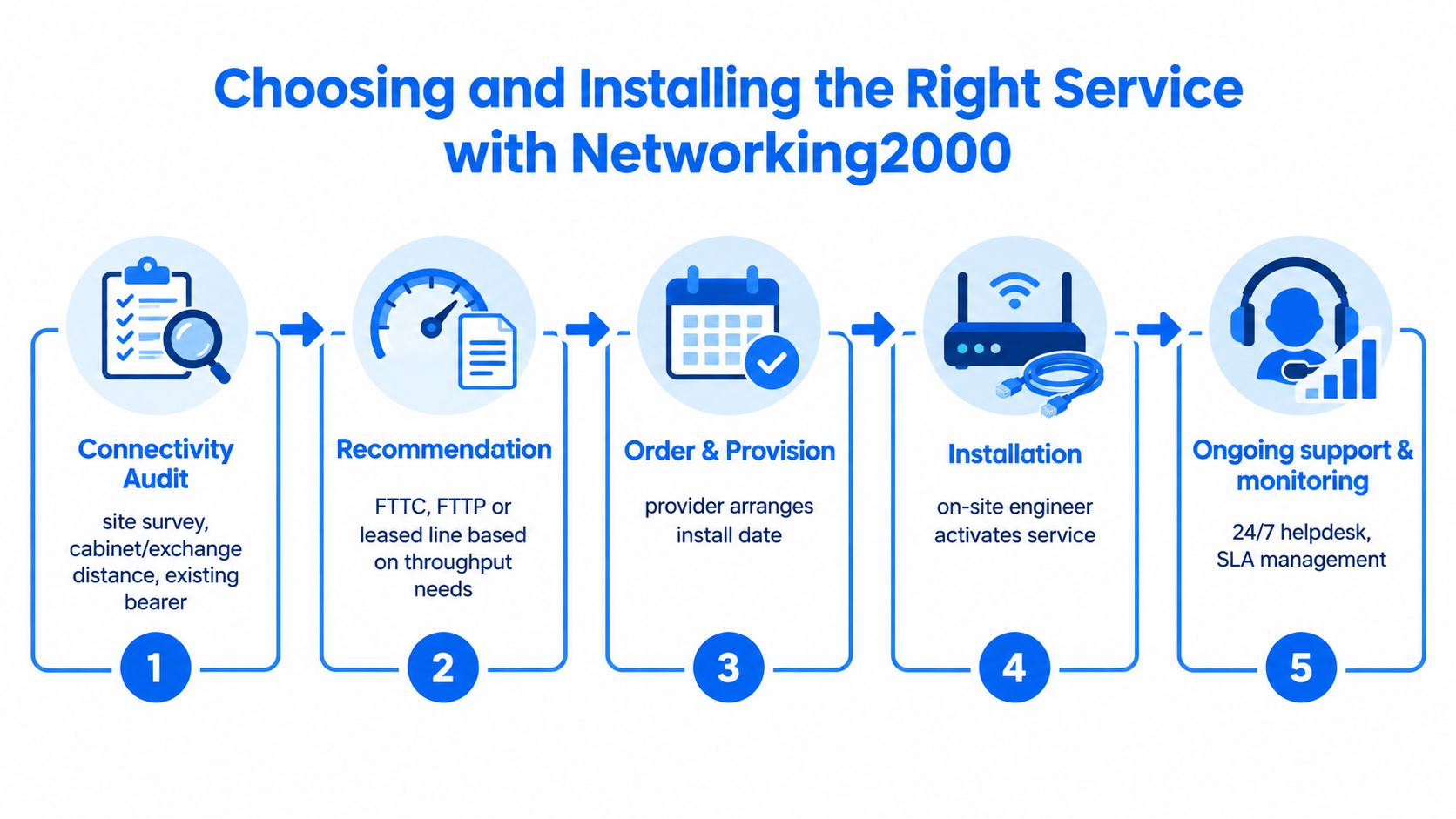
Ongoing support should provide a named contact or clear escalation path, fault ownership, monitoring where offered and a process for handling SLA credits. Review capacity after business growth, rather than waiting for contract renewal.
Networking2000 provides business internet connectivity, including FTTC services with location-dependent download speeds of up to 40Mb and upload speeds of up to 10Mb, plus business broadband packages that can include fixed IP addressing, as described in its internet connectivity services. Businesses in London and Essex that rely on voice, cloud systems or multiple sites should obtain an independent consultation before signing. The review can prevent unnecessary bandwidth spend and expose a repair arrangement the operation cannot tolerate.
Networking2000 can assess the site, compare FTTC, FTTP, Ethernet over Fibre and leased-line options, and coordinate router, failover and support requirements around the actual workload. Visit Networking2000 to arrange a connectivity consultation for your London or Essex business.

