You're fitting out a new office in Chelmsford, extending a home network in Brentwood, or adding Wi-Fi access points to an older London property. The installer asks whether you want Cat5e or Cat6, and the obvious answer seems to be “the faster one”. That answer is incomplete.
For most current broadband connections, both can deliver gigabit networking over a full-length structured cabling channel. Cat6 earns its extra cost through bandwidth headroom, stronger performance margin, easier future upgrades and, in some installations, better support for Power over Ethernet. Cat5e still has a legitimate place where you're extending an existing system, working within tight containment or need reliable 1 Gbit/s connectivity.
So, is Cat6 better than Cat5e? For new commercial cabling in London and Essex, my answer is usually yes. For a short retrofit where the existing infrastructure, budget and building constraints matter more than future capacity, Cat5e can still be the sensible choice. The decision should be based on the life of the building and the difficulty of replacing the cable, not just the speed printed on the box.
Table of Contents
- Introduction Why This Question Matters Now
- Understanding Cat5e and Cat6 in UK Structured Cabling
- Head to Head Performance Comparison That Actually Matters
- Real World Speed and When You Will Notice the Difference
- Installation PoE and Compliance Considerations for UK Premises
- Cost Future Proofing and Lifecycle Value for SMEs and Homes
- Our Recommendation for Choosing Between Cat6 and Cat5e
Introduction Why This Question Matters Now
A small business owner rarely asks this question in isolation. They're usually dealing with a wider job: a new switch, several wireless access points, CCTV, VoIP phones, a server or NAS, and staff who need dependable connectivity while the premises remain open. A homeowner may be running cable upstairs, improving a home office, or trying to stop wireless dead spots from affecting work calls.
That's why the simple online answer, “Cat6 is faster”, can lead to poor decisions. If the switch, network interface and service all operate at 1 Gbit/s, replacing Cat5e with Cat6 won't magically make the internet connection faster. The value may instead lie in cleaner installation performance, better crosstalk margin, higher-power PoE planning or avoiding disruptive recabling later.
The UK standards context matters too. Structured cabling guidance commonly aligns with BS EN 50173 and ISO/IEC 11801, and the market has moved from Cat5e as the basic gigabit option towards Cat6 as the stronger baseline for new commercial work. The UK Cat5e and Cat6 comparison guide explains this distinction in practical terms, including the difference between full-length gigabit performance and shorter-run 10 Gbit/s capability.
The practical answer: Cat6 is normally the right starting point for new cabling. Cat5e remains useful for sensible, contained retrofits.
This guide is for London and Essex SMEs, home users, landlords and property managers who need a decision they can defend. It covers technical performance, cable length, interference, Wi-Fi backhaul, PoE, fire and installation compliance, cost, disruption and expected service life.
By the end, you'll know when Cat6 should be treated as a long-term infrastructure asset, when Cat5e is adequate, and when Cat6A deserves consideration instead. You'll also have a straightforward way to brief an installer without getting lost in networking jargon.
Understanding Cat5e and Cat6 in UK Structured Cabling
Cat5e and Cat6 are performance categories, not descriptions of internet packages. They define how a cabling system is expected to behave when the cable, connectors, patch panels and installation are treated as one channel.
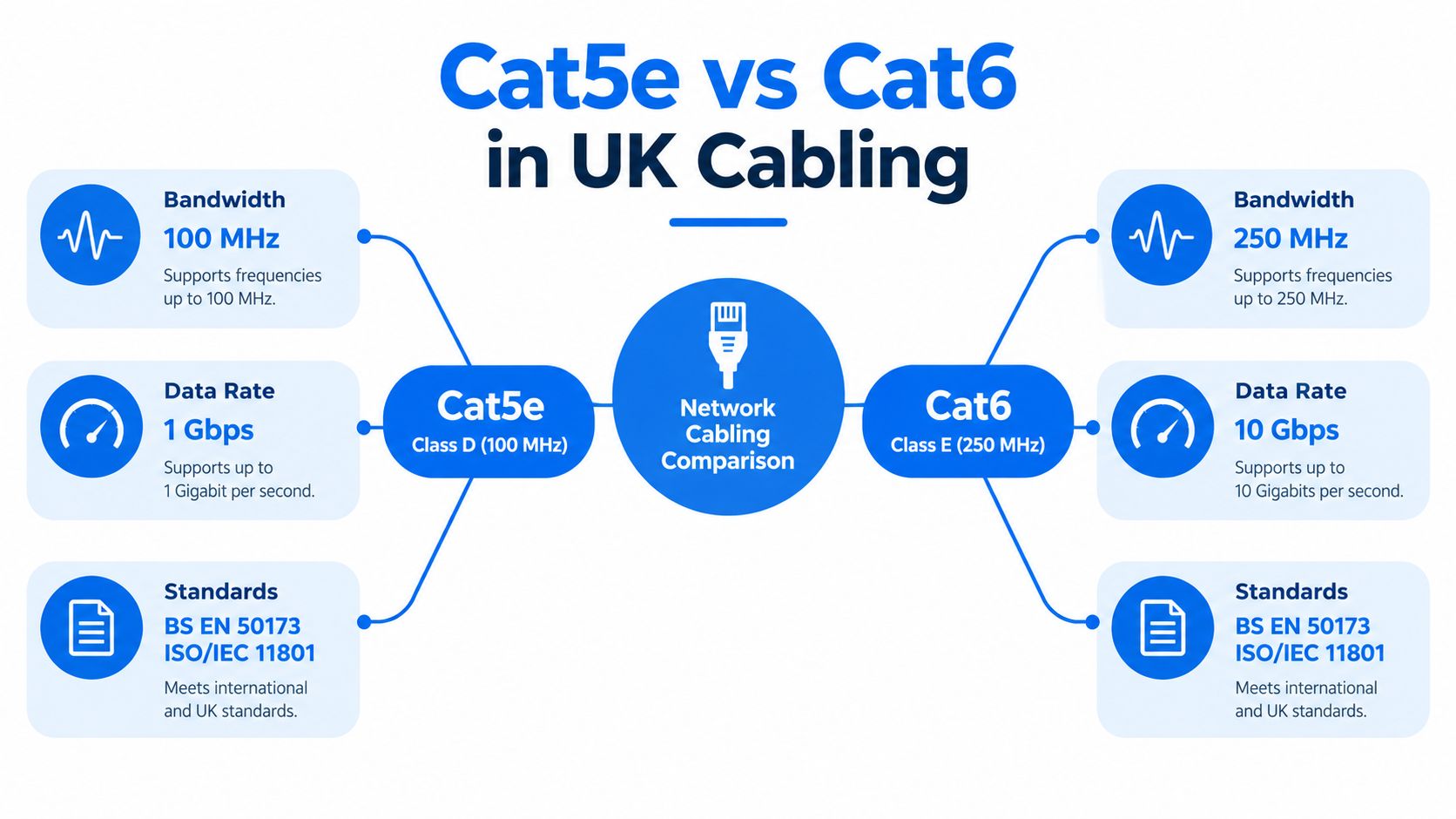
Under common UK structured cabling guidance, Cat5e is a Class D, 100 MHz option. Cat6 is a Class E, 250 MHz option. Both support 1 Gbit/s to 100 metres, provided the channel is designed, terminated and tested correctly. Cat6 can also support 10 Gbit/s over shorter runs, commonly around 37 to 55 metres, depending on the environment and installation conditions, as described in this UK Cat6 data cable guide.
The frequency rating is where the main engineering difference begins. Cat6's 250 MHz rating is 2.5 times Cat5e's 100 MHz rating. That doesn't mean a Cat6 connection automatically runs at 2.5 times the speed. It means the cable has more bandwidth headroom and can maintain better margin against crosstalk and installation imperfections.
Read the standards and markings correctly
Look for the category marking on the cable sheath, not just a retailer's product title. A credible specification should identify the category, conductor type, jacket rating and whether the cable is shielded or unshielded. Category, shielding and fire classification are different properties, so “Cat6” alone doesn't tell you whether a cable is suitable for a particular riser, tray or wall cavity.
The UK standards history also explains why recommendations have changed. BS EN 50173-1:2018 superseded the withdrawn BS EN 50173-1:2011 edition, reflecting the continued move towards standards-based structured cabling and higher-frequency systems. In practical terms, Cat5e is increasingly treated as a legacy or retrofit option, while Cat6 is commonly selected for new commercial installations.
If you're comparing terminology with overseas advice, the Brisbane data cabling guide offers useful background on structured cabling concepts. The local installation rules and fire requirements still need to be checked against UK conditions.
Cat6 doesn't make a gigabit service faster over a full-length channel. It gives the cabling more room to cope with higher-frequency signals and future equipment.
Head to Head Performance Comparison That Actually Matters
The useful comparison isn't “slow cable versus fast cable”. It's standard gigabit capability versus additional operating margin and upgrade capacity.
| Feature | Cat5e | Cat6 |
|---|---|---|
| Frequency rating | 100 MHz | 250 MHz |
| Class under common UK structured cabling guidance | Class D | Class E |
| 1 Gbit/s capability | Up to 100 metres | Up to 100 metres |
| 10 Gbit/s capability | Not the normal choice for this requirement | Shorter runs, commonly around 37 to 55 metres, depending on conditions |
| Crosstalk margin | Suitable when correctly installed | Greater headroom and stricter performance expectations |
| Typical new-install position | Retrofit or legacy reuse | Stronger baseline for new work |
Bandwidth is not the same as internet speed
Cat5e's 100 MHz rating is enough for standard gigabit Ethernet over the full channel length. Cat6's 250 MHz rating supports a broader signal range, which gives the system more margin when several cables share containment or when termination and electromagnetic conditions aren't perfect.
That margin matters most in commercial premises. A crowded ceiling void in an Essex office, a mixed-service riser in a London block or a patch panel with poor cable management can expose weaknesses that won't appear in a short desk connection.
Distance changes the 10 Gbit/s answer
Cat6's headline 10 Gbit/s capability applies to shorter runs, not a general replacement for Cat6A across a full 100-metre channel. UK guidance commonly places Cat6 10GBASE-T runs around 37 to 55 metres, with the usable distance affected by the installation environment.
Distance rule: If you need dependable 10 Gbit/s across a full-length channel, don't treat ordinary Cat6 as a guarantee. Specify the cabling category for the actual link length and performance target.
Crosstalk and upgrade headroom
Crosstalk is unwanted interference between wire pairs or between adjacent cables. Cat6's construction and tighter performance requirements provide better protection against this problem than Cat5e, although the installer still needs to maintain separation, respect bend limits and terminate every component properly.
The difference becomes more valuable as equipment improves. A business may start with gigabit-to-the-desk switches, then introduce faster server uplinks, multi-gigabit wireless backhaul or larger PoE deployments. Cat6 gives that upgrade path more breathing room without claiming that today's devices will run faster because the cable category is higher.
Real World Speed and When You Will Notice the Difference
Most homes and SMEs won't notice a speed difference between correctly installed Cat5e and Cat6 if their network equipment operates at 1 Gbit/s. The router, switch, network card and broadband service form the complete path. Replacing one cable category without upgrading the limiting component won't change the negotiated connection speed.

A home office with one laptop, a printer and ordinary streaming traffic may be perfectly well served by existing Cat5e. The same applies to a small shop with a till, a few workstations and a basic wireless network, provided the cabling is in good condition and the installation meets the required standard.
The picture changes when several devices use the wired network at once. A design studio transferring large files to a NAS, a professional office connecting multiple wireless access points, or a business moving data between a server and a switch can make better use of Cat6's additional headroom. The benefit still depends on compatible switches and network interfaces.
Where Cat6 starts earning its place
Wi-Fi access points don't send traffic through the air all the way back to the router. Their wired uplinks can become a shared bottleneck, particularly where many users connect at the same time. Cat6 gives an installer a stronger baseline for those uplinks, especially when the runs are short and the business expects equipment upgrades.
A home user should ask practical questions:
- What devices do you own? Check whether the switch, NAS and computers support only gigabit or offer multi-gigabit ports.
- How long are the runs? Cat6's short-run 10 Gbit/s advantage depends on distance and installation conditions.
- What will you add? Consider access points, cameras, smart-home hubs, a home server and higher-powered PoE devices.
- Are the walls open now? Cable installation is far less disruptive before plasterboard, flooring or fitted furniture is complete.
UK gigabit availability also adds context, but it doesn't settle the decision. Ofcom-linked reporting indicates that 89% of UK premises had gigabit broadband by January 2026 (UK public-sector cabling specification and related market context). A gigabit service still doesn't require Cat6 by itself. It does make it sensible to plan the internal network carefully, because the cabling may remain in place after the broadband contract and router have changed.
Installation PoE and Compliance Considerations for UK Premises
The cable category is only one part of a compliant installation. In real buildings, routing, containment, termination, heat, segregation and jacket classification can matter more than the theoretical data rate.
Cat6 commonly uses thicker conductors and tighter pair construction. Those features help performance and can provide useful margin for PoE deployments, but they also make the cable less forgiving in tight routes. It may be harder to pull through an old conduit, fit into a crowded tray or turn neatly inside a shallow back box.
Plan the physical route before buying cable
An installer should inspect the route rather than assume that a cable drum will solve everything. London offices often contain congested containment, suspended ceilings and shared risers. Older Essex properties may have narrow voids, awkward floor penetrations or legacy services that limit access.
The installation team should check:
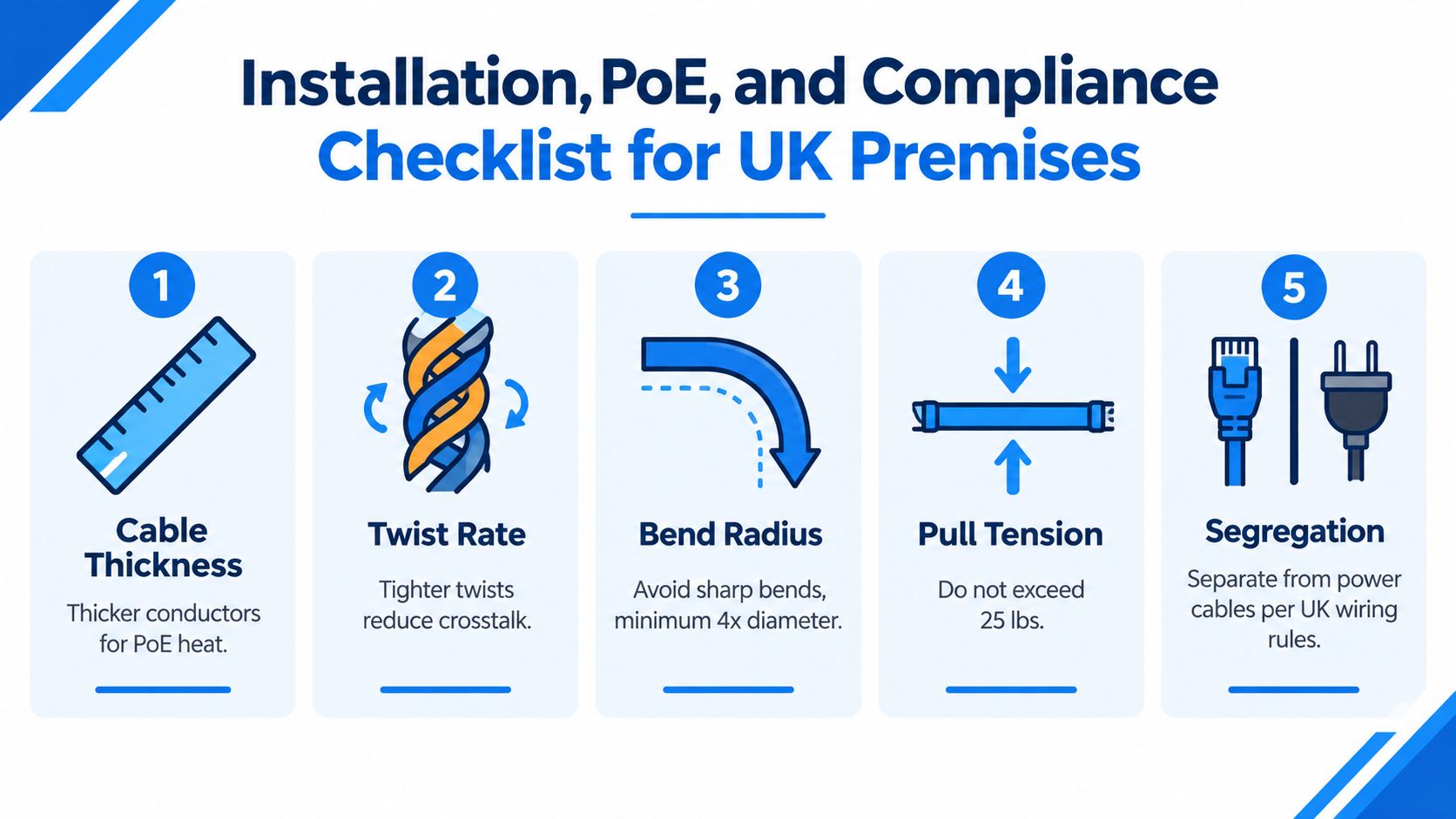
- Bend radius: Don't force Cat6 around sharp corners or crush it behind faceplates.
- Pull tension: Excessive force can damage the geometry that gives Cat6 its performance margin.
- Segregation: Keep telecoms cabling appropriately separated from power cabling under applicable UK wiring requirements.
- Termination: Use compatible outlets, patch panels and plugs, then test the completed channel.
- Containment: Allow enough room for the cable's diameter and future additions rather than filling every available route.
PoE deserves specific attention for Wi-Fi access points, CCTV cameras, door controllers and other devices that receive power through the network cable. Cable quality, conductor size, bundle density and ambient temperature affect how confidently the system can deliver power without creating avoidable heat.
Fire and building compliance are not optional
UK structured cabling guidance increasingly links cable selection to installation safety. BS6701 governs telecom cable direction in buildings, and UK guidance identifies Cca Euroclass as the minimum standard for permanent telecom cable installations. The cable jacket and installation method therefore need to match the building and the route, not merely the network equipment.
A cheaper cable that fails the building specification isn't a bargain. It creates rework, delay and a compliance problem.
A competent survey should record existing containment, access restrictions, fire-stopping requirements and the proposed locations of patch panels and outlets. Networking2000 provides Cat5e and Cat6 data cabling alongside wider network and security work, so a client can assess cabling in relation to wireless coverage, CCTV, access control and business continuity rather than treating it as an isolated purchase.
Cost Future Proofing and Lifecycle Value for SMEs and Homes
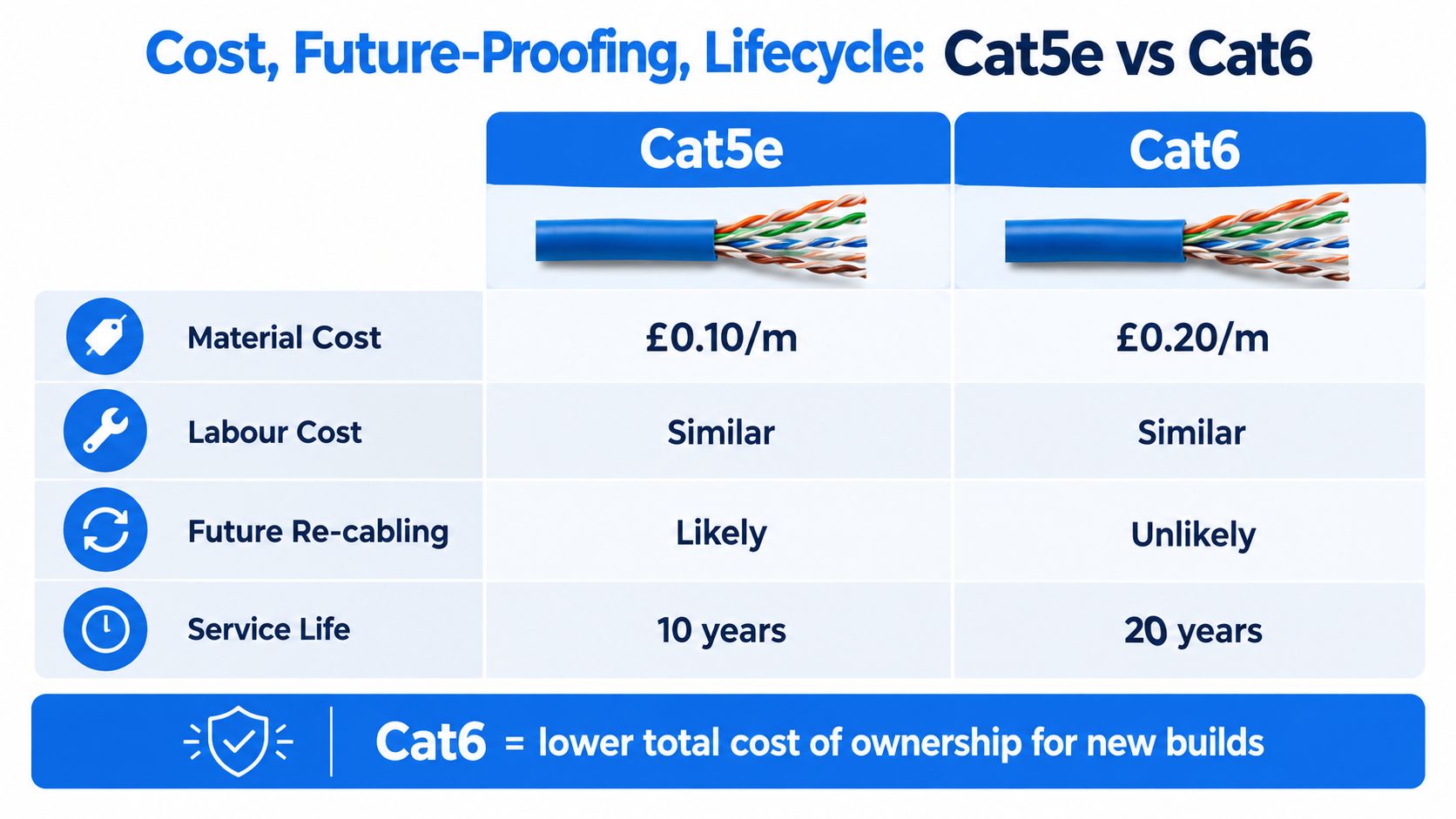
A cable quote based only on the price per metre misses the largest cost. The comparison includes labour, access equipment, ceiling removal, redecorating, downtime and the disruption caused when a business needs to recable an occupied building.
Cat5e may be the right financial decision when you're extending an existing Cat5e system, connecting a temporary office or working in a property where routes are too constrained for a practical Cat6 installation. The shorter project cycle can matter more than theoretical upgrade capacity.
For a new office fit, however, the question is different. A UK public-sector cabling specification describes Cat5e infrastructure with an expected life of 15 years, while Cat6, Cat6A and uplink cabling are expected to last 25 years (UK public-sector structured cabling specification). The same specification requires Cat6A for new developments and significant refurbishments rather than Cat5e or Cat6.
Think in building cycles
A business taking a long lease or refurbishing a property should value cable that remains useful through several equipment refreshes. Cat6 is often the sensible baseline for new work because it supports the current gigabit requirement while offering greater headroom for shorter-run high-speed links.
A homeowner needs a different calculation. If you're opening walls during a renovation and plan to stay for years, the labour and disruption may justify Cat6. If you're adding one connection to a rented property or extending a functioning network along an accessible route, Cat5e can be entirely rational.
When Cat6A enters the discussion
Cat6A is the more appropriate planning choice where the project needs dependable 10 Gbit/s over the full channel or where the client is creating a long-term commercial asset. Don't specify Cat6 because “future-proofing” sounds good. Specify the category that matches the intended service life, link distance, PoE design and building standard.
The strongest business case for Cat6 or Cat6A appears when opening the building once avoids a second invasive installation. That calculation often matters more than the small difference in cable material cost.
Our Recommendation for Choosing Between Cat6 and Cat5e
My recommendation is straightforward:
- New office fit: Choose Cat6 as the baseline, or Cat6A where the specification demands a longer-term high-capacity asset.
- Major refurbishment: Choose Cat6 or Cat6A after checking containment, fire requirements, route lengths and future uplinks.
- Small retail or hospitality retrofit: Keep good Cat5e where it already works, and use Cat6 for new routes serving access points, tills, cameras or critical equipment.
- Home office renovation: Choose Cat6 if the walls are open and you expect better wireless backhaul, a NAS or multi-gigabit equipment.
- Simple home extension: Cat5e remains sensible where the run is accessible, the equipment is gigabit-only and future recabling would be easy.
- Tight or congested routes: Don't force Cat6 into a route that will damage the cable or breach installation requirements. Redesign the route or use a compliant alternative.
Use four questions to make the final call:
- Are you installing from scratch? If yes, favour Cat6.
- Will the cable stay in the building through future equipment refreshes? If yes, invest in more headroom.
- Will you use PoE devices or faster uplinks? If yes, plan the cable and containment together.
- Is the existing route difficult or the project short-term? If yes, Cat5e may be the better retrofit choice.
Cat6 isn't automatically faster in every network, but it is usually the stronger choice for new London and Essex commercial cabling. Cat5e is not obsolete. It's a practical retrofit option when the building, budget and equipment don't justify replacing a sound installation.
Networking2000 can survey your premises, assess Cat5e and Cat6 routes, and plan cabling around Wi-Fi, PoE, CCTV and future network equipment. Visit Networking2000 to discuss a practical cabling recommendation for your home or business in London and Essex.

