At a Shoreditch technology firm, a client video call can falter just as developers push code and cloud backups run. In Canary Wharf, a finance team may find that voice calls, remote desktops and large files compete for the same shared connection. In both cases, the advertised download speed may look sufficient, yet performance becomes unpredictable at busy times.
A leased line is a private internet connection reserved for one business. It provides dedicated capacity and matching upload and download performance, unlike many shared broadband services. That makes it suitable for organisations whose daily work depends on cloud platforms, VoIP, VPNs, remote systems or frequent file transfers.
The trade-off is cost and availability. A leased line can make sense for a London office where a short outage disrupts client work, trading operations or remote access. It may also help an Essex business park with limited alternatives, or a rural premises where the available broadband connection becomes congested when several staff use it together. However, paying for dedicated service is difficult to justify if the business mainly handles email, web browsing and occasional cloud tasks.
The practical decision rests on three questions: how much downtime costs, how heavily the team relies on reliable uploads and real-time applications, and whether the premises can be connected without substantial construction work. Guaranteed performance and service-level support have value, but only when they address a genuine operational risk.
Table of Contents
- Beyond Broadband Why Businesses Need Better Internet
- How a Leased Line Works The Private Motorway Analogy
- Key Business Benefits Guaranteed Performance and Uptime
- Leased Line vs Business Broadband and FTTP
- Understanding Leased Line Costs and Installation
- Is a Leased Line Right for Your London or Essex Business
Beyond Broadband Why Businesses Need Better Internet
A connectivity fault rarely arrives at a convenient time. A sales presentation freezes during a client call. Finance waits for a cloud system to load while a payment or report is due. A design team sends large files as staff try to use voice calls and shared applications. The Wi-Fi gets blamed first, but the bottleneck may sit in the shared connection serving the building.
Standard broadband can handle light browsing, email and occasional cloud use. Trouble starts when the business relies on it as core infrastructure while paying for a shared, best-effort service. Peak-time slowdowns delay cloud work, weak upload performance holds up file transfers, and uncertain fault handling leaves staff without a clear recovery route.
One failed circuit can stop customer conversations, delay transactions and leave remote workers unable to reach office systems. In a London office, that interruption may affect client meetings and access to hosted applications. For an Essex business, limited local alternatives can make a recurring fault harder to work around.
Practical rule: If a connection failure stops staff working, processing transactions or speaking to customers, assess it as business infrastructure rather than a household utility.
A leased line addresses this risk by reserving capacity for one customer and providing matching upload and download performance. The value is not merely a higher headline speed. It is more predictable service for cloud platforms, VoIP, VPN access and large transfers, supported by defined fault handling. That matters when an outage costs more than the monthly saving from cheaper broadband.
The right question is, “What happens when the connection is busy or unavailable?” Review the cost of downtime, upload demands, real-time applications and the availability of a second connection. network resilience testing can help expose single points of failure before they interrupt operations.
How a Leased Line Works The Private Motorway Analogy
Think of ordinary broadband as a public A-road. Your business uses the same general route as other homes and companies, and conditions can change as demand rises. A leased line is closer to a private motorway reserved for your organisation's traffic. The important difference isn't just the headline speed. It's the control and predictability built into the route.
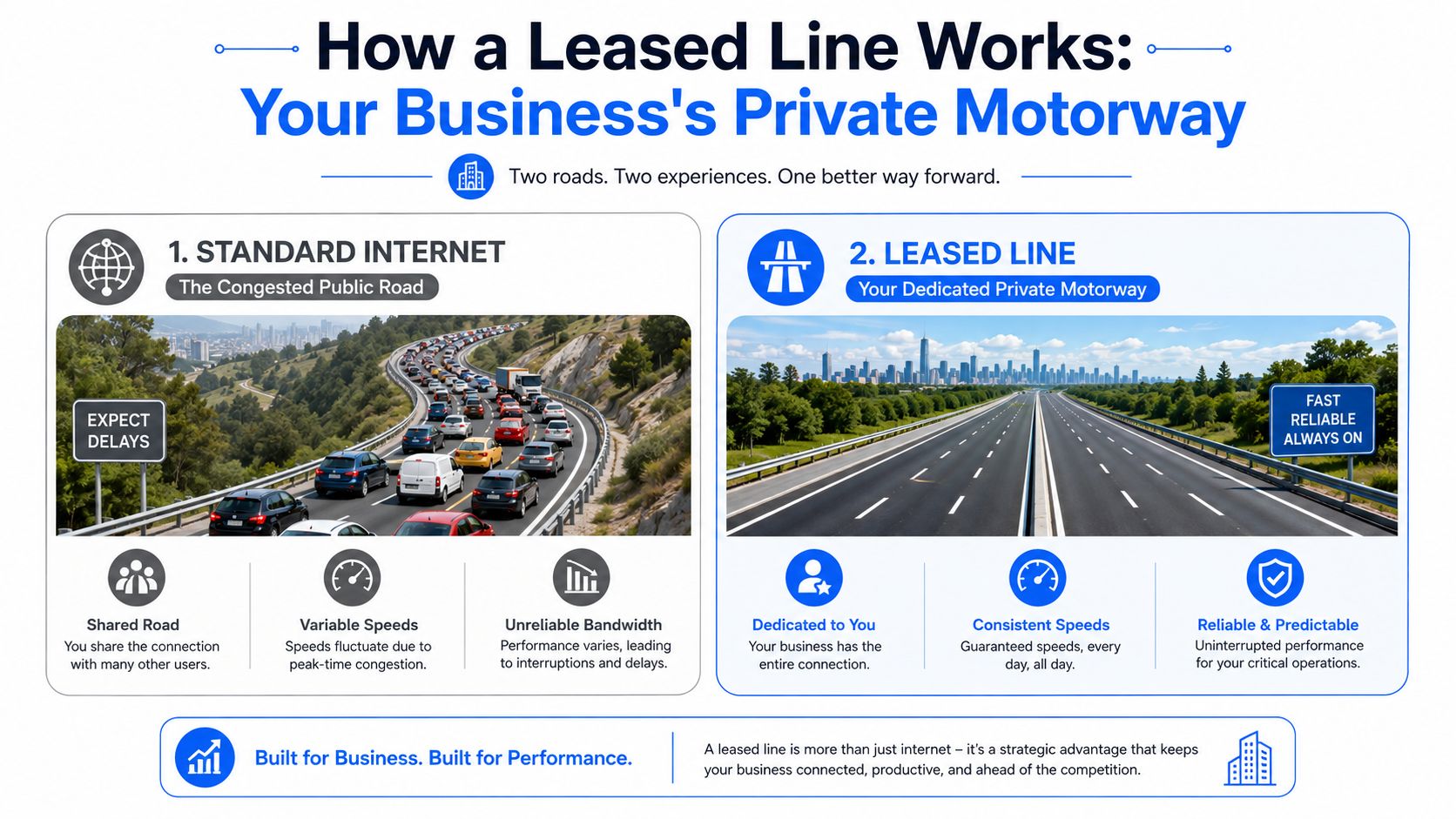
Dedicated means reserved for your business
A leased line provides dedicated transmission capacity between fixed locations. The access circuit isn't shared with neighbouring customers in the way a contended broadband service is. If your office has a busy period, another customer's usage shouldn't consume the capacity you've contracted for.
That doesn't mean every part of the public internet is private. Once traffic leaves your provider's network, it still reaches external services and websites through wider networks. The dedicated part refers to the connection between your premises and the provider's network, or between two agreed business locations. That distinction matters for offices connecting to hosted applications, data centres or another branch.
Uncontended means fewer peak-time surprises
“Uncontended” describes the access circuit's capacity. Your service isn't competing with nearby customers for the same last-mile bandwidth. This gives your network a more consistent foundation for cloud applications, VPN traffic, file transfers and hosted telephony.
It won't fix a poorly configured firewall, overloaded switch or weak wireless network. It also can't control congestion inside a third-party cloud platform. What it does is remove one common and difficult-to-diagnose source of variation at the access connection.
Symmetric means uploads match downloads
Most business activity involves sending data as well as receiving it. Staff upload documents, synchronise cloud storage, send backups, use hosted desktops and make VoIP calls. A leased line is symmetric, so the contracted upload and download rates are equal.
Ofcom describes UK leased lines as dedicated Ethernet services with symmetric speeds. The same Ofcom guidance on Ethernet and leased lines explains why uncontended capacity supports more predictable latency for VoIP, VPNs and cloud-based applications.
The practical effect is straightforward. A large upload is less likely to consume the upstream capacity needed by a video call, and a cloud backup is less likely to make everyday applications feel unresponsive. Engineers still need to size the service properly, but the connection behaves more like a controlled business resource than a shared household pipe.
The circuit may also connect two fixed business locations rather than providing internet access alone. That can support private links between offices, data centres or network hubs, depending on the service design. Your provider will define the handover, routing and managed equipment, so ask whether the quote includes the router, firewall or only the circuit presentation.
Key Business Benefits Guaranteed Performance and Uptime
The business case for a leased line is rarely “our speed test needs to be higher”. The stronger case is predictable performance when several important services run at the same time. A stable circuit helps staff use cloud systems, hosted phones, VPNs and backups without constantly working around peak-time variation.
VoIP illustrates the difference well. A phone call needs traffic to arrive consistently, not merely quickly on average. Variation in delay can produce clipped audio, awkward pauses or calls that drop. Video conferencing has the same sensitivity, while cloud applications can feel slow when upload traffic queues behind other users.
SLAs turn connectivity into a commitment
A Service Level Agreement sets out what the provider commits to deliver and how faults will be handled. UK leased-line providers commonly target availability between 99.85% and 99.93%, with repair commitments often discussed around a 5-hour standard for Ethernet leased-line faults, as detailed in this UK leased-line SLA comparison.
Read the wording carefully. Check what availability means, when the clock starts, which equipment is covered and whether planned maintenance is excluded. Also confirm the support hours and escalation process. A promised repair target has limited value if your organisation can't reach the right support team when an incident occurs.
Businesses with internal development or operations teams may also want a wider view of SLA monitoring for DevOps teams. Monitoring should compare the provider's commitments with the service your users experience.

Reliability supports continuity
A leased line won't make a business immune to outages. A damaged cable, failed provider component or local power problem can still interrupt service. The difference is that the service is designed and supported around a defined operational commitment, giving your team a clearer response path than a best-effort connection normally provides.
For a London office, this can protect customer calls, cloud CRM access and remote collaboration. For an Essex company with fewer alternative providers nearby, the site survey and fault process deserve particular attention. Ask whether the route is diverse, whether a backup connection is recommended and how failover will work. One leased line is still one physical service, so resilience may require a second connection from a different route or technology.
Security also needs precise wording. A dedicated circuit isn't a replacement for encryption, firewalling or access controls. It can reduce sharing at the access layer, but your network still needs proper segmentation and protection. Treat the leased line as a dependable transport service, then secure the traffic travelling across it.
Leased Line vs Business Broadband and FTTP
A leased line is not automatically the right upgrade for every business. Many SMEs work effectively with business broadband or Ethernet over FTTP when occasional performance variation has little commercial impact. The decision should follow the consequences of slow uploads, congestion or downtime, rather than the product name.
Business broadband may include better support than a consumer package, but it can still use shared access with best-effort performance. FTTP delivers fibre-based speeds, yet its capacity, fault commitments and SLA may not match a leased line. Compare the contract and service design, not just the technology used to reach the building.
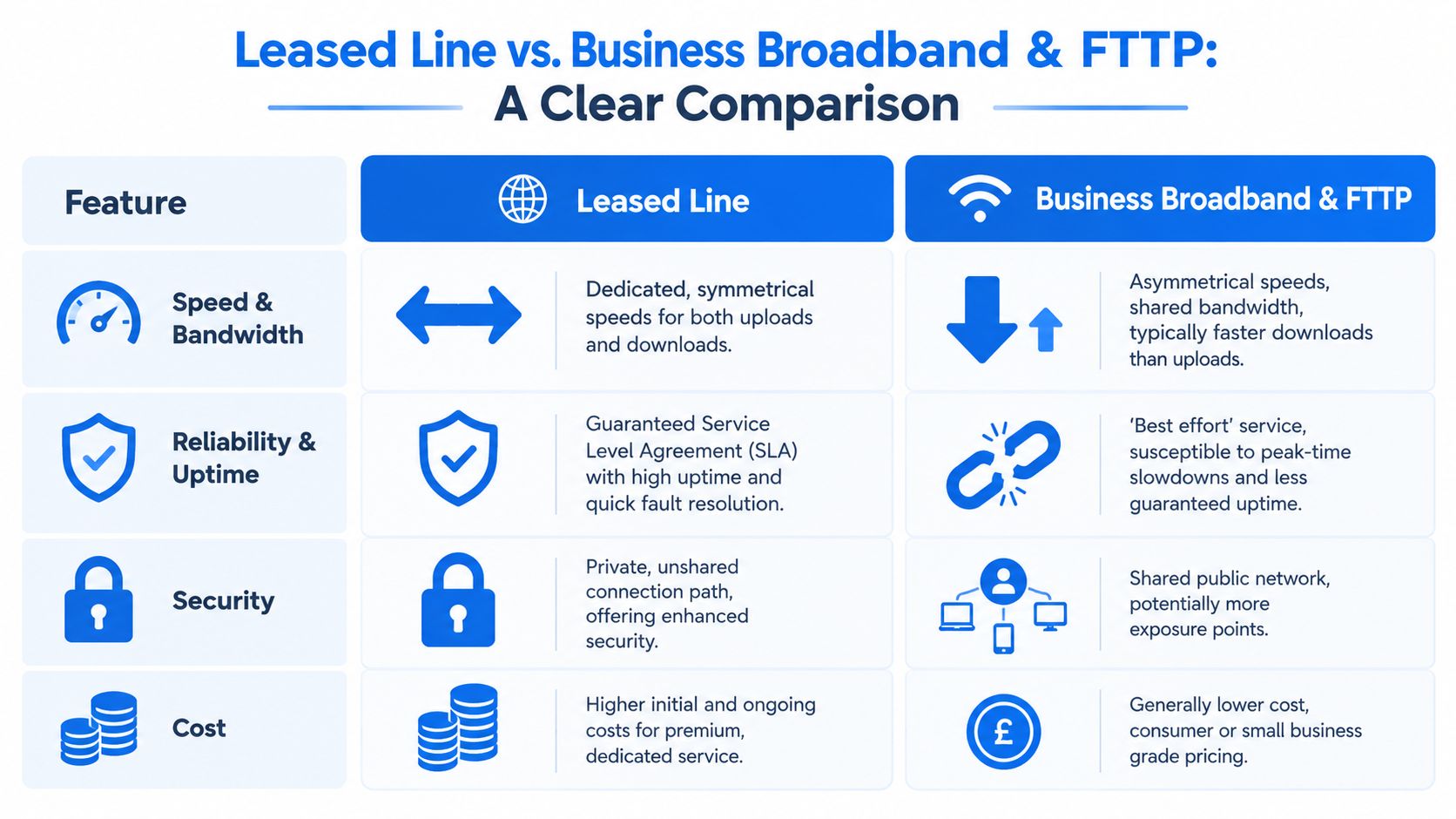
Connectivity options compared
| Feature | Leased Line | Ethernet over FTTP | Business Broadband (FTTC) |
|---|---|---|---|
| Bandwidth model | Dedicated and uncontended | Depends on the product and provider | Usually shared and contended |
| Speed profile | Symmetric upload and download | May be symmetric or asymmetric | Typically asymmetric |
| Peak-time behaviour | More predictable on the access circuit | Can vary according to the service design | More exposed to contention |
| SLA | Formal business-grade SLA is standard | Varies by provider and product | Usually best effort or has less detailed terms |
| Fault handling | Defined business repair commitment | Product-dependent | Typically less stringent |
| Best fit | Cloud-dependent, voice-heavy or downtime-sensitive operations | Businesses needing fibre capacity at a lower cost | Light or moderate internet use |
| Cost position | Higher investment | Often between the two, depending on specification | Generally lower |
A small office with light usage may gain little from paying for dedicated capacity. If employees mainly browse, email and use modest cloud applications, FTTP or business broadband can be a sensible commercial choice.
Upload performance changes the calculation. Hosted phones, VPNs, large design files, remote desktop sessions and cloud backups all send data from the premises. An asymmetric service can produce an impressive download result while uploads remain the practical constraint.
Ofcom reported that around 385,000 UK premises lacked access to “decent” broadband in July 2024, defined as at least 10 Mbit/s download and 1 Mbit/s upload on fixed-line broadband, according to its Connected Nations 2024 report. Coverage alone does not settle the business decision. Fast broadband may still lack the guaranteed, uncontended capacity offered by a leased line.
Location matters across London and Essex. In the City of London, dense fibre infrastructure can make FTTP a strong contender where the available product offers sufficient upload capacity and suitable support terms. A business in a rural Essex area may face fewer provider routes, weaker alternatives or a longer path to reliable fibre. In that situation, a leased line may be the only practical way to obtain guaranteed performance.
Compare contention, upload symmetry, SLA wording, fault handling, installation assumptions and upgrade options before choosing on price alone. For a London site, FTTP may provide enough capacity at a lower cost. For a rural Essex operation that depends on cloud systems or hosted voice, the leased line premium may be justified by the service commitment.
Understanding Leased Line Costs and Installation
Leased-line pricing has two separate parts. The first is the recurring monthly charge for the circuit and service level. The second is the installation or construction cost required to bring the connection to your premises. Treating the monthly figure as the whole price is how businesses receive an attractive quote and then encounter an unexpected project cost.
Current UK price guidance puts a 100 Mbps service at roughly £69 to £320 or more per month, while 1 Gbps services range from about £129 to £800 or more, according to this UK leased-line cost guide. Those are guide ranges, not a promise for a particular London or Essex address.
What changes the monthly charge
Bandwidth is one factor, but it isn't the only one. Providers may price differently according to contract length, service management, router inclusion, support arrangements and the route available to the building. A longer commitment may reduce the monthly price while making it harder to change provider or relocate later.
Ask whether the quoted service includes the managed router, monitoring, installation, static addresses and any support outside standard hours. If your team needs a firewall or SD-WAN appliance, establish where the provider's responsibility ends and your IT support responsibility begins.
Installation is where postcode risk appears
The provider needs to establish how close the premises is to suitable fibre infrastructure and how the cable will enter the building. A central London office may have existing ducts and nearby connectivity, while an Essex business park may need a longer route, landlord permission or external works.
Excess Construction Charges, often shortened to ECCs, cover additional work required to deliver the circuit. That can include civils, duct work, traffic management, difficult access or extending the route from existing fibre. Installation may be free on some commercial terms, but UK guidance places the possible range from free to more than £15,000, depending on the construction required.
Ask for the risk in writing: Confirm whether the quote is subject to survey, who pays ECCs, what happens if permission is refused and whether you can cancel before construction begins.
A proper site survey should confirm the route, building entry point, equipment location and likely handover. Don't approve a leased line based only on an online postcode checker. Use the survey to compare providers and ask each one to separate monthly service, installation and possible construction costs.
Is a Leased Line Right for Your London or Essex Business
The strongest candidates are businesses where internet performance has a direct operational consequence. That includes offices that rely on VoIP throughout the day, teams working continuously in cloud CRM or ERP systems, companies sending large files, and organisations running backups or hosted services from their premises.
A leased line is also easier to justify when the cost of downtime is higher than the premium for dedicated connectivity. If a failed connection prevents staff from taking calls, accessing records, processing orders or serving customers, reliability belongs in the purchasing decision. If the connection is mainly used for occasional browsing and email, a lower-cost fibre service may be more proportionate.
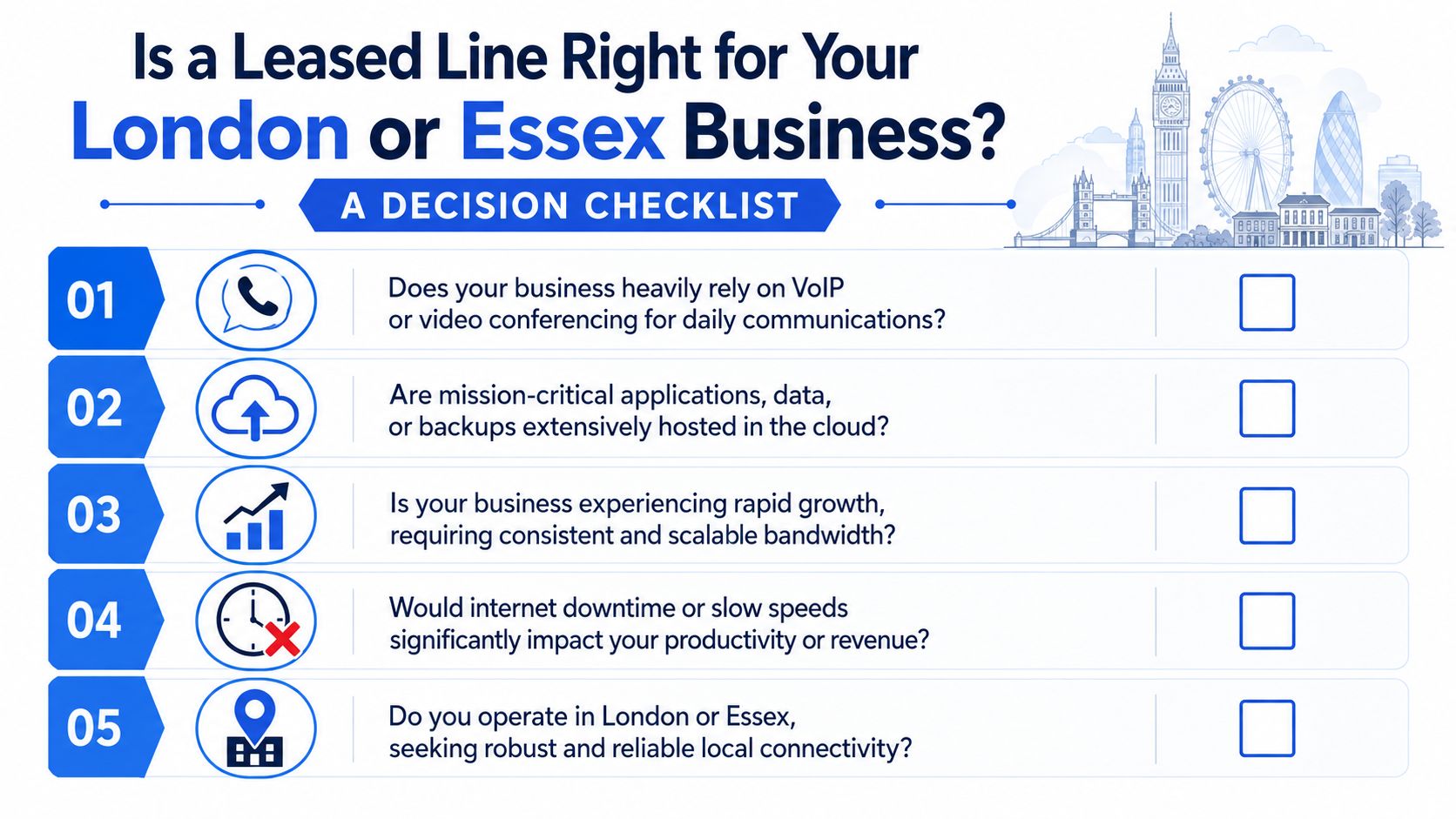
Use the operational test
Answer these questions:
- Does your team depend on real-time communication? Frequent VoIP and video conferencing make stable latency and upload capacity more valuable.
- Does the business work primarily in the cloud? Slow synchronisation or an unreliable VPN can affect every department.
- Would an outage create immediate cost or customer disruption? If yes, an SLA deserves serious consideration.
- Do you transfer substantial files or run regular backups? Symmetric capacity can prevent upstream traffic from interfering with normal work.
- Is the premises difficult to serve? A site survey may reveal construction charges that change the business case.
- Are you expanding? A connection selected with future capacity in mind can avoid another infrastructure project later.
A leased line may be overkill for a small office with few users, limited cloud dependence and a tolerance for occasional slowdowns. It can also be the wrong first fix if the underlying issue is poor internal cabling, inadequate Wi-Fi coverage, an overloaded firewall or unmanaged devices consuming bandwidth. Diagnose the whole network before assuming the access line is responsible.
Plan for capacity rather than chasing speed
Ofcom's 2026 to 2031 market review projects that the share of leased lines at 100 Mbit/s or less will continue to fall, while usage above 1 Gbit/s will increase. Ofcom's market review presents this as a shift towards higher-capacity services.
That doesn't mean every SME needs a multi-gigabit circuit. It does show why the decision shouldn't be framed as a simple broadband speed upgrade. Consider guaranteed upstream capacity, cloud and VoIP performance, resilience, support obligations and the cost of expanding later.
Networking2000 provides leased-line connectivity for businesses, including guaranteed upload and download speeds and an uptime SLA, alongside related IT, firewall, networking and VoIP services. A site survey and service review can establish whether a leased line is justified, whether a fibre alternative is sufficient, and what installation risks apply to your address.
If your London or Essex business needs dependable cloud access, hosted telephony or a clearer answer on leased-line installation costs, visit Networking2000 to discuss your requirements. Their engineers can review the existing network, assess connectivity options and provide practical advice before you commit to a service.

