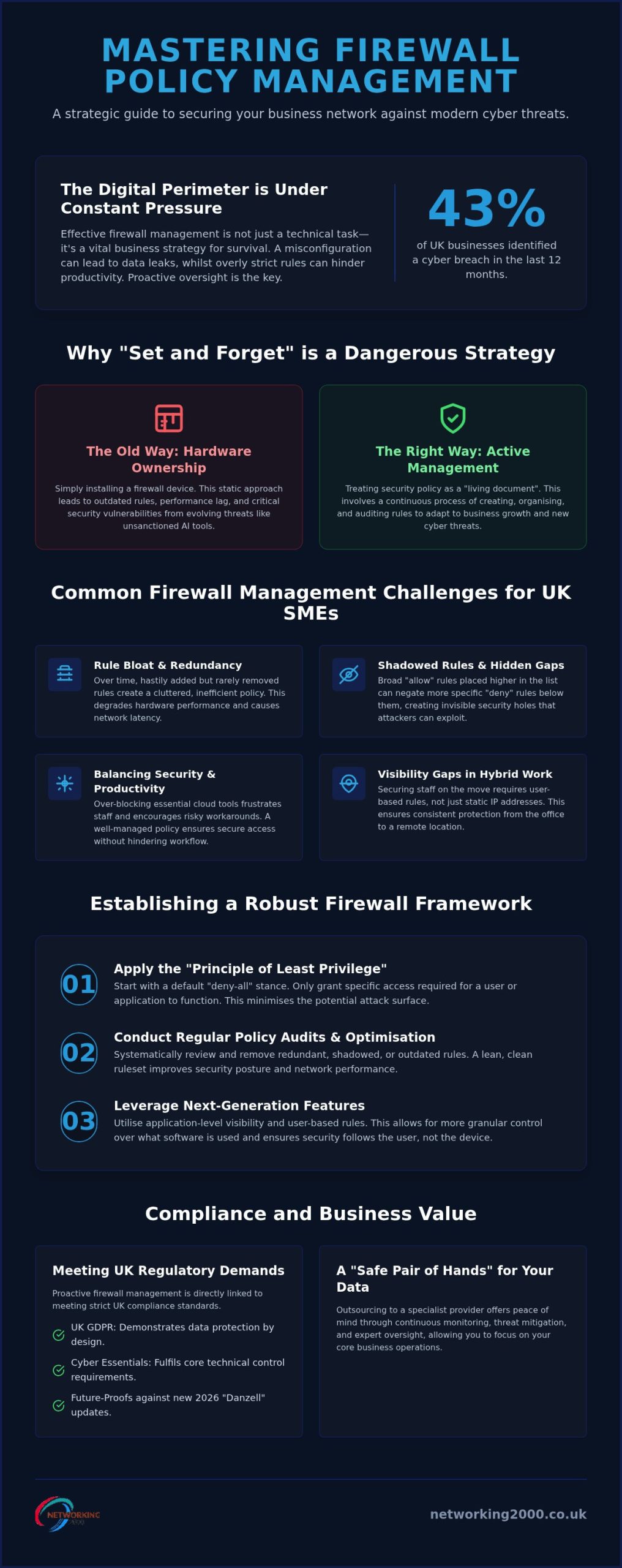
Did you know that 43% of UK businesses identified a cyber breach in the last 12 months? It’s a sobering figure that proves your digital perimeter is under constant pressure. Implementing robust firewall policy management for business isn’t just a technical task; it’s a vital strategy for survival. If you feel overwhelmed by a relentless stream of security alerts or the fear of a single misconfiguration leading to a leak, you’re certainly not alone. Most leaders want a secure, compliant network, but the pressure from GDPR and the new Cyber Essentials “Danzell” requirements can feel like a moving target.
This guide helps you master the art of securing your network through proactive oversight. We’ll show you how to turn reactive stress into a “safe pair of hands” for your company data. We’ll explore the latest 2026 regulatory updates, practical steps for rule optimisation, and how professional monitoring provides the peace of mind you need. You can focus on your core operations without the threat of unexpected downtime caused by security blocks. It’s time to take control of your perimeter with confidence and clarity.
Key Takeaways
- Learn why effective firewall policy management for business requires active rule organisation rather than just installing hardware.
- Identify and resolve common security bottlenecks such as rule bloat and visibility gaps within hybrid work setups.
- Discover how to apply the principle of “Least Privilege” to build a more resilient and secure network framework.
- Understand the direct link between proactive policy audits and meeting strict UK GDPR and Cyber Essentials requirements.
- See how outsourcing to a local specialist provides a “safe pair of hands” for continuous monitoring and threat mitigation.
What is Firewall Policy Management and Why Does Your Business Need It?
Think of your firewall as the digital perimeter of your office. Owning a high-end network security system is a great start, but the hardware is only as effective as the instructions you give it. Firewall policy management for business is the strategic process of creating, organising, and auditing the rules that dictate what enters and leaves your network. It’s the difference between having a locked door and having a security guard who knows exactly who is allowed inside.
Many firms confuse hardware ownership with active management. Simply plugging in a device doesn’t protect you from evolving threats. Effective management ensures that your security protocols remain a “living document” that adapts to your growth. It involves a constant balance: blocking unauthorised access whilst ensuring your team can work without being slowed down by unnecessary security blocks.
The Core Components of a Modern Firewall Policy
A robust policy relies on several technical layers. Access Control Lists (ACLs) act as the primary gatekeepers, filtering traffic based on predefined criteria. However, modern firewall policy management for business goes deeper. Next-generation firewalls now offer application-level visibility. This allows you to see exactly which software is consuming bandwidth or posing a risk. In a hybrid world, we also prioritise user-based rules over static IP addresses. This ensures your staff stay secure whether they’re working from a London coffee shop or our local Wickford hub.
Why “Set and Forget” is a Dangerous Strategy in 2026
The “set and forget” mentality is a major vulnerability. Cyber threats evolve daily. Rules that were safe two years ago might now be open doors for attackers. Cluttered, outdated policies also degrade your hardware performance. Every time your firewall has to process a redundant or conflicting rule, it uses up vital processing power, which leads to network lag.
There is also the growing risk of “shadow IT”. Research shows that unsanctioned AI use was a factor in 45% of breaches analysed in 2026. Without active policy oversight, these tools can bypass your perimeter entirely. Regular audits ensure that your ruleset is lean, fast, and capable of blocking the latest exploits. Maintaining a clean policy isn’t just about security; it’s about keeping your business agile and responsive.
Common Firewall Management Challenges for UK SMEs
Maintaining a secure perimeter is a full-time commitment that many UK SMEs struggle to resource. Internal IT teams are often stretched across multiple projects, leaving little time for deep security audits. This leads to configuration drift, where the firewall policy slowly becomes a tangled web of legacy rules. Implementing effective firewall policy management for business requires constant vigilance that small teams simply cannot always provide.
The Cyber Essentials scheme highlights the importance of these controls, yet many firms find the practical application difficult. When business needs change rapidly, security rules are often added in haste but rarely removed. This creates a cluttered environment that is difficult to troubleshoot and easy to exploit.
The Problem of Redundant and Shadowed Rules
Shadowed rules are a silent threat to your security posture. They occur when a broad rule sits higher in the list than a specific one, essentially “hiding” the second instruction. If you have a rule that allows all traffic from a certain department, any specific block rule below it becomes useless. This creates hidden security holes that remain invisible during basic checks.
Redundant rules also impact your day-to-day operations. Each unnecessary rule adds to the list the firewall must check before allowing traffic through. This increases network latency and can frustrate staff with slow connection speeds. Cleaning up your rulebase reduces the processing load on your device, effectively extending its operational lifespan.
Balancing Security with Employee Productivity
Over-blocking is one of the most common points of friction between IT and the wider business. If security rules are too restrictive, staff cannot access the essential cloud tools they need to do their jobs. This often forces employees to find workarounds, which increases the risk of data leaks. Managing the demands of remote access and VPN connections securely whilst keeping the workflow smooth is a delicate task.
Poor policy management inevitably leads to IT support bottlenecks. If your internal team is constantly manual-whitelisting sites or fixing broken connections, they aren’t focusing on high-value tasks. If your team is struggling with these complexities, our managed IT support provides the expert oversight you need to stay secure without sacrificing speed.
Establishing a Robust Firewall Rule Framework
Building a secure network starts with the principle of “Least Privilege”. This approach ensures that every user and application only has the access they absolutely need to function. By defaulting to “deny all” and selectively opening ports, you significantly reduce your attack surface. However, this level of control requires meticulous documentation. Without a clear record of why a rule exists, future IT staff might be afraid to touch it, leading to the rule bloat we discussed earlier. Effective firewall policy management for business relies on knowing the “who, what, and why” of every single entry in your database.
A formal change management process is essential for maintaining this clarity. Every modification should be logged, reviewed, and tested before it goes live. When a project ends or a tool is replaced, decommissioning old rules must be handled with care. We recommend a “soft disable” period where the rule is turned off but not deleted. This allows for a quick rollback if an unforeseen dependency emerges. Taking this methodical approach prevents the accidental creation of security gaps during rapid business changes.
The Lifecycle of a Firewall Rule
Treating every rule as a temporary asset with a clear lifecycle prevents your security posture from becoming stagnant. This methodical process ensures that your perimeter remains lean and effective.
- Step 1: Request and Justification. Every new access request must have a clear business reason and a designated owner who is responsible for its necessity.
- Step 2: Risk Assessment. Before implementation, evaluate the technical risk. Our team always checks if there’s a more secure way to achieve the same result without opening broad ports.
- Step 3: Monitoring and Expiry. Set expiry dates for temporary access. Regularly monitor traffic to ensure the rule is actually being used as intended.
Network Segmentation: Dividing to Conquer
Flat networks are a gift to cybercriminals. If a breach occurs, an attacker can move laterally across your entire system. Network segmentation solves this by creating internal barriers. You should always separate guest Wi-Fi from your corporate data. This ensures a visitor’s compromised device cannot reach your internal servers. Similarly, isolating sensitive departments like finance or HR adds another layer of protection. This strategy limits the “blast radius” of a potential breach, containing the threat to a single segment whilst the rest of your business continues to operate safely.
Compliance, Cyber Essentials, and Business Value
Compliance is no longer a “nice to have” for UK firms. Under the Data (Use and Access) Act 2025, which came into effect on June 19, 2026, organisations must provide clear, accessible mechanisms for handling data concerns. Robust firewall policy management for business is a cornerstone of this legal requirement. It provides the essential trail of evidence needed for UK GDPR compliance by proving that access to sensitive personal data is strictly controlled. Without these logs, an insurance claim or a legal audit becomes significantly more difficult to navigate.
The regulatory landscape is shifting towards greater accountability. Board-level responsibility for cyber security has increased to 31% of businesses this year. This shift reflects a growing understanding that security is a business risk, not just an IT one. Proper management ensures your perimeter isn’t just a barrier, but a documented system that protects your reputation and your bottom line.
Meeting Cyber Essentials Requirements
Passing a Cyber Essentials assessment has become significantly tougher recently. As of April 2026, all new assessments must use the “Danzell” (v3.3) question set. This update introduces stricter requirements, including a non-negotiable 14-day patching window for all critical vulnerabilities. If your firewall rules are cluttered or “any-any” rules are present, you’ll face an automatic failure. You must change all default administrative passwords and document the business justification for every open port. Professional IT security oversight ensures these technical boxes are ticked before your assessor arrives.
The ROI of Proactive Security Management
Investing in active management is far more cost-effective than recovering from a breach. With 43% of UK businesses identifying a cyber attack in the last 12 months, the risk is statistically high. Optimised policies also prevent your hardware from slowing down. When rules are lean and efficient, your devices process traffic faster, which reduces the need for expensive, premature hardware upgrades. This proactive approach is a core part of our managed IT support in Essex, where we focus on long-term infrastructure health.
Strong security is now a competitive advantage. Large organisations are increasingly scrutinising their supply chains due to the new Cyber Security and Resilience Bill. Being able to demonstrate that your network is managed to high standards makes you a more attractive partner. It provides your clients with peace of mind, knowing their data is in a safe pair of hands whilst allowing you to focus on growth.
Why Outsource to a Managed Firewall Provider in Essex?
Software automation tools can suggest rule changes, but they lack the vital context of your unique business operations. Effective firewall policy management for business requires a blend of technical precision and human insight. By partnering with a local specialist, you gain a “safe pair of hands” that understands your workflow in Wickford or London. We provide proactive oversight that keeps your perimeter secure whilst allowing your team to work without interruption. This personalised touch is something national providers often fail to deliver.
Choosing a local veteran means you aren’t just another entry in a global database. We’ve been supporting regional enterprises since 1998, giving us a deep understanding of the specific challenges Essex firms face. Our approach integrates firewall oversight into a total IT care package. This ensures your security posture isn’t a standalone silo but a core part of your business stability.
Expertise Without the In-House Overhead
Recruiting senior security engineers is a significant investment that many SMEs find difficult to justify. Outsourcing allows you to access high-level expertise without the burden of a full-time executive salary. Our team stays ahead of the latest threats, so you don’t have to. We handle the “boring but critical” tasks that often get missed in busy offices, similar to the specialist support provided by ITS Canada Inc in the North American market. This includes regular firmware updates, security patching, and rulebase optimisation. We ensure your hardware remains performant and your rules stay lean.
Our local presence in Wickford and London allows us to be responsive to your needs. We don’t just manage your firewall remotely; we act as an extension of your own team. This relationship-driven model provides a level of reliability that builds genuine peace of mind for business owners.
Every successful security strategy begins with a clear understanding of the current state. We start with a comprehensive network security audit to identify hidden vulnerabilities in your setup. Many firms come to us with “messy” rulesets that have accumulated over several years. We specialise in transitioning these legacy configurations into clean, documented policies that meet 2026 standards.
Our process is methodical and designed to avoid any network downtime. We clean up redundant rules and implement the segmentation strategies discussed earlier in this guide. If you are ready to secure your perimeter with professional oversight, our Managed Firewall Essex service provides the expert network security your business deserves. We take the technical burden off your shoulders, leaving you free to focus on your core operations.
Securing Your Digital Future with Confidence
Effective security in 2026 demands more than just installing hardware. It requires a commitment to active oversight and regular rule refinement. By adopting the principle of “Least Privilege” and maintaining a clean policy, you protect your company from evolving threats whilst ensuring your network remains fast and responsive. We’ve explored how streamlined firewall policy management for business directly supports your compliance with Cyber Essentials and the latest UK data regulations.
Don’t let a cluttered ruleset or a missed patch become your biggest vulnerability. Our local Wickford-based team has been supporting UK businesses since 1998, acting as a “safe pair of hands” for complex IT infrastructure. We provide the proactive security monitoring and policy auditing you need to stay ahead of cybercriminals. It’s about building a perimeter that works for you, not against you.
Secure your business perimeter with Networking2000’s managed firewall services and enjoy the peace of mind that comes with expert protection. Your business deserves a secure, reliable foundation for growth.
Frequently Asked Questions
What is the difference between a firewall and firewall policy management?
A firewall is the hardware or software that blocks traffic, whilst firewall policy management for business is the ongoing strategic process of configuring and auditing the rules that govern it. Simply owning the device doesn’t protect you. Management ensures those rules stay relevant as your business grows and threats evolve. It involves constant oversight to prevent authorised staff from being blocked whilst keeping cybercriminals out of your network.
How often should a business audit its firewall rules?
We recommend auditing your firewall rules at least every six months, though quarterly reviews are better for high-growth firms. Regular audits are now essential for maintaining the Cyber Essentials “Danzell” standard introduced in April 2026. You should also perform a focused review whenever you implement major changes, such as onboarding new cloud software or transitioning to a more permanent hybrid work model for your Wickford or London team.
Can poor firewall management slow down my office internet speed?
Does my business need a managed firewall if we use cloud applications?
Absolutely, because your local network remains the primary gateway for your staff to access those cloud services. Even if your data sits in the cloud, your employees are still using local devices that need protection from malware and phishing. Managed firewall oversight ensures that the connection between your office and your cloud providers remains secure, encrypted, and monitored for any suspicious behaviour that could compromise your business credentials.
What is a “shadowed rule” and why is it a security risk?
A shadowed rule occurs when a broad instruction is placed higher in the list than a more specific one, effectively “hiding” the second rule. For example, if rule one allows all traffic from an IP range, any rule below it intended to block a specific app within that range will never be triggered. This is a major security risk as it creates unintended openings in your perimeter that are notoriously difficult to spot during basic checks.
Is firewall management included in standard managed IT support?
At Networking2000, we consider firewall policy management for business a fundamental part of our total IT care. Whilst some national providers might charge for it as an optional extra, we integrate it into our core security posture. This proactive approach ensures your perimeter is always monitored and updated without you having to ask. It is a key part of being a “safe pair of hands” for your Essex-based infrastructure.
How does firewall policy affect Cyber Essentials certification?
Your firewall policy is one of the most scrutinised areas during a Cyber Essentials assessment. To pass the 2026 “Danzell” requirements, you must prove that all default passwords are changed and that every open port has a documented business justification. A single “any-any” rule or an unpatched vulnerability can lead to an automatic failure. Proper management ensures you are always audit-ready and compliant with the latest UK national security standards.
What happens if we misconfigure a firewall rule ourselves?
Misconfiguring a rule yourself can lead to immediate network downtime or, worse, a silent security breach. It’s easy to accidentally block essential services like VoIP telephony or email whilst trying to tighten security. Even a small typo in an IP address can leave a massive hole in your defences. This is why we recommend leaving complex configuration tasks to an expert team with long-standing experience in local threat mitigation and network stability.

