A client in London has just asked for evidence that your business can protect its systems before renewing a valuable contract. Your cyber insurer is asking similar questions, your IT provider says the backups look healthy, and nobody can confidently explain which former employees still have access to cloud accounts. That isn't a paperwork problem. It's a control problem.
An IT security audit gives you an evidence-based view of what protects the business, where the gaps sit, and what needs fixing first. The useful audit doesn't end with a polished PDF. It produces an owned, prioritised plan that reduces exposure, supports sales conversations and gives your team a practical security workload for this quarter.
Table of Contents
- What an IT Security Audit Actually Is
- The Four Audit Types and When to Use Each
- How a Typical IT Security Audit Unfolds
- Pre-Audit Checklist and Remediation Planning
- Choosing an Auditor and Why Local Coverage Matters
- Cost Factors and ROI for Smaller UK Businesses
- Your 90-Day IT Security Audit Action Plan
What an IT Security Audit Actually Is
Suppose you run an accountancy practice in Brentwood or a manufacturing firm in Romford. A major customer asks for assurance before signing a new agreement. You send over an information-security policy, a Cyber Essentials certificate and a paragraph from your IT supplier saying the firewall is monitored. The customer then asks for access reviews, backup evidence, incident-response testing and proof that vulnerabilities are being managed.
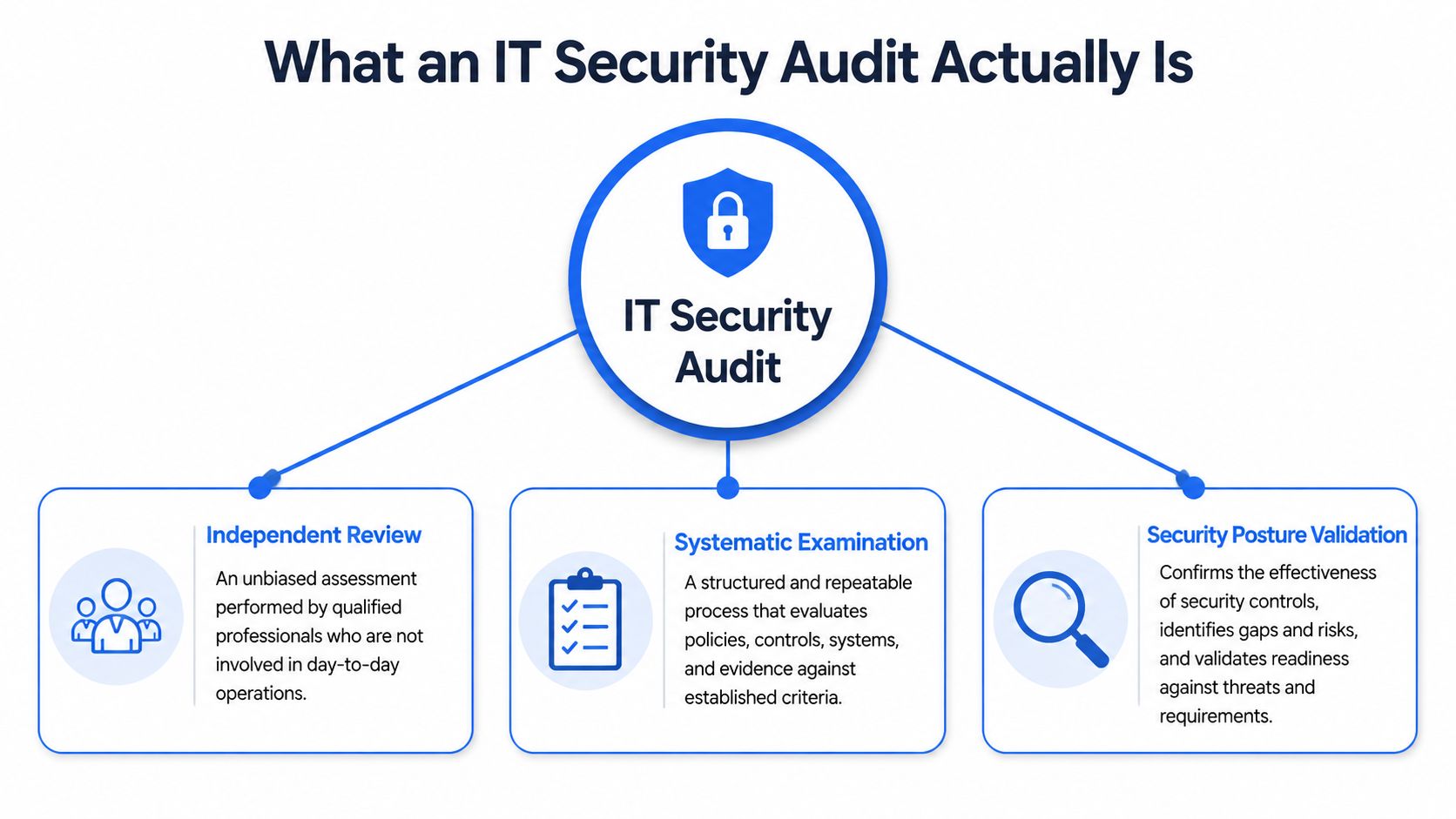
That is where an IT security audit earns its place. It is an independent, evidence-based review of how your people, processes and technology protect information and keep important services running. An auditor doesn't just ask whether a policy exists. They test whether staff follow it, whether technical controls are configured properly and whether the evidence supports the answer.
What the audit tests
A sensible audit examines:
- Identity and access: Who can enter systems, who has administrator rights, and whether leavers are removed promptly.
- Technical protection: How firewalls, endpoint security, email controls, cloud services and network segmentation are configured.
- Resilience: Whether backups can be restored and whether the business can continue after an incident.
- Governance: Who owns security decisions, how risks are recorded and how suppliers are assessed.
- Human behaviour: Whether staff recognise phishing, report incidents and follow secure handling procedures.
The UK government's Cyber Security Breaches Survey 2025 found that 43% of businesses and 30% of charities experienced a cyber security breach or attack in the previous 12 months. That equated to about 612,000 businesses and 61,000 charities nationwide. The same survey found that 3% of all businesses and 1% of all charities were victims of fraud resulting from a cyber breach or attack. Exposure clearly isn't limited to large enterprises.
Practical rule: If a customer, insurer, regulator or board member needs evidence of control effectiveness, a policy pack alone won't be enough.
An audit is not a one-off penetration test, a firewall review or a certificate purchase. Those activities can form part of it, but an audit connects technical findings to business risk and accountability. If you haven't reviewed access, vulnerabilities, recovery capability and supplier controls this year, you should plan an audit rather than defer it.
For a broader preparation reference, use this complete network security checklist alongside your auditor's evidence request.
The Four Audit Types and When to Use Each
Business owners often commission the wrong assessment because providers use similar language for different jobs. A vulnerability scan won't prove that an attacker can move through your environment. A compliance audit won't necessarily reveal every insecure setting. Choose the assessment according to the decision you need to make.
Match the test to the trigger
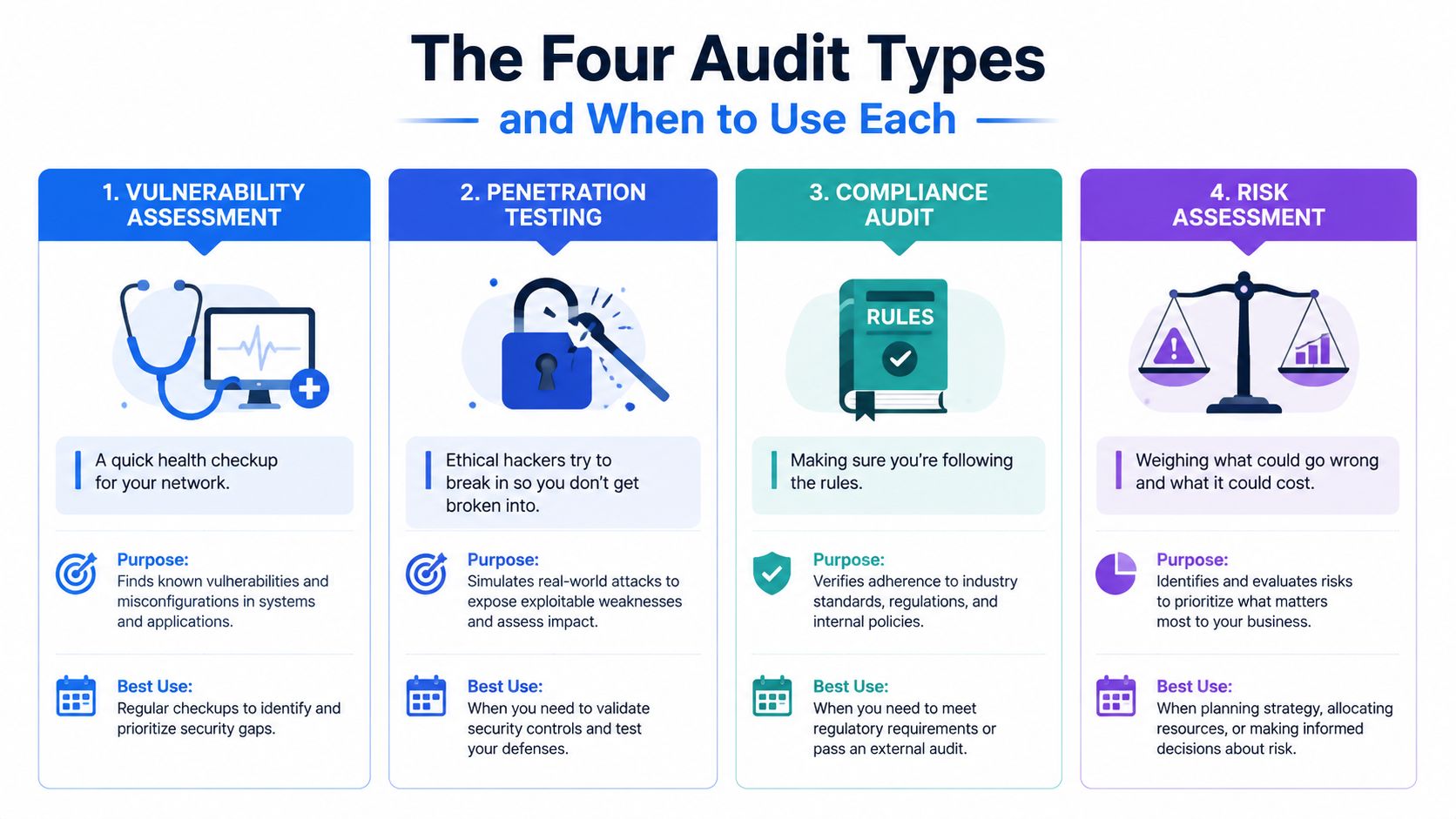
Vulnerability assessment is the network equivalent of an MOT. Tools scan systems and software for known weaknesses, missing patches and exposed services. It suits regular monitoring and gives a useful technical list, but someone still needs to validate findings and rank them against business impact.
Penetration testing is a controlled attempt to break through agreed boundaries. A tester may examine an external perimeter, web application, wireless network or selected internal systems. Choose it when a client contract demands independent attack simulation, when a major application has changed, or when you need to understand what a determined attacker could reach.
Compliance auditing checks evidence against a defined requirement. That may include Cyber Essentials, ISO 27001 or PCI DSS, depending on your customers and operations. It works best when a contract, tender, insurer or regulator has specified the framework. Passing a compliance assessment doesn't mean every possible risk has disappeared.
Configuration and technical auditing examines how your environment is built and administered. The auditor reviews firewall rules, cloud settings, administrator privileges, endpoint controls, patching, logging, backup arrangements and network design. This is often the most useful starting point for an SME whose controls have grown informally.
| Audit type | Main question | Best trigger |
|---|---|---|
| Vulnerability assessment | What known weaknesses are present? | Routine technical review |
| Penetration test | Could a tester exploit the agreed attack surface? | Client demand or major system change |
| Compliance audit | Can we evidence a required standard? | Contract, tender or assurance request |
| Configuration audit | Are our controls correctly designed and managed? | Unclear ownership or inherited IT estate |
Ask the provider exactly what deliverable you'll receive. You want affected assets, evidence, severity reasoning, remediation advice and clear limitations. A scan report full of unverified alerts isn't an audit outcome.
This short video can help non-technical directors understand why testing methods shouldn't be treated as interchangeable.
How a Typical IT Security Audit Unfolds
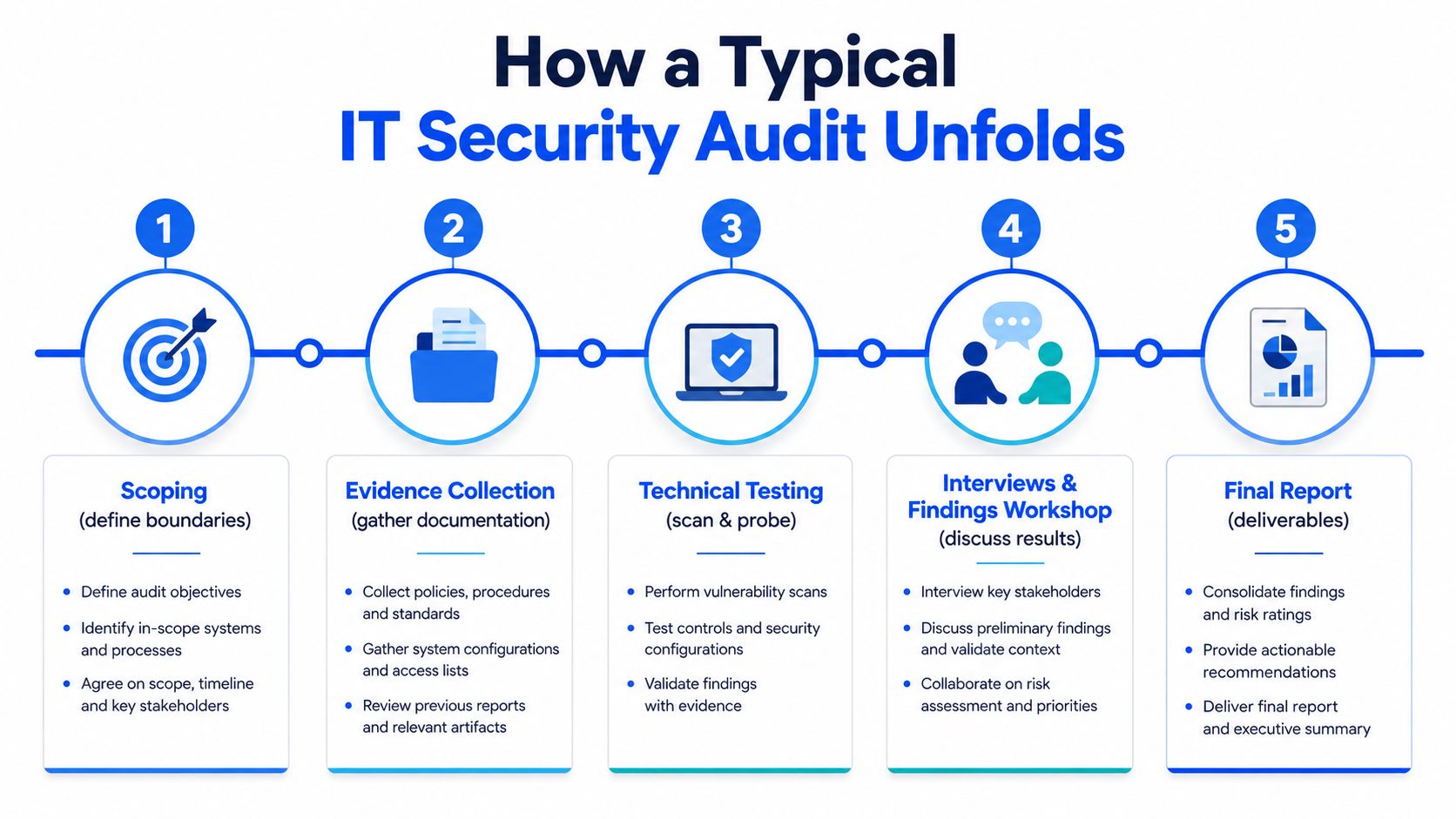
A well-run SME audit follows a defined sequence. The exact duration depends on scope, access and complexity, but the work should move from boundaries, to evidence, to testing, to decisions. Treating the engagement as an unplanned request for passwords and screenshots creates delay and weakens the quality of the result.
Scoping comes first
At the start, agree which sites, cloud platforms, applications, suppliers, users and business services are included. Define whether the auditor will test remotely, visit premises, assess an external perimeter, interview staff or review a particular compliance framework.
The scope should also name exclusions. If a hosted platform is outside your control, the audit should record the supplier assurance you rely on and the residual risk you accept. Don't allow an important dependency to disappear because nobody owns the contract internally.
Evidence and testing
During the evidence stage, expect requests for:
- Asset information: Hardware, software, cloud services, critical applications and suppliers.
- Access records: Administrator lists, joiner and leaver processes, remote access arrangements and multi-factor authentication coverage.
- Operational records: Patch reports, backup logs, restore tests, security alerts and incident records.
- Governance documents: Policies, risk registers, training records, supplier reviews and continuity plans.
Technical testing then checks whether the written position matches the live environment. Interviews add the human context. An auditor may discover that a documented approval process exists, but managers routinely bypass it to solve urgent problems.
Findings and reporting
The findings workshop is where raw observations become business decisions. Ask the auditor to explain which services are exposed, what an attacker or error could affect, what evidence supports the finding and what action will reduce the risk.
The final report should separate confirmed control gaps from recommendations and observations. It should also identify owners, dependencies and suggested priority. An external audit offers stronger independence when a client or regulator expects assurance from someone who isn't responsible for maintaining the controls.
The UK government's 2025/2026 technical report used a random probability survey covering 2,112 UK businesses, 1,085 registered charities and 577 education institutions, supported by 44 in-depth interviews. The methodology is useful because it provides a structured UK benchmark for thinking about exposure and control adoption, rather than relying on individual incident stories. The NCSC's audit and review scheme provides further context on independent cyber security assessment.
Pre-Audit Checklist and Remediation Planning
The two weeks before an audit should be organised, not frantic. You don't need to make every control perfect before the auditor arrives. You do need to know what exists, who owns it and where evidence is stored.
Prepare the evidence pack
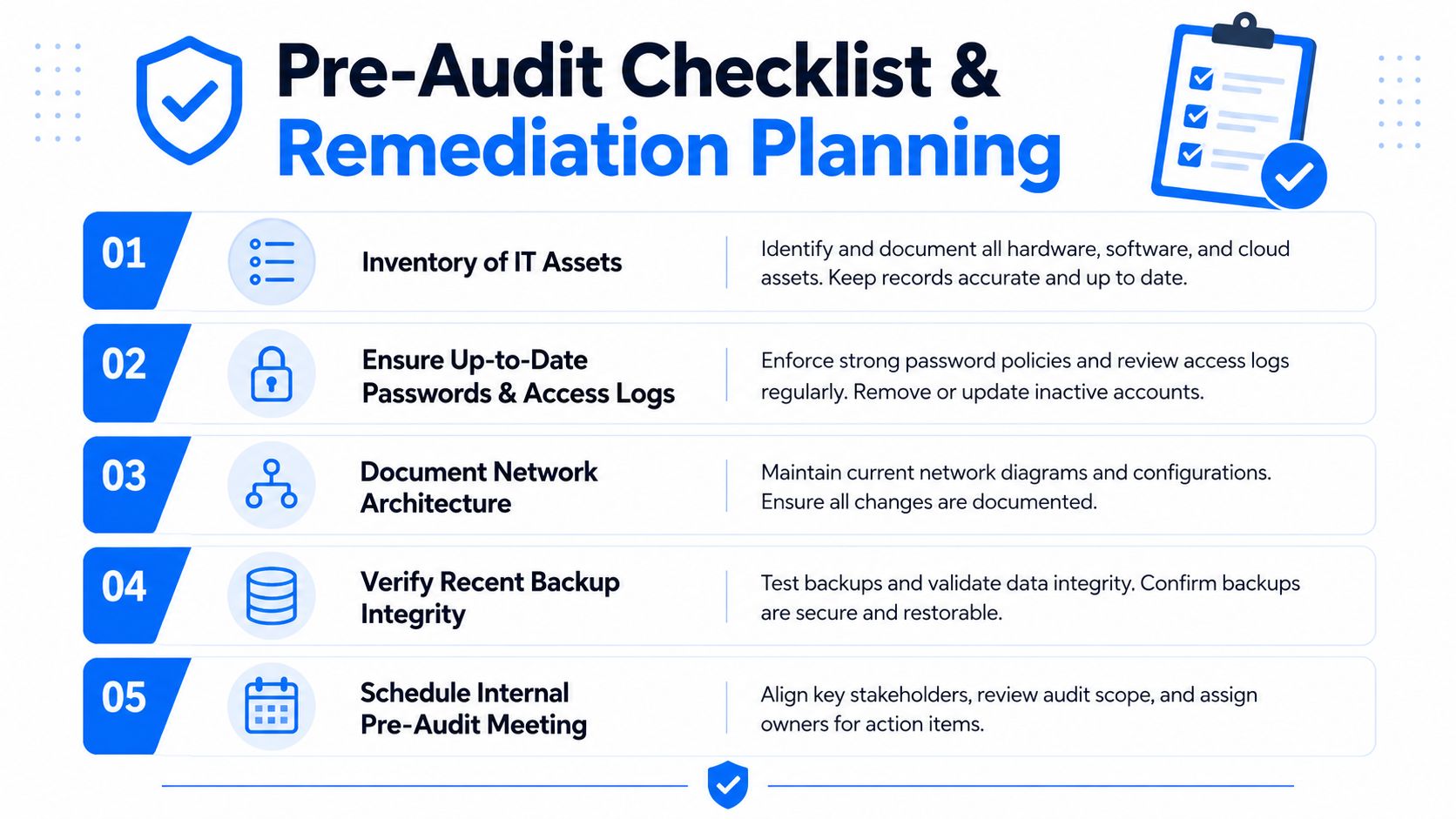
Use this working checklist:
- Update the asset register: Include laptops, servers, network devices, cloud services, key applications and third-party systems.
- Review privileged access: Confirm administrator accounts, remove dormant users and check that leavers no longer have access.
- Check multi-factor authentication: Enable it for administrator and remote access accounts, then record exceptions with owners.
- Test backup recovery: Don't stop at a successful backup job. Restore representative data and record the result.
- Review patching: Identify unsupported systems, overdue updates and any business-approved exceptions.
- Gather policies: Make acceptable-use, access, incident response, continuity and supplier documents easy to find.
- Name one coordinator: Give the auditor one accountable contact who can obtain evidence and arrange interviews.
A practical IT infrastructure audit checklist for 2025 can help structure the evidence request, but tailor it to your systems and contractual obligations.
Turn the report into work
The report matters only if every material finding becomes a tracked action. Put each item into a register with a plain-English description, affected asset, business consequence, priority, owner, target date, dependency and proof of closure.
Use critical, high, medium and low priorities, but don't let severity replace judgement. A medium technical weakness on a system holding payroll data may deserve faster attention than a high finding on an isolated test device.
A typical SME finding might be excessive administrator access. The remediation roadmap could look like this:
- First 30 days: Validate the account list, remove unnecessary privileges and introduce an approval record for new administrator access.
- By 60 days: Separate daily user accounts from privileged accounts and enable stronger authentication for the administrative path.
- By 90 days: Review access with business owners, record exceptions and schedule a recurring check.
The measurable improvement isn't “security enhanced”. It's a smaller approved administrator list, evidence of authentication coverage, a named access owner and a dated review record. That language helps directors understand progress and helps auditors verify closure.
The PDF is not the deliverable. The risk-reduction backlog is.
Choosing an Auditor and Why Local Coverage Matters
The right auditor should be independent enough to challenge your controls and practical enough to explain what fixing them will involve. A provider that finds a problem but can't help you understand the operational consequence has only completed half the job.
Selection criteria that matter
Ask prospective auditors for:
- Relevant credentials: Check whether the people doing the work hold suitable credentials, such as Cyber Scheme, CHECK or ISO 27001 lead-auditor qualifications where relevant to the engagement.
- Sector experience: A law firm, engineering business and healthcare provider won't have identical priorities. Ask for examples of comparable environments, without requesting confidential client information.
- A transparent method: You should see the scope, evidence requirements, testing boundaries, severity model and report format before signing.
- Independence clarity: If the same organisation operates your controls, agree how the audit will remain objective and whether an independent reviewer is needed.
- Commercial precision: Require clear assumptions around users, sites, cloud platforms, testing depth, retesting and remediation support.
A large national consultancy can bring specialist teams and formal assurance processes. It may also introduce more layers, less continuity and a report that assumes you have a security department. A regional IT partner can offer closer operational knowledge and faster access to engineers, but you must test whether its audit methodology and independence are strong enough for your customer's requirements.
For London and Essex SMEs, Networking2000 is one local option to assess. It covers Romford, Hornchurch, Rayleigh, Brentwood, Wickford and Chelmsford, provides support from 6am to 10pm, seven days a week, and works across managed firewalls, CCTV, access control, broadband and wider IT support. That breadth can be useful when an audit identifies connected issues across the office network, premises security and communications estate. If the provider also maintains your environment, commission an independent audit or define an independent review stage.
The NCSC describes the Cyber Assessment Framework as a systematic approach to assessing and improving cyber security and resilience. Its Cyber Resilience Audit scheme currently bases independent audits on CAF, while allowing flexibility for other standards later. For regulated or public-sector work, ask your auditor to map evidence to the relevant CAF outcomes rather than presenting a generic checklist.
Cost Factors and ROI for Smaller UK Businesses
Audit pricing reflects the work involved, not just the number of pages in the final report. The main cost drivers are the number of users and sites, cloud and application scope, testing depth, technical complexity, report requirements, independence and whether remediation support is included.
The following bands are planning categories rather than verified market prices. Treat them as a way to compare quotes, not as a promise of what an engagement should cost.
| Audit type | Typical SME scope | Indicative price band | Best for |
|---|---|---|---|
| Vulnerability assessment | External and internal technical scan with validation | Obtain a scoped quotation | Finding known technical weaknesses |
| Penetration test | Agreed perimeter, application, wireless or internal test | Obtain a scoped quotation | Demonstrating attack resistance |
| Compliance audit | Evidence review against a named framework | Obtain a scoped quotation | Customer, tender or insurer assurance |
| Configuration audit | Firewall, cloud, endpoint, access, backup and network review | Obtain a scoped quotation | Improving day-to-day control effectiveness |
Don't choose the cheapest quote until you've checked what it excludes. A low price may cover a scan but omit manual validation, interviews, retesting, an executive summary or remediation planning. Those omissions can leave you with a list that nobody can confidently act on.
The return on investment is practical. An audit can help you retain a client contract, answer due-diligence questions during a sale, reduce avoidable downtime and show an insurer that controls are actively managed. It can also expose a recovery weakness before an incident makes the test urgent and expensive.
The UK government survey found that 3% of businesses experienced fraud resulting from a cyber breach or attack, which is a reminder that the risk has a direct financial dimension, not only a technical one. For a clear business-facing explanation of what disruption can mean, use this cyber attack survival guide for SMEs, then translate its lessons into your own continuity and recovery priorities.
A finance director doesn't need a theoretical risk score. They need to know what investment protects revenue, which control closes the largest exposure and when the business will have evidence that the work is complete.
Your 90-Day IT Security Audit Action Plan
Start on Monday with an owner, a scope and a decision date. Don't wait for a perfect policy library or a customer deadline. A controlled audit is more useful than another quarter of assumptions.
Days 1 to 30
Write down the business services that must keep operating, the information that matters and the suppliers that support them. Agree whether you need a configuration review, vulnerability assessment, penetration test, compliance audit or broader independent review.
Then appoint one internal owner and complete the pre-audit checklist. Collect the asset register, access records, backup evidence, patch information, policies and supplier details. Ask at least two providers to explain their methodology, independence and deliverables before you approve the scope.
Days 31 to 60
Give the auditor controlled access to the evidence and make staff availability explicit. Tell employees why interviews are taking place, because defensive answers and hidden workarounds reduce the value of the assessment.
Keep a live question and decision log. If the auditor identifies an immediate exposure, don't wait for the final report to take sensible containment action. Record what changed, who approved it and what evidence will prove the fix.
Days 61 to 90
Hold a findings workshop with the owner of each affected service. Put every agreed action into a remediation register with priority, owner, target date, dependency and closure evidence.
Use the report to update managed IT routines. Access reviews, backup restoration, patch exceptions, supplier checks and incident exercises should become repeatable operational tasks, not audit-season activities.
Questions UK business owners ask
How often should we audit? Set a recurring review cycle based on your risk, customer expectations, regulatory duties and the pace of system change. Review controls after major changes, acquisitions or serious incidents rather than relying only on a calendar.
Does Cyber Essentials count as an audit? It can provide useful assurance against its requirements, but it doesn't automatically replace a broader review of governance, resilience, suppliers, recovery and control effectiveness.
What about legacy systems we don't own? Record the system, owner, business dependency, available supplier assurance, known limitations and compensating controls. The National Audit Office reported that 58 critical UK government IT systems independently assessed in 2024 had significant cyber resilience gaps, and the government couldn't determine how vulnerable at least 228 legacy systems were to attack. The lesson for an SME is simple: unknown systems belong on the risk register. The NAO's findings on legacy and cyber resilience provide useful context.
How should I brief the board? Present the top business risks, affected services, agreed owners, required investment, target dates and evidence of progress. Avoid a technical dump that hides the decisions directors need to make.
If you operate in London or Essex and want one accountable partner to help organise the audit, improve network controls and manage the resulting work, speak with a provider that can separate assurance from implementation and explain both in plain English.
Networking2000 provides IT support, managed firewalls, networking, connectivity and security services for businesses across London and Essex, with coverage including Romford, Hornchurch, Rayleigh, Brentwood, Wickford and Chelmsford. Visit Networking2000 to discuss an IT security audit, pre-audit preparation or a practical remediation plan for this quarter.

