A UK facilities-management study found that 32.5% of alarm call-outs were caused by poorly maintained systems, with another 11% linked to staff error and 13% to rodents, spiders, and other insects, while only about 19% were genuine emergencies such as burglary attempts, vandalism, water leaks, or confirmed fires (source study summary). This highlights the core issue of intruder alarm maintenance; it's not about polishing a panel, it's about reducing avoidable activations, missed alarms, and the kind of operational friction that costs UK SMEs time, money, and credibility.
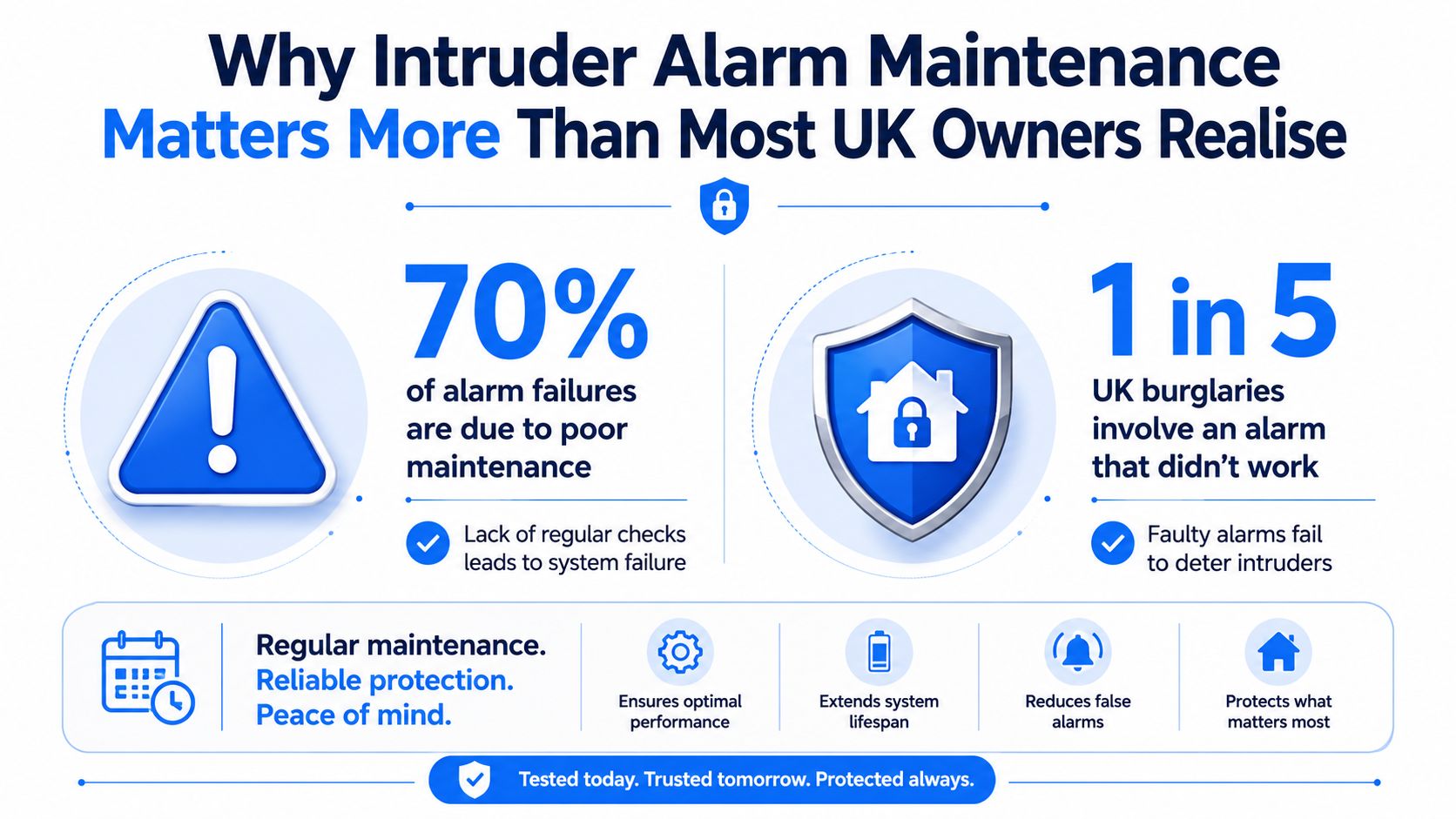
Table of Contents
- Why Intruder Alarm Maintenance Matters More Than Most UK Owners Realise
- Weekly and Monthly User Checks You Can Do Yourself
- What a Professional Alarm Service Should Cover
- Batteries, Sensors and Signalling Paths That Commonly Fail
- How Often to Service and What It Really Costs in the UK
- Maintaining Connected and App-Based Alarm Systems
- When to Call a Local Engineer and How to Keep Records
Why Intruder Alarm Maintenance Matters More Than Most UK Owners Realise
Intruder alarms fail in boring ways long before they fail in dramatic ones. A dirty detector, a weak battery, a tired communicator, or a code left active after a staff change usually sits unnoticed until a false call-out, a missed activation, or a signalling fault turns into wasted time and avoidable cost. In the UK call-out study, 32.5% of alarm attendances were linked to poor maintenance, with 11% tied to staff error and 13% to pests, which is a clear reminder that many alarm problems start well before the siren sounds.
For UK SMEs, that is not just a technical issue. False activations pull people away from their work, create friction with monitoring providers, and make teams less confident in the system when a real alarm happens. If the site relies on a Police URN or an insurer-linked response, weak upkeep can turn a simple fault into a compliance headache, and sometimes into a claim or response problem that costs far more than the service would have done.
The practical servicing rhythm is straightforward. Most commercial sites should expect at least one professional service a year, while monitored or higher-risk premises often need two visits annually (commercial servicing guidance). That sits alongside regular user checks, because a yearly engineer visit will not catch every blocked contact, low battery, or creeping issue between visits.
Practical rule: if an alarm only gets attention after a fault light appears, the site is already paying for the delay.
Owners who want a hands-on overview can also use DIY checks and servicing for alarms. Basic checks and professional servicing work best together, because one keeps the system honest week to week, and the other deals with the parts that fail slowly or hide inside the panel, the detectors, and the signalling path.
A healthy panel does not mean the alarm is dependable. The system still needs clean detectors, backup power that will hold up under pressure, current user codes, and a signalling route that still reaches the monitoring station when the building has a bad day.
Weekly and Monthly User Checks You Can Do Yourself
A good user routine doesn't need tools or technical confidence. It needs consistency, a few minutes, and someone who notices small changes before they become out-of-hours call-outs. Weekly checks can be light, monthly checks can be slightly fuller, and both should be documented.
The quick weekly habit
Start with the panel. Look for unexpected beeps, warning lights, or messages that weren't there last week. If the system has a display, treat any new fault as a proper fault until an engineer proves otherwise.
Then do a visual sweep of key parts of the system. Check for dust on detectors, cobwebs across ceiling devices, blocked door contacts, or anything stored too close to sensors. A dirty detector can cause nuisance behaviour, and a blocked contact can stop the system seeing a door open or close correctly.
The monthly ten-minute routine
Use the same route each time. Walk the building, trigger the system in a controlled way if your site procedure allows it, and confirm that sounders, contacts, and key detectors respond as expected. If you've got staff turnover, update user codes and remove old ones promptly, because forgotten credentials are a security weakness as much as a convenience issue.
Don't rely on one trigger point. A single sensor test can tell you the siren works, but it won't prove that every detector, contact, or user code is doing its job.
A simple monthly checklist works well:
- Panel status: confirm there are no new faults, tamper warnings, or low-battery messages.
- Detector condition: look for dust, paint, cobwebs, or physical obstruction.
- User access: check old staff codes, lost fobs, and shared PINs.
- Sounder response: make sure the alarm still sounds where it should.
- Record the result: note the date, what you tested, and anything unusual.
That routine catches the everyday failures people ignore until they turn into an emergency. It also gives you a baseline, so if the system behaves differently next month, you'll spot it quickly.
What a Professional Alarm Service Should Cover
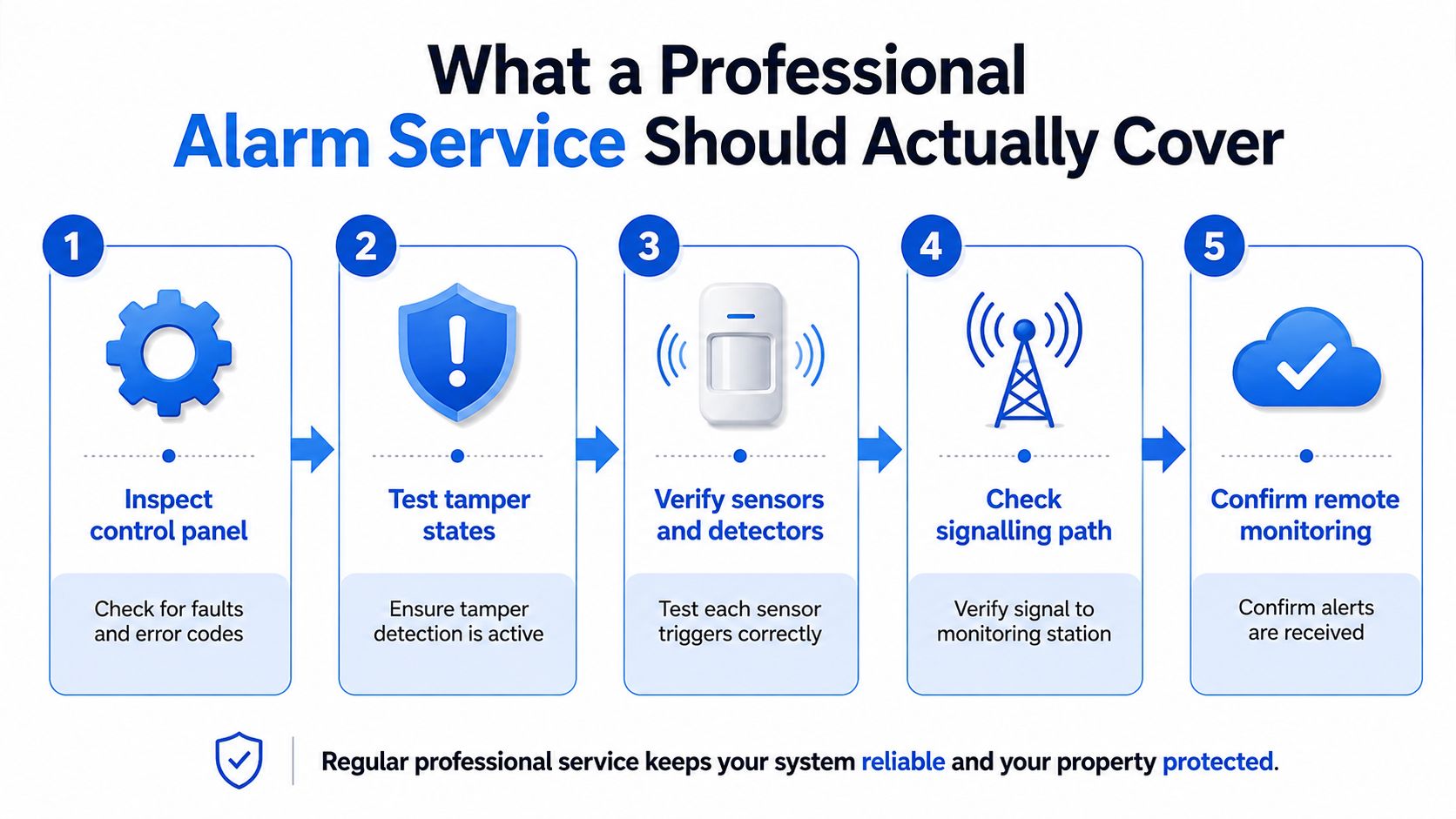
A proper service visit is a verification exercise, not a glance and a signature. For monitored systems, UK guidance commonly points to 6-monthly servicing, while simpler systems are usually checked once a year. The point of the visit is to prove that the system still behaves like a security device, not a collection of parts that happen to be powered on. A well-run service reduces the chance of nuisance alarms, missed activations, and call-outs that cost a business time and money.
The sequence that matters
A competent engineer should start with the control panel and tamper states, then confirm mains and standby battery condition, verify signalling paths, walk-test detectors and contacts, and finish by documenting faults and sign-off. That order matters because it mirrors how failures show up in real life, first at the panel, then at backup power, then in transmission, then at the field devices.
The common shortcut is to fire one sensor and listen for a beep. That tells you very little. It does not prove the backup battery can hold load, it does not tell you whether the signalling route is healthy, and it does not confirm that every detector or panic button responds in the field.
A real service should prove the alarm can detect, signal, and recover. If any of those three is skipped, the visit was incomplete.
Service providers also tie compliance to verification of alarms, entry and exit procedures, power supplies, batteries, signalling paths, and warning devices, which is exactly what you want to see documented. BS 9263:2016 sets out the planned maintenance approach for intruder alarm systems in the UK (BS 9263:2016 reference).
What good paperwork tells you
A service sheet should make it obvious what was tested, what was replaced, and what still needs attention. If the report only says “working at time of inspection”, you have learned almost nothing. Good records turn the next visit into a follow-up rather than a guess. They also help prove that faults were handled promptly if a false alarm, missed activation, or signalling failure becomes a dispute later.
Batteries, Sensors and Signalling Paths That Commonly Fail
The parts that let you down are usually the ones nobody checks until there is a problem. Backup batteries age slowly, sensors collect dust and drift, and signalling paths can look healthy on site while failing between the panel and the monitoring centre. That is why intruder alarm maintenance has to focus on weak points, not just what looks worn out.
Backup batteries need measurement, not guesswork
Manufacturer guidance commonly puts replacement at 3–5 years, and professional checklists call for both quiescent and alarm-current readings plus capacity calculations so the battery can support standby and alarm demand (battery guidance). That matters because a battery can still look fine on the wall and fail under load during a mains cut or a long alarm event.
A visual inspection alone is not enough. Engineers need to test the battery under load and check whether it still has the reserve to keep the system alive when the building loses power. In practice, that is where a lot of avoidable call-outs start.
Sensors fail quietly
Dust, cobwebs, and slight misalignment are common reasons detectors behave badly. They can reduce sensitivity, create nuisance activations, or stop a detector seeing movement properly when it matters. Clean lenses, clear the mounting area, and check alignment whenever a detector has started to act unreliably.
PIRs and contacts rarely fail in a dramatic way. They drift, get contaminated, or get knocked just enough to become inconsistent, which is how false alarms and missed activations creep in. On a commercial site, that usually means wasted staff time, frustrated users, and sometimes a real loss event that nobody spots quickly enough.
Signalling paths deserve the same attention
A modern alarm may use landline, cellular, or internet routes, and each one can fail in a different way. A panel can report no obvious local fault while remote signalling is broken, so communication-path verification matters during servicing. If the signal cannot reach the monitoring station, the system's local health is only part of the story.
That is where a lot of UK SMEs get caught out. The siren works, the panel looks normal, and the fault only shows up when a genuine activation never reaches the ARC or the call goes unanswered. Missed signalling is not a cosmetic issue, it turns a working alarm into a false sense of cover.
Good maintenance habit: treat communications as part of the alarm, not a separate add-on.
For smaller sites, the safest mix is regular visual checks by users, then a certified inspection that tests battery load and signalling paths properly. That combination catches the faults that tend to surface during outages, holidays, and busy trading periods.
How Often to Service and What It Really Costs in the UK
A neglected alarm usually costs far more than a routine service. UK service guides put a typical burglar alarm service at about £90, and the visit usually takes around 1 to 3 hours (UK service cost guidance). That gives owners a practical budget anchor. The choice is not whether to spend money, but whether to pay a small, predictable amount now or keep absorbing fault visits, lost time, and avoidable call-outs later.
For a simple site, an annual service is usually enough. Monitored systems and higher-risk premises are often put on a six-monthly cycle, which is the normal pattern for many commercial alarms in the UK (service interval guidance). That schedule is about more than box-ticking. It helps catch tired batteries, communication faults, detector drift, and site changes before they turn into missed activations or false alarms.
A rough planning table helps when you are setting expectations with staff or finance.
| System Type | Recommended Service Frequency | Typical UK Cost |
|---|---|---|
| Basic intruder alarm | Once a year | About £90 (UK service cost guidance) |
| Monitored alarm | Often every 6 months | About £90 per service visit (service interval guidance, UK service cost guidance) |
| Higher-risk or insurance-linked site | Often every 6 months | About £90 per service visit (service interval guidance, UK service cost guidance) |
The hidden cost is usually what gets ignored. Repeated false call-outs waste staff time, and a poorly maintained system can weaken trust with monitoring partners, insurers, and anyone who has to respond to an activation. A low-cost visit that skips battery load checks, signalling checks, or detector testing often ends up costing more than a proper service because the same faults keep returning.
Maintaining Connected and App-Based Alarm Systems
Connected alarms have changed the maintenance conversation. The old assumption was simple, if the panel was powered and the siren worked, the system was fine. That doesn't hold up now, because a modern alarm can look healthy on-site and still fail at the communications layer.
The fragile points are usually broadband, router resilience, SIM backup, app notifications, and firmware. If the alarm depends on the premises network, then a router reboot, broadband outage, or configuration issue can stop remote alerts even when every detector still triggers locally. That's the part many owners overlook.
What to verify with your installer
Ask how the system behaves if the internet drops. Ask whether there's a cellular fallback, how alerts are routed, and what happens to app notifications if the monitoring path fails. If firmware updates are part of the platform, they need a clear maintenance process, not an occasional afterthought.
The shift away from older PSTN-style signalling means maintenance now has to include the wider connectivity stack, not just the panel and peripherals. A system that is “fine” in the hallway but silent at the signalling layer is not a fine system.
Practical rule: if the alarm relies on a router, treat that router like part of the security system.
A combined IT and security provider can be useful. A business such as Networking2000 is relevant here because it works across networking, connectivity, and intruder alarms, so the alarm's communication route doesn't get treated in isolation from the network it depends on. That joined-up view matters more with app-based systems than it did with older, standalone panels.
The point isn't to chase the newest features. It's to make sure the alarm can still reach someone when the premises network is having a bad day.
When to Call a Local Engineer and How to Keep Records
A working alarm that is ignored, misused, or left with unresolved faults can cost a UK business time, money, and credibility. False activations pull staff away from the job, missed activations leave the site exposed, and signalling faults mean the system may shout locally without telling anyone useful. That is the point where a local engineer stops being optional and starts being the sensible call.
Escalation signs that shouldn't be ignored
Repeated false activations, panel error lights, low-battery warnings, and communication failure alerts all mean the system has moved beyond routine user checks. A recent change in staff or tenants can matter too, because access control, user codes, and arming habits often change at the same time and can expose weak spots that were hidden before.
- Repeated false activations: more than one false alarm in a short period usually points to a fault, contamination, or a setup problem.
- Panel error lights: a red or amber warning means the panel has detected something that needs attention.
- Low-battery warnings: audible or visual battery alerts should be investigated before standby power drops further.
- Communication failures: if the monitoring station cannot be reached, the alarm may still make noise locally while failing to signal the event properly.
BS 9263:2016 is the UK maintenance reference for intruder alarm systems, and the standard sets out planned checks around alarm verification, entry and exit procedures, power supplies, batteries, ATS paths, and warning devices. That gives you a practical line between a nuisance fault and a system that needs proper inspection.
Record keeping makes everything easier
A logbook saves time on multi-user sites and during handovers. Record the date of each test, faults observed, engineer visits, battery replacements, code changes, and service certificates. If an insurer asks questions or the monitoring provider reviews the account, that paper trail is usually more useful than memory.
A simple template helps small businesses stay consistent, and the Facility Management Insights maintenance log is a useful prompt if you want a structured way to capture inspections and corrective actions without building a system from scratch.
Keep the log where people use it. A good record is updated after every test and handed to the next person who needs to know what happened before.
If you want a local team to look at your intruder alarm maintenance alongside the wider network or connectivity it depends on, visit Networking2000. They work across intruder alarms, networking, and communications, which makes them a practical point of contact when you need the alarm, router, and monitoring path checked as one system.

