You're usually not searching for outsourced IT support because everything is fine. You're searching because something keeps breaking, staff are losing time, and nobody in the business feels confident that the next problem won't land at the worst possible moment.
For a London or Essex SME, that moment is often painfully familiar. The phones depend on the internet. The files are in Microsoft 365 or a cloud platform nobody fully understands. A laptop dies before a client meeting. A printer issue turns into a network issue. Your software supplier says it's “an IT problem”, and your IT person says it's “a software problem”. Meanwhile, your team is waiting, your customers are waiting, and you're paying for the delay whether anyone admits it or not.
That's why more firms are looking seriously at outsource IT support in the UK. Not as a technical nice-to-have, but as a business decision about reliability, accountability, and peace of mind.
Table of Contents
- Is Your IT Holding Your Business Back
- Understanding Outsourced IT and Managed Services
- The Business Case for Outsourcing Your IT Support
- Decoding Service Models and Pricing for UK SMEs
- UK Data Protection and Security Considerations
- How to Choose the Right IT Partner in London and Essex
- Your Next Steps to Secure and Reliable IT
Is Your IT Holding Your Business Back
A business owner in Essex doesn't usually describe the problem as “we need a new IT operating model”. They say something more direct. The systems are slow. Staff can't get help quickly enough. Nobody knows who owns what. Problems get patched, then come back.
In practice, that looks like this. Your accounts team can't access a shared folder on payroll day. One person's email stops syncing. The office Wi-Fi drops out in the middle of trading hours. You ring whoever helped last time, leave a voicemail, and hope they call back before the day gets away from you.
That kind of setup drains time because it turns every issue into a fresh incident. There's no continuity, no prevention, and no clear commercial view of what downtime is costing you. The business starts working around IT instead of relying on it.
Good IT support should make the business feel calmer, not more dependent on heroics.
This is one reason outsourcing has become so common. In the UK, information technology outsourcing was the largest segment of the outsourcing market in 2025, accounting for 59.5% of total market share in a market valued at USD 990.00 billion, according to UK outsourcing market analysis from Market Data Forecast. That doesn't mean every contract is good. It does mean a large share of businesses have decided IT is too important, too broad, or too difficult to run informally.
When internal workarounds become the real problem
Small firms are especially vulnerable here. One capable office manager often becomes the unofficial IT lead. A director approves purchases ad hoc. A local technician handles emergencies. A software vendor manages one system. Nobody sees the whole picture.
The result is predictable:
- Support is fragmented. Each supplier protects their own corner.
- Costs are hard to forecast. One bad month can mean several invoices.
- Responsibility gets blurred. Problems bounce between vendors.
- Staff confidence drops. People stop reporting issues until they become serious.
For most SMEs, the question isn't whether they have some form of support already. It's whether that support gives them control.
Understanding Outsourced IT and Managed Services
Most confusion starts with one basic point. Outsourced IT support and managed IT services are related, but they're not the same thing in practice.
A lot of business owners think they already outsource IT because they have somebody they can ring when something breaks. That's outsourced support in the broadest sense. It isn't necessarily managed service.
Two models that feel similar but behave very differently
The simplest way to think about it is a car.
A break-fix arrangement is like having a mechanic's number saved in your phone. If the car stops, you call. If it's making a strange noise, you wait until it gets worse or inconvenient enough to book it in. You pay for the repair when it happens.
A managed service is closer to a service plan. The car gets checked regularly. Wear and tear is spotted early. Routine maintenance is scheduled. Problems are less likely to become emergencies, and the costs are easier to budget for.
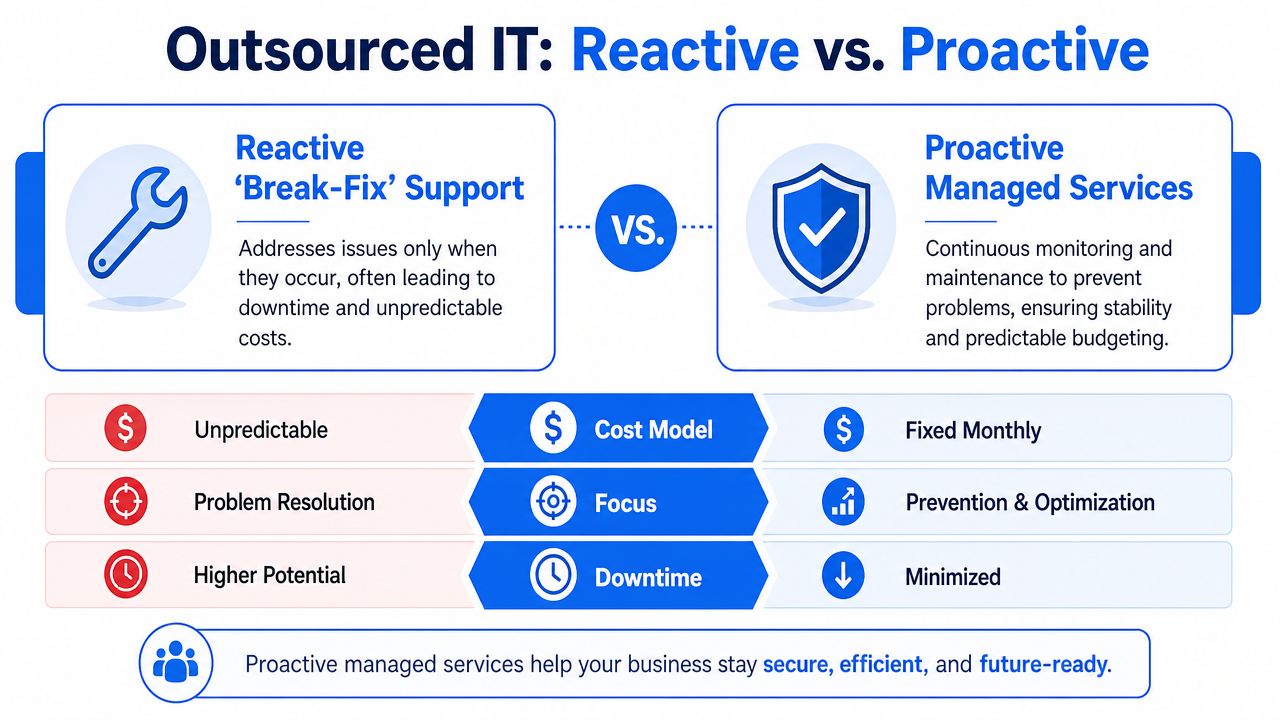
In an office, that difference is significant. Break-fix support solves incidents after users feel them. Managed support aims to reduce the number of incidents users ever notice.
What a managed provider actually does day to day
A proper managed provider doesn't just answer the phone. They usually take responsibility for the steady, unglamorous work that keeps a business stable.
That often includes:
- Monitoring so failed backups, device alerts, or storage issues are noticed early
- Patching and updates so known security and stability issues don't sit unresolved
- User support for email, login, laptop, printer, Microsoft 365, and access problems
- Security management around firewalls, device controls, and suspicious activity
- Supplier coordination when broadband, software, telephony, or line-of-business vendors need to be involved
- Planning for hardware refreshes, onboarding, leavers, and office changes
That shift matters because prevention is operational, not theoretical. A decent managed provider reduces the number of avoidable interruptions your team has to absorb.
If your firm also relies on outsourced customer operations, it helps to see how support standards work in adjacent service environments. This overview of expert IT support for BPO companies is useful because it highlights the importance of uptime, responsiveness, and clear ownership when service delivery depends on technology.
Practical rule: If your provider only becomes visible when something breaks, you're buying repairs, not management.
One example in the local market is Networking2000, which provides outsourced IT support alongside connectivity, telephony, managed firewalls, cabling, and related services for London and Essex organisations. That sort of broader scope can help when the fault sits between systems rather than inside one neat category.
The Business Case for Outsourcing Your IT Support
For most SMEs, the case for outsourcing isn't built on fashion. It's built on staffing reality, risk, and management time.
Why the argument is stronger now than it used to be
The strongest practical reason is access to skills. One internal person, even a good one, rarely covers user support, Microsoft 365, network troubleshooting, security, backup, telephony, cloud migration, hardware procurement, and vendor management at the level a growing firm needs.
That pressure is being felt across the country. The UK IT services outsourcing market is projected to grow at an 8.70% CAGR from 2025 to 2033, driven by an acute UK skills shortage that pushes organisations to outsource for technical expertise, according to Grand View Research on UK IT services outsourcing.
That lines up with what many SMEs already know from experience. Hiring and retaining broad IT capability in-house is difficult. Covering holidays, sickness, project work, and security responsibilities makes it harder.
Here's where outsourcing usually helps most:
- Budget control. A managed agreement is often easier to plan around than repeated emergency callouts and ad hoc purchases.
- Broader expertise. You get access to engineers with different specialisms instead of relying on one overstretched person.
- Business continuity. Support doesn't disappear because one employee is off sick or leaves.
- Focus. Directors and operations staff spend less time arbitrating technical issues that shouldn't be theirs to manage.
A short explainer can help if you want the broader commercial view before comparing providers.
The trade-offs you should weigh honestly
Outsourcing does have downsides if it's done badly.
Some owners worry about losing control. That happens when the provider keeps knowledge to themselves, uses vague reporting, or hides behind ticket systems. Others worry about security, communication, or being locked into a package that doesn't suit the business.
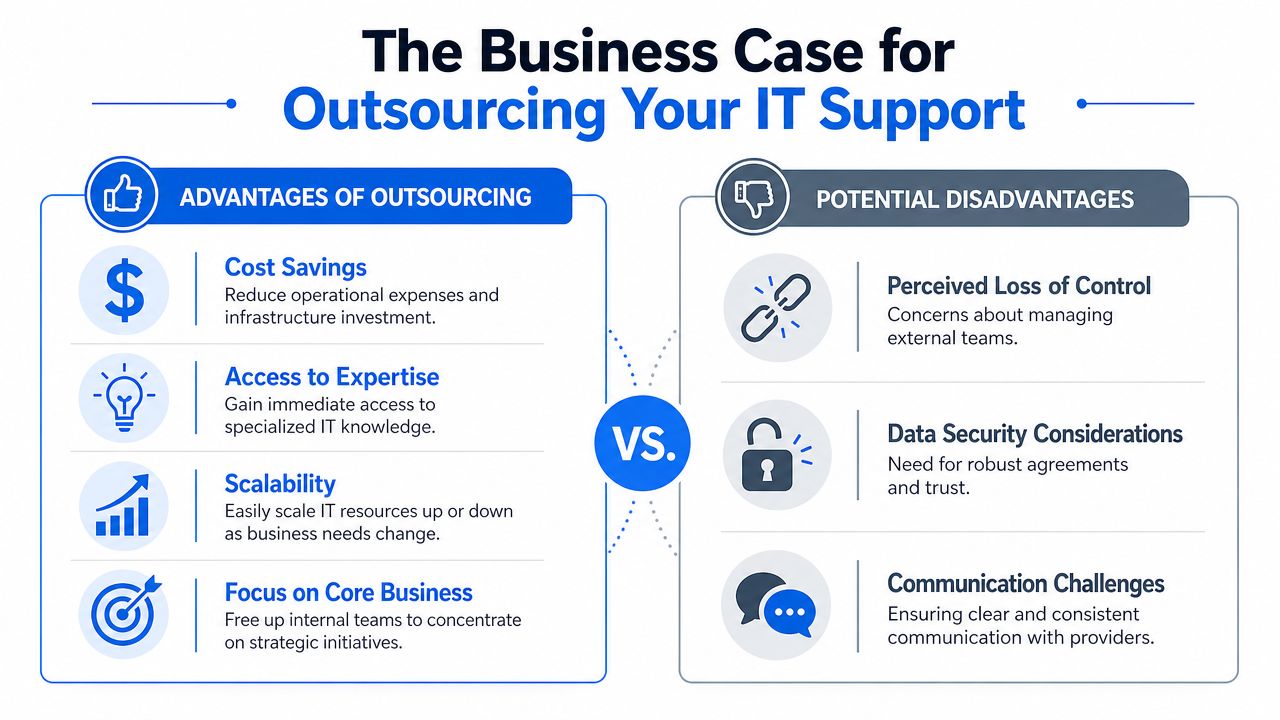
Those concerns are valid. They're also manageable if the contract is clear.
The right partner should give you more visibility than you have now, not less.
A good outsourced setup should tell you who is responsible, what's covered, how issues are prioritised, what gets escalated, and what falls outside the agreement. If those basics are fuzzy at the proposal stage, they won't become clearer once you've signed.
Decoding Service Models and Pricing for UK SMEs
The biggest mistake I see isn't choosing outsourced support. It's choosing the wrong service model and only realising after the first few invoices arrive.
Why so many contracts go wrong
Many London and Essex SMEs frequently encounter difficulties. A 2025 UKITSA survey found that 68% of SMEs in the Greater London area abandoned managed IT contracts within 12 months because of perceived hidden costs or misaligned service expectations, according to Support Save's summary of outsourced IT support issues for UK businesses.
That figure matters because it points to a very specific problem. Businesses don't just leave because they dislike outsourcing. They leave because what they thought they were buying isn't what they received.
Common examples include support hours that don't match trading hours, onsite visits billed separately when the client assumed they were included, project work implicitly excluded, or security tools sold as “standard” but priced as extras.
How the main pricing models work
The right model depends on how your business operates, how stable your systems are, and how much certainty you want.
| Model | Best For | Cost Structure | Key Feature |
|---|---|---|---|
| Pay as you go | Very small firms with simple setups and low support demand | Ad hoc billing for time and materials | Flexibility without a long-term commitment |
| Per user or per device | SMEs that want predictable monthly support tied to headcount or estate size | Recurring monthly fee based on users or supported devices | Easier budgeting as the business grows |
| Fully managed | Businesses that want broad operational cover and one accountable partner | Fixed monthly agreement with defined inclusions and exclusions | Prevention, monitoring, and support under one service framework |
Pay as you go can work for a very small office with limited complexity. The problem is that it often looks cheap until there's a cluster of issues, an office move, or a security incident.
Per-user and per-device models are common because they scale more neatly. They can be sensible, but only if the proposal defines exactly what counts as a billable user, supported endpoint, server, or shared device.
Fully managed agreements usually suit firms that want fewer surprises. They're not automatically better. They're better when the scope is honest.
Questions that expose hidden costs fast
If you want clarity, ask blunt questions and insist on written answers.
- What is not included. Ask for exclusions in one list. If they can't provide it cleanly, expect billing disputes later.
- How are onsite visits handled. Included, capped, chargeable, or only available under certain conditions?
- What counts as project work. User support and system changes are often treated very differently.
- Which security tools are standard. Don't assume backup, endpoint protection, email filtering, or firewall management are bundled.
- What are the support hours. Many contracts look fine until you realise your issue started outside cover.
- How does pricing change. Headcount, extra devices, new locations, and server changes should have a clear commercial rule.
Cheap support often becomes expensive at the exact moment you need it most.
Ask for examples too. If you onboard a new starter, move premises, replace laptops, or need help with a third-party software issue, how is each scenario billed? Real examples expose vague pricing faster than polished brochures do.
UK Data Protection and Security Considerations
A lot of owners hesitate over outsourcing because they think it creates extra data risk. In reality, poor informal support is often the bigger risk.
Security improves when responsibility is clear
If nobody is clearly responsible for updates, backups, access control, device standards, and incident handling, gaps appear quickly. Those gaps usually aren't dramatic at first. A missed patch here, an ex-employee account there, a backup nobody has tested for months. Then one day, a manageable oversight becomes a serious business problem.
A reputable UK-based provider should strengthen your position under GDPR and the Data Protection Act 2018 by helping you document, standardise, and maintain your controls. That doesn't remove your responsibility as the business owner or data controller. It does give you operational support that many small firms can't build alone.

What to expect from a serious provider
Look for evidence of process, not just reassuring language.
A capable provider should be able to explain:
- How backups are monitored and restored
- How security patches are handled across devices and systems
- How user access is granted, changed, and removed
- How firewall and endpoint protections are managed
- How incidents are recorded and escalated
- What documentation exists for audits and internal reviews
If they can't walk you through those areas in plain English, they're unlikely to support you properly when pressure rises.
Some firms also underestimate the value of supplier coordination in a security context. When email, internet connectivity, telephony, cloud platforms, and endpoint tools all come from different vendors, somebody needs to own the response when something suspicious happens. Good outsourced support gives you one operational lead instead of five separate support desks.
Security is rarely weakened by outsourcing itself. It's weakened by unclear ownership, poor standards, and missing follow-through.
For SMEs, that distinction matters. The right partner doesn't just fix faults. They help turn security from a patchwork of assumptions into a maintained routine.
How to Choose the Right IT Partner in London and Essex
Choosing a provider is less about the sales pitch and more about what survives scrutiny.
In the UK, 34% of B2B organisations outsource IT support, making it the most commonly outsourced service, according to Exploding Topics coverage of outsourcing statistics. The firms that do this well tend to follow a disciplined evaluation process rather than choosing whoever answered the phone first.
A shortlist should survive basic scrutiny
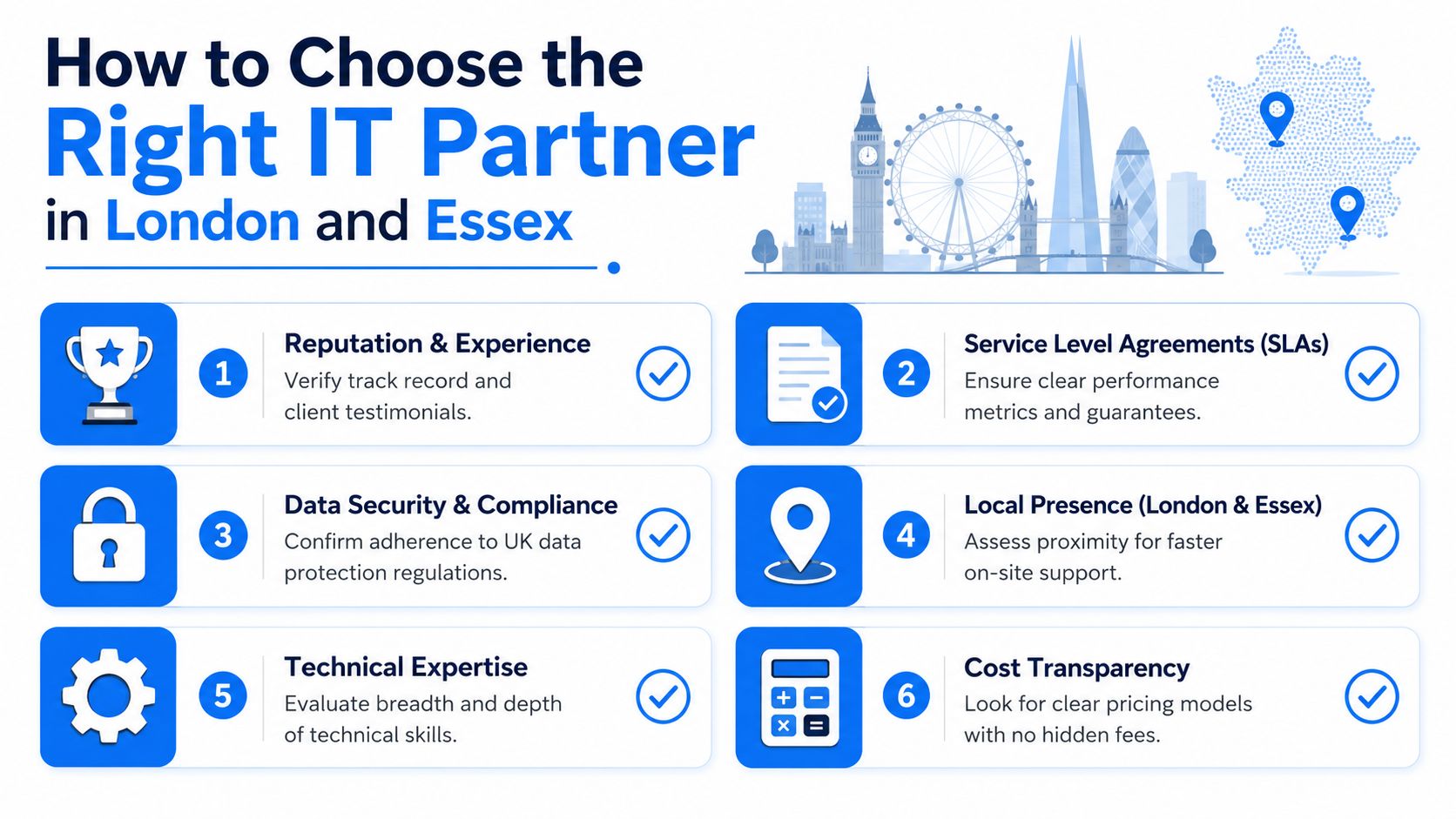
Start with a shortlist of providers that can support businesses of your size and complexity. Then test them against practical criteria.
- Relevant experience. Ask what kinds of organisations they support now. A small accountancy practice, a warehouse, and a multi-site care provider don't need exactly the same service model.
- Clear SLAs. You want written response targets, escalation rules, and a definition of priorities. “We respond quickly” isn't a service standard.
- Commercial clarity. Make them explain the package, the exclusions, and how changes are billed.
- Security competence. Ask who handles patching, backup oversight, account controls, and firewall responsibility.
- Supplier handling. Check whether they'll deal directly with broadband, telephony, cloud, and software vendors when faults overlap.
One practical test is to raise a messy scenario rather than a simple one. For example, ask what happens if a user can't log in, email isn't syncing, and the issue turns out to involve both Microsoft 365 and a local device. The answer tells you whether they think in tickets or outcomes.
Local support matters more than many owners expect
For London and Essex firms, geography still matters. Remote support handles a lot, but not everything. Office moves, cabling issues, router faults, hardware swaps, desk relocations, Wi-Fi dead spots, and user-facing disruption often need hands on site.
That's why local presence should be part of the evaluation, not an afterthought. If your provider can't realistically get to Romford, Hornchurch, Brentwood, Chelmsford, or wider Essex when the situation requires it, the relationship may look better on paper than it feels in operation.
Also ask about support hours. Some businesses only discover after signing that the contract mirrors standard office hours while their own team starts earlier, finishes later, or trades at weekends. If your business needs extended cover, ask for it explicitly and get it written into the agreement.
A useful checklist for final interviews looks like this:
- Request a plain-English proposal with inclusions, exclusions, and escalation paths.
- Ask for local references from businesses that resemble yours operationally.
- Test their responsiveness early by seeing how they handle pre-sales questions.
- Review the contract wording for notice periods, onboarding assumptions, and change control.
- Check whether the service matches your rhythm, including onsite need, out-of-hours support, and vendor coordination.
The right partner should feel organised, transparent, and steady. Not flashy.
Your Next Steps to Secure and Reliable IT
If your current setup depends on one helpful person, a few supplier phone numbers, and a lot of crossed fingers, you don't need more complexity. You need structure.
That usually starts with three simple actions. Write down the systems your team relies on every day. List the recurring problems that interrupt work. Then compare that reality against any support agreement you already have. Most gaps become obvious once they're on paper.
For London and Essex SMEs, the aim isn't to buy the biggest package. It's to get the right level of cover, the right response model, and a contract that matches how the business runs. Good outsourced IT support should reduce noise, remove ambiguity, and give your staff confidence that somebody competent is dealing with issues before they spread.
If you're reviewing providers, keep the standard practical. Clear pricing. Clear ownership. Local reach. Security discipline. Support hours that fit the business. Those basics matter more than polished sales language.
If you want a straightforward conversation about outsourced IT support, Networking2000 is a local option for businesses across London and Essex, including areas such as Romford, Hornchurch, and Brentwood. The useful starting point isn't a hard sell. It's a practical review of what you rely on, where the current risks sit, and whether your support model matches the way your business operates day to day.

