You're probably doing what most small business owners in London and Essex do. You're running the business first and trying to squeeze marketing into the gaps. One day it's a website tweak, the next it's a boosted post, then a few emails, then a promise to “sort SEO properly next month”. Months pass, money goes out, and you still can't say what's working.
That's exactly where a small business marketing consultant should help. Not by giving you a glossy strategy document you never use, and not by drowning you in jargon. A good consultant gives you a practical plan, ties activity to outcomes, and helps you stop guessing.
That matters because confusion is common. According to the FSB 2025 UK Small Business Index summary, 68% of UK small businesses report they cannot measure marketing ROI due to fragmented tools and consultant jargon. If that sounds familiar, you're not behind. You're dealing with the same mess many owners face.
If you're also trying to work out where AI fits into the picture, Wispra on AI agency advantages is a useful read. It's worth looking at if you want to understand where specialist support can save time without replacing sound business judgement.
Table of Contents
- Is a Marketing Consultant Right for Your Business
- What a Small Business Marketing Consultant Actually Does
- The Tangible Benefits for Your Small Business
- When Is the Right Time to Hire a Consultant
- Finding the Right Fit Your Evaluation Checklist
- The Networking2000 Difference Marketing Integrated with IT
- Your Next Steps to Smarter Business Growth
Is a Marketing Consultant Right for Your Business
A lot of owners think hiring a consultant is something you do later, once the business is bigger, calmer, and somehow has spare cash lying around. That's backwards. Most businesses look for help when they've already wasted too much time doing marketing in a piecemeal way.
Take a typical local service firm. The owner knows the work inside out, keeps customers happy, manages staff, chases invoices, and still tries to post on LinkedIn, update the website, ask for reviews, and run the odd campaign. None of it is completely wrong. It's just disconnected. That's why the results feel random.
Practical rule: If your marketing depends on “when I get a minute”, you don't have a marketing system. You have a backlog.
The right consultant steps in when your business has reached the point where improvising costs more than guidance. That doesn't mean handing everything over. It means getting someone to sort the priorities, strip out waste, and tell you what to stop doing as much as what to start doing.
You should seriously consider hiring a consultant if any of these sound familiar:
- You're busy but growth feels uneven: Enquiries come in, then go quiet, and you can't tell why.
- You've tried several tactics without a joined-up plan: A bit of SEO, a few ads, some social posting, no clear line between effort and outcome.
- You want accountability: Not vague encouragement. Clear actions, ownership, and proper follow-through.
- You're tired of being sold generic packages: Small firms don't need bloated marketing. They need sensible priorities.
A consultant isn't right for every business. If you refuse to track anything, won't make time for decision-making, and expect instant results from every channel, save your money. But if you want practical guidance and you're ready to treat marketing as part of running the business, not a side hobby, then yes, it's probably time.
What a Small Business Marketing Consultant Actually Does
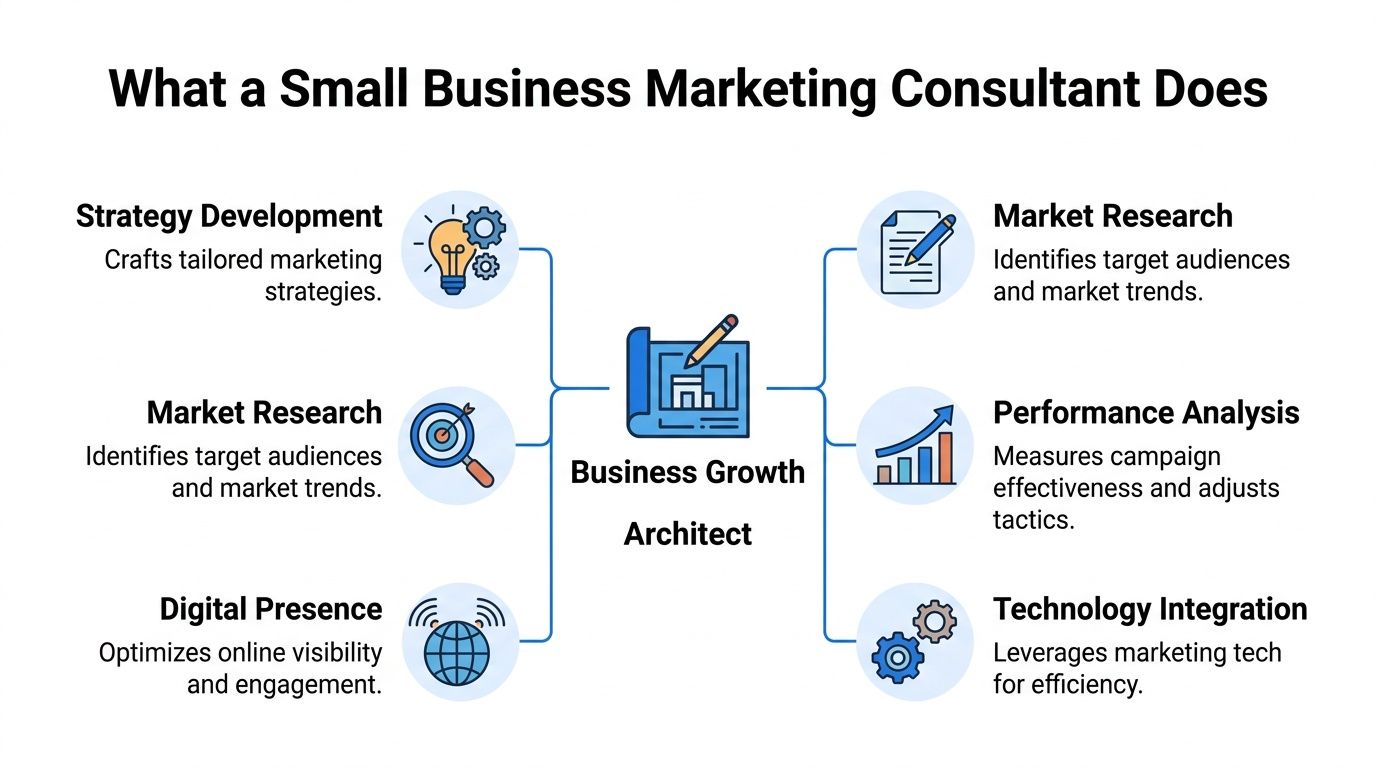
A good small business marketing consultant is a business growth architect. They don't just throw ideas at you. They look at where you are, what you sell, who buys, what's getting in the way, and how to build a route from attention to enquiry to sale.
Early on, it helps to see the role visually.
They set direction before tactics
This is the part too many businesses skip. They jump straight to “we need ads” or “we need social media” without agreeing the basics.
A consultant starts with the questions that decide everything else:
- Who are you trying to win more of: New customers, repeat customers, higher-value customers, or a different type of customer entirely?
- What makes you the better choice: Faster service, stronger expertise, sharper pricing, better communication, local trust, or a cleaner process?
- Where are leads really coming from: Search, referrals, repeat business, local reputation, email, partnerships, or paid campaigns?
- What happens after someone shows interest: Do they get a quick reply, an easy quote process, and a trustworthy website, or do they hit delays and confusion?
That strategic layer matters because it stops waste. You don't need more tactics until you know which commercial problem you're solving.
The best consultants don't start by talking about channels. They start by asking how your business actually wins work.
They turn your marketing into a working system
Once direction is clear, the consultant moves into delivery. That usually covers several areas at once.
First, there's positioning and messaging. This is how your business sounds and what it promises. If your website says the same bland things every competitor says, people won't remember you. A consultant sharpens the message so your offer is easier to understand and easier to trust.
Then there's your digital presence. That includes your website, local visibility, search presence, and content. For many businesses, the website is where interest either turns into an enquiry or dissipates. Consultants often spot obvious friction quickly. Weak calls to action, outdated pages, poor mobile usability, inconsistent branding, or enquiry forms that ask too much.
A lot of firms also need help with lead generation. That might include Google-focused visibility, content planning, email campaigns, landing pages, or paid ads where appropriate. The point isn't to be everywhere. It's to choose the channels that match the business.
A strong consultant also handles measurement. They should tell you what's being tracked, what counts as a lead, and how performance will be reviewed. If they can't explain that plainly, they're not doing the job properly.
This walkthrough gives a helpful general view of the role in practice:
At the practical level, a consultant may work on:
- Website improvement: Sharper copy, clearer user journeys, better enquiry flow.
- Campaign planning: Seasonal offers, launches, lead magnets, or local promotions.
- Content guidance: Blog topics, service page structure, email ideas, case study themes.
- Brand consistency: Making sure the business looks and sounds coherent across channels.
- Commercial reporting: Showing what's happening and what needs changing.
That's the core job. Not posting for the sake of posting. Not vanity metrics. Building a marketing engine your business can use effectively.
The Tangible Benefits for Your Small Business
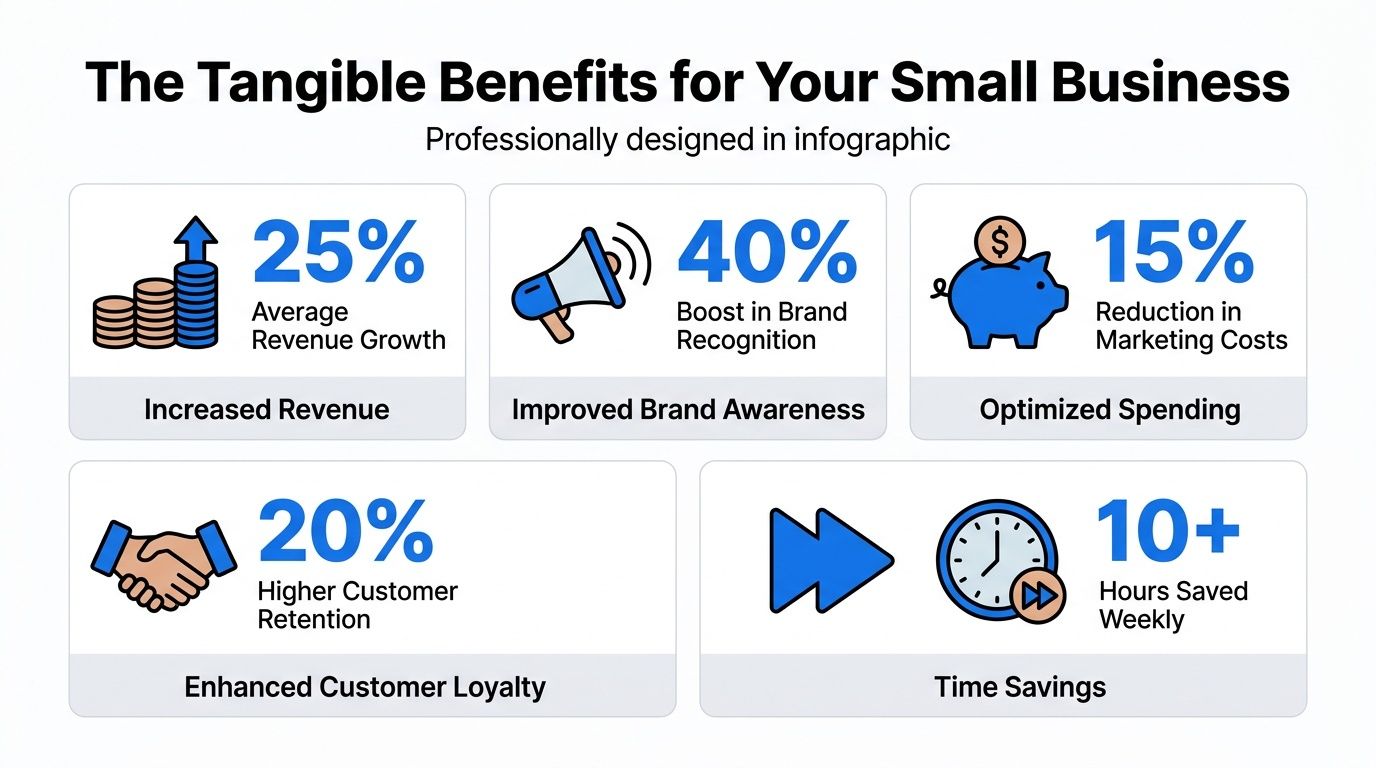
The biggest benefit of hiring a small business marketing consultant is simple. You stop confusing motion with progress.
A lot of owner-managed businesses are active. They're updating pages, trying ads, writing posts, answering messages, tweaking logos, and talking about lead generation. Activity feels productive. It often isn't. A consultant forces the business to focus on what moves revenue, enquiries, and follow-up.
You get movement, not just activity
There's a reason many small firms see consultancy as a turning point. Trade Mastermind's small business marketing consulting page states that small businesses in the UK that engage marketing consultants can experience productivity improvements of up to 258% within three months, alongside a 30% increase in foot traffic and a doubling of online sales.
Those outcomes matter because they reflect what owners actually care about. More useful enquiries. Better use of time. Stronger sales performance. Not prettier reports.
Here's what that looks like in practice for a local business:
- A retailer gains clarity on promotions: Instead of running random offers, they build a repeatable seasonal plan that drives store visits and online orders.
- A trades business improves lead handling: The marketing doesn't just attract attention. It directs prospects to the right page, the right message, and the right next step.
- A professional service firm sharpens its website: Visitors quickly understand the service, the difference, and how to get in touch.
Better marketing isn't just about reaching more people. It's about making it easier for the right people to choose you.
You buy back time and clarity
Owners often overlook this. Good consultancy gives you time back because you stop second-guessing every decision.
Instead of asking “Should we be on this platform?” or “Should we run another ad?”, you work from a plan. You know what matters this quarter. You know what's being reviewed. You know what can wait.
There's also the value of an outside view. Businesses get too close to their own habits. You stop noticing the weak follow-up process, the unclear service pages, the inconsistent branding, or the fact that your best leads always come from one source and you've neglected it.
A consultant brings structure to all of that. They can also fill skill gaps without you hiring a full in-house team. Most small businesses don't need a full-time strategist, copywriter, web specialist, paid ads manager, and analyst. They need smart guidance that joins those pieces up and keeps spending sensible.
The right consultant won't make marketing feel bigger. They'll make it feel clearer.
When Is the Right Time to Hire a Consultant
The right time is usually earlier than owners think. Most wait until frustration turns into urgency. By then, they've already lost time, leads, or confidence.
You don't need to wait for a crisis. You need to spot the symptoms.
Signs you need help now
Ask yourself these questions truthfully.
- Are marketing jobs piling up every week? If your to-do list keeps growing and none of it gets done properly, you need structure.
- Are you spending money without a clear line to results? That includes ads, web changes, outsourced content, or agency retainers you can't explain.
- Has growth gone flat even though the business is working hard? Stagnation often points to weak messaging, poor visibility, or a broken follow-up process.
- Do you rely on one source of work too heavily? That source might be referrals, one platform, one introducer, or repeat customers. If it slows, you're exposed.
A consultant is useful when the business has hit a ceiling that effort alone won't fix.
Moments when outside perspective pays off
There are also clear business moments when bringing in a consultant makes sense.
One is before a relaunch or expansion. If you're introducing a new service, targeting a different market, opening another location, or rebuilding your website, get the strategy right first. It's far cheaper than fixing bad decisions after launch.
Another is after repeated false starts. Plenty of firms have already “had a go” at marketing. They've tried freelancers, ad credits, DIY website updates, and inconsistent posting. If you've made several attempts and still don't have a reliable process, stop patching.
A consultant also becomes valuable when the owner is the bottleneck. If every decision, every piece of copy, every campaign sign-off, and every follow-up sits with you, growth will stay constrained.
If your business depends on you making every marketing decision, you haven't built a system. You've built a choke point.
The best time to hire is when you still have the headspace to do it properly. Not when everything is already on fire.
Finding the Right Fit Your Evaluation Checklist
Choosing a consultant badly is expensive. Not just because of the fee. Because poor advice burns time, distracts your team, and can send your business in the wrong direction for months.
A lot of consultants sound convincing. Far fewer can show how their work connects to enquiries, sales, and real business constraints. That's the standard you should use.
How consultants usually charge
You'll usually see three engagement models.
Retainer work suits ongoing support. You get regular input, reviews, and hands-on guidance across multiple areas. This works well if your business needs consistency and someone keeping the machine moving.
Project-based work is better for a defined piece of work, such as a website overhaul, campaign plan, messaging refresh, or launch strategy. It's cleaner when the scope is fixed.
Hourly consulting can work for advisory sessions, problem-solving, or senior input on specific decisions. It's useful if you already have people executing the work but need direction.
None of these models is automatically better. The right one depends on whether you need strategy, implementation, oversight, or all three.
A useful specialist comparison is DigiVisi's guide to hiring a CRO consultant. It's helpful because it shows how to think about performance-focused advice, not just generic marketing support.
Marketing Consultant Evaluation Checklist
One fact matters here more than most. Miles Marketing's guidance for choosing a small business marketing agency says 72% of service-based businesses rely on referrals as their primary new customer source, and 54% of UK SMEs report wasting money on consultants who lacked sector-specific insight. That tells you exactly what to test. Can the consultant trace lead sources, and do they understand your type of business?
Use this checklist in meetings. If the answers are vague, walk away.
| Category | Question to Ask | Why It Matters |
|---|---|---|
| Experience | Have you worked with businesses like mine in London or Essex? | Local and sector context changes what works. A consultant who understands your market gets to the real issues faster. |
| Commercial understanding | How do you connect marketing activity to leads, enquiries, or sales? | If they can't explain commercial impact clearly, they're selling activity instead of outcomes. |
| Lead tracking | How will you trace leads back to channels, campaigns, or messages? | Good consultants don't hide behind dashboards. They show what produced each type of lead where possible. |
| Sector fit | What would be different about marketing for my industry compared with another one? | This exposes whether they understand your buyers or just repeat a generic process. |
| Referral strategy | How would you handle a business that already gets work by referral? | Many firms don't need to replace referrals. They need to strengthen them and reduce overdependence. |
| Budget realism | What would you prioritise first on my current budget? | You want judgement, not a wish list. Good advice respects cash flow. |
| Reporting | What will I receive each month or at each review point? | Reporting should be plain English and tied to decisions, not vanity metrics. |
| Collaboration | What do you need from me or my team to make this work? | A strong consultant knows results depend on responsiveness, approvals, and internal follow-through. |
| Website role | What would you check on my website before suggesting more traffic activity? | More traffic to a weak website usually wastes money. |
| Decision-making | What would you tell me to stop doing? | This is a strong filter. Serious consultants cut waste. Weak ones add more tasks. |
You should also listen for tone. Good consultants talk plainly. They can explain what they do without dressing it up. If every answer sounds impressive but still leaves you unsure what happens next, keep looking.
The Networking2000 Difference Marketing Integrated with IT
Most articles about marketing consultancy miss the part that causes half the practical problems. Marketing only works properly when the technical foundations are solid.
That sounds obvious, but small businesses often split these issues into separate boxes. One supplier handles the website. Another handles email. Someone else set up the phones years ago. Security is an afterthought. Then the owner wonders why campaigns underperform, enquiries go missing, or staff can't follow up properly.

Marketing fails when the technical basics fail
A website can look excellent and still lose business if it loads badly, breaks on mobile, or routes enquiries unreliably.
An email campaign can be well written and still fail if your business email setup is inconsistent, poorly managed, or treated as a separate admin issue instead of part of customer communication.
A paid campaign can drive interest and still underperform if staff miss calls, internet reliability is poor, or form submissions aren't handled cleanly.
These aren't “IT issues” sitting off to the side. They affect the result. Directly.
A marketing plan is only as strong as the systems supporting it. Visibility means little if people can't reach you, trust you, or get a reply.
Why local businesses need joined-up support
This matters even more for local firms in London and Essex, where buyers often make quick decisions and expect smooth communication.
Think about a trades business in Romford. The marketing brings someone to the site, the customer fills in a form, then wants a fast callback. If the message handling is patchy, the phone setup is dated, or email follow-up is inconsistent, the lead cools off fast.
Now think about a retailer in Brentwood or a service firm in Chelmsford. Their website, Wi-Fi, payment systems, phones, email, security, and online presence all shape customer experience. The buyer doesn't separate them. They judge the business as one whole operation.
That's why integrated support makes sense. The main win isn't just better branding or better campaigns. It's a setup where marketing, communications, security, and core IT support each other instead of pulling in different directions.
Businesses run better when the technical backbone and the marketing plan are aligned from the start.
Your Next Steps to Smarter Business Growth
If you've read this far, you probably don't need more inspiration. You need a decision.
If your marketing feels scattered, hard to measure, or too dependent on your own spare time, stop trying to patch it with another random tactic. Get help that brings order to the business. The right consultant should simplify decisions, tighten your message, improve follow-up, and give you a clearer route from visibility to sales.
What to do next
Start with a blunt review of your current position.
- List what you're doing now: Website work, SEO, referrals, ads, email, social media, print, networking.
- Mark what you can measure: Not what you hope is working. What you can connect to enquiries or sales.
- Identify the weak link: Traffic, messaging, trust, conversion, follow-up, or systems.
- Decide what kind of help you need: Strategy, implementation, oversight, or a mix.
Then speak to a consultant with your eyes open. Ask the uncomfortable questions. Push for clarity. Don't buy a package because it sounds modern. Buy a plan because it fits the business.
Why this decision is mainstream, not risky
Some owners still think bringing in a consultant is a luxury. It isn't. It's established business practice.
According to IBISWorld's UK marketing consultants industry overview, the UK Marketing Consultants industry reached a market size of £5.5 billion in 2026, comprising over 20,000 businesses. That tells you two things. First, businesses across the country use consultants because they need specialist support. Second, the market is crowded, which means you need to choose carefully.
The smart move isn't hiring any consultant. It's hiring one that can look at the whole commercial picture and give you advice that works effectively in practice.
If you want a practical conversation that looks at marketing properly, not in isolation, speak to Networking2000. They support London and Essex businesses with the technical backbone that marketing depends on, including IT, communications, security, websites, branding, and sales support. If your business needs clear advice without jargon, and a setup that works reliably day to day, they're well worth contacting.

