You win a new client, send over the onboarding pack, and then their procurement team asks a simple question: how do you protect the personal data you hold?
That's the moment many SMEs in London and Essex realise their processes have grown faster than their controls. Customer details live in spreadsheets, staff records sit in shared folders, CCTV runs without a clear retention policy, and email has become the default place for everything from invoices to passport scans. Nothing feels wildly careless, but it also doesn't feel defendable.
For most small businesses, data protection problems don't start with a dramatic cyber incident. They start with ordinary habits. A rushed member of staff sends the wrong attachment. A shared mailbox has too many people in it. A new camera system goes in without anyone thinking through privacy impact. Then a customer asks questions, an employee raises a concern, or a supplier wants assurance before signing a contract.
That's where practical data protection consultancy matters. Not as a stack of documents that sit in a drawer, but as a way to make your systems, people, and day-to-day operations safer and easier to manage.
Table of Contents
- Is Your Business Data Truly Secure
- What Is Data Protection Consultancy
- Why Your London or Essex SME Needs a Consultant
- Core Services a Data Protection Consultant Offers
- Navigating Key UK Data Protection Laws
- How to Choose the Right Consultant for Your Business
- Your First Engagement and Next Steps
Is Your Business Data Truly Secure
A business owner in Essex usually doesn't wake up worrying about Article numbers or privacy notices. They worry about keeping the team productive, getting invoices out, and making sure nothing interrupts sales.
Then something small exposes the gap.
A manager can't say who has access to the HR folder. A customer asks for a copy of the information you hold on them. A bigger client wants proof that your CCTV, email, and file storage are handled properly before they approve you as a supplier. Suddenly, data protection stops looking like admin and starts looking like risk.
The weak spots SMEs usually find
Most problems sit in ordinary business tools and routines:
- Shared mailboxes: Several people can view sensitive messages, but no one reviews access.
- Spreadsheets: Customer lists get copied, emailed around, and saved locally.
- CCTV systems: Cameras are installed for security, but signs, retention periods, and access rules are unclear.
- Leavers and joiners: Old accounts stay active longer than they should.
- Informal backups: Files are backed up, but no one has checked whether restoration works.
Practical rule: If you can't explain where personal data sits, who can access it, and why you still need it, you don't have control yet.
That doesn't mean your business is reckless. It usually means it has grown in a normal way. The owner made sensible decisions at the time, but the process never caught up with the volume of data and the number of systems involved.
What good looks like
Secure data handling in a small business isn't about building a giant compliance department. It's about knowing what you hold, limiting access, documenting key decisions, and putting sensible technical controls around the tools you already use.
That's often enough to change the conversation from “we hope we're compliant” to “we know how our data is handled and we can show it”.
What Is Data Protection Consultancy
Data protection consultancy is the practical work of turning privacy obligations into day-to-day controls your business can follow.
The simplest way to think about it is this: a consultant acts like a health and safety officer for your data. They don't just hand you a policy and leave. They inspect how the business works, spot hazards, decide which risks matter most, and help put controls in place that staff can use without slowing the company down.

More than paperwork
A weak consultancy engagement produces templates. A useful one asks awkward but necessary questions.
Who has access to finance emails? Why is old CCTV footage still available? What happens if a laptop goes missing? Why are customer details stored in three different places? If a staff member leaves today, who removes access to cloud systems, phone apps, and shared folders?
Those questions matter because they expose the gap between written policy and real behaviour.
Here's a simple comparison:
| Role | Main focus | When they're most useful |
|---|---|---|
| Lawyer | Interprets law, disputes, enforcement issues | After a serious issue, dispute, or complex legal question |
| IT provider | Keeps systems running and secure | During technical setup, maintenance, monitoring, and support |
| Data protection consultant | Aligns people, process, and technology with privacy obligations | Before issues happen, during audits, change projects, and risk reviews |
Who does what
A consultant shouldn't replace your IT team. They should help your IT team and your management team make better decisions.
For example, if you're moving to a new email platform, the consultant asks what personal data the system will hold, who needs access, what retention rules apply, and how staff will use it. Your IT provider then handles the configuration, security settings, access controls, backups, and support.
Good data protection consultancy sits between legal theory and technical reality.
That middle ground is where many SMEs struggle on their own. They either get advice that's legally sound but operationally vague, or they get technical support that improves security but doesn't address documentation, accountability, or staff process.
The consultant's real value is joining those pieces up so the business works more safely without becoming harder to run.
Why Your London or Essex SME Needs a Consultant
A member of staff leaves on Friday. Their email still works on Monday. CCTV footage is saving to a recorder no one has checked in months. Customer details sit in a shared spreadsheet that half the office can open. That is what data protection looks like in a real SME. It is not just a policy question. It is an IT, security, and day-to-day operations issue.
For businesses in Romford, Chelmsford, Brentwood, and across London and Essex, personal data sits inside the systems that keep the company running. Email, phones, cloud storage, payroll, access control, backups, and CCTV all carry risk if they are set up badly or left unmanaged.
The legal position is clear. The UK GDPR forms part of the UK data protection framework, alongside the Data Protection Act 2018, as set out by the ICO's guide to data protection. For an SME owner, the practical point is simpler. If your business holds information about customers, staff, or visitors, you need controls that work in practice.
The local SME reality
Many SMEs underestimate how many systems handle personal data until someone maps it properly.
A typical business may have:
- Customer information in a CRM, mailbox, accounts package, job sheets, or spreadsheets
- Staff records in payroll files, HR folders, sickness logs, and right-to-work documents
- CCTV footage covering employees, visitors, contractors, and members of the public
- Email and VoIP systems carrying names, contact details, recordings, attachments, and signatures
Each one raises practical questions. Who can access it? How long is it kept? Is it backed up? Is it encrypted? Can you remove access quickly when someone changes roles or leaves?
Those questions often cut across several suppliers and several people inside the business. The office manager may own the process. The IT provider may control the systems. The owner still carries the risk.
Why outside input helps
SMEs usually do not need more paperwork first. They need a clear order of work.
A consultant helps separate the issues that can wait from the ones that can hurt the business now. In practice, that often means fixing shared logins, tightening mailbox access, checking mobile device controls, reviewing CCTV retention, and making sure leavers lose access on time.
That matters for security as much as compliance. A weak data protection setup often points to weak operational discipline elsewhere. If nobody knows where personal data is stored, nobody knows what has to be protected, restored, or restricted.
For firms we work with, the discussion rarely starts with legislation. It starts with systems. Is Microsoft 365 configured properly? Are firewalls blocking what they should? Who can view CCTV? Are backups tested? Can sensitive email be sent securely? Good consultancy connects those technical decisions to the legal and business risk behind them.
Where the value shows up
Useful consultancy should make the business easier to run safely.
A good consultant helps you:
- Focus on the highest-risk gaps first, such as poor access control, weak offboarding, and excessive data retention
- Answer customer due diligence questions with confidence when larger clients ask how you handle personal data
- Reduce avoidable disruption by giving staff clear rules that match the systems they use
- Review new tools before rollout so a new camera system, cloud app, or phone platform does not create extra exposure
Growth usually exposes the cracks. A process that works with five staff often breaks at fifteen, especially once remote working, multiple sites, personal mobiles, or new security systems are added.
The value of a consultant is practical judgement. The job is to help an SME owner reduce risk, improve control, and make sensible changes without slowing the business to a crawl.
Core Services a Data Protection Consultant Offers
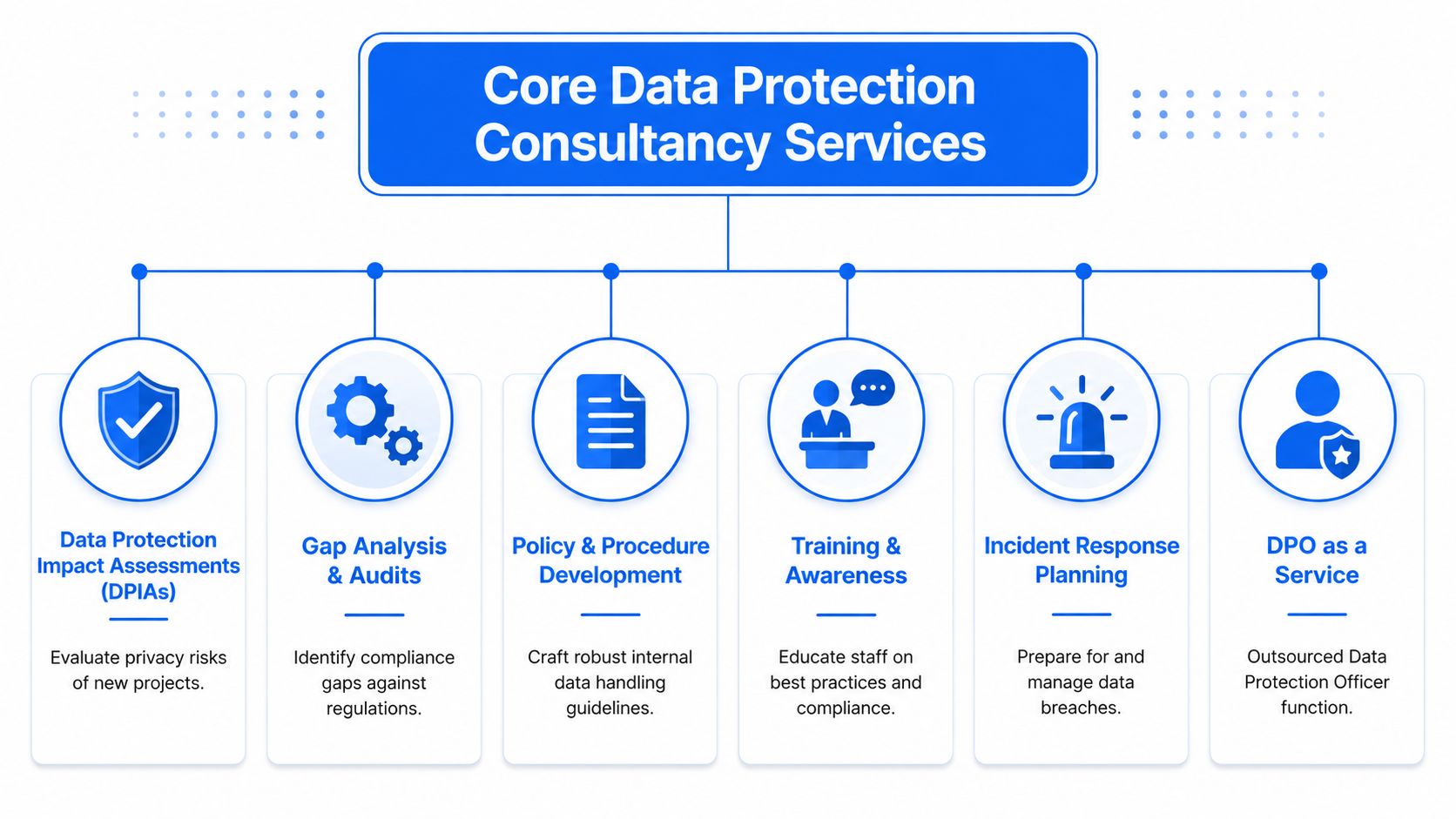
A good consultant should be able to walk through your business and point to the places where data risk lives. Shared inboxes. Over-permissioned folders. Unencrypted laptops. CCTV nobody reviews until there is a complaint. If the advice does not connect to those day-to-day systems, it usually ends up as paperwork nobody uses.
Data audits and gap analysis
This is usually the first job, and it should be grounded in reality, not a questionnaire copied from a template.
A proper audit maps what personal data you hold, where it sits, how it moves, who can get to it, and which systems create the biggest exposure if something goes wrong. In a typical SME, that means checking Microsoft 365, file shares, laptops, mobile devices, backup systems, line-of-business apps, CCTV storage, and email handling.
The useful output is a prioritised view of risk. Not every weakness needs fixing at once. A consultant should help you separate genuine problems from low-value admin.
Questions worth answering early include:
- What personal data do we hold, and why do we still need it?
- Which systems store or transmit it?
- Who has access today, and is that access justified?
- Where are the weak points if a device is lost, an account is misused, or a system fails?
Policy and procedure development
Policies are only useful if managers can apply them and staff can follow them under pressure.
That includes privacy notices, retention schedules, subject access request handling, breach reporting steps, acceptable use rules, remote-working guidance, and procedures for portable devices or personal mobiles. Good consultants write these around the way your business runs. They name real systems, real teams, and real approval points.
That matters more than it sounds. A vague policy creates delay at the exact moment someone needs to act. A clear one tells staff what to do with a suspicious email, how long CCTV footage is kept, who approves access to HR files, and when an incident gets escalated.
For founders handling early-stage growth, the same practical discipline applies outside the UK as well. Resources such as Protect your startup's data privacy show how quickly data handling becomes a business risk once customer records, marketing systems, and third-party tools start to pile up.
DPIAs
A Data Protection Impact Assessment, or DPIA, is used when a new process or technology could create a higher risk to individuals.
In SME terms, that often comes up when adding smarter CCTV, biometric access control, staff monitoring tools, location tracking, or a new customer platform that gathers more data than the old one. The point is to assess the purpose, check whether the approach is proportionate, identify the risks, and record what safeguards are needed before rollout.
Timing matters. A DPIA has more value while options are still open. If a business has already bought the system, installed it, and trained staff, the exercise turns into justification rather than decision-making.
A short explainer can help before the technical detail:
Incident response planning
Breaches are rarely handled badly because nobody cares. They are handled badly because nobody knows who owns the decision.
The ICO's data security incident trends dataset records reported incidents across sectors, and it is a useful reminder that data breaches are a routine operational problem, not a rare legal event. For an SME, the main issue is response speed and clarity. Who investigates first? Who contains access? Who decides whether the ICO or affected individuals need to be told? Who preserves evidence?
A workable incident plan should cover:
- Escalation paths: who gets called and in what order
- Containment steps: disabling accounts, isolating devices, restricting access
- Evidence handling: preserving logs, emails, footage, and device details
- Communication rules: internal updates, customer messaging, supplier contact, regulator decisions
- Recovery actions: restoring clean data, fixing the control failure, and documenting what changed
Technical controls advisory
Consultancy translates into measurable risk reduction.
The consultant identifies the control gaps, then your internal IT team or provider puts the changes in place. For SMEs in London and Essex, that often means practical work across email, networks, endpoints, backups, and physical security, not just policy updates.
Typical recommendations include:
- Access control reviews: remove unnecessary access to finance, HR, and customer records
- Secure email measures: protect sensitive messages and reduce sending errors
- Firewall and network segmentation advice: limit unnecessary paths between users, guest devices, and critical systems
- Backup and recovery checks: confirm key data can be restored and that recovery has been tested
- CCTV governance: set clear rules for placement, retention, footage access, and disclosure
Networking2000 handles the technical side of those decisions, including IT support, managed firewalls, email services, CCTV, access control, and backup-related services. That joined-up approach matters because data protection failures often start as IT configuration problems, then become operational disruption, customer complaints, or reportable incidents.
Navigating Key UK Data Protection Laws
A typical SME problem looks like this. A manager adds CCTV to cover a stock area, HR starts keeping more applicant details than it needs, and sales exports customer records into a spreadsheet for convenience. None of those decisions feels dramatic on its own. Together, they create legal risk, security gaps, and a much bigger clean-up job if something goes wrong.
The main UK rules are not hard to follow once they are tied to day-to-day operations. For most businesses, three principles drive the decisions that matter: lawfulness and transparency, data minimisation, and accountability.
Lawfulness and transparency
People should be able to understand what data you collect, why you collect it, and what you do with it.
That applies across your business, not just on a website privacy notice. It covers staff monitoring, CCTV signs, contact forms, visitor logs, call recording, and any system where personal data is stored or shared. If a member of staff or a customer asks, “Why do you need this?”, your team should be able to answer clearly and consistently.
Weak practice usually sounds vague. “We've always collected that.” “It might be useful later.”
Good practice is specific. “We collect these details to provide the service, manage the account, prevent misuse, and meet tax or employment obligations. Access is limited to the people and providers involved.”
That difference matters because unclear collection usually leads to unclear storage, wider access than intended, and longer retention than anyone planned.
Data minimisation
SMEs often collect extra data because systems make it easy. Forms grow over time. Shared inboxes become long-term archives. Old files stay on a server because deleting them feels risky. CCTV footage is retained far beyond any operational need.
Cheap storage does not make excess data harmless. It gives attackers more to steal, gives staff more to misuse by mistake, and gives the business more to review if there is a complaint, subject access request, or breach.
A practical test is simple:
| Question | Healthy answer |
|---|---|
| Do we need this data? | There is a clear business reason |
| Do we need all of it? | Only the minimum is collected |
| Do we need it for this long? | A retention period is set and followed |
For SMEs in London and Essex, this usually turns into technical decisions as much as policy ones. Mailbox retention settings, user permissions, firewall rules, shared folder access, and CCTV retention all shape whether data minimisation happens in practice.
Accountability and DPIAs
Accountability means keeping a record of why decisions were made and what controls were put in place. If the ICO asks questions after a complaint or incident, the business needs more than good intentions.
A DPIA, short for Data Protection Impact Assessment, is one of the clearest examples. The ICO explains when a DPIA is required and what it should cover in its guidance on Data Protection Impact Assessments. In plain terms, if a project is likely to create a high risk for people, the risks need to be assessed before rollout, not after procurement.
Common SME triggers include new CCTV coverage in sensitive areas, biometric entry systems, software that profiles staff or customers, and monitoring that is wider than people would reasonably expect.
A useful DPIA records four things. What the project does. Why the processing is needed. What could go wrong for the people affected. What controls reduce that risk to an acceptable level.
That is where data protection stops being a paper exercise and becomes an operational one. If a new system needs tighter access control, secure remote access, segmented networks, or shorter retention settings, those technical changes should be part of the assessment from the start.
If you are dealing with overseas founders or comparing UK obligations with US privacy advice, this guide on Protect your startup's data privacy is a useful reference point.
A weak DPIA is completed after the purchase order is signed. A useful one helps the business choose safer settings, avoid unnecessary data collection, and reduce the chance that a simple project turns into a reportable problem.
How to Choose the Right Consultant for Your Business
Not every consultant is right for an SME. Some are built for large enterprise programmes. Others know the regulation but can't translate it into practical steps for a busy office, warehouse, clinic, or retail business.
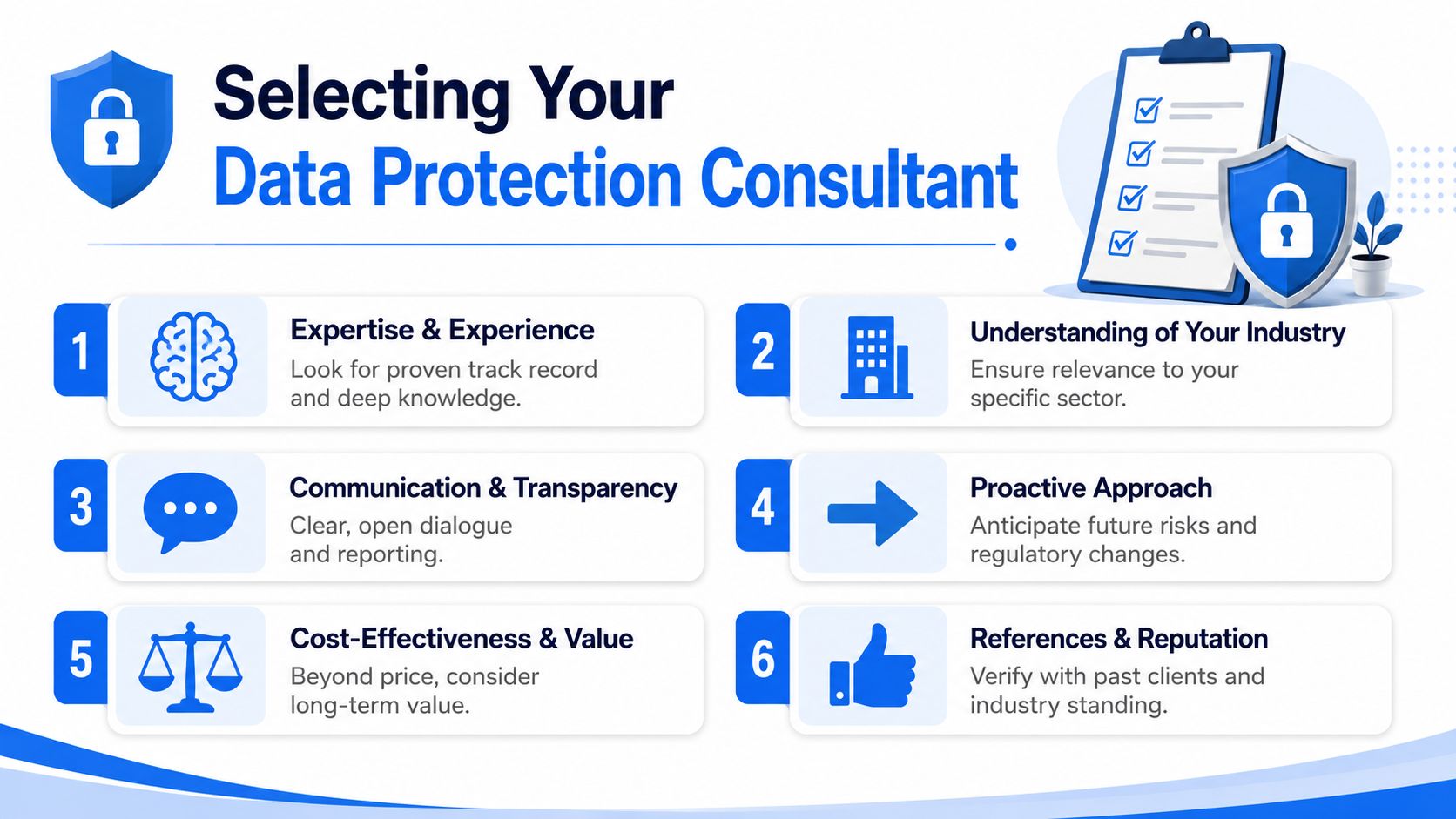
The easiest way to compare providers is to score them on fit, not just price.
A simple scorecard
Use these criteria when you speak to potential consultants:
- SME experience: Have they worked with companies that don't have internal legal and compliance teams?
- Technical understanding: Can they discuss email security, access control, backups, CCTV, and user permissions in plain English?
- Operational realism: Do their recommendations sound usable for your staff, or do they sound copied from a large corporate environment?
- Documentation quality: Can they produce clear policies, records, and assessments that reflect your actual setup?
- Support model: Will they disappear after the report, or can they help with implementation and follow-up?
A consultant who only talks about policy often leaves a gap. A consultant who only talks about cyber tools may miss the governance side. For most SMEs, the best fit is someone who understands both.
Ask how they handle the handoff from advice to implementation. If the answer is vague, expect delays and unfinished actions.
It also helps to read a plain-language external explanation before those calls so you can judge how clearly a consultant communicates. This article on Understanding GDPR compliance is useful because it breaks the subject into practical concerns rather than legal jargon alone.
Questions worth asking before you sign
You'll get better answers if you ask specific questions.
What would your first month with our business look like?
This reveals whether they have a process or just a sales pitch.How do you handle systems like CCTV, shared email, VoIP, and remote working?
You want evidence they can deal with operational tools, not just policies.What documents or outputs will we receive?
Ask whether you'll get risk findings, prioritised actions, draft policies, DPIAs, staff guidance, or training input.Who will do the work?
Some firms sell with senior people and deliver with juniors.How do you help us prioritise?
If everything is urgent, nothing is.
The right consultant should leave you clearer, not more overwhelmed.
Your First Engagement and Next Steps
The first engagement is usually less formal than people expect. It starts with the business explaining how it works, what systems it uses, and where the owner or management team feels exposed.
What the process usually looks like
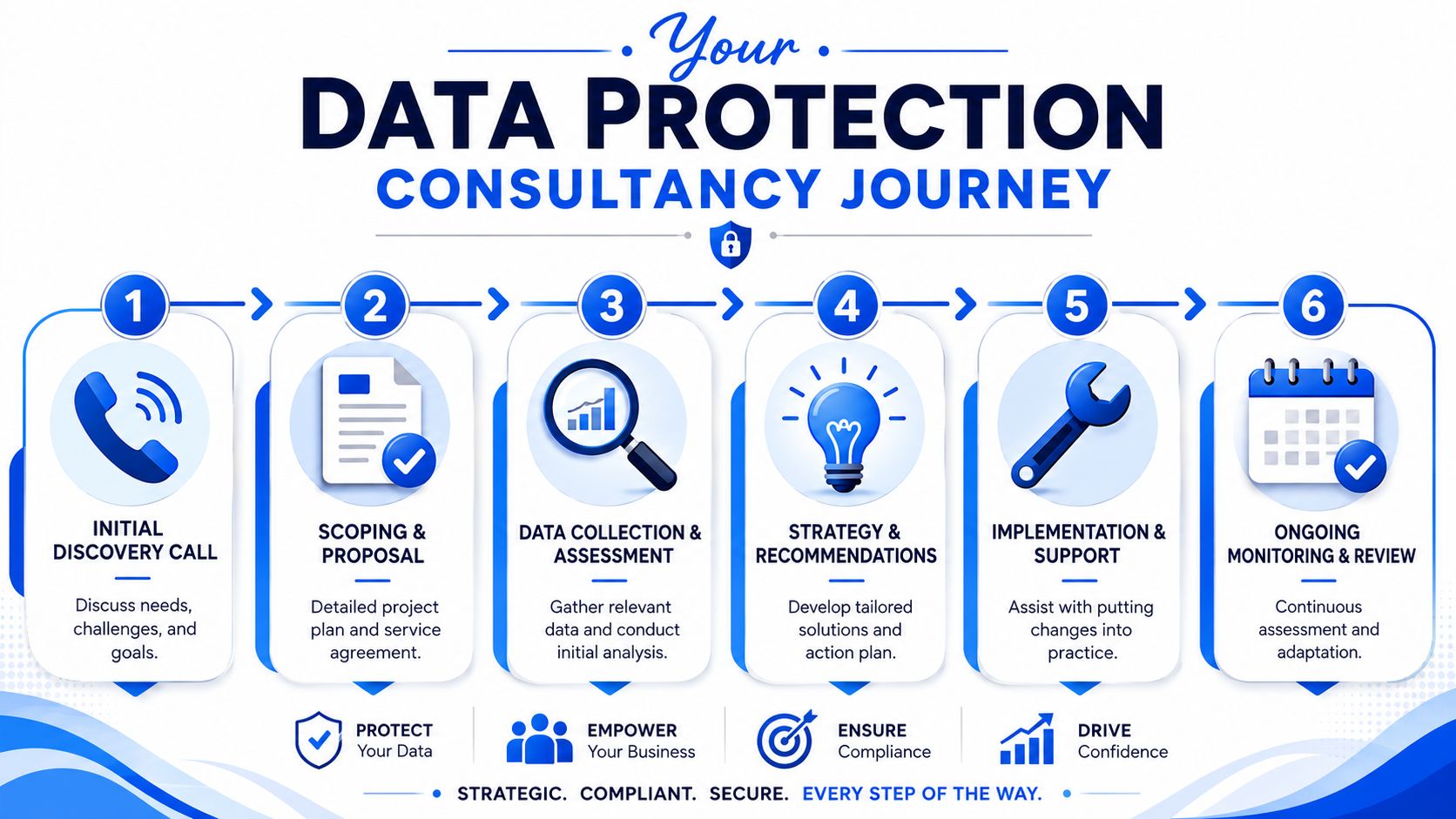
Most projects follow a recognisable pattern:
- Initial discovery call: The consultant asks about your business model, systems, sites, data types, and concerns.
- Scoping and proposal: You get a defined piece of work rather than vague advice.
- Assessment: This may be remote, on-site, or both, depending on your systems and premises.
- Recommendations: Risks are prioritised and translated into actions.
- Implementation support: Policies, controls, training, and technical changes get put into practice.
The key trade-off is depth versus speed. A lighter review gets you moving faster. A deeper assessment gives you better detail, especially if you use multiple systems or have more than one site.
How fees are usually structured
For SMEs, pricing often falls into one of two patterns:
- Project fee: Best for audits, policy refreshes, DPIAs, or a defined remediation plan.
- Retained support: Better if your systems change regularly or you want ongoing advice as the business grows.
What matters most isn't the label. It's whether the scope is clear, the outputs are useful, and someone owns the follow-through.
If your business handles customer records, staff data, email, CCTV, or cloud systems and you're not fully confident in the controls around them, speak to Networking2000 for a no-obligation conversation about the practical side of protecting data in a London or Essex SME.

