If you're reading this after a laptop has frozen, the Wi-Fi has dropped, or a printer has chosen the busiest hour of the day to stop talking to the network, you're in familiar territory. For a small business in Essex, that kind of failure doesn't stay technical for long. It turns into missed calls, delayed quotes, angry customers, staff standing around waiting, and one person trying to fix everything while still doing their actual job.
The same goes for home users and hybrid workers. A flaky broadband setup in Rayleigh, a home office VPN that keeps disconnecting in Brentwood, or a family PC in Chelmsford that has slowed to a crawl can ruin a perfectly normal day. At such times, individuals don't need more jargon. They need clear answers, sensible priorities, and support from someone who understands the area as well as the technology.
Good it support in essex isn't just about repairing what's broken. It's about preventing repeat issues, designing systems that suit how local firms work, and being close enough to understand the practical differences between a retail shop in Romford, a commuter-based office in Hornchurch, and a home worker in Wickford. Local knowledge changes the advice you get.
Table of Contents
- Introduction When Your Technology Stops Working
- Why Local Essex Expertise Matters More Than Ever
- The Core IT Support Services Your Organisation Needs
- How to Evaluate and Choose the Right IT Provider in Essex
- Real-World IT Scenarios for Essex Businesses and Homes
- Your Local IT Partner in Romford, Chelmsford, and Across Essex
- Frequently Asked Questions About IT Support
Introduction When Your Technology Stops Working
A common Essex support call starts with something like this. The phones are quiet, but not because business is slow. The VoIP system has dropped. Staff can't get into email. The card machine is still taking payments, but the back office can't see stock levels, and the owner is trying to explain to customers why everything's taking longer than usual.
In homes, the pattern is different but the stress is the same. A parent is trying to work remotely, a child needs the internet for coursework, the wireless signal doesn't reach the back room properly, and an ageing laptop has picked today to install updates and crawl through every task. The issue might look small on paper. In real life, it knocks the whole day sideways.
That's why proper support matters. A decent engineer doesn't just clear the fault and disappear. They ask why the problem happened, whether it's likely to happen again, and what can be put in place so the same business or household isn't back in the same mess next week.
Most recurring IT problems aren't mysterious. They're usually a mix of neglected maintenance, poor setup, and support that only arrives after the damage is already done.
Across Essex, from Romford to Chelmsford, that pattern shows up in offices, warehouses, retail units, and home studies. The businesses that cope best are usually the ones that treat support as part of day-to-day operations, not as a panic purchase.
Why Local Essex Expertise Matters More Than Ever
A local provider doesn't only win on travel time. The bigger advantage is context. Essex isn't one uniform market, and support works better when the engineer already understands the kind of pressure a site is under.

Local knowledge changes the advice
An office in Brentwood with lots of commuters and hybrid staff has different needs from a retail unit in Romford or a home-based setup in Wickford. In one place, the pain point may be secure remote access and reliable calls. In another, it may be shop-floor connectivity, card terminals, printers, CCTV, and the network all needing to behave together.
A local engineer usually spots these patterns earlier. They know when cabling is often the weak point, when wireless coverage is the actual problem behind “slow computers”, and when a business has outgrown the improvised setup it started with.
That matters because generic support desks often work from a script. Local support tends to work from experience.
Essex has a real talent pool
The county isn't short of technical capability. The median salary for 1st Line Support roles in Essex stands at £30,000 per year, based on vacancies posted in the six months leading up to 15 August 2025, according to Essex 1st Line Support salary data from IT Jobs Watch. That tells you there is a competitive local market for support staff, which is good news for businesses that want access to capable engineers without relying on a distant provider.
A strong local skills base also improves continuity. If your provider is rooted in Essex, they can build teams around the area they serve instead of treating local clients as outliers from a London-centred operation.
Partnership beats ticket processing
There's a practical difference between a supplier and a local partner.
- A supplier closes tickets: They fix the immediate fault and move on.
- A partner understands your site: They remember the recurring printer issue, the awkward cable run, the broadband limitation, and which staff need simpler guidance.
- A partner also protects your budget: They'll tell you when a repair is sensible and when you're spending good money on old hardware.
Practical rule: If an IT company never asks how your business actually operates, they're probably selling labour, not support.
That's why it support in essex works best when it's local, plain-speaking, and grounded in the realities of Essex businesses rather than generic service desk scripts.
The Core IT Support Services Your Organisation Needs
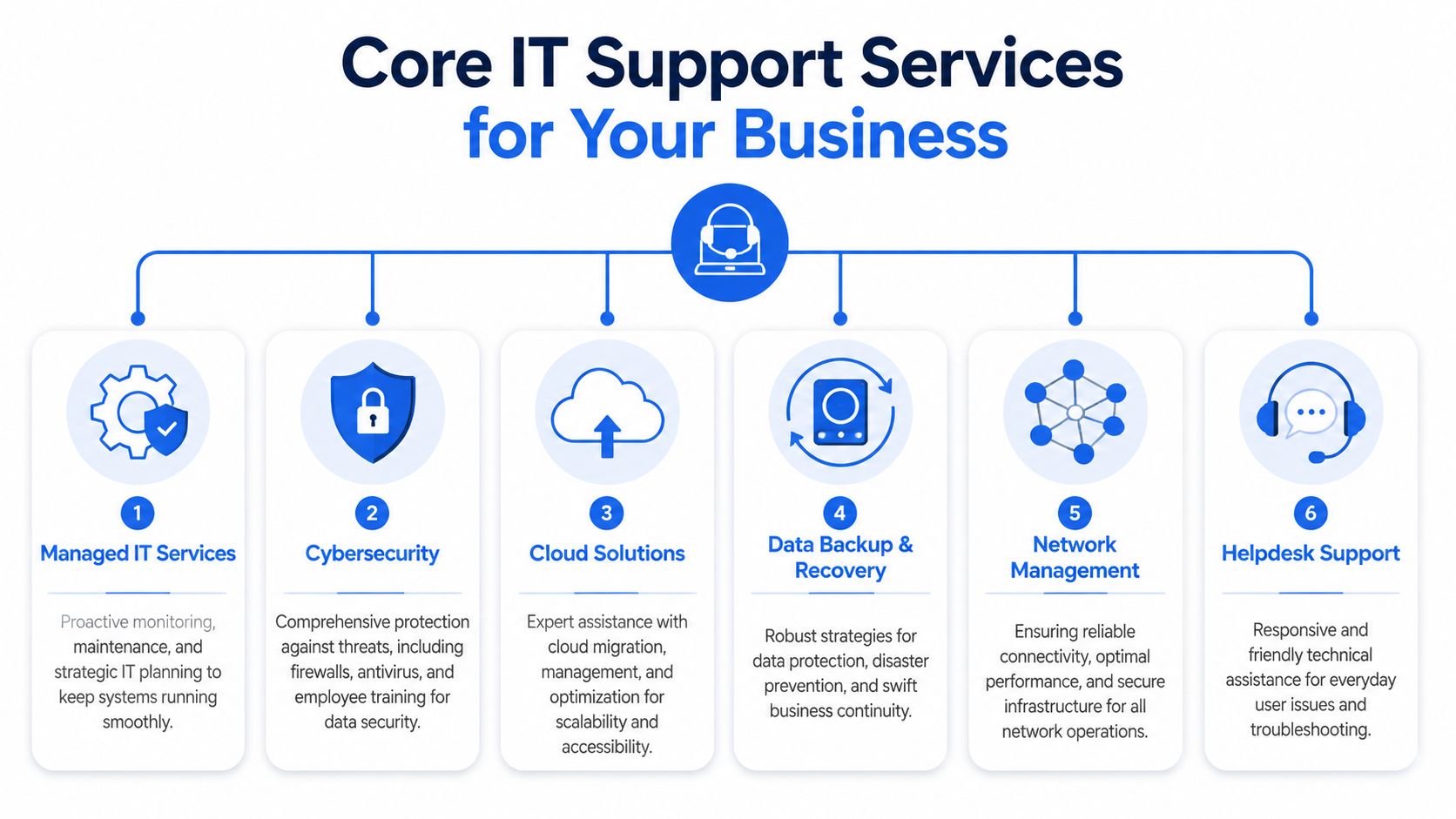
A helpdesk alone does not keep an organisation running. Essex firms need support encompassing the full working setup. Devices, Wi-Fi, phones, backups, user accounts, and security all affect the same day-to-day operation. In a warehouse in Basildon, a clinic in Chelmsford, or a small office in Romford, one weak point usually spreads quickly into lost time for everyone else.
Managed IT services
Managed IT services cover the routine work that stops systems drifting into trouble. That means patching, monitoring, hardware health checks, account support, software updates, and regular review of what is starting to age or fail.
Analysts at IT Builder, in its analysis of business support challenges, found that unpatched systems increase downtime risk for SMEs and that proactive support shortens resolution times. That fits the practical pattern seen on local sites. Neglected machines rarely fail neatly. They slow down first, drop connections, miss backups, or start causing odd faults that waste half a morning before anyone raises a ticket.
Good managed support also reflects how the organisation works. A professional office in Brentwood has different pressures from a school, a retail unit, or a workshop near Southend. Local engineers can account for term-time pressure, seasonal trade, shared spaces, old buildings, and the broadband limitations that still affect some parts of Essex.
Networking and cabling
Network faults often look like general IT faults. Staff report slow systems, broken calls, or cloud apps timing out. The actual issue may be poor access point placement, overloaded switches, untidy cabling, or flat network design that lets every device compete with every other device.
A proper network review should check:
- Wireless coverage: Dead spots, interference, and access points carrying too many users.
- Structured cabling: Whether the cabling is labelled, tidy, and suitable for current speeds and device counts.
- Switching and routing: Ageing hardware, bottlenecks, and whether traffic is segmented properly.
- Building layout: Thick walls, loft offices, stock rooms, outbuildings, and extensions that weaken signal and complicate installs.
In Essex, local knowledge pays for itself in ways national providers often miss. Essex has plenty of converted buildings, mixed-use sites, and offices that have grown room by room over the years. A support company that knows the area is less likely to treat signal loss or awkward cable routes as a surprise. For firms handling customer data or guest access, security matters as much as coverage. Purple's network and wireless security guide gives a useful plain-English overview.
VoIP and communications
Phone systems now depend on the same network as email, cloud software, and remote access. If the network is unstable, calls suffer first. Staff hear delay, dropped audio, failed transfers, or phones that register and unregister during the day.
VoIP support starts with planning, not just buying licences. How many concurrent calls are realistic? Which staff work between home and office? Do mobile users need the same extension wherever they are? What happens if the main internet line drops? Businesses in towns with older premises or patchy mobile reception need honest answers to those questions before any rollout starts.
Cybersecurity
Security is day-to-day housekeeping backed by the right controls. Firewalls, endpoint protection, multi-factor authentication, patching, backups, secure remote access, and sensible permissions all need to work together.
Many breaches start with ordinary gaps. A laptop misses updates. A former user account stays live. Backup alerts go unread. Shared passwords spread around the office because changing them feels inconvenient.
For many Essex SMEs, the sensible starting point is not another security product. It is getting the basics under control, then reviewing them regularly. Tested backups, patched devices, monitored endpoints, and clear responsibility for user access usually prevent more trouble than a long list of tools nobody owns properly.
Home user support
Home support still matters, especially now that work and home technology overlap so often. A broadband issue in a home office can stop a staff member working just as effectively as a switch failure in the main office. Residents also need practical help with laptop repairs, malware removal, printer setup, Wi-Fi improvements, email problems, and getting new devices installed properly.
That overlap is one reason mixed business and home capability is useful in Essex. Networking2000 provides IT support, networking, communications, and security services for businesses and home users across London and Essex. In practice, that matters when the fault sits across broadband, wireless, user devices, and telephony rather than fitting neatly into one box.
How to Evaluate and Choose the Right IT Provider in Essex
Choosing a provider is less about glossy promises and more about how they behave when something breaks at the worst time. Ask direct questions. If the answers are vague, that usually tells you enough.

What to ask before you sign anything
Providers in Essex that focus on SME support often talk about fast helpdesk performance, and that's worth probing. Pinnaca Retail's Essex support discussion notes that providers with some of the fastest helpdesk response times in Essex focus on enterprise-grade support adapted for SMEs. That's a useful benchmark because downtime gets expensive long before a major outage makes the news.
Use a shortlist like this:
- Ask about response and resolution: What counts as urgent, who answers first, and what happens if remote support can't solve it?
- Check local coverage: Can they attend your site in Romford, Chelmsford, Brentwood, Wickford, Rayleigh, or Hornchurch without turning every visit into a scheduling battle?
- Review service scope: Do they only fix PCs, or can they handle switches, wireless, VoIP, printers, firewalls, and user support together?
- Clarify contract flexibility: Is there ad-hoc support, a monthly agreement, or a mix depending on your size and risk profile?
A provider should also be able to explain the difference between a reactive helpdesk and a broader service model. If you want a quick primer before those conversations, Halo AI's guide on how to choose the right support framework gives a straightforward comparison.
What good support looks like in practice
A solid provider doesn't drown you in acronyms. They can explain risk, cost, and trade-offs in plain English.
Here's the practical test. If you ask, “Should we replace this server, improve our Wi-Fi, or move our phones first?”, they should be able to prioritise based on business impact rather than selling the biggest project.
This short video is useful if you're weighing what modern outsourced support should include.
Good support feels organised from the first conversation. Clear ticket handling, clear ownership, and clear next steps matter as much as technical skill.
Real-World IT Scenarios for Essex Businesses and Homes
While theory is valuable, understanding one's own situation often comes more quickly through examples. Here are three that come up repeatedly in Essex.
Retail resilience in Romford
A busy shop in Romford depends on more than tills. It needs card payments, stock systems, email, CCTV, staff devices, printers, and reliable internet. If one part drops out, the rest of the day starts to wobble.
The right support package here usually combines proactive monitoring, secure wireless, managed firewall rules, VoIP reliability, and fast fault isolation. Retail sites don't benefit from overcomplicated setups. They benefit from stable basics and one provider who can work across the whole environment.
Hybrid working in Brentwood
A professional services firm in Brentwood may have part of the team in the office and part at home on any given day. That sounds straightforward until calls start dropping, VPN access is inconsistent, and home workers are using very different broadband and Wi-Fi setups.
This is no niche problem. With 24% of the Essex workforce operating in a hybrid or remote model in 2025, there is clear demand for secure home VPNs, scalable VoIP, and home office network optimisation, according to ECL's overview of IT support needs in Essex.
For this type of business, the support plan needs to treat the home office as part of the working estate. Policies, devices, calls, access, and user support have to join up.
Home and family support in Rayleigh
Home support often starts small. A computer is slow. A printer won't connect. The Wi-Fi reaches the kitchen but not the loft room. Then you dig deeper and find old drivers, questionable antivirus, poor router placement, and years of little fixes piled on top of each other.
What works here is calm, methodical support. Check the hardware health. Clean up startup items. Review storage. Rebuild the wireless setup if needed. Make sure backups exist for anything important. Families and home workers don't usually need a corporate stack. They need dependable devices and someone local they can call without feeling silly.
Your Local IT Partner in Romford, Chelmsford, and Across Essex
Essex isn't one type of customer, and that's exactly why local support matters. The needs shift town by town.
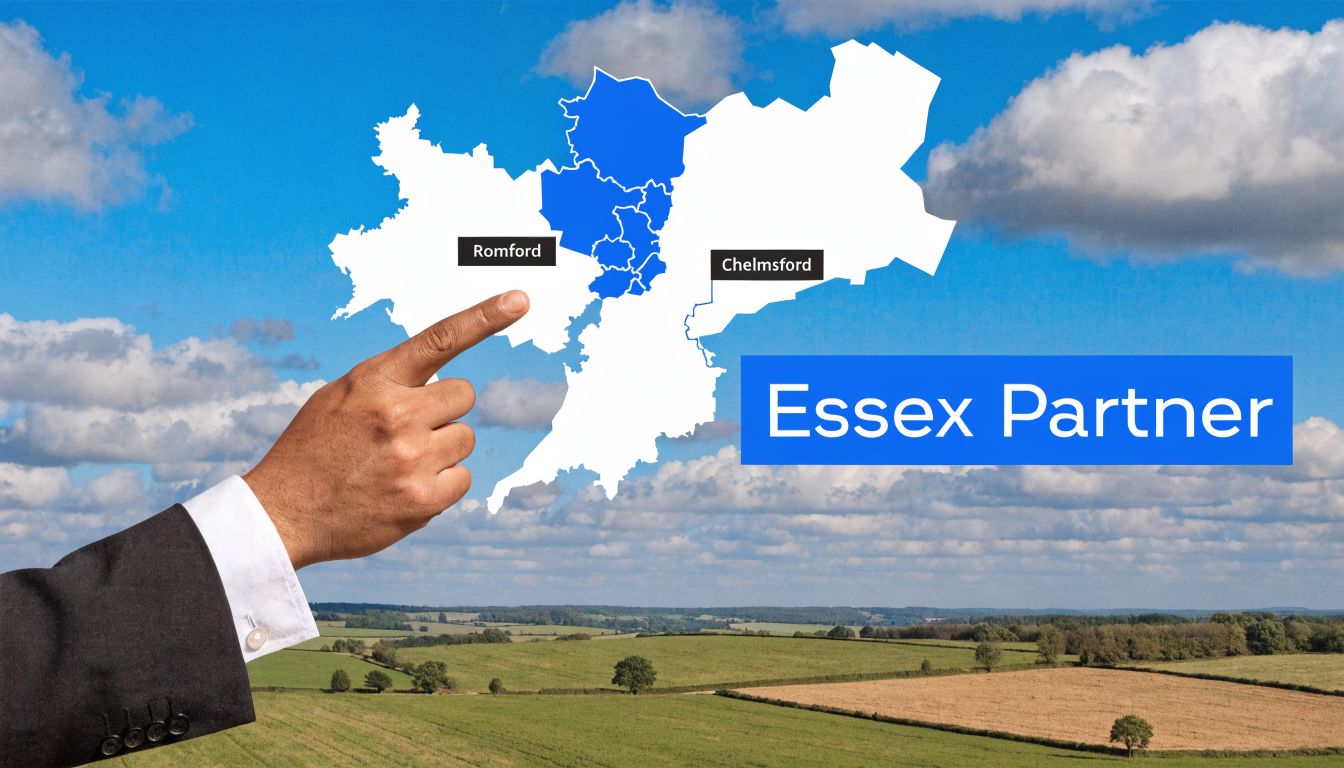
Towns where local context makes a difference
| Town | Typical local need |
|---|---|
| Romford | Retail connectivity, payment systems, CCTV, and dependable front-of-house support |
| Hornchurch | Small office support, user help, broadband stability, and mixed on-site plus remote working |
| Rayleigh | Home office reliability, family device support, and stronger wireless coverage |
| Brentwood | Secure hybrid access, VoIP, and support for commuter-heavy professional teams |
| Wickford | Practical SME support, network tidy-ups, and device maintenance without unnecessary complexity |
| Chelmsford | Growing business sites that need scalable support across users, phones, and infrastructure |
In Romford and Hornchurch, support often needs to be responsive and grounded in the needs of busy customer-facing businesses. In Brentwood, the conversation is more likely to centre on hybrid users, secure access, and call quality. In Wickford and Rayleigh, many firms want steady, cost-aware support that keeps things running without overengineering the setup.
Chelmsford often brings a mix of growth and complexity. More users, more devices, more shared systems, and more moving parts. That's where a local partner earns their keep by keeping standards consistent as the business expands.
The local advantage isn't just getting an engineer through the door faster. It's working with someone who already understands what businesses in your part of Essex usually struggle with.
Frequently Asked Questions About IT Support
Do I need a long-term contract?
Not always. Some businesses are better served by an ongoing managed agreement, especially if they rely heavily on email, shared files, cloud apps, phones, and multiple devices. Others need ad-hoc support first, then move to a contract once recurring issues and weak points are clearer.
Are support hours important?
Yes. Hours matter because faults rarely happen at tidy times. If your team starts early, trades late, or has weekend activity, support availability should match how you work. There's no value in a cheap agreement if nobody can help when your systems fail.
Can proactive support really stop common problems?
Often, yes. Agile Technical Solutions' Essex IT support analysis notes that common IT issues causing 45% of downtime, such as outdated drivers and unoptimised storage, can be preempted with proactive monitoring. That reflects a basic truth in support work. A lot of disruption comes from neglected housekeeping, not dramatic one-off failures.
Do home users need professional IT support too?
They can do, especially when work, school, security, and entertainment all depend on the same devices and network. Home users usually call for help when things stop working. The better outcome is getting the setup stable enough that those interruptions happen less often.
If your business or home setup in Essex feels more fragile than it should, a straightforward conversation with a local engineer can save a lot of frustration later.
If you need clear, local, jargon-free help with IT, phones, cabling, wireless, or security, speak to Networking2000. They support businesses and home users across Essex and London, with practical advice and extended hours that fit real working days.

