You're likely in the same position many UK homeowners find themselves. You want a CCTV system that provides real help if something goes wrong, but after half an hour of searching you're knee-deep in terms like PoE, ColorVu, NVR, H.265, cloud storage and smart detection. Every product page says it's the best. Very few explain what that means on a real house, with a real driveway, real neighbours and real budget limits.
That's where most buying mistakes happen. People either buy too cheaply and end up with patchy footage, weak Wi-Fi coverage and constant charging, or they overbuy features they'll never use while missing basics like coverage, storage and legal setup. Good security isn't about the flashiest box. It's about getting clear footage, dependable recording and fewer weak spots around the property.
A sensible home security plan also starts before cameras. If your front door hardware is poor, CCTV becomes the witness instead of the deterrent. That's why it's worth comparing 3-star rated Euro cylinder locks alongside camera options so your physical and visible security work together.
Table of Contents
- Securing Your Home and Peace of Mind in 2026
- Wired vs Wireless Choosing Your CCTV Foundation
- Decoding CCTV Specs From Resolution to Remote Access
- Staying Compliant Your Legal Duties for Home CCTV
- How Much Does Home CCTV Cost in the UK
- DIY vs Professional CCTV Installation Which Is Right for You
- Frequently Asked Questions About Home CCTV
Securing Your Home and Peace of Mind in 2026
Home CCTV used to be a niche purchase. Now it's a normal part of protecting a house, checking deliveries, keeping an eye on side access and getting a quick view of what triggered a late-night alert. That change is showing up across the market. The UK smart home security camera market was valued at USD 326.6 million in 2023 and is projected to grow at a CAGR of 20.4% to 2030, reflecting stronger demand for connected home protection in areas including London and Essex, according to Grand View Research's UK smart home security camera market report.
That growth makes sense on the ground. People want reassurance when they're away for the weekend. They want to see whether a car pulled onto the drive, whether someone opened the side gate, or whether a courier left a parcel where they said they did. The need is simple. The buying process usually isn't.
A good CCTV system should reduce uncertainty. If it creates more work than confidence, it's the wrong system.
For most homes, the best home cctv system uk choice comes down to a few practical questions. Do you want something quick and flexible, or something fixed and reliable? Do you need one camera watching the front door, or full coverage across the front, rear and side path? Are you trying to keep the upfront spend low, or are you trying to avoid repeat costs over the next few years?
The strongest systems are the ones matched to the property, not the ones with the longest feature list. A terraced house with a narrow front and rear alley needs different coverage from a detached home with driveway, garage and garden access. The right answer usually becomes much clearer once you stop shopping by brand alone and start looking at reliability, storage, installation quality and legal setup.
Wired vs Wireless Choosing Your CCTV Foundation
The biggest decision isn't brand. It's the system type. Get the foundation wrong and even a good camera can feel disappointing.
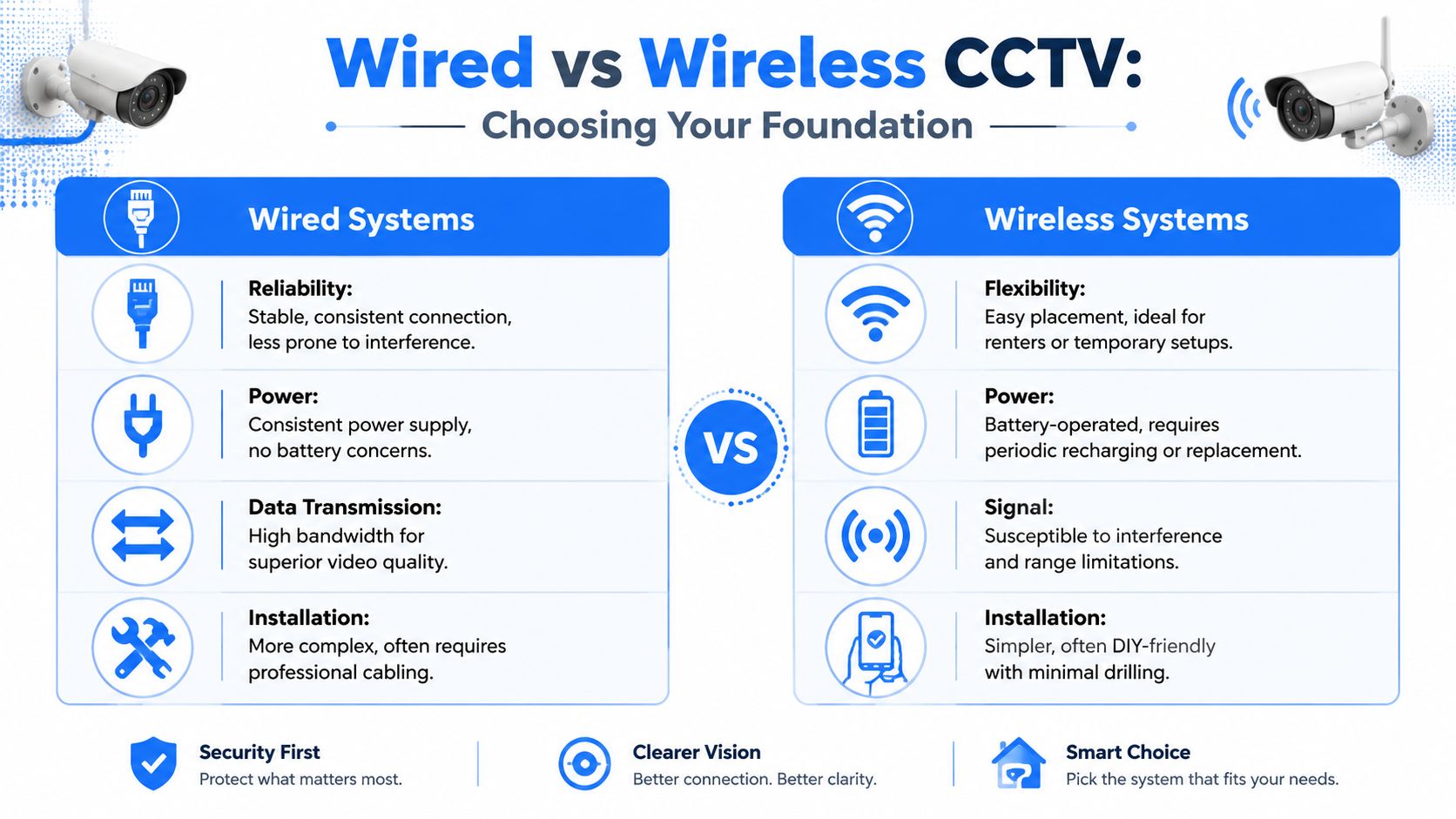
The four system types homeowners usually compare
Traditional wired analogue/coax systems still exist, especially where older DVR setups are being replaced bit by bit. They can work, but for most new residential installs they're no longer the first choice. You're usually buying into older architecture with less flexibility.
Modern wired PoE systems are where many well-planned home installs land. PoE means one network cable carries both power and data, which keeps the setup tidy and reliable. For many UK homes, PoE using Cat5e or Cat6 offers the best balance because it provides a stable connection up to 100m with minimal signal loss and supports H.265+ compression, which can reduce bandwidth and storage needs by up to 80% compared with older standards, according to Third Eye's guide to choosing the best home security camera in the UK.
Think of PoE like a single well-run cable that does two jobs cleanly. That matters more than people realise. It means fewer random disconnects, more consistent recording and less dependence on the strength of your household Wi-Fi.
Wireless plug-in cameras use Wi-Fi for data but still need mains power. They're often a good fit where you want easier placement without opening walls or running cable back to a recorder. The trade-off is that performance depends far more on signal quality, router placement and interference from the rest of the home.
Battery-powered cameras are the easiest to deploy. They're popular for renters, light-use areas and homes where cabling is awkward. But they need charging or battery replacement, and some owners get tired of maintaining them once the novelty wears off.
Practical rule: If you want reliable multi-camera recording every day, start by considering PoE. If you want speed and minimal disruption, wireless is easier but usually asks more from you later.
CCTV System Types At a Glance
| System Type | Reliability | Installation | Flexibility | Best For |
|---|---|---|---|---|
| Traditional wired analogue/coax | Generally stable once installed | More involved, older-style cabling | Lower flexibility for upgrades | Replacing or extending an older setup |
| Wired PoE | Strong and consistent | Best done with planned cable routes | Good long-term flexibility | Full home coverage, regular recording, long-term value |
| Wireless plug-in | Good when Wi-Fi is strong | Easier than full cabling | Easy to reposition | Smaller homes, flats, lighter installs |
| Battery-powered | Varies with battery level and signal | Fastest to set up | Highest placement freedom | Renters, temporary coverage, occasional-use areas |
A common mistake is mixing up “wireless” with “maintenance-free”. It isn't. Wireless usually means easier day one, but it can mean more attention later. That could be app troubleshooting, battery charging, reconnecting after broadband changes, or dealing with a camera that works fine at noon and struggles at the far end of the garden at night.
By contrast, wired PoE tends to feel less exciting in the showroom and more satisfying over time. If your goal is proper home coverage rather than a gadget to try out, it's often the more sensible foundation.
Decoding CCTV Specs From Resolution to Remote Access
A common mistake is buying on headline specs alone, then finding the footage still does not answer the one question that matters after an incident. Who was there, what did they do, and can you prove it clearly enough to act on it.
What better image quality gives you
Resolution matters because it affects what you can identify, not because bigger numbers look better on the box. A well-positioned 4K camera can retain more useful detail than 1080p across a driveway, front garden or wider entrance, which gives you a better chance of picking out faces, clothing, number plates in the right conditions, and direction of travel. Hikvision's own overview of 4K and ColorVu camera capabilities shows why higher resolution and colour night footage are often paired in systems aimed at clearer evidence rather than basic monitoring.
That said, 4K is not an automatic win. It needs the right lens, sensible mounting height, enough recording storage, and lighting that does not blow out faces or reflective number plates. I have seen plenty of expensive cameras produce poor evidence because the installer chased a spec sheet instead of the viewing angle.
Night performance often decides whether a system feels reassuring or frustrating. Colour night vision can help you distinguish a blue car from a black one, or a red jacket from a dark hoodie, where standard infrared footage only gives you shapes and movement. On many UK homes, that difference matters more than the jump from one resolution tier to the next.
The best footage answers a question fast.
Which features matter and which ones cost you later
A few features tend to earn their keep over time.
- Smart detection: Person and vehicle detection usually cuts false alerts far better than basic motion sensing, especially near roads, trees, or changing light.
- Local recording: NVRs and other local storage options usually give better long-term value than building your whole system around monthly cloud fees.
- Remote app access: The app needs to load quickly, show the right camera first time, and make clip export simple when you need to share footage.
- Cybersecurity basics: Strong passwords, firmware updates, and sensible router settings reduce the risk of your cameras becoming an easy target.
Total cost of ownership is critical here. A cheaper camera featuring weak detection, awkward playback, and a paid cloud plan can cost more over three or five years than a professionally installed recorder-based system that just runs properly every day. Reviews often focus on purchase price. Homeowners usually care more about whether the system still feels dependable after the novelty has worn off.
Some extras sound attractive but do not always improve the result. Built-in sirens, flashing lights and two-way audio can be useful near a front door, but they will not rescue poor coverage, weak night performance or missing recordings. Good placement and stable recording do more for security than a longer feature list.
There is also value in making footage and household records easier to search after a break-in or insurance claim. If you keep track of valuables, AI-powered search for home inventory can work alongside CCTV by helping you document items and find records faster.
Camera shape matters too. Turret cameras are often the most forgiving choice for UK homes because they are easier to aim cleanly under soffits and along side passages, and they tend to suffer less from infrared reflection than some dome designs. A tidy-looking camera is no use if it misses the gate, garage corner or path to the back door.
Staying Compliant Your Legal Duties for Home CCTV
Many homeowners only think about privacy after a complaint. That's backwards. Legal setup should be part of choosing the system, not an afterthought once the cameras are already up.

When home CCTV becomes a privacy issue
If your cameras only record within your own boundary, the legal position is simpler. The moment a camera captures part of a public pavement, shared access, road or a neighbour's property, your responsibilities increase. That's where camera placement, field of view and privacy settings stop being technical details and become legal ones.
This isn't rare. 41% of the 1,200+ CCTV-related complaints filed with the ICO in 2025 involved neighbour disputes over recording, and only an estimated 15% of UK home systems were fully compliant with privacy guidelines, according to Expert Reviews' analysis of home security camera compliance issues.
That figure tells you something important. Plenty of people buy cameras. Far fewer install them with privacy in mind.
Simple ways to stay on the right side of the rules
A compliant setup usually comes down to restraint and documentation.
- Aim tightly: Don't cover more than you need. If your goal is the front path and doorway, don't sweep half the street.
- Use privacy masking where available: Many systems let you block out parts of the frame, which is useful for neighbouring windows or gardens.
- Add clear signage: If your system captures beyond your boundary, visible notice matters.
- Keep a sensible reason for each camera: “I wanted full road coverage” is weak. “I needed to protect the entrance and drive” is easier to justify.
- Store and share footage carefully: Treat clips as personal data when they include others.
A short explainer on domestic CCTV responsibilities can help if you're unsure how the rules apply in practice:
If a camera can see more than your property, set it up as if someone will eventually ask you to justify that view.
One of the biggest mistakes is assuming legal trouble only follows malicious use. Most problems start with ordinary setups that were too wide, too intrusive or never explained properly. A camera angled a few degrees too far can cause more grief than a camera with fewer features but better restraint.
How Much Does Home CCTV Cost in the UK
You spot movement outside at 2am, open the app, and the camera is offline again. That is usually the point where the cheapest option stops looking cheap.
Home CCTV cost in the UK makes more sense when you price the whole ownership period, not just the box on day one. For a homeowner planning to stay put for several years, the central question is what you will spend to buy it, install it, maintain it, and trust it when you need footage.
Why the cheapest system often costs more later
Battery and app-based kits can work well for small jobs. A front door, a side gate, maybe a short-term fix for a rented property. The problem starts when buyers scale that approach to a full house and still expect low-maintenance coverage.
Extra batteries, cloud subscriptions, replacement mounts, missed recordings, and time spent fixing Wi-Fi dropouts all add to the bill. Eufy's guide to wired home CCTV in the UK also makes the broader point that wired systems are often cheaper to own over time once you move beyond a very small setup.
That trade-off matters more than many review roundups admit.
A lower shelf price can still lead to a higher five-year spend.
Where professional installation changes the maths
Professional installation raises the upfront cost, but it often cuts waste later. A properly fitted system is less likely to suffer from poor camera angles, weak night coverage, awkward recorder placement, or cable runs that were clearly an afterthought.
For a typical four-camera home system, UK pricing usually lands somewhere between basic DIY territory and a more serious installed setup, depending on recording quality, access, cabling complexity, and whether the property needs ladders, loft runs, or exterior drilling. Checkatrade's guide to CCTV installation costs gives a useful benchmark for what homeowners commonly pay.
If you're costing out a wired system, labour is part of the picture. A guide to hourly electrician rates gives useful context for why neat outdoor power work and safe cable routing can shift the final quote.
In practice, the cost choices usually look like this:
- DIY wireless suits a small flat, one entrance, or a short-term budget fix.
- Professionally installed wired CCTV costs more upfront, but ownership costs are usually steadier and the system needs less attention.
- A hybrid setup can work well if most of the property suits wired cameras but one awkward area does not.
From a total cost of ownership point of view, the best value often comes from buying once and installing properly. I've seen plenty of homeowners spend less in year one, then spend more overall replacing a system that never gave them reliable coverage in the first place.
DIY vs Professional CCTV Installation Which Is Right for You
There isn't one right answer for everyone. A lot depends on the size of the property, how much time you want to spend on setup, and how important reliability is to you once the system is live.
When DIY makes sense
DIY is reasonable when the job is small and expectations are realistic. One or two cameras. Straightforward app setup. Good Wi-Fi where the cameras will sit. No need for hidden cable routes, recorder placement or broader property coverage.
DIY can work well if you:
- Need quick coverage: A front door camera or simple rear garden view can often be set up in an afternoon.
- Live in a flat or rented home: Wireless and battery options are less disruptive and easier to remove later.
- Don't mind occasional maintenance: Charging, repositioning and app troubleshooting are part of the trade-off.
For a basic setup, that's often enough. The risk is assuming the same approach scales neatly to a bigger home. It usually doesn't.
When professional installation is the better call
Once you move to a full home system, installation quality starts shaping the result as much as camera quality. Good installers think beyond whether a camera powers on. They think about sight lines, glare, blind spots, secure cable routes, recorder placement, legal boundaries and whether the app experience will still make sense six months later.
Professional installation usually makes more sense when:
- You want full perimeter coverage. Front, rear, side access and driveway need coordinated placement, not guesswork.
- You prefer a wired system. PoE delivers strong long-term value, but only if cabling is planned and finished properly.
- You want fewer weak points. Loose external cables, poor angles and recorder locations in obvious spots can undermine a system fast.
- You value support after the install. If something stops recording, you want a clear route to fixing it.
A simple checklist helps. Ask yourself:
- How many areas need watching at once?
- Can I route cables neatly and safely if I choose wired?
- Will I maintain batteries and app settings?
- Do I know how to angle cameras without overreaching into public or neighbouring space?
- If footage matters after an incident, am I confident it will be usable?
For one camera over a porch, DIY is often fine. For a multi-camera best home cctv system uk setup meant to protect the whole property, professional installation usually gives better placement, cleaner finish and fewer regrets.
Frequently Asked Questions About Home CCTV
Can home CCTV work without internet
Yes, many systems can still record locally without internet access. Internet is mainly needed for remote viewing, app alerts and some smart features. A local recorder-based setup can continue capturing footage even if broadband drops.
How much storage do I need
Storage depends on the number of cameras, resolution, recording mode and retention period. More cameras and higher quality footage need more space. If you want longer retention, local recording with efficient compression is usually the more practical route than relying on short clip histories.
Should I choose local storage or cloud storage
For many homeowners, local storage is the better fit if they want predictable running costs and direct control of footage. Cloud storage can be convenient, but ongoing fees and clip limits can become frustrating over time.
Are subscription-free systems actually subscription-free
Some are, but check carefully. A system may offer local recording with no monthly fee while still pushing optional cloud features in the app. Read what's included by default, especially for event history, sharing and smart alerts.
What camera count is right for a typical home
It depends on layout rather than house price or brand. A small flat may only need one or two views. A house with front door, driveway, rear garden and side access usually needs broader coverage. Buy for entry points and vulnerable approaches, not for the box count.
Is 4K worth it for home use
If identification matters, 4K is often worth it. The biggest benefit appears when cameras are placed well and aimed at useful choke points such as a gate, driveway entrance or front path rather than a wide empty scene.
If you want help choosing a CCTV setup that suits your property, budget and long-term running costs, Networking2000 can advise on practical options for homes across London and Essex. The team handles everything from cabling and connectivity to security systems, so you get clear advice, tidy installation and a system built for dependable day-to-day use rather than showroom specs alone.

